Day 2 Lesson: Selecting the Right Camera
There are more cameras, more lenses, and more photography accessories available today than ever before. From smartphone cameras to small mirrorless cameras that virtually fit in your pocket to professional-level cameras with super high resolution and broadcast-quality video capabilities, there is something for everyone whowho wants to get into landscape photography.
There is something for every budget as well, from those who can spend a few hundred dollars for a camera body and kit lens to those who will set you back thousands of dollars for a camera body alone.
So, what camera is right for you?
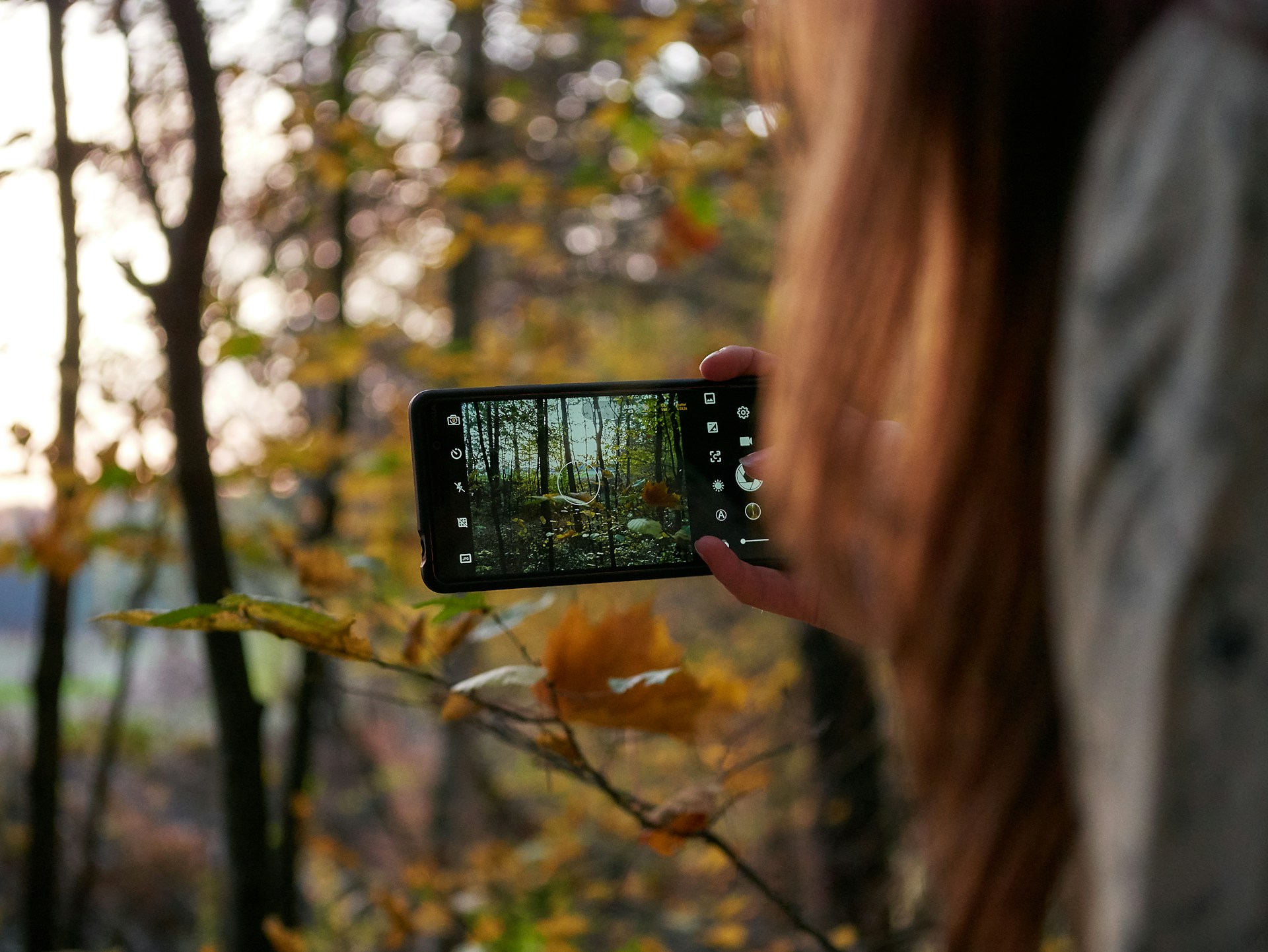
As was mentioned in lesson one of the course, the decision you make regarding the best camera for your landscape photography will ultimately come down to your end goal. If you just enjoy taking photos and want to share them online with friends and family, something like your smartphone might just do the trick. But if you want a more serious pursuit of landscape photography, you’ll obviously need to invest in a system that has more capabilities and flexibility than your phone.
In this lesson, we provide in-depth details on several camera systems, each of which has unique pros and cons.
Full-Frame vs APS-C vs MFT
An initial choice for whatever type of camera you get will be what digital format to choose. There are advantages and disadvantages for each of the three most used formats for serious photography.
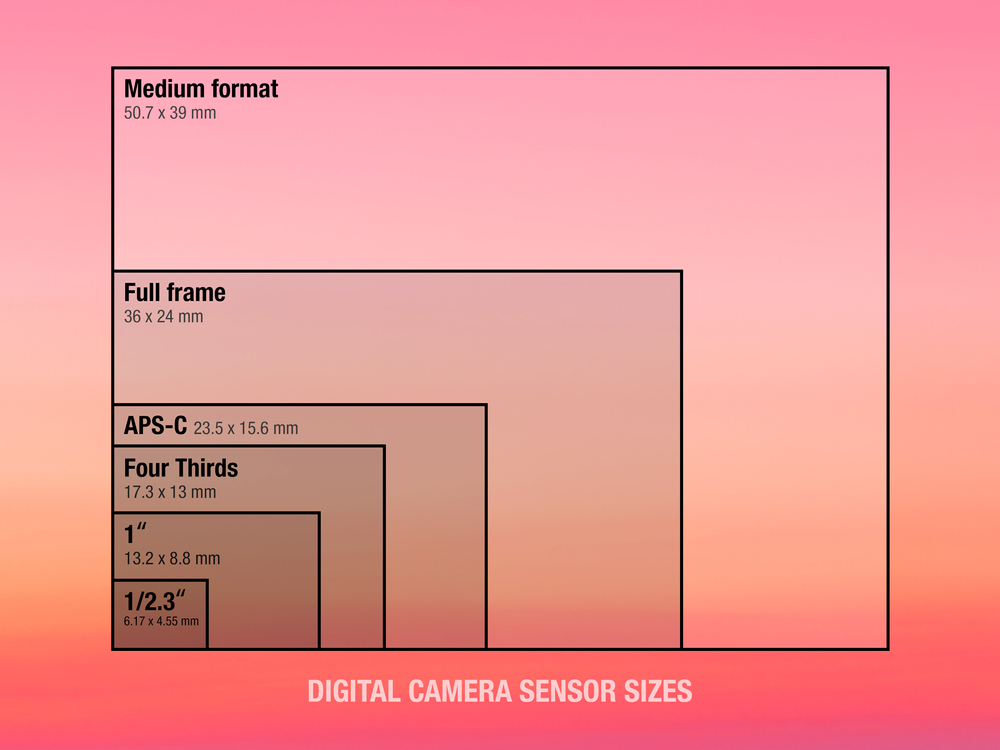
Full-frame format is the natural progression from 35mm film cameras that ruled beginner, casual amateur, serious or intermediate, and a lot of professional photography for many decades. As a digital format, full-frame is the same size as the standard 135 film frame (aka 35mm), namely 24mm x 36mm.
The aspect ratio is the same for full-frame digital and 35mm film formats. Aspect ratio is the ratio of the long to the short sides of the rectangle that defines the imaging area. This also affects how much needs to be cropped to save the image or print it in certain standard sizes.
Full-frame aspect ratio is 3:2, meaning an uncropped image will print as multiples of 3:2, such as 4×6 inches for photo albums or 40×60 inches for prints to hang on a wall.
The other two formats we’ll cover are called cropped formats since they are smaller than (or cropped down from) the full-frame format. APS-C has the same aspect ratio as full- frame, while MFT (Micro Four Thirds or Micro 4/3rds) has an aspect ratio of 4:3.
Imaging sensor sizes are 24mm x 36mm for full-frame, 16.7mm x 25.1mm for APS-C, and 13mm x 17.3mm for MFT. These sensor sizes result in a crop factor of 1.5X for APS-C and 2X for MFT. We’ll discuss crop factor in depth during Lesson 3, which covers lenses.

Advantages of MFT – Extremely compact cameras and lenses. Most have an excellent video recording capability. Crop factor of 2X compared to full-frame works well for telephoto needs.
Disadvantages of MFT – Less low-light ability. Smaller file size needs more enlargement, which affects final quality. A crop factor of 2X means wide-angle lenses must be incredibly short-focal-length designs, which can increase their price. 2X crop factor also affects selective focus capability.
Advantages of APS-C – Size and weight of these cameras and lenses are often significantly less than comparable full frame equipment. The lowest-price beginner-level and prosumer cameras are found in this format, especially as DSLRs. Crop factor of 1.5X or 1.6X compared to full frame works well for telephoto needs. Better low-light performance than comparable MFT format cameras. Many mirrorless cameras also offer excellent video modes.
Disadvantages of APS-C – Less low-light ability than full frame format cameras. Smaller file size needs more enlargement, which affects final quality. A crop factor of 1.5X or 1.6X means wide-angle lenses must be very short-focal-length designs, which can increase the price of these lenses, especially high-quality zoom lenses. The lens crop factor also affects selective focus capability.
Advantages of full frame – Compared to similar-resolution sensors in crop formats, full frame offers higher image quality and better low-light performance. Selective focus techniques are the same as in 35mm film photography. Mirrorless cameras often offer excellent video quality, with some models up to 8K.
Disadvantages of full-frame – Size, weight, and monetary costs of cameras and lenses are increased. With mirrorless cameras, fast lenses can be huge compared to DSLR or other formats.
Mirrorless or DSLR?
Many modern digital cameras stick to the same familiar form and configuration of the past 70 years or so of 35mm SLRs. The term SLR, or single-lens reflex, refers to how we see the image through the lens that will be recorded on the sensor or film. A mirror and a pentaprism are the basic mechanics of how this is done. With digital photography, we now call this style of camera DSLR.
With digital photography, a mechanical and optical system is not really necessary, so camera designers developed cameras without a mirror and prism, relying fully on the electronics of digital photography to show us the image before we snap that picture. These cameras are called mirrorless since there isn’t a mirror involved.
Mirrorless cameras still tend to follow the familiar shape and configuration of DSLRs, so there is still much that remains the same. Without a mirror box and heavy prism, though, camera makers can provide smaller and lighter cameras in the same formats as DSLR cameras.
Which is right for you? There are pros and cons for each type.
Advantages of DSLRs – Many models, especially entry-level and intermediate (sometimes called prosumer) DSLRs, can be surprisingly budget-friendly for similar features. Battery life is often among the best of modern digital cameras.
Disadvantages of DLSRs – DSLRs are larger and heavier than mirrorless cameras for the same formats and features, there is the added noise from the mirror box, and the mirror must be locked up to capture video, if the camera even has a decent video mode at all.
Advantages of Mirrorless – Smaller and lighter bodies are the norm for mirrorless cameras vs comparable DSLRs. Almost all mirrorless cameras, regardless of format, have excellent video modes. Using lens adapters, lenses with various mounts from different manufacturers can be fitted to a mirrorless camera. This also enables the use of legacy lenses from years ago.
Disadvantages of Mirrorless – Battery life is shorter because the camera has to use an electronic display at eye level or as a rear view screen. Many cameras and lenses are more expensive than comparable DSLR models.
Full-Frame Cameras

We’ll start off with the biggest and best cameras of the bunch – full-frame DSLRs. These are the cameras that many pros use to create the images you see in magazines.
The sensors in full-frame cameras are much larger than those found in other camera systems, meaning they can collect more light. The more light a sensor can collect, the better its performance in difficult lighting conditions and the higher the signal-to-noise ratio, which means cleaner images with less noise and finer detail. With a larger sensor comes more pixels as well, and that means you can create enormous prints without losing the image quality.
For example, a landscape image taken with a modern full-frame camera could easily be printed at around 24”x16” at 300 dpi, which is the standard print quality for publication. If your goal is to get published, open a gallery, or sell fine art prints, full-frame cameras are the best option on this list. Image files from full-frame cameras can be successfully printed in measurements using feet, not mere inches!

Full-frame systems are not without their detriments, however. Price will be the biggest hurdle for most people as full-frame bodies usually start in the $2,000 range and go up (way up) from there, though there are some full-frame mirrorless and DSLR cameras for right around $1000.
Full-frame DSLRs are also quite bulky because they have to accommodate their larger sensors and mirror boxes. Some photographers are turned off by the largeness of the full- frame body, simply because it’s more difficult to handle, causes finger, hand, and arm fatigue faster than other cameras, and it takes up a lot more room in a camera bag or backpack. If you’ll be doing a lot of hiking to your shoot locations, the weight of a full-frame DSLR camera might be a consideration to ponder.
Full frame mirrorless cameras are often considerably lighter since they don’t have the mirrorbox and pentaprism of a DSLR. However, many full-frame mirrorless camera lenses can be quite bulky. It’s an issue that doesn’t show up much with crop-format camera lenses. However, it does with full-frame cameras because the lens still has to meet design requirements to project the right-sized image circle onto the sensor plane.
A benefit of full-frame format mirrorless camera lenses that is being taken full advantage of, however, is the ability to design ultra-fast-aperture lenses, both single focal-length primes and high-quality zoom lenses.
Advantages: Incredible image quality and excellent low-light performance.
Disadvantages: The extremely high cost and relative bulkiness of full-frame cameras and lenses will eliminate them from contention for some photographers.
Best for: Experienced photographers looking to make the leap into landscape photography as a profession, or at least a very serious hobby.
Not for: Casual photographers who are just learning the ropes.
APS-C Format Crop Sensor Cameras
Crop sensor cameras get that moniker because their sensors are smaller than those found in full-frame models. Where a full-frame sensor is 36x24mm, an APS-C sensor typically measures approximately 23.6×15.6mm.
Because the sensor is cropped, the field of view is narrowed, meaning the sensor effectively crops into the image projected by its lens. Crop sensor cameras have different levels of cropping, but a popular focal length factor is 1.5X. That means that a 24mm lens on an APS-C camera acts like a 36mm lens would on a full-frame camera.
When digital photography first took hold, the crop factor of APS-C cameras was an issue for landscape photography because the landscape genre typically benefits from wide-angle views of the scene. This was harder to accomplish with a camera that had a crop factor of 1.5X or 1.6X compared to full-frame.
However, recent years have seen a huge variety of ultra-wide-angle prime lenses and zooms made for APS-C cameras, so this is no longer a problem at all.
One advantage of the crop factor sensors in APS-C cameras is that they allow you to more easily fill the frame with a subject – a flower, for example, that fills the frame on an APS-C camera wouldn’t do so on a full-frame camera when shot from the exact same distance. As a result, when shooting a distant subject in a landscape, an APS-C camera might be an advantage.

Crop sensor cameras have many of the benefits of full-frame cameras, in particular, the ability to make manual adjustments to settings like aperture, shutter speed, and ISO. APS-C cameras have a distinct advantage in terms of size and weight – because of their smaller sensors, they are much less cumbersome to hold and carry. The lenses are also smaller than full-frame camera lenses.
Image quality is quite good on APS-C cameras, though not quite as good as a full-frame camera can achieve. An issue that persists is that APS-C cameras do not have the extended ISO capabilities or low-lightlow-light performance of full-framefull-frame models. This is because APS-C cameras have a smaller sensor, which collects less light than theifull-frameme cousins.

Improvements to other technology, such as in-body image stabilization in mirrorless cameras, help close the gap somewhat, but a full-frame sensor camera of comparable resolution will always have better low-light performance than crop sensor cameras – it’s simply a matter of physics.
When it comes to price, many APS-C DSLR cameras are very budget-friendly and affordable. That makes many APS-C DSLR systems more affordable for entry-level or beginner users.

That said, some APS-C cameras, such as mirrorless systems or pro-level models, can cost as much as some full-frame systems. Mirrorless APS-C cameras will generally cost more than a similarly capable DSLR, but you will often gain superb video recording, lighter-weight cameras, and the ability to adapt lenses.
Advantages: Generally, the most affordable cameras with an enormous selection of lenses. Smaller size and weight of cameras and lenses compared to full-frame.
Disadvantages: Image quality is not as good as full-frame for comparable resolution sensors, and low-light shooting can be an issue on some models.
Best for: Entry-level and intermediate (and even many professional) shooters who wish to break into serious photography, create very high-quality images with smaller gear, or don’t have a high budget limit.
Not for: Photographers who wish to produce the absolute best quality in very large prints or work in extremely low-light conditions.
MFT and Medium Format – the Large and the Small of Things
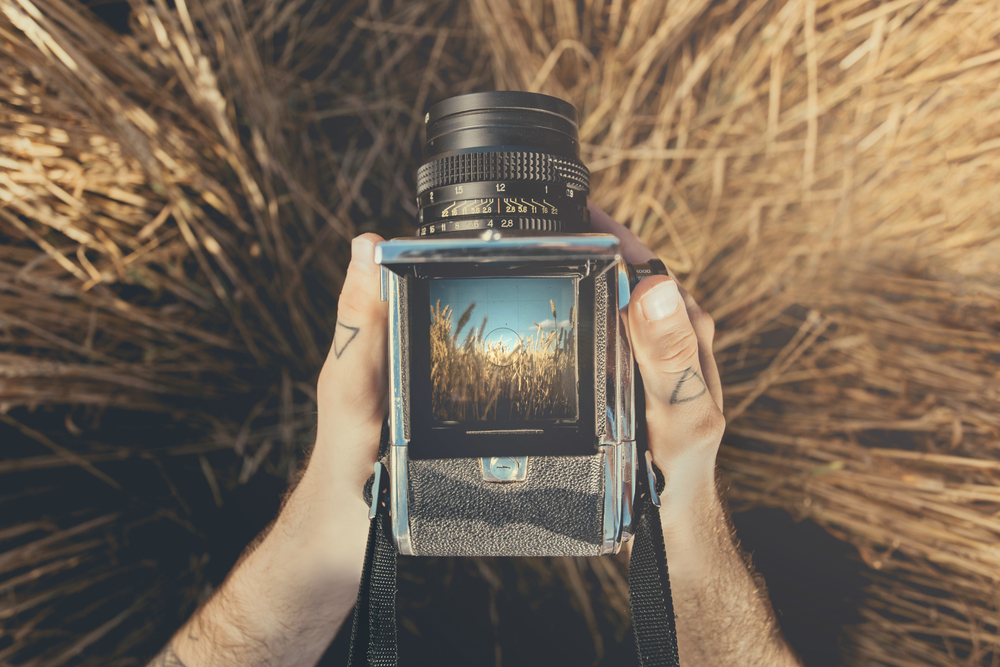
If you’re interested in landscape photography, you’re likely not looking at too many MFT-format or medium-format systems. That is, unless the MFT ultra-compact cameras and lenses are a primary concern or if videography is your first love over still photography.
The crop factor, low light performance, and lower image quality of MFT compared to larger formats are definitely things to think long and hard about if you really want the super small equipment.
All medium format systems will be much larger and oftentimes extremely expensive when compared to what we can find in the full-frame and crop formats.
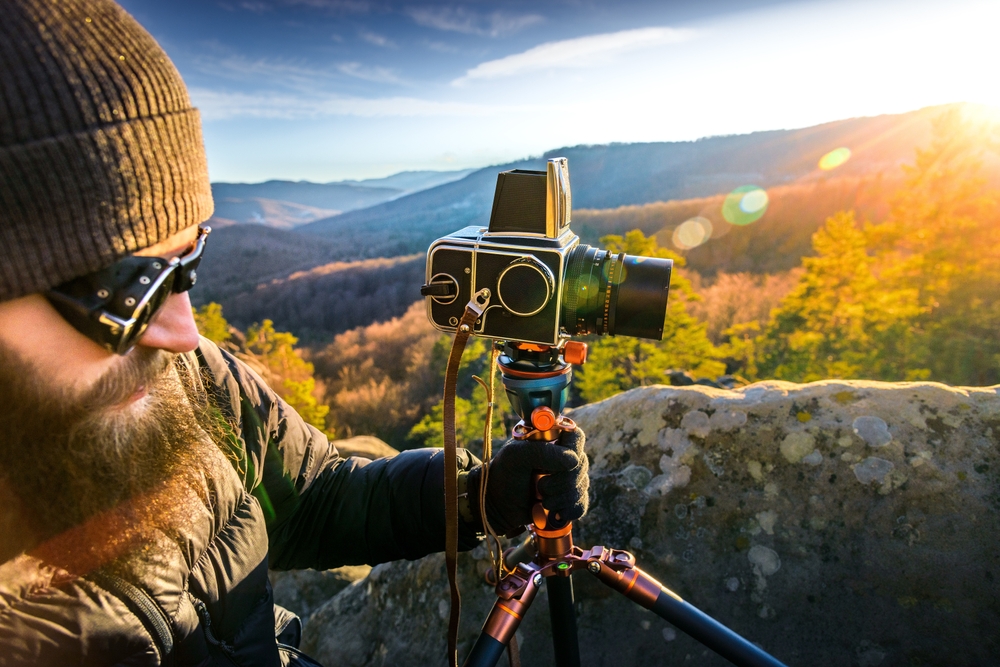
But, if MFT is your format choice, there are many excellent cameras to choose from manufacturers such as Olympus and Panasonic. A lot of MFT cameras and lenses, especially those designed for more serious use, are weather sealed, which protects them from dust and moisture, making those items appealing for outdoor photography under harsh conditions.
MFT Advantages: Small and easy to use, with image quality that is on par with many APS-C cameras. Most have high-quality 4K video capability. Improvements in electronic eye-level viewfinders have made MFT more user-friendly for landscape photographers.
MFT Disadvantages: Most models lack an optical viewfinder, causing more battery usage. Specialty lenses can be expensive, particularly ultra-wide-angle and fast prime or zoom lenses.
MFT Best for: Entry-level and intermediate shooters who want a highly functional camera system in a very small and lightweight body. Anyone needing exceptional video quality in a small camera s
MFT Not for: Photographers shooting in lower light or wanting the highest image quality.
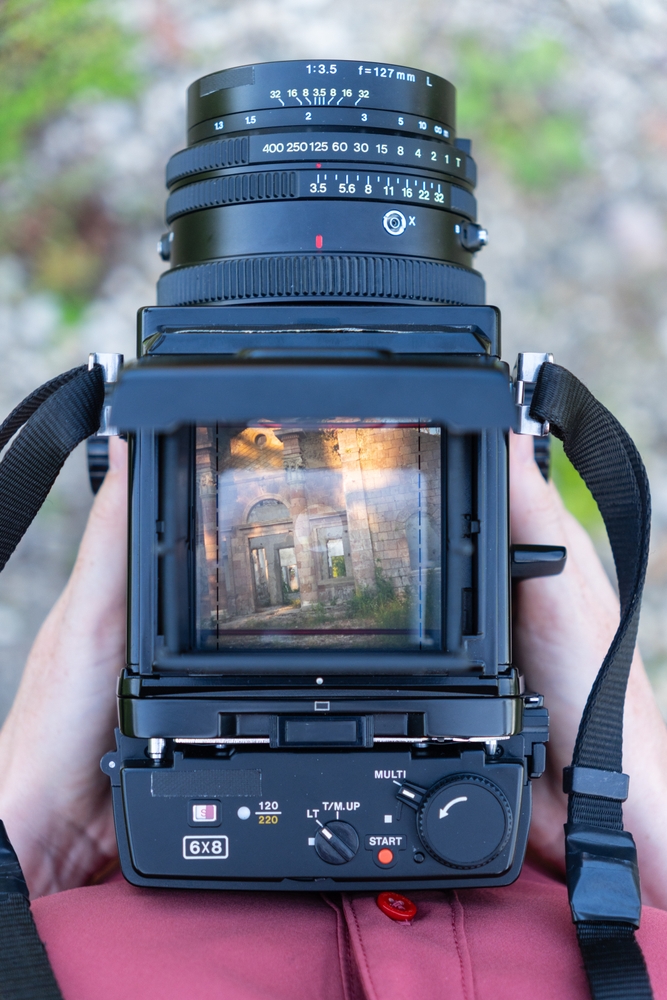
And now, for the medium-format options. We won’t spend a lot of time on these cameras because their size, weight, and price are somewhat prohibitive for the largest percentage of us.
The lower-priced medium-format options run in the $4,500 range with their kit lens. Higher-end options can be $48,000 without any lens added yet!
Medium-format cameras offer the highest image quality possible in a portable system. Still, unless you are heavily involved as a very successful professional photographer or are just very well off financially, the advantages come at a high price: a lot of extra size and weight, greatly increased costs, and fewer lens choices overall.
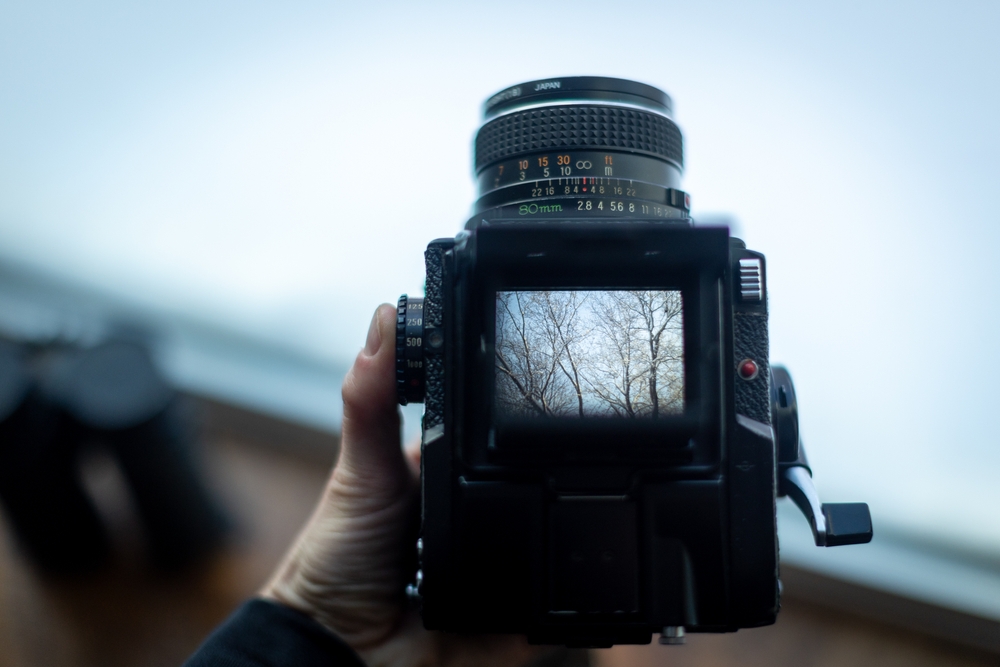
Medium Format Advantages – Highest image quality in a system that is still reasonably portable. A full system of lenses is available from the camera makers.
Medium Format Disadvantages – Large size and weight of cameras and lenses, extremely high prices. Not many lens choices, especially from 3rd party manufacturers.
Medium Format Best for – Well-established pros needing the absolute highest quality images.
Medium Format Not for – Quite frankly, most of us. Very high prices and large sizes can make these out of reach to all but the largest budgets or those requiring extremely high resolution.
Helpful Features

Regardless of the type of system you choose to go with, there are some features you might want to consider that will be beneficial for landscape photography. These aren’t essentials, per se, but will certainly help:
- More pixels – If you intend to create large prints, the more pixels, the better.
- Live view – Having live view capability on your camera’s LCD will aid you in determining focus, especially when focusing manually. An articulating LCD is a bonus as well, as that will give you the ability to shoot from odd angles while still having a view of how you’ve composed the scene.
- ISO – Cameras with higher ISO capabilities will allow you to push the shutter speed higher to account for blurring effects of things like the wind. A higher ISO also means you can handhold your camera at lower shutter speeds.
- Electronic horizon – Some cameras come equipped with a framing assist tool called an electronic horizon. Since crooked horizons are one of the most common errors in landscape photography, this can prove to be a handy feature.
- Depth of field preview – On cameras that have an optical viewfinder, the image you see is not at the aperture at which you’re shooting. Depth of field preview allows you to see the image you’ve composed at the shooting aperture, so you can ensure you’ve got the image well-framed with the proper depth of field.
- Weather-sealed body – If you’re going to be outdoors shooting landscapes, a camera body with weatherproofing will come in handy.
- RAW – Having RAW shooting capabilities is perhaps one of the most important features to look for. RAW files are uncompressed versions of the images you take and contain far more information than JPEGs. RAW files give you greater leeway in post-processing and will result in a better final product.
Actionable Steps
- Review the pros and cons of each camera system discussed in this lesson. Note which camera system seems to fit your needs the best.
- Explore the helpful features listed at the end of the lesson. Identify which among them is most important for your purposes, and use that information to help you identify possible cameras to purchase, if need be.
Homework

If you already have a camera system and will be using it throughout this course, take time to learn how to use it properly if you have not done so already. Read the owner’s manual. Take practice images. Get to know the camera like the back of your hand. Doing so will enable you to make on-the-fly adjustments to camera settings, which will benefit you greatly when shooting in the field.
If you don’t already have a camera, use the information in this lesson to research possible cameras for you. Making an informed decision regarding the type of camera system that best suits your needs will allow you to move forward in landscape photography in the most meaningful and productive way. Remember – the camera is not what will make the best photo. It’s your skills and talents as a photographer that will get you incredible images, so you don’t necessarily need to buy the most expensive full frame body available!