


The tools we choose shape the work we make. For creative folks who move fast across crosswalks at blue hour, through rain-slicked alleys, or into quiet corners where tiny subjects wait, the camera has to feel instinctive. It has to respond without hesitation. It has to deliver files that hold up when the work leaves the memory card and enters the real world. The OM System OM-3 was built with that pressure in mind. It doesn’t ask you to slow down. It asks you what you want to make next.
This camera lands at a moment when hybrid creators no longer want separate devices for separate disciplines. Photographers expect serious video. Filmmakers expect dependable autofocus. Everyone expects stabilization that actually works handheld. And no one wants to carry a brick. The OM System OM-3 answers that brief with a compact Micro Four Thirds system that carries the heart of the OM-1 Mark II: a 20MP Stacked BSI Live MOS MFT sensor, the TruePic X engine, and 1053 cross-type AF points. The result is a camera that feels smaller than its résumé.
The charm of the OM System OM-3 isn’t a single spec. It’s how the pieces cooperate. It blends tactile, SLR-style dials with computational photography tools that used to demand tripods, filters, or complicated rigs. It shoots 4K up to 60p without melting down. It focuses on stars, birds, pets, and people with equal confidence. And it stabilizes images at up to 7.5 stops when paired with compatible glass. If you like making images in unpredictable places, this one feels like a steady companion that won’t fight you when conditions do. Let’s learn more about it!
Table of Contents
- Timeless Elegance and Customizable Creative Design
- 20MP Stacked BSI Live MOS MFT Sensor + TruePic X
- 5-Axis IBIS and Sync IS Stabilization
- Flagship Autofocus: AI, Quad Pixel AF, and Starry Sky AF
- Video Power, S&Q Modes, and OM-Cinema Color
- Value, Longevity & Buying Used OM System OM-3 Gear on MPB
- OM System OM-3 FAQ
Timeless Elegance and Customizable Creative Design
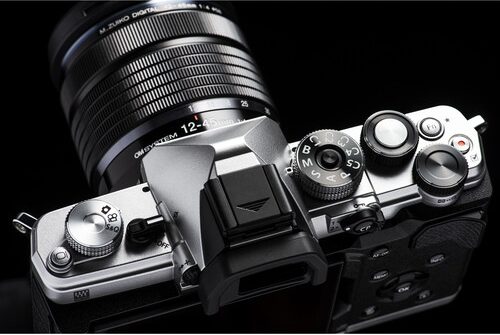
The OM System OM-3 was shaped by a design philosophy that trusts the photographer. Instead of hiding creative tools in menus, it surfaces them through physical controls that feel familiar to anyone who’s used a classic SLR. The magnesium alloy body gives it reassuring rigidity in hand. It feels dense where it should and light where it can, weighing 0.9 lb body-only and 1.1 lb with the BLX-1 battery installed.
Meanwhile, the body measures 5.5 x 3.5 x 1.8 in, so it’s compact enough to fit into sling bags and small travel kits without forcing lens compromises. For someone who shoots night street scenes, that size matters. When you’re walking for hours at night, 5 ounces saved is 5 ounces earned.
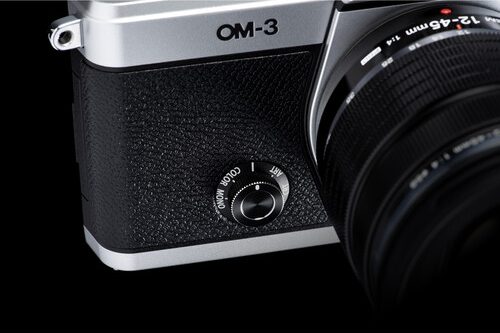
The dials are the real story. A dedicated creative dial allows fast switching between color profiles, monochrome profiles, and user-tuned looks. The dedicated computational photography button consolidates features like Live ND, GND simulation, and focus stacking under one control. That button changes how you shoot.
For example, handheld long exposures become viable without threading a variable ND filter onto your lens in the dark. Light trails can be captured cleanly without stacking multiple test shots. Macro shooters can blend depth planes in-camera without juggling burst sequences manually. The OM System OM-3 encourages curiosity instead of punishment for changing your mind mid-shoot.
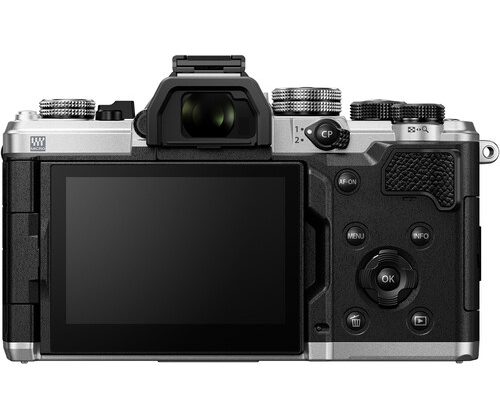
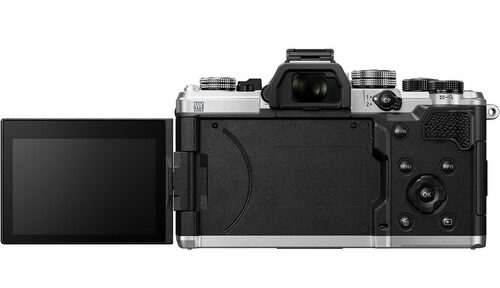
The articulating 3-inch touchscreen LCD with 1.62M dots adds flexibility without fragility. It swings out for vertical compositions inches from the ground or flips forward for framing yourself in a scene when you’re working alone. The touchscreen is responsive even with light gloves in cold weather. Rated operating conditions run from 14°F to 104°F and 30–90% humidity, which means it tolerates winter street sessions and tropical shoots alike.
The viewfinder also complements the design with a 2.36M-dot OLED panel, 100% coverage, 27 mm eye point, and 1.23x magnification. It feels comfortable for long compositions, even if you wear glasses. There’s no tunnel vision here—just a clean window into the scene.
20MP Stacked BSI Live MOS MFT Sensor + TruePic X
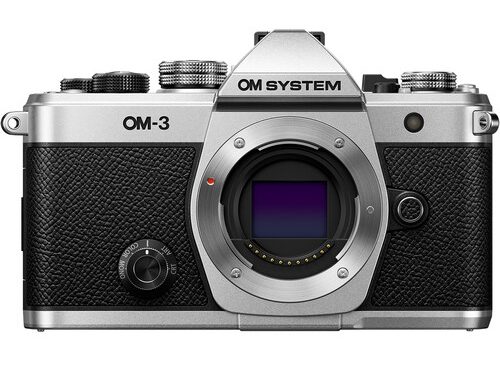
At the core of the OM System OM-3 sits a 17.4 x 13 mm (Four Thirds) Stacked BSI MOS sensor delivering 20.4 effective megapixels. The stacked architecture changes how the sensor reads data. It clears information faster, giving you reduced rolling shutter, improved dynamic response, and burst speeds that feel absurd in a body this small.
It supports 120 fps at full resolution, with continuous AF tracking maintained at 50 fps. That’s not a marketing ploy. It means you can actually follow motion in a frame—street dancers, birds darting between streetlamps, motorcycles cutting through city haze—and trust the camera to keep up without turning AF into a suggestion instead of a promise.
The 2x crop factor native to Micro Four Thirds isn’t a limitation; it’s leverage. A 50 mm lens behaves like 100 mm in full-frame terms, giving you reach without length and compression without size. Wildlife and urban nature shooters gain framing precision without carrying a telephoto the size of a water bottle.
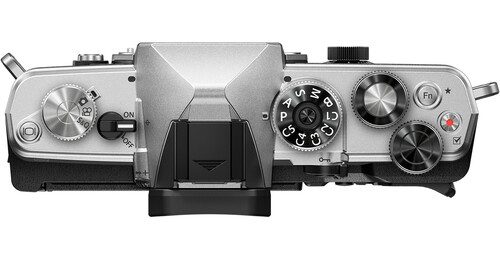
I’ve used MFT systems for urban bird photography, and the biggest benefit is speed of composition. You raise the camera, twist a dial, tap the computational button, and shoot. The OM System OM-3 sensor also supports computational modes like handheld Live ND and GND simulation without physical filters, enabling exposures that normally demand extra glass, extra time, and extra patience.
The TruePic X processor keeps the 20MP stacked sensor fed and focused. It handles noise gracefully from ISO 200 to 25,600, letting you push into night scenes without falling into watercolor noise reduction. Files retain micro-contrast and texture in city details—brick, neon glow gradients, wet asphalt specular highlights, and small natural surfaces like moss or feathers.
The sensor also powers features like focus stacking, which is genuinely useful for macro photography. Instead of stopping down to f/16 and losing sharpness to diffraction, you can shoot wide, stack depth planes in-camera, and keep detail where it belongs. For evolving creatives, the sensor isn’t just a part—it’s the partner that makes everything else feel possible.
5-Axis IBIS and Sync IS Stabilization
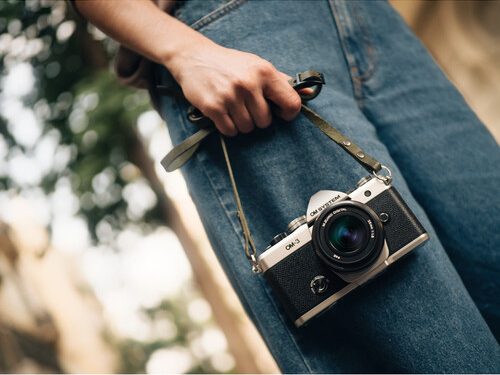
Handheld shooting is only fun when it works. The OM System OM-3 delivers up to 6.5 shutter speed stops of compensation in the center of the frame and 5.5 stops in the corners. Pair it with a compatible Sync IS lens and that climbs to 7.5 stops in the center and 6.5 in the corners. Those numbers translate to images that stay sharp at shutter speeds you wouldn’t normally attempt without a tripod.
In other words, a 1/2-second exposure at 24 mm (48 mm equivalent) becomes realistic. A 1-second exposure becomes plausible. A 2-second exposure becomes a party trick you’ll actually use for motion-blur city work, night rivers, or cloud movement above skyscrapers.
For video, the 5-axis stabilization turns walking footage into something watchable without extra rigs. You can move through a city park, track a pet, pan up to a bird on a signpost, or pivot into slow-motion B-roll using the dedicated video dial, and the frame stays calm instead of seasick.
The OM System OM-3 doesn’t include a built-in ND filter, but Sync IS plus Live ND simulation means you often don’t need one. You can dial in motion blur for 4K 60p in daylight without stacking extra glass. If you’ve ever shot street video at 1/60 in bright sun, you know the struggle. The OM-3 offers a smoother answer: stabilization that supports longer exposures and computational ND that maintains handheld practicality.
For photographers, IBIS and Sync IS remove friction. You don’t think about stabilization; you just shoot. Low-angle compositions in awkward places become fast. Night street work becomes quieter. And macro shooters gain stability without switching bodies.
When you’re photographing a tiny subject, every micron of shake is magnified. The OM System OM-3 reduces that shake in the capture stage instead of asking you to fix it later. The result is more usable frames, fewer repeats, and more confidence when you’re working quickly or alone.
Flagship Autofocus: AI, Quad Pixel AF, and Starry Sky AF

The autofocus system in the OM System OM-3 carries the same 1053-point cross-type, on-chip Quad Pixel phase detection AF found in the OM-1 Mark II. Quad Pixel AF reads information from every pixel quadrant, increasing focus precision for both stills and video.
That density of AF points means full sensor coverage, fewer focus-and-recompose gymnastics, and more reliable subject tracking across the frame. AF works in lighting down to –5.5 EV, which is darker than a city sidewalk lit only by reflected neon. It means you can focus in places where contrast is low, light is scarce, or subjects move unpredictably.
AI Detection AF recognizes people, birds, pets, and motorsports subjects. The OM System OM-3 doesn’t treat subject recognition as an add-on. It treats it as a default language. You can track a dog sprinting across a crosswalk, a bird flitting between trees in a downtown park, or a motorcycle passing through the frame without feeling like you’re negotiating with AF. It locks, follows, and stays with the subject instead of drifting into background texture.

For astrophotographers, Starry Sky AF allows you to autofocus on stars without switching to manual, zooming in, or hoping infinity actually means infinity on your lens barrel. It removes one of the most irritating parts of night sky capture: confirming focus in the dark.
Pro Capture Mode adds another layer of usefulness. The OM System OM-3 can buffer up to 70 frames before you fully press the shutter. The camera is already collecting images while you half-press, then commits them when you fully press. If you shoot street scenes, you know the moment often happens before your brain finishes narrating it.
Pro Capture means you still get the frames that happened before your reflexes did. Add OM Image Share support over Wi-Fi 4 (802.11n) and Bluetooth 4.2, and you can remote-trigger the camera or pull files on the move. The OM-3 makes autofocus feel less like a technical process and more like a creative reflex.
Video Power, S&Q Modes, and OM-Cinema Color
As Zach Mayfield explains in the video above, the OM System OM-3 is a capable video tool without feeling like a video camera pretending to be a stills body. It records DCI 4K (4096 x 2160) and UHD 4K (3840 x 2160) up to 60p using internal 8-bit 4:2:0 in H.264 Long GOP or 10-bit 4:2:0 in H.265 Long GOP. Bitrates range from 77 to 205 Mb/s, depending on resolution and codec.
Over HDMI, it outputs up to 10-bit 4:2:2 or 4:2:0, giving you cleaner chroma for external recording or monitoring. You can switch between stills, video, and S&Q modes instantly using the dedicated video dial. That means you can capture a still frame, twist a dial, and roll into slow-motion or time-compressed B-roll without breaking your pace.
S&Q frame rates run from 1 fps to 120 fps. That range gives you intentional pacing control. Slow motion at 120 fps becomes smooth without interpolation. Quick motion at 1–24 fps becomes intentional instead of gimmicky. The 2-hour recording limit in 4K is a safeguard you’ll rarely hit because the OM-3 handles heat better than many small hybrid bodies. It was built to record longer without throttling itself into a thermal timeout. If you shoot talking-head segments, events, or long atmospheric sequences, the OM System OM-3 behaves like a reliable recorder instead of a stopwatch.
OM-Cinema Mode adds color profiles shaped for narrative work. Gamma curves include FLAT, HDR-HLG, and OM-Log. OM-Log is useful if you like controlling the grade later, but the OM-Cinema looks give you a thoughtful starting point if you want cinematic color without heavy post-production.
The files are 16-bit 48 kHz LPCM audio using the stereo internal mic, with 3.5 mm mic and headphone ports available for external audio. Light integration support means the OM System OM-3 can pair with video lights, too, without awkward adapters. For hybrid creators, this camera lets you carry one body for both disciplines and trust that neither side of the hybrid brief feels undercooked.
Value, Longevity & Buying Used OM System OM-3 Gear on MPB

Cameras are long-term tools. The OM System OM-3 was engineered to last, with a magnesium alloy chassis and IP53-rated splash and dust resistance. That durability means this body ages gracefully in the used market. Buying used isn’t a compromise here; it’s a smart move for creatives who want performance without paying the full retail price. The OM System OM-3 holds its own for years because the internals mirror a flagship platform, not a trimmed-down spec list.
Online marketplaces have made used gear safer than the old days of classified listings and unknown shutter counts. MPB has earned trust by grading gear consistently, testing every camera and lens, and showing real product photos of the exact item you’ll receive. There’s no guessing. You know the condition, the included accessories, and the shutter actuation range before you buy.
For a body like the OM System OM-3, that transparency matters. This is a camera people often use hard: travel, weather, long handheld exposures, and action bursts. A tested marketplace reduces the risk of inheriting someone else’s surprises.
The financial upside is real. Used OM System OM-3 bodies often land below retail, depending on grade. That savings can be redirected into lenses, storage, audio, or lighting; the parts that shape the final image more than the body does.
And because MFT lenses are smaller, used telephoto and macro glass is easier to ship, easier to carry, and easier to bundle into a system. MPB also offers a warranty period, which means your used OM-3 kit is protected after arrival. If you’re building a system that lasts without burning budget, buying a used OM System OM-3 from a trusted platform like MPB is a logical step for creatives who want more camera and less cost.
Why This Camera Feels Right for the Long Road
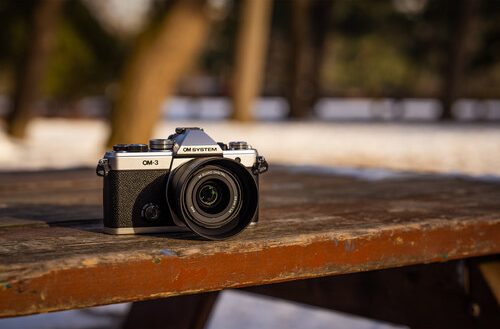
The OM System OM-3 was built for years, not seasons. The magnesium alloy frame, thoughtful dial layout, and weather sealing mean it tolerates a pace that other small hybrid bodies sometimes push back on. I’ve carried Micro Four Thirds systems through rain, desert dust, and long night walks.
The biggest benefit is endurance. When a body is small, stable, and sealed, you shoot more. You think less about protecting the camera and more about making images. The OM System OM-3 keeps that promise by combining size, stabilization, and processing power into one tool that doesn’t mind being used in awkward weather or fast transitions.
Battery life is a quiet benefit too. The BLX-1 battery supports longer sessions than many expect from a small body. USB-C power sharing means you can top up in cars, cafés, or on power banks without proprietary chargers. A single UHS-II SD card slot keeps the kit simple and inexpensive to maintain as well. Storage is easy to source, easy to replace, and easy to pack.

The camera also supports interval recording for long sequences. That’s useful if you shoot urban time lapses or natural movement above a city. The OM System OM-3 gives you the tools to record longer, stabilize more, and capture motion with confidence instead of apology.
The OM System OM-3 isn’t a camera that needs to be babied into longevity. It was engineered to survive real conditions, then reward you for using it. The design encourages tactile shooting. The stabilization rewards handheld curiosity. The autofocus keeps up in low light. The video modes let you pivot without breaking stride. And the durability means buying used still feels safe. For folks who evolve faster than their gear cycles, this camera ages with dignity instead of resistance.
FAQ
Does the OM System OM-3 have a built-in ND filter?
The OM System OM-3 does not include a built-in ND filter, but Live ND computational simulation makes handheld long exposures practical without external ND glass.
How strong is the stabilization in the OM System OM-3?
5-axis IBIS provides up to 6.5 stops (center) and 5.5 stops (corners). Sync IS with compatible lenses increases that to 7.5 stops (center) and 6.5 stops (corners).
What is the 4K recording limit?
The OM System OM-3 supports up to 2 hours of 4K recording internally before the limit is reached.
How many autofocus points does the OM System OM-3 have?
The OM System OM-3 includes 1053 cross-type on-chip phase detection AF points with Quad Pixel readout for full sensor coverage.
What codecs are supported internally?
The OM System OM-3 records H.264 Long GOP 8-bit 4:2:0 and H.265 Long GOP 10-bit 4:2:0 in MOV format.
Is buying a used OM System OM-3 a good idea?
Yes. The OM System OM-3 was built for durability. Buying used from a tested marketplace like MPB reduces risk and saves money that can go into lenses and support gear.
Can the OM System OM-3 autofocus on stars?
Yes. Starry Sky AF allows autofocus on stars without switching to manual focus.
Does the OM System OM-3 support slow motion?
Yes. S&Q modes support frame rates from 1 to 120 fps internally.
Can I control the camera remotely?
Yes. OM Image Share (Android/iOS) supports live view, remote control, and file transfer over Wi-Fi and Bluetooth.
Friendly disclaimer: Our articles may contain affiliate links that support us without costing you more, and sometimes we spice things up with sponsored content—but only for products we truly stand behind!

