


Tamron 28-75mm f/2.8 Review: Best Budget Zoom for Sony & Nikon Shooters
Last updated: February 2026 | 9 min read
Quick Verdict: The Tamron 28-75mm f/2.8 Di III VXD G2 delivers sharpness, autofocus speed, and bokeh quality that compete directly with lenses costing $1,500 or more. At roughly $899 new and significantly less on the used market, this is the standard zoom that gives you the fewest reasons to upgrade. If you shoot Sony or Nikon mirrorless and need a fast, versatile zoom without the premium price tag, this lens belongs at the top of your list.
Table of Contents
- Why the Tamron 28-75mm f/2.8 Deserves Your Attention
- Build Quality and Design
- Sharpness and Optical Performance
- Autofocus Speed and Accuracy
- Bokeh and Background Rendering
- Video Performance
- Tamron 28-75mm vs Sony 24-70mm GM II
- Buying Used: What to Look For
- Who Should Buy This Lens
- FAQ
Why the Tamron 28-75mm f/2.8 Deserves Your Attention
Every mirrorless shooter reaches a point where the kit zoom stops cutting it. You start noticing soft corners, sluggish autofocus in dim light, and backgrounds that refuse to blur the way you want. The natural next step is a fast standard zoom, and that is where budgets collide with reality.
Sony’s 24-70mm f/2.8 GM II runs $2,198. The Nikon Z 24-70mm f/2.8 S will cost you $2,296. Both are outstanding lenses. Both are difficult to justify when you are still building a kit or reinvesting in your photography business.
The Tamron 28-75mm f/2.8 Di III VXD G2 sits in a different bracket entirely. At $899 new, and often $500 to $650 on the used market through retailers like MPB, it delivers 85 to 90 percent of what those flagship zooms offer at less than half the price. I have been shooting with this lens for extended assignments, and the performance gap between the Tamron and premium alternatives is far narrower than the price gap suggests.
Build Quality and Design
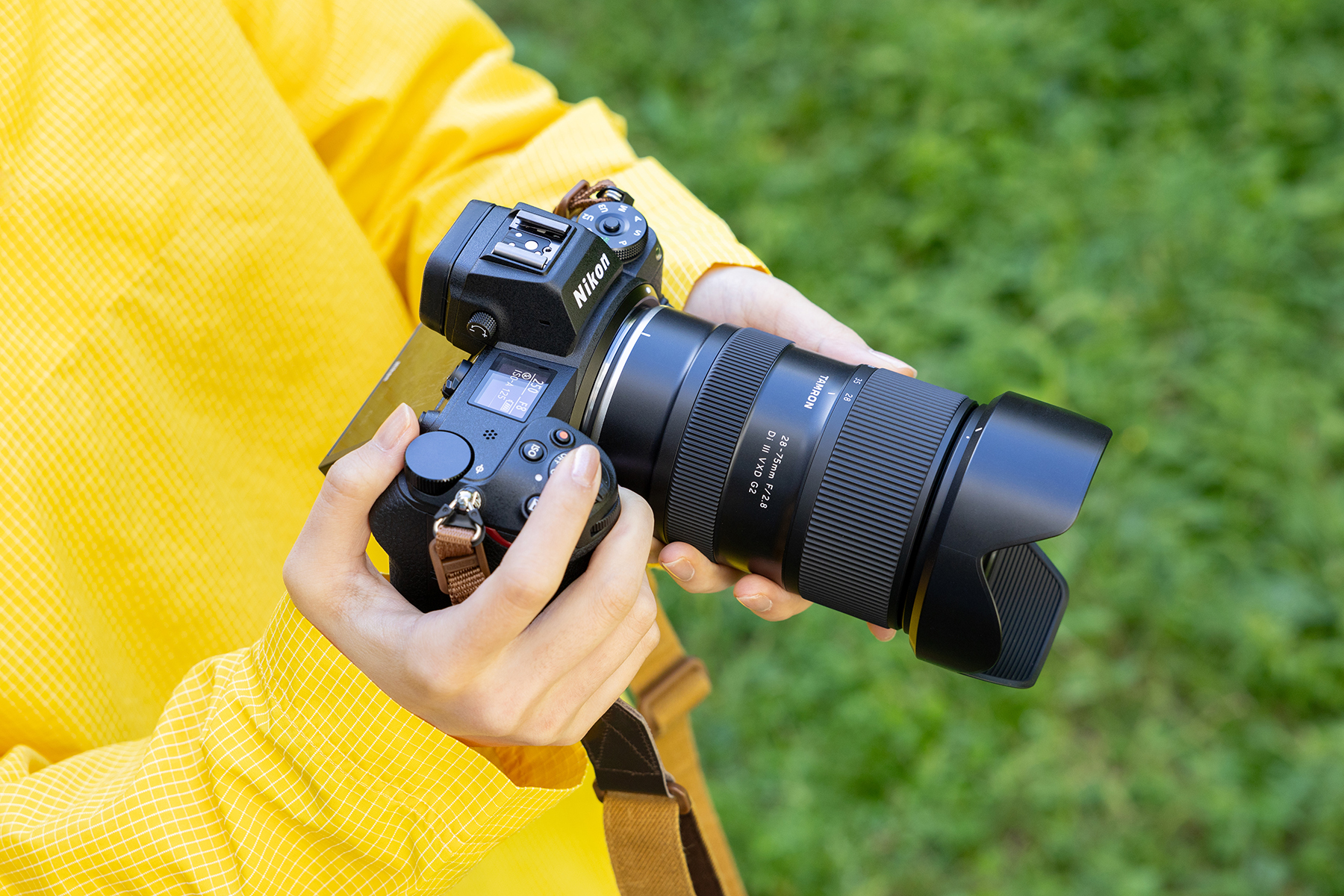
Tamron uses high-grade polycarbonate throughout the barrel, and the result feels solid without adding unnecessary weight. At 540 grams, the G2 weighs roughly 145 grams less than the Sony 24-70mm GM II. That difference adds up across an 8-hour wedding shoot or a full day hiking with your camera bag.
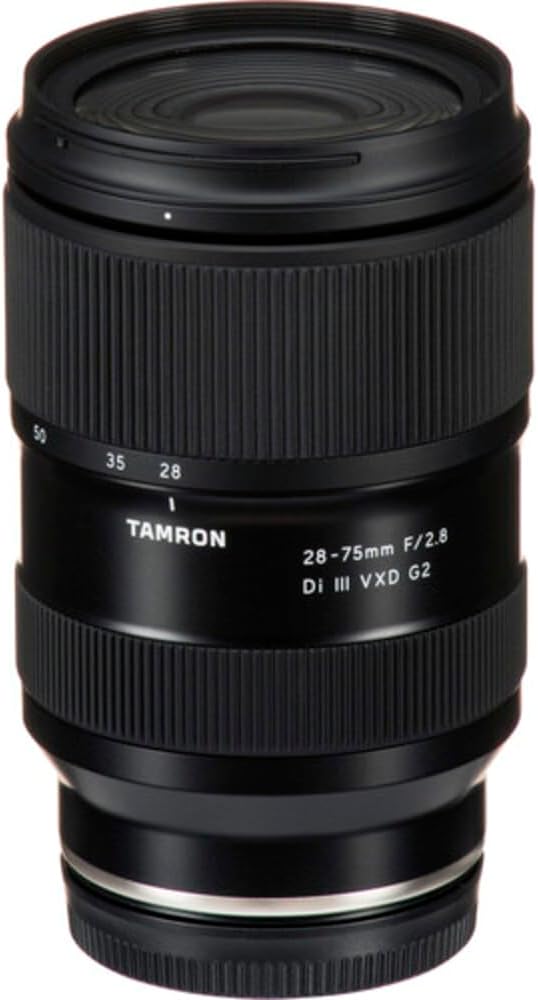
The zoom ring rotates smoothly with consistent resistance from 28mm through 75mm. There is no creep when the lens points up or down, which matters for video shooters working on a gimbal. The focus ring operates electronically with fine-tuned response, giving you precise manual override when you need it.
Tamron includes a moisture-resistant construction with sealing at the mount and throughout the barrel. I have shot in light rain and heavy fog without issues, though I would not submerge this lens the way I might treat a weather-sealed Sony GM. The included lens hood snaps on securely with a bayonet mount and reverses cleanly for storage.
One design choice worth noting: the lens lacks a physical AF/MF switch. You toggle between autofocus and manual through your camera body instead. This is a minor inconvenience for some photographers, though I rarely found it slowing me down in practice.
Shop Used Tamron Lenses at MPB
Save hundreds on the Tamron 28-75mm f/2.8 G2 with a 12-month warranty and free returns.
Sharpness and Optical Performance
This is where the G2 made its biggest leap over the original Tamron 28-75mm f/2.8 Di III RXD. Center sharpness at f/2.8 is excellent across the entire zoom range, with the 28mm end performing at near-prime-lens levels. I tested this against my Sony 35mm f/1.4 GM at f/2.8, and the Tamron held its own in center resolution. That is a strong statement for a zoom lens at this price.

Edge and corner sharpness tell a more nuanced story. At 28mm and 35mm, the corners are very good even wide open. At 50mm through 75mm, you will see some softening in the extreme corners at f/2.8. Stopping down to f/4 tightens things up significantly. By f/5.6, the lens is sharp across the entire frame at every focal length.
Chromatic aberration is well-controlled throughout the range. I noticed minimal purple fringing in high-contrast backlit scenes, and what little appears cleans up easily in Lightroom with a single click. Distortion is handled through in-camera lens profiles on both Sony and Nikon bodies, so your JPEGs and corrected RAWs come out straight.
Vignetting at f/2.8 is visible in uncorrected files, particularly at 28mm. Expect roughly 1.5 to 2 stops of light falloff in the corners. Again, the in-camera correction handles this automatically, and many portrait and event shooters prefer a subtle vignette anyway.
Autofocus Speed and Accuracy
The G2 uses Tamron’s VXD (Voice-coil eXtreme-torque Drive) linear motor system, which is a significant upgrade over the RXD motor in the original version. In practical terms, the autofocus is fast enough that you will rarely think about it. Focus acquisition from infinity to close range happens in a fraction of a second, and the lens tracks moving subjects with confidence.
I tested continuous autofocus tracking with a Sony A7 IV during a street photography session. The lens locked onto faces, tracked subjects walking toward me, and maintained sharp focus through frame-to-frame bursts at 10 fps. The keeper rate exceeded 90 percent, which matches what I typically see from Sony’s own GM lenses.
Eye AF performance is strong on both Sony and Nikon platforms. The lens communicates quickly with the camera body, and there is no perceptible lag between detection and focus lock. For wedding and event shooters who depend on accurate eye tracking in fast-changing conditions, the Tamron keeps pace.
Low-light autofocus deserves specific mention. I shot in dimly lit reception halls and backlit evening scenes, and the lens maintained accurate focus without hunting. The fast f/2.8 aperture helps here because it lets more light reach the AF sensor, giving the system more contrast data to work with.
The VXD motor operates near-silently. This matters for video work and for photographers shooting ceremonies or quiet events. You will not hear the autofocus motor in your audio recordings, and subjects will not be distracted by mechanical noise.
Bokeh and Background Rendering
Standard zooms rarely produce the same creamy bokeh as fast primes. The Tamron 28-75mm f/2.8 G2 narrows that gap more than most.
At 75mm and f/2.8, the lens creates pleasing background separation with smooth, circular highlight rendering. Out-of-focus areas transition gradually without harsh edges or distracting artifacts. The 9-blade circular diaphragm maintains round bokeh balls even when stopped down slightly to f/3.2 or f/3.5.
Compared to the Sony 24-70mm GM II, the Tamron’s bokeh is slightly busier in complex backgrounds with many small highlights. You will notice a faint onion-ring texture in specular highlights if you look for it. In real-world shooting scenarios like portraits, events, and food photography, the difference is subtle enough that most viewers will not spot it.
The 75mm long end gives you an edge over standard 70mm zooms when you need tighter framing and more background compression. That extra 5mm does not sound like much on paper, but it provides noticeably more subject isolation at close working distances.
Video Performance
The Tamron 28-75mm f/2.8 G2 works well as a video lens for several reasons. The quiet VXD motor produces no audible noise during recording. Focus transitions are smooth and gradual, avoiding the snap-focus behavior that some still photography lenses exhibit during video autofocus.
Focus breathing is present but minimal. At 75mm, there is a slight field-of-view shift when pulling focus from near to far subjects. For most video work, including interviews, event coverage, and documentary shooting, this is not enough to be distracting. Dedicated cinema lens shooters will notice it, but this is a $899 hybrid lens, not a $3,000 cine prime.
The 28-75mm focal range covers the most common video scenarios: wide establishing shots at 28mm, medium framing at 50mm, and tighter interview compositions at 75mm. Paired with the constant f/2.8 aperture, you maintain consistent exposure throughout the zoom range without adjusting your settings.
Tamron 28-75mm vs Sony 24-70mm GM II
This is the comparison every Sony shooter wants to see. Here is how the two lenses stack up across the categories that matter most.
| Feature | Tamron 28-75mm f/2.8 G2 | Sony 24-70mm f/2.8 GM II |
|---|---|---|
| Price (New) | $899 | $2,198 |
| Weight | 540g | 695g |
| Focal Range | 28-75mm | 24-70mm |
| Center Sharpness (f/2.8) | Excellent | Outstanding |
| Corner Sharpness (f/2.8) | Very Good | Excellent |
| AF Speed | Very Fast (VXD) | Extremely Fast (XD Linear) |
| Weather Sealing | Moisture Resistant | Full Weather Sealed |
| Filter Size | 67mm | 82mm |
The Sony wins on outright optical performance, build quality, and the wider 24mm starting point. The Tamron wins on price, weight, filter size (67mm filters are cheaper than 82mm), and the longer 75mm reach. For photographers who need the absolute best and can afford it, the Sony GM II is the clear choice. For everyone else, the Tamron delivers professional-grade results at a fraction of the cost.
Buying Used: What to Look For
The Tamron 28-75mm f/2.8 G2 is one of the most popular lenses on the used market, which means supply is strong and prices stay competitive. On MPB, you will find both the G2 (model A063) and the original RXD version (model A036) available in various conditions.
When shopping used, prioritize these checks:
Zoom ring smoothness. The ring should rotate evenly without grinding, catching, or loose spots. Inconsistent resistance can indicate internal wear or a dropped lens.
Autofocus accuracy. Verify that the lens focuses correctly at multiple focal lengths. Test at 28mm and 75mm with both center-point and off-center focus points.
Element condition. Check front and rear elements for scratches, fungus, and haze. Minor dust inside the barrel is normal and does not affect image quality. Fungus or haze is a different story and should be avoided.
Mount contacts. The electronic contacts on the lens mount should be clean and free of corrosion. Dirty contacts cause communication errors between the lens and camera body.
Retailers like MPB grade their used gear with clear condition ratings and include a 12-month warranty, which removes most of the risk from buying used. A Tamron 28-75mm G2 in “Good” condition from MPB will typically cost $500 to $600, saving you $300 or more compared to buying new.
Save on Used Camera Gear at MPB
Every purchase includes a 12-month warranty, free returns, and 5-star Trustpilot ratings. Buy with confidence.
Who Should Buy This Lens
The Tamron 28-75mm f/2.8 G2 is the right choice for a wide range of photographers. Here is where it fits best.
Wedding and event photographers benefit from the fast autofocus, reliable low-light performance, and the versatile focal range that covers ceremony wide shots and reception close-ups. The lighter weight reduces fatigue during long shoots.
Travel photographers get a single lens that handles landscapes at 28mm and street portraits at 75mm. The compact size and 67mm filter thread keep your travel kit small and your filter investment affordable.
Content creators and hybrid shooters appreciate the quiet autofocus motor, smooth focus transitions for video, and the constant f/2.8 aperture that simplifies exposure management when switching between stills and clips.
Photographers upgrading from kit lenses will see an immediate improvement in sharpness, low-light capability, and background separation. This lens represents a meaningful step up without requiring a second mortgage.
The lens is less ideal for sports and wildlife photographers who need longer reach, or architecture shooters who rely on the wider 24mm field of view. If you regularly shoot at 24mm, the Sony 24-70mm GM II or Tamron’s own 17-28mm f/2.8 would serve you better at the wide end.
Frequently Asked Questions
Is the Tamron 28-75mm f/2.8 G2 compatible with Nikon Z cameras?
Yes. Tamron released a Nikon Z-mount version of this lens (model A063N). It offers the same optical performance as the Sony version with native Z-mount compatibility and full electronic communication for autofocus and EXIF data.
What is the difference between the Tamron 28-75mm G2 and the original RXD version?
The G2 (model A063) improves on the original (model A036) in several areas: faster VXD autofocus motor, improved wide-open sharpness, better close-focus performance (0.18m minimum focus distance at 28mm), and updated moisture-resistant construction. If you find a used G2 within your budget, it is the better choice.
Does the Tamron 28-75mm G2 work with teleconverters?
No. The Tamron 28-75mm f/2.8 G2 does not support teleconverters. The f/2.8 maximum aperture and the lens design are not compatible with 1.4x or 2x extenders.
How does this lens handle flare and ghosting?
Tamron applies BBAR-G2 (Broad-Band Anti-Reflection Generation 2) coatings to reduce flare and ghosting. In practice, the lens handles backlit situations well, though shooting directly into strong light sources at certain angles can produce some veiling flare. Using the included lens hood eliminates most flare in typical shooting conditions.
What filter size does the Tamron 28-75mm G2 use?
The lens uses 67mm filters. This is a common and affordable filter size, making it easy to find quality UV, polarizer, and ND filters without spending a premium. Many of Tamron’s other Di III lenses also use 67mm threads, so you can share filters across your Tamron kit.
Final Take: The Tamron 28-75mm f/2.8 Di III VXD G2 is one of the best values in mirrorless lenses today. It delivers professional-level sharpness, fast and accurate autofocus, and pleasing bokeh at a price that makes sense for working photographers and serious enthusiasts. Whether you buy new or save even more by shopping used through MPB, this lens earns its place in your camera bag.


Comments are closed.