


There’s a certain moment every traveler knows well: the scene shifts quickly, the light changes, and the moment is either captured or gone. Travel photography rewards responsiveness more than perfection. It rewards cameras that are easy to carry, fast to focus, and simple enough to operate while you’re juggling airport lines, foreign streets, and spontaneous detours. The right camera shouldn’t feel like luggage. It should feel like a passport.
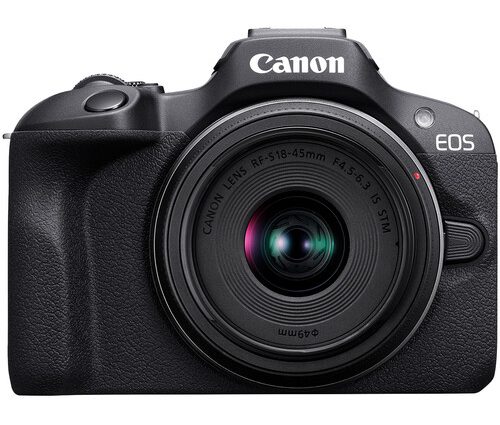
The Canon EOS R100 fits that description in a way that makes sense for many photographers who want strong results without a heavy setup. It’s small, light, and built around a 24.1MP APS-C sensor that balances detail and file sizes well for long trips. It also shoots 4K 24p video (with a crop), includes a 3.5mm mic input, and supports GPS tagging by borrowing data from your phone. It’s a camera that knows you’ll be moving, sharing, and shooting without a script.
But what makes the Canon EOS R100 truly travel-ready isn’t just its spec sheet—it’s how those features come together when you’re actually on the road. A good travel camera earns its keep after 10 miles of walking, not in a studio test. In the sections ahead, we’ll look at what the Canon EOS R100 does well for travelers, where it demands a little patience, and how to get the most from it whether you’re buying new or used.
Table of Contents
- Canon EOS R100 Travel-Friendly Design
- Canon EOS R100 Image Quality for Travel
- Canon EOS R100 Autofocus for Travel Photography
- Canon EOS R100 Video for Travel Creators
- Canon EOS R100 Connectivity for Travelers
- Canon EOS R100 Lens Pairings for Travel
- Canon EOS R100 Travel Camera Settings
- Canon EOS R100 Value and Buying Used
- On the Road with the Canon EOS R100
- Canon EOS R100 Travel FAQ
- Should You Pack the Canon EOS R100?
Canon EOS R100 Travel-Friendly Design
When you’re packing for a trip, every ounce becomes a negotiation. As Engadget discusses in the video above, the Canon EOS R100 weighs in at a level that rarely causes second thoughts. This is the kind of camera you can sling over your shoulder before breakfast and forget you’re carrying until something worth shooting appears. Its compact body keeps your kit nimble, which is essential when navigating buses, markets, or crowded sidewalks.
The 3.0-inch 1.04m-dot LCD is bright, sharp, and easy to review in midday sun. While it isn’t a fully articulating screen, the display is clear enough that you can comfortably shoot from the hip or hold the camera overhead and still compose accurately. The interface stays true to Canon’s long-standing menu logic, which is clean, color-coded, and easy to understand even if you’re new to the EOS system.
The 2.36m-dot OLED electronic viewfinder gives you crisp, high-resolution eye-level composition. In tight spaces or when shooting discreetly, an EVF is a gift. You can press the camera to your face and disappear into the scene without advertising your screen to everyone around you. For travelers who like to shoot candid street frames or frame landscapes without glare, the viewfinder makes a practical difference.
The single SD card slot supports both 4K recording and 6.5 fps bursts. While dual card redundancy is nice, most travelers won’t miss it unless they’re shooting paid client work abroad. The slot is fast, dependable, and keeps storage simple. My advice? Pack two solid SD cards, rotate them daily, and back up at night if you’re shooting something irreplaceable.
Canon EOS R100 Image Quality for Travel

The 24.1MP APS-C CMOS sensor and DIGIC 8 processor strike a balance that works well for travel: plenty of detail for large prints, moderate file sizes for limited storage, and solid performance across varied lighting. The camera renders scenes with pleasing clarity and color that leans natural rather than dramatic. That’s a bonus when you want your photos to feel honest to the place you visited.
The native ISO range of 100-12800 gives you flexibility for dusk alleys, indoor cafés, museums, and early morning landscapes. In low light, the Canon EOS R100 stays composed as long as you expose carefully. Noise becomes noticeable at higher ISOs, but still very usable for sharing and memory keeping. When shooting at night, ISO 6400 is a good number; it offers slightly underexposed images that protect highlights while giving you files that can be cleaned up nicely in post.
Dynamic range is respectable for the price class. You won’t get extreme shadow recovery like high-end bodies, but you’ll have enough latitude to protect skies, textured architecture, and layered street scenes if you expose with intent. Shooting RAW makes a big difference here—if you’re traveling somewhere with intense contrast, RAW gives you room to adjust without the image falling apart.
Continuous shooting at 6.5 fps is quick enough for passing wildlife, splashing fountains, street performers, or a friend jumping off something questionable. The buffer isn’t deep, so bursts should be short and purposeful. This camera rewards timing more than spray-and-pray. If you anticipate the action, you’ll get the shot before the camera asks for a breath.
Canon EOS R100 Autofocus for Travel Photography

Autofocus is one of the strongest reasons to consider the Canon EOS R100 for travel. Dual Pixel CMOS AF brings 3,975 focus points across 143 zones, covering most of the frame. This wide coverage makes focus-and-recompose mostly unnecessary. You can place your subject almost anywhere and trust the camera to find it.
Face Detection and Eye Detection AF work quickly on real human subjects, even in motion. It’s especially helpful when photographing travel companions, portraits of locals (with permission), or street candids where expressions make the image. The system locks decisively as long as the subject isn’t tiny in the frame or moving unpredictably fast toward the lens.
The R100’s subject tracking is reliable for general motion—people walking, cyclists crossing, boats moving parallel to the frame, animals at moderate distance, and candid slices of life. It isn’t built for pro sports, but it’s built for moments. My favorite trick for travel is enabling a larger AF zone for chaotic scenes, letting the camera identify faces automatically, then tapping the screen to override if it grabs the wrong subject.
Back-button AF is supported and worth setting up if you plan to shoot both moving subjects and landscapes on the same day. Decoupling shutter and focus lets you pre-focus for scenes like trains entering a station or a person stepping into a shaft of light, then fire exactly when the frame lines up. This setup increases your keeper rate and reduces refocusing delays.
Canon EOS R100 Video for Travel Creators
As noted by DSI Pictures in the video above, the Canon EOS R100 shoots 4K 24p video with a crop, which means tighter framing but also a little extra perceived reach—useful for detail clips, environmental B-roll, or compressing distant scenery. While the crop limits wide-angle vlogging without a wide lens, it works well for cinematic inserts and location texture shots.
1080p video is available uncropped, giving you more breathing room for handheld clips, walk-through sequences, and casual vlog segments. If you’re capturing storytelling content on the road, 1080p is often the smarter travel mode simply because you can frame more without switching lenses constantly.
The 3.5mm microphone input is one of the most travel-friendly features for video. Built-in audio works in a pinch, but a small shotgun or compact travel mic transforms your dialogue quality instantly. The micro-HDMI port also lets you output clean video to external recorders if you want maximum quality from a minimal footprint.
There’s no in-body stabilization, but Canon’s RF lenses with optical IS do a solid job smoothing handheld footage. Pair this camera with a stabilized lens and good stance while walking, and your clips stay steady enough for most travel storytelling. If you want to capture motion without inducing seasickness in your viewers, lens stabilization becomes your best co-pilot.
Canon EOS R100 Connectivity for Travelers

Connectivity is where the Canon EOS R100 shows that it was designed for the way people travel now. Bluetooth pairing with the Canon Camera Connect app makes wireless transfers quick and mostly painless. When you’re on hotel Wi-Fi or sitting in a train station, you can pull images to your phone without cables.
Built-in Wi-Fi allows faster batch transfers and direct sharing to mobile devices. For travelers who share highlights daily, this means you can edit on your phone and post without a laptop. The workflow becomes simple: shoot, transfer, cull, tweak, and share.
GPS tagging via your phone is one of the best travel habits you can adopt. The camera borrows your phone’s location data so you know exactly where the shot was made. Months later, when you’re sorting images, GPS tags turn “somewhere in Lisbon” into an actual pin on a map. This feature makes photo organization richer and more meaningful long after the trip.
USB-C support also makes wired transfers and charging easier when you need them. If you want one cable to do almost everything while traveling, USB-C is the one you want. Between Bluetooth, Wi-Fi, and GPS sharing, the Canon EOS R100 behaves like a camera built for movement, not a desk.
Canon EOS R100 Lens Pairings for Travel

The Canon EOS R100 uses the RF mount, which gives you access to lightweight lenses that are ideal for travel. If you want to keep your kit small, Canon’s RF-S lenses are the logical companions. They’re built for APS-C bodies, lighter than full-frame glass, and sized to match cameras like the R100.
A compact zoom lens is one of the smartest pairings for travel flexibility. Something in the 18-45mm or 18-150mm range lets you move from wide city scenes to tighter details without swapping lenses in dusty or crowded environments. Zooms also make framing faster when you don’t know exactly where you’ll be standing next.
A small prime lens adds a second layer to your travel kit: low-light ability, sharper detail, and subject separation for portraits and food shots. The 24mm or 35mm options are easy to pack, quick to use, and give you that slightly cinematic look for storytelling frames.
My personal advice? Pack one small zoom for daily reliability and one small prime for mood shots after sunset. That pairing gives you reach, flexibility, and low-light confidence without turning your bag into a mobile optics store.
Canon EOS R100 Travel Camera Settings

Setting up the Canon EOS R100 for travel is about reducing friction. Start with Auto White Balance—it handles mixed lighting well enough that you won’t need to babysit color in every environment. For most trips, AWB gets you 90% of the way there.
Shoot in Aperture Priority (Av) for landscapes, architecture, and environmental portraits. This mode lets you control depth of field while the camera handles shutter speed automatically. If you want sharp foreground and background detail, aim for f/5.6-f/8. If you want softer backgrounds for portraits or food, open it up.
Enable Face + Eye Detection AF. For travel companions, locals, or street candids, this setting prioritizes focus on expressions, which are often more memorable than total scene detail. If you’re shooting moving subjects, consider a larger AF zone so the camera can track without losing the subject.
Keep ISO on Auto with a ceiling around 6400-8000 if you’re shooting after dark. This prevents the camera from climbing to levels that demand heavy noise reduction later. Short, intentional bursts at 6.5 fps help you capture fast moments without clogging the buffer.
Canon EOS R100 Value and Buying Used

Travel cameras live harder lives than most. They’re bumped, packed, hauled, and exposed to weather and questionable decisions. The Canon EOS R100 delivers good value new, but it becomes an even easier recommendation when purchased used, where depreciation works in your favor without gutting performance.
Buying used gear for travel also reduces stress. Scratches feel less tragic when you didn’t pay retail. That psychological freedom can make you shoot more, worry less, and enjoy the process more. This camera’s feature set—autofocus, sensor quality, and connectivity—remains useful even after years of careful ownership.
If you ask me, MPB is one of the best places to buy used camera gear online. Their grading system is clear, the gear is inspected, and you can often find cameras in excellent condition for prices that make more sense for travelers who still need to buy plane tickets and overpriced almonds at the airport.
If you’re looking for a Canon EOS R100 used deal, MPB consistently lists clean bodies and travel-friendly lenses at prices that stretch your budget without stretching your chiropractor bills. For a first travel mirrorless body, it’s one of the most rational ways to spend less and still pack capable gear.
On the Road with the Canon EOS R100

The Canon EOS R100 feels best when you treat it like a travel camera, not a lab instrument. It thrives in motion. It thrives when you’re walking, reacting, and shooting quickly. Its small size encourages you to take it places you might skip with heavier bodies.
Whether you’re using the R100 on coastal mornings, alleyway afternoons, and night market evenings, you’ll find the autofocus and color makes the process smoother than expected for the class. The lack of a flip screen isn’t ideal, but it also makes you compose more deliberately, which helps you shoot fewer throwaway frames.
Battery life is adequate for day outings, but for long travel days, pack a small USB-C power bank or a spare LP-E17 battery. Short bursts instead of long sequences help maintain performance. This camera likes intention over endurance.
In return, it gives you portability, dependable AF, and a workflow that doesn’t demand a laptop. The Canon EOS R100 asks for a little restraint and gives back a lot of convenience. That’s a fair trade when you’re trying to enjoy the trip, not carry it.
Should You Pack the Canon EOS R100?

Let’s close this out by talking about what matters when you’re staring at your packing list. The Canon EOS R100 isn’t trying to be the most powerful camera ever made. It’s trying to be the camera you actually take with you. For travel, that is 80% of the job.
It’s light enough that you’ll carry it farther. It focuses fast enough that you’ll capture more real moments. It connects easily enough that you’ll share while the memories are still fresh. It’s not delicate, complicated, or exhausting to operate.
Buying it used from MPB makes the value even stronger, leaving more room in your budget for experiences instead of gear insurance therapy. Pair it with a small zoom and a compact prime, expose carefully, and keep bursts short, and you’ll return home with photos that feel like the trip did.
If you want a camera that behaves like a good travel companion—quiet, quick, light, and reliable—the Canon EOS R100 earns consideration. It doesn’t ask you to slow down, and that’s exactly what many travelers need.
FAQs
Is the Canon EOS R100 good for travel photography?
Yes. It’s light, compact, has fast Dual Pixel AF, a 24.1MP APS-C sensor, and strong phone connectivity including GPS tagging, making it practical for travel.
Does the Canon EOS R100 have image stabilization?
No in-body stabilization, but RF lenses with optical IS provide effective stabilization for photos and smoother handheld video.
Is 4K video usable for vlogging on the Canon EOS R100?
It can work for B-roll and tighter clips, but 4K is cropped. For wide handheld or vlog framing, 1080p or a wide lens is a better fit.
What ISO is safe to use on the Canon EOS R100 at night?
ISO 3200-6400 is very usable. ISO 8000+ works for sharing but benefits from noise reduction in post.
Should I buy the Canon EOS R100 used for travel?
Absolutely. It becomes an even better value used, where you can save significantly while keeping autofocus, image quality, and connectivity.
Where is the best place to buy a used Canon EOS R100?
MPB is a trusted online marketplace with inspected gear and clear grading, often listing excellent-condition Canon EOS R100 bodies and lenses at traveler-friendly prices.

