


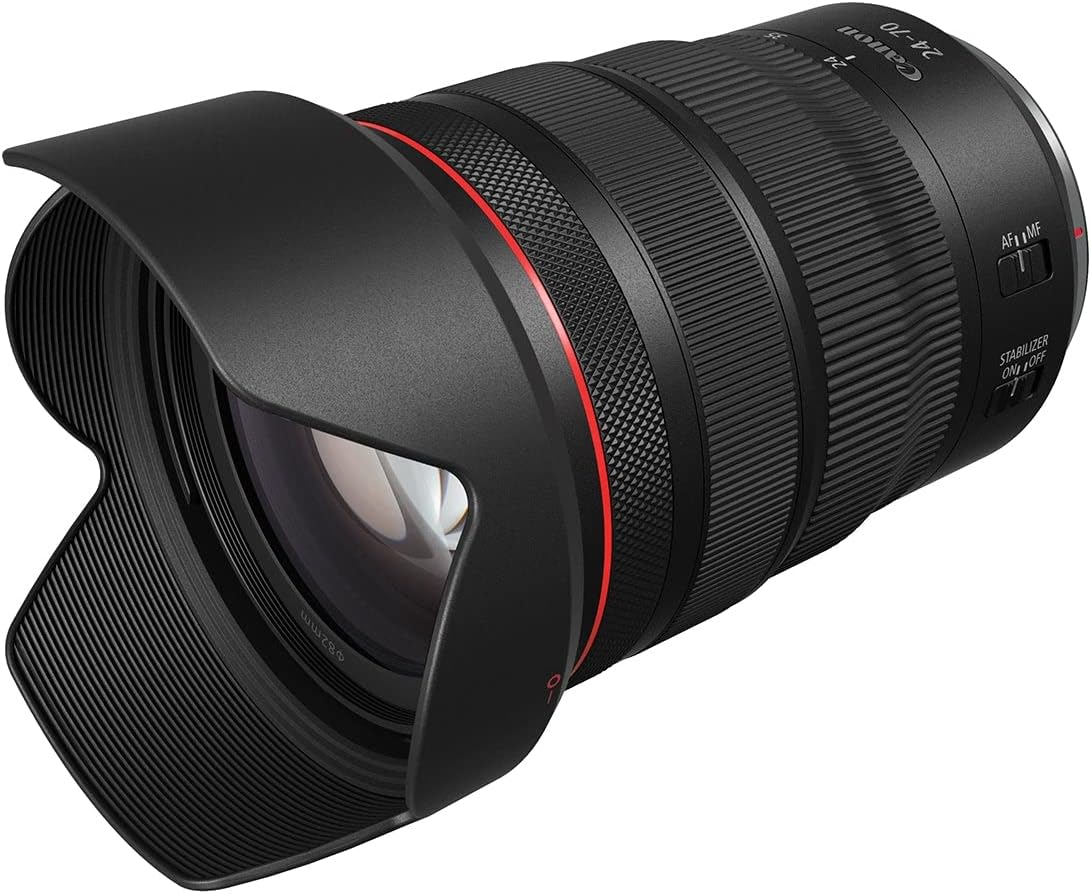
Quick Verdict: The Canon RF 24-70mm f/2.8 L IS USM is Canon’s first 24-70mm f/2.8 with built-in optical image stabilization, delivering up to 5 stops of shake correction. It pairs a 21-element optical design with Nano USM autofocus and weighs 900g at $2,299 new. The optical performance is outstanding across the frame from wide open, and the IS system changes how you shoot handheld in low light. The trade-off: it’s heavier and pricier than the Sigma 24-70mm f/2.8 DG DN Art, and barrel distortion at 24mm relies on software correction.
Last updated: March 2026 | 10 min read
In This Review
- Canon RF 24-70mm f/2.8 L IS USM Overview: Who Needs This Lens?
- Key Specs at a Glance
- Optical Quality: Sharpness, Contrast, and Color
- Autofocus Speed and Accuracy
- Image Stabilization Performance
- Build Quality and Weather Sealing
- Bokeh and Background Rendering
- Canon RF 24-70mm f/2.8 vs. Sony 24-70mm f/2.8 GM II: Which Should You Choose?
- Should You Buy the Canon RF 24-70mm f/2.8 L IS USM Used?
- Pros and Cons
- Final Verdict
- Frequently Asked Questions
Canon RF 24-70mm f/2.8 L IS USM Overview: Who Needs This Lens?
The Canon RF 24-70mm f/2.8 L IS USM targets working professionals and serious enthusiasts who need one lens to handle weddings, events, portraits, and editorial assignments on Canon’s RF mirrorless system. If you shoot Canon R5, R5 II, R6 II, or R3 bodies, this is the flagship standard zoom built to match those cameras.
What Changed From the EF Version
Canon launched this lens in 2019 as the RF-mount replacement for the EF 24-70mm f/2.8L II USM. Most importantly, the headline upgrade is optical image stabilization. No previous Canon 24-70mm f/2.8 for full-frame cameras offered IS. As a result, the RF version delivers up to 5 stops of stabilization at 70mm. Additionally, when paired with an IBIS-equipped body like the R5 II, the coordinated IS system extends your handheld shooting range even further.
Pricing and Alternatives
At $2,299 new, this lens sits in the premium tier. The best Canon RF lenses roundup consistently places it as the top standard zoom for professionals. However, for hobbyists or budget-minded shooters, the Canon RF 24-105mm f/4 L IS USM offers a wider zoom range at roughly half the price and weight. On the other hand, you lose a full stop of light and the shallow depth-of-field control a f/2.8 aperture provides.
Here’s a common real-world scenario: you’re shooting a wedding reception in dim lighting. The f/2.8 aperture keeps your ISO manageable, while the IS system lets you handhold at 1/15s for ambient-light detail shots. Meanwhile, the 24-70mm range covers group photos through tight portraits without swapping glass.
Key Specs at a Glance
| Specification | Details |
|---|---|
| Mount | Canon RF (Full-Frame) |
| Aperture Range | f/2.8 to f/22 |
| Optical Design | 21 elements in 15 groups |
| Special Elements | 3 aspherical, 3 ultra-low dispersion (UD) |
| Image Stabilization | Up to 5 stops (lens-based OIS) |
| Autofocus | Nano USM |
| Minimum Focus Distance | 0.21m (wide) / 0.38m (tele) |
| Maximum Magnification | 0.30x |
| Filter Size | 82mm |
| Diaphragm | 9 rounded blades |
| Weight | 900g (1.98 lbs) |
| Dimensions | 88.5 x 125.7mm |
| Price (New) | $2,299 USD |
Featured on MPB
Used Canon RF 24-70mm f/2.8 L IS USM – From $1,599
Save $700+ vs. retail on Canon’s professional standard zoom. Every used lens from MPB ships with a 6-month warranty, free delivery, and a rated condition grade so you know the exact cosmetic and functional state before purchasing.
Optical Quality: Sharpness, Contrast, and Color
Center sharpness at f/2.8 is excellent across the entire zoom range. At 24mm and 35mm, the center delivers near-peak resolution wide open, so you rarely need to stop down for detail work. Similarly, at 50mm and 70mm, the performance holds, with the center remaining crisp and contrasty at every aperture.
However, corner sharpness tells a different story. At 24mm wide open, corners are noticeably softer than the center. When you stop down to f/5.6, corners tighten up significantly. At 50-70mm, corner performance improves, and the lens delivers strong edge-to-edge results by f/4. In addition, the 3 aspherical elements and 3 UD elements in the optical formula control chromatic aberration well; you’ll see minimal purple fringing even in high-contrast backlit scenes.
Coatings and Flare Control
Color rendition is neutral and accurate, consistent with Canon’s L-series standard. Contrast is also high, and the Air Sphere Coating (ASC) on the front elements controls flare and ghosting when shooting into strong light sources. During real-world testing, direct sun in the frame at 24mm produces faint ghost artifacts, but nothing that compromises the image.
Distortion and Vignetting
On the other hand, barrel distortion at 24mm is pronounced. Canon’s Digital Lens Optimizer and in-camera correction profiles handle it automatically on RF bodies. But if you shoot with correction disabled, the raw files show noticeable bowing at the wide end. Pincushion distortion at 70mm is mild. Likewise, vignetting at 24mm f/2.8 is strong (roughly 2.5 stops in the corners), though in-camera correction reduces it to negligible levels.
Autofocus Speed and Accuracy
The Nano USM motor drives fast, nearly silent autofocus. In bright conditions on an R5 II body, the lens locks focus in approximately 0.3 seconds across the full focus range. As a result, tracking performance is responsive, and the lens keeps pace with subjects moving at moderate speeds, including children, pets, and athletes at mid-range distances.
Video AF and Focus Breathing
For video shooters, the Nano USM system provides smooth, quiet focus pulls with minimal hunting. Moreover, focus breathing is reduced compared to the EF predecessor, though it’s not eliminated entirely. At 70mm, racking from close to infinity shows a slight field-of-view shift. For interview setups and documentary work, this is a minor issue. Still, for cinematic focus racks where breathing matters, the Canon RF 24-70mm outperforms most standard zooms in this category.
In addition, full-time manual focus override works seamlessly. You rotate the focus ring at any time during AF operation to take manual control. The electronically coupled focus ring is smooth and well-damped, giving you precise adjustment for critical work like macro-adjacent close-up shots (the 0.21m minimum focus distance at 24mm gives you a useful 0.30x magnification).
Image Stabilization Performance

This is the headline feature. Canon rates the IS system at up to 5 stops at 70mm. In real-world handheld testing, expect 3-4 stops of reliable improvement. Specifically, at 70mm, you’ll consistently get sharp results at 1/8 second. At 24mm, 1/2 second handheld shots are achievable with good technique.
Coordinated IS With IBIS Bodies
When you pair the lens with an IBIS-equipped body like the Canon EOS R5 II or R6 II, the coordinated dual IS system extends the range further. Canon claims up to 7.5 stops of combined stabilization with compatible bodies. In practice, 5-6 stops is realistic at 70mm.
What This Means for Real-World Shooting
Consequently, for a working wedding photographer, the combined IS opens up slow-shutter possibilities that were previously impractical with the non-stabilized EF 24-70mm f/2.8L II. You carry fewer lenses and rely less on high ISO in dim venues. The stabilized 24-70mm f/2.8 handles ambient light reception shots, candlelit ceremonies, and indoor portraits without pushing your sensor past ISO 3200 in most situations.
Upgrade for Less on MPB
Sell Your Old 24-70mm and Save on the RF Version
Trade in your EF 24-70mm f/2.8L II or older zoom on MPB. Get an instant quote, free shipping on your trade-in, and apply the credit toward a used RF 24-70mm f/2.8 L IS USM.
Build Quality and Weather Sealing
The RF 24-70mm f/2.8 L IS USM is built to L-series standards: magnesium alloy barrel, rubber sealing gaskets at every joint and switch, and a fluorine coating on the front and rear elements. The lens mount is metal, and both the zoom and focus rings operate with smooth, consistent resistance throughout their travel.
Weight Comparison

At 900g, this is not a lightweight lens. For example, mounted on an R5 II (680g body), the combined system weighs 1,580g. You’ll feel it over a full day of shooting. By comparison, the Sigma 24-70mm f/2.8 DG DN Art weighs 835g, while the Sony FE 24-70mm f/2.8 GM II weighs 695g. The Canon’s weight is a direct consequence of the IS unit and the complex 21-element optical design.
Control Ring and Handling
The customizable Control Ring sits at the front of the lens barrel. You assign it to aperture, ISO, exposure compensation, or other settings through the camera menu. In practice, this ring gives you direct, tactile control over exposure settings without lifting your eye from the viewfinder. The ring clicks by default, but you disable the click detent in the camera’s settings on newer bodies for silent video operation.
Meanwhile, weather sealing handles rain, dust, and cold-weather shoots. The gaskets protect against moisture intrusion at the mount, switches, and zoom barrel joints. Although the lens is not submersible, it handles standard outdoor weather conditions without issue. The fluorine coating on the front element also causes water to bead and roll off, reducing the need to wipe the glass mid-shoot.
Bokeh and Background Rendering
The 9 rounded diaphragm blades produce smooth, circular out-of-focus highlights at f/2.8 through f/4. At 70mm and f/2.8, the lens delivers pleasing subject separation for headshots and half-body portraits. Overall, the bokeh character is neutral to slightly warm, without harsh onion-ring patterns or busy textures in the out-of-focus areas.
Close-Focus Bokeh and Magnification
Close-up work at the 0.21m minimum focus distance (24mm) produces a 0.30x magnification ratio, which is notably higher than most competing 24-70mm f/2.8 zooms. As a result, this close-focus ability gives you tight detail shots of rings, flowers, food, and products with a smooth, defocused background. At 70mm, the minimum focus distance extends to 0.38m, which still provides enough working distance for tabletop and small-product photography.
For portrait photographers, the bokeh at 70mm f/2.8 is clean and flattering. Although it’s not a 70-200mm or an 85mm f/1.4 for subject isolation, for environmental portraits and event coverage where you need context in the background, the rendering is smooth and professional.
Canon RF 24-70mm f/2.8 vs. Sony 24-70mm f/2.8 GM II: Which Should You Choose?
The Sony FE 24-70mm f/2.8 GM II is the direct competitor. Sony’s lens weighs 695g, making it 205g lighter than the Canon. Sony also measures shorter at 119.9mm vs. Canon’s 125.7mm. Therefore, if weight and size are your top priorities, the Sony wins. Both lenses use the same 82mm filter thread, and Sony includes linear motor AF for fast, silent focusing.
Where the Canon Pulls Ahead
The Canon’s key advantages include built-in optical image stabilization (Sony relies entirely on IBIS for stabilization), a configurable Control Ring, and slightly higher center sharpness at 24mm f/2.8 based on published Modulation Transfer Function data. Furthermore, the Canon’s 0.30x maximum magnification and 0.21m minimum focus distance give it an edge for close-up work.
In terms of pricing, the Sony retails at $2,298, nearly identical to Canon’s $2,299. Used, the Canon typically runs $1,599-$1,899 on MPB, while the Sony GM II trades at $1,699-$1,999. If you’re already in the Canon RF system, the Canon lens is the better match. On the other hand, if you’re system-agnostic or prioritize portability, the Sony GM II is the lighter, more compact option with comparable optical quality.
Should You Buy the Canon RF 24-70mm f/2.8 L IS USM Used?
This lens holds its value well on the used market. Typical used pricing on MPB ranges from $1,599 for Good condition to $1,899 for Like New. Compared to the $2,299 new retail price, a used purchase in Excellent condition saves you $500-$600 while getting a lens with full optical performance and minimal cosmetic wear.
What to Check on a Used Unit
When buying used, first check for smooth zoom action (the barrel should zoom evenly without catching). Next, inspect the glass for haze, fungus, or deep scratches on elements. Also verify the IS is functional (the stabilizer should engage smoothly and produce a visible viewfinder stabilization effect). A lens with some exterior paint wear but clean optics is a smart buy, because cosmetic marks have zero impact on image quality.
Why MPB for Used Canon L Glass
MPB is the recommended marketplace for used Canon L glass. Every lens ships with a 6-month warranty, free shipping, and an independently verified condition rating. Unlike eBay or Craigslist, you also get a structured return policy and buyer protection. In particular, MPB provides detailed condition descriptions and photos, so you know if the lens has light wear marks before purchasing. For a $2,299 lens, this level of protection and transparency is worth it.
Pros and Cons
✔ Pros
- Excellent center sharpness wide open at f/2.8 across all focal lengths
- First Canon 24-70mm f/2.8 with optical IS (up to 5 stops)
- Coordinated IS with IBIS bodies extends stabilization to 7.5 stops claimed
- Nano USM autofocus: fast, accurate, and near-silent for video
- 0.30x magnification at 0.21m minimum focus (24mm), useful for close-up work
- Full L-series weather sealing with fluorine coating
- Customizable Control Ring for direct exposure adjustment
- Smooth, neutral bokeh from 9 rounded diaphragm blades
✘ Cons
- 900g weight, heavier than Sony GM II (695g) and Sigma Art (835g)
- $2,299 retail, premium pricing for the standard zoom category
- Pronounced barrel distortion at 24mm (requires software correction)
- Strong vignetting at 24mm f/2.8 (~2.5 stops in corners)
- 82mm filter size increases filter cost vs. 77mm competitors
- Some focus breathing visible at 70mm during rack focusing
Final Verdict
The Canon RF 24-70mm f/2.8 L IS USM is the professional standard zoom for Canon RF shooters. It delivers L-series optical quality, class-leading image stabilization for a 24-70mm f/2.8, and the build quality to handle years of hard use. If you shoot events, weddings, portraits, or editorial work on Canon mirrorless, this is the workhorse zoom for your bag.
The Trade-Offs
However, the weight is the biggest compromise. At 900g, it’s the heaviest lens in its class. If your shooting style prioritizes a light kit for travel or street photography, consider the Canon RF 24-105mm f/4 L IS USM (700g) instead. Alternatively, the Tamron 28-75mm f/2.8 offers a budget-friendly f/2.8 option at significantly less weight and cost.
The Used Market Advantage
The value equation improves significantly on the used market. At $1,599-$1,899 on MPB, you’re getting a professional-grade stabilized f/2.8 zoom for the price of a mid-range lens new. As a result, the savings of $400-$700 vs. retail pricing make the used route worth serious consideration, especially when backed by MPB’s warranty and condition guarantee.
The Bottom Line

For Canon RF system shooters who need a fast standard zoom with IS, this remains the reference lens in the category. If you prefer a lighter option and shoot Sony or Nikon, the Sony 24-70mm f/2.8 GM II and Nikon Z 24-70mm f/2.8 S are strong alternatives. For Canon shooters, the RF 24-70mm f/2.8 L IS USM earns its place as the system’s best all-around zoom.
PhotographyTalk Rating: 4.5 / 5
Featured on MPB
Ready to Buy? Used Canon RF 24-70mm f/2.8 L IS USM – From $1,599
Check today’s prices on MPB. 6-month warranty, free shipping, rated condition grades. Save $700+ vs. new retail pricing.
Frequently Asked Questions About the Canon RF 24-70mm f/2.8 L IS USM
Is the Canon RF 24-70mm f/2.8 L IS USM weather sealed?
Yes. The lens features full L-series weather sealing with rubber gaskets at the mount, switches, and zoom barrel joints. The front and rear elements include a fluorine coating that repels water and dust. It handles rain and dusty outdoor environments, though Canon does not publish an IP rating for this lens.
Does the Canon RF 24-70mm f/2.8 work with APS-C Canon RF bodies?
Yes. The lens mounts on APS-C RF bodies like the Canon EOS R7 and R10 with a 1.6x crop factor applied. The effective focal range becomes 38-112mm, which serves as a versatile portrait-to-telephoto zoom on crop-sensor bodies. Autofocus and IS performance remain identical.
Is the Canon RF 24-70mm f/2.8 better than the EF 24-70mm f/2.8L II?
The RF version adds optical image stabilization, a customizable Control Ring, and improved close-focus performance (0.21m vs. 0.38m). Optical sharpness is comparable or slightly improved. The RF version weighs 105g more than the EF II (900g vs. 805g). If you’ve moved to the RF system, the RF version is the clear upgrade. If you’re using an EF adapter, the EF II still performs well optically, but you lose the IS advantage.
What filter size does the Canon RF 24-70mm f/2.8 L IS USM use?
The lens uses 82mm filters. This is larger than the 77mm filter thread common on many competing 24-70mm f/2.8 lenses (including the Sony GM II). Factor in the cost of 82mm filters, ND sets, and polarizers when budgeting for this lens. A quality 82mm circular polarizer runs $60-$150 depending on brand.
How does the Canon RF 24-70mm f/2.8 perform for video?
The Nano USM autofocus is smooth and quiet, making it suitable for video production. Focus breathing at 70mm is present but reduced compared to the EF predecessor. The built-in IS helps stabilize handheld footage, and the Control Ring provides silent aperture or ISO adjustment during recording. For dedicated cinema work, the Canon RF 24-70mm f/2.8 performs well for documentary, interview, and run-and-gun shooting styles.
*Disclosure: This article contains affiliate links and sponsored content. PhotographyTalk may earn a commission if you purchase through our links at no extra cost to you.*

