


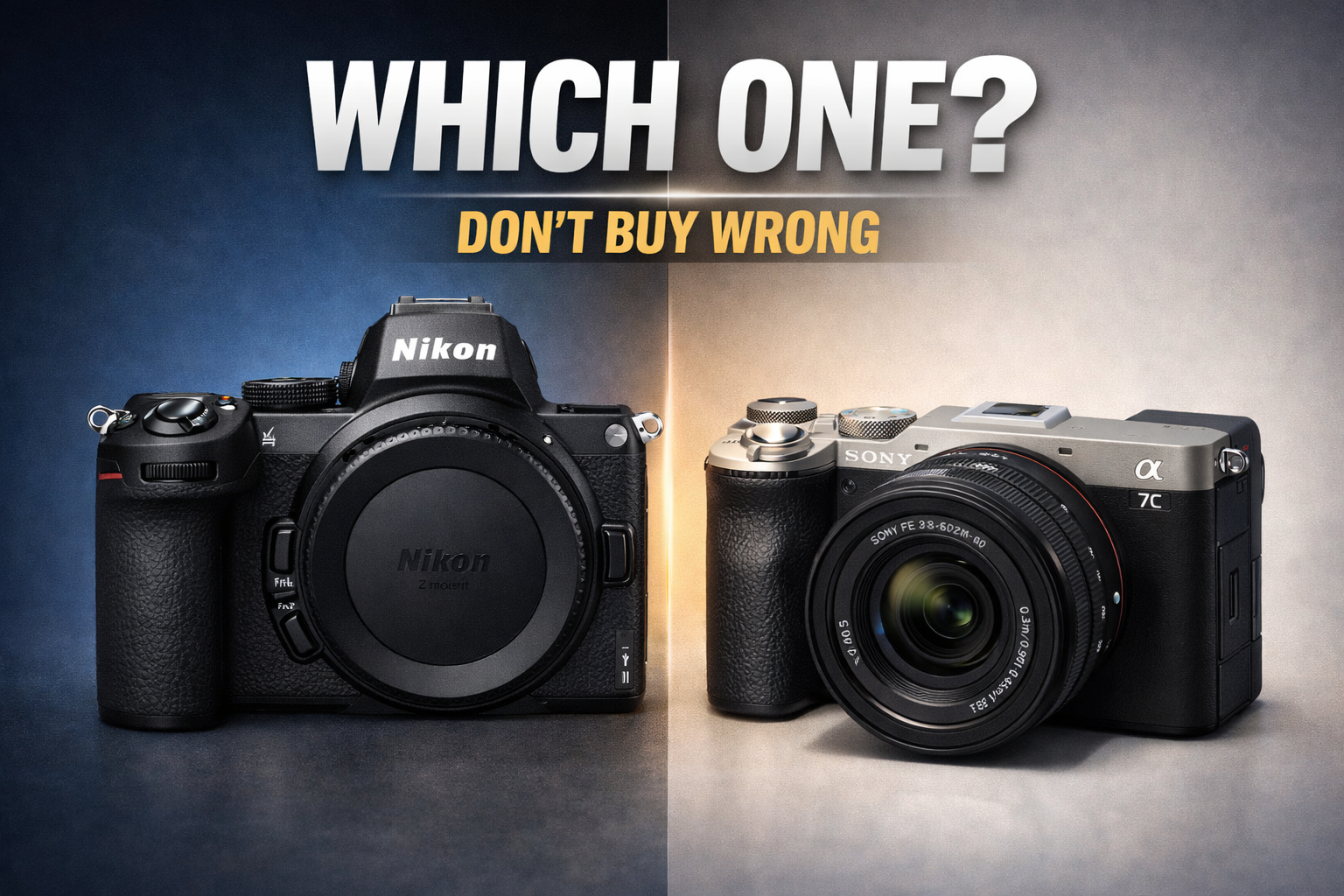
Quick Verdict: The Nikon Z5II vs Sony A7C II decision splits on value versus versatility. Specifically, the Z5II ($1,699) wins on price, IBIS performance (7.5 stops), dual card slots, and EVF brightness (3,000 nits). In contrast, the A7C II ($2,199) wins on resolution (33MP vs 24.5MP), autofocus coverage (759 points vs 299), uncropped 4K/60p video, portability (186g lighter), and battery life (510+ shots vs 330). Both are available used on MPB for significant savings, making this full-frame mirrorless comparison one where neither camera is a wrong choice.
Last updated: March 2026 | 10 min read
In This Comparison
- Nikon Z5II vs Sony A7C II: Overview
- Side-by-Side Specs Comparison
- Sensor, Resolution, and Image Quality
- Autofocus Performance Head-to-Head
- Video Capabilities
- IBIS, Battery Life, and Ergonomics
- Lens Ecosystem: Z-Mount vs E-Mount
- Pros and Cons
- Final Verdict: Who Should Buy Which
- Frequently Asked Questions
Nikon Z5II vs Sony A7C II: Overview
The Nikon Z5II vs Sony A7C II matchup is the most important decision in the entry-level full-frame camera market right now. Both cameras target hybrid shooters who want full-frame quality without the bulk or price of flagship bodies. However, they approach the problem from opposite directions, and the $500 price gap between them makes this full-frame mirrorless comparison more nuanced than raw spec sheets suggest.
Nikon released the Z5II in early 2025 as a dramatic upgrade over the original Z5. Notably, the Nikon Z5II specs include EXPEED 7 processing, 7.5-stop IBIS, 299-point AF, and uncropped 4K/30p video. Sony, meanwhile, launched the A7C II in late 2023 with its 33MP sensor, 759-point AF, and uncropped 4K/60p capability. As a result, both cameras represent the current best entry-level full-frame options from their respective manufacturers.
If you want the best mirrorless camera as a beginner with full-frame quality, this Nikon Z5II vs Sony A7C II breakdown will help you decide. Each camera excels in specific shooting scenarios, so the right choice depends entirely on your priorities and budget.
Side-by-Side Nikon Z5II vs Sony A7C II Specs
| Feature | Nikon Z5II | Sony A7C II |
|---|---|---|
| Sensor | 24.5MP Full-Frame BSI-CMOS | 33MP Full-Frame Exmor R BSI-CMOS |
| Processor | EXPEED 7 | BIONZ XR |
| AF Points | 299 (phase detection) | 759 (phase detection) |
| IBIS | 7.5 stops + Focus Point VR | 7 stops + Active Mode |
| Video | 4K/30p uncropped, 4K/60p (1.5x crop) | 4K/60p uncropped, 4K/30p oversampled |
| Video Codecs | N-RAW, N-Log, 10-bit | S-Log3, S-Cinetone, 10-bit 4:2:2 |
| EVF | 3.69M dots, 3,000 nits | 2.36M dots |
| Screen | 3.2″ articulating, 2.1M dots | 3.0″ articulating |
| Card Slots | Dual SD UHS-II | Single SD UHS-II |
| Battery (CIPA) | 330 shots | 510-540 shots |
| Weight | 700g (with battery) | 514g (with battery) |
| Price (New) | $1,699 | $2,199 |
| Price (Used, MPB) | From ~$1,400 | From ~$1,959 |
Both Available on MPB
Save on the Z5II or A7C II with 6-Month Warranty
Buy used and save hundreds on either body. Trade in your current camera for credit toward an upgrade.
Sensor and Image Quality in the Nikon Z5II vs Sony A7C II

Resolution is the first area where the Sony A7C II specs pull ahead. Its 33MP sensor provides an 8-megapixel advantage over the Nikon Z5II’s 24.5MP chip. In practical terms, this means larger print sizes, more aggressive cropping headroom, and sharper detail in landscapes and product photography. If you regularly crop images for social media or need prints above 20×30 inches, the Sony’s resolution advantage is meaningful.
The Nikon Z5II specs tell a different story in dynamic range and high-ISO performance, however. Its 24.5MP sensor paired with EXPEED 7 processing delivers clean files through ISO 6,400 and usable output to ISO 12,800. Because fewer pixels sit on the same sensor size, each pixel collects more light. Consequently, the Z5II holds a slight edge in noise performance above ISO 3,200. For event photographers and low-light shooters, that trade-off favors the Nikon in this full-frame mirrorless comparison.
Color science differs between the two brands, too. Sony’s color accuracy has improved dramatically since the A7 III era, and the A7C II now delivers natural skin tones without heavy editing. Meanwhile, Nikon’s warm rendering remains a favorite among portrait photographers who prefer less time in post-processing. I’d give a slight nod to Nikon here for out-of-camera color, especially in mixed lighting at events.
Autofocus Performance: Nikon Z5II vs Sony A7C II
Autofocus is where the gap in this Nikon Z5II vs Sony A7C II comparison widens in Sony’s favor. The Sony A7C II specs include 759 phase-detection points covering 94% of the frame. By comparison, the Z5II uses 299 points. Sony’s AI-powered subject detection also recognizes people, animals, birds, insects, cars, trains, and airplanes with accuracy refined through multiple firmware generations.
Where the Nikon Z5II fights back is low-light AF performance. Its detection range extends to -10 EV, a substantial improvement over the original Z5’s -4.5 EV. In dimly lit venues, churches, and indoor events, the Z5II acquires focus reliably in conditions where many other cameras hunt. Additionally, it offers 3D Tracking and 9 subject-detection categories that work well for unpredictable movement.
Video-focused shooters should weigh this carefully in the Nikon Z5II vs Sony A7C II comparison. The Sony’s 495-point video AF with real-time tracking gives it a clear lead for motion work. Features like Auto Framing, Breathing Compensation, and Focus Map add polish that solo video creators need. While the Nikon’s video AF performs respectably, Sony’s years of refinement show in the smoothness and reliability of focus transitions during recording.
Video: Where the Nikon Z5II vs Sony A7C II Gap Widens
Video capability is the area where the $500 price difference between these cameras starts to look justified. The Sony A7C II records 4K/60p from a full-width sensor readout with no crop. The Nikon Z5II shoots 4K/30p uncropped, but stepping up to 4K/60p introduces a 1.5x crop that noticeably narrows the field of view. For wide-angle video work, this crop factor is a deal-breaker.
Both cameras offer professional-grade color grading options, fortunately. Sony provides S-Log3 and S-Cinetone in 10-bit 4:2:2 color. Nikon, in contrast, offers N-Log and 12-bit N-RAW internal capture. If you already edit in DaVinci Resolve or Final Cut, both codecs integrate smoothly into existing workflows. The Sony’s S-Cinetone profile produces broadcast-ready color with minimal grading, which saves considerable time on quick-turnaround projects.
Trade In Your Old Gear
Upgrade to Full-Frame for Less on MPB
Get an instant quote for your current camera. Apply the credit toward a Z5II or A7C II. Free shipping included.
Here is the bottom line on video in this Nikon Z5II vs Sony A7C II face-off: if 4K/60p matters to your work, the Sony is the clear choice. Photographers who shoot occasional video at 4K/30p will find the Nikon Z5II delivers excellent quality with the added benefit of N-RAW for maximum post-production flexibility.
IBIS, Battery Life, and Ergonomics

Stabilization is one area where the Nikon Z5II specs genuinely impress. Its 7.5-stop IBIS with Focus Point VR edges ahead of the Sony A7C II’s 7-stop system. In practice, the Nikon holds steady at shutter speeds as slow as 1/5 second handheld. For photographers working in low light without a tripod, especially at focal lengths above 50mm, this extra stabilization is noticeable and practical.
Battery life, on the other hand, tilts heavily toward the Sony in this full-frame mirrorless comparison. The A7C II’s NP-FZ100 battery delivers 510-540 shots per CIPA rating, with real-world usage often exceeding 1,000 shots per charge. The Z5II’s EN-EL15c manages 330 shots CIPA, which is frankly disappointing for a 2025 release. As a result, all-day event shooters or extended video sessions will require spare batteries with the Nikon.
Weight and ergonomics split along predictable lines. The Sony weighs 514g with battery compared to the Nikon’s 700g, and that 186g difference adds up during a full day of handheld shooting or travel photography. Conversely, the Nikon’s larger body provides a deeper grip and a bigger EVF at 3.69M dots and 3,000 nits. If you have larger hands or prioritize viewfinder quality above all else, the Z5II feels substantially better to hold and shoot with.
Lens Ecosystem: Z-Mount vs E-Mount
The lens ecosystem remains Sony’s biggest structural advantage in the Nikon Z5II vs Sony A7C II decision. Sony’s E-mount offers hundreds of native lenses from Sony, Sigma, Tamron, and other third-party manufacturers. Whether you need a $200 prime or a $2,000 professional zoom, the E-mount library covers it with multiple options at every focal length and price point.
Nikon’s Z-mount is growing, and the native glass Nikon produces is optically excellent. Still, third-party support remains more limited compared to Sony. Tamron and Sigma have expanded their Z-mount offerings throughout 2025, but the overall selection stays narrower. For photographers who want affordable third-party options, Sony’s ecosystem therefore provides more flexibility at every price point.
Existing lens investments matter here, too. If you already own Nikon F-mount lenses, the FTZ II adapter provides full compatibility with the Z5II. Similarly, photographers already invested in Sony E-mount glass benefit from seamless backward compatibility with the A7C II. Starting fresh with no existing lenses? Sony’s broader ecosystem gives you more room to build a versatile kit over time, and that long-term flexibility is worth considering in any Nikon Z5II vs Sony A7C II purchasing decision.
Pros and Cons
Nikon Z5II Strengths
- $500 less than the A7C II at $1,699 vs $2,199 new
- 7.5-stop IBIS with Focus Point VR outperforms in stabilization testing
- Dual SD UHS-II card slots for professional backup and overflow
- 3.69M-dot EVF at 3,000 nits brightness is the best in its class
- 12-bit N-RAW internal recording for maximum post-production flexibility
- AF detection to -10 EV for reliable low-light focus acquisition
Nikon Z5II Weaknesses
- 24.5MP resolution limits cropping headroom and large-format printing
- 4K/60p applies a 1.5x crop, noticeably narrowing the field of view
- 330-shot CIPA battery life requires carrying spare batteries for any full day
- Smaller Z-mount lens ecosystem with fewer third-party options
- Heavier at 700g compared to the A7C II’s 514g
Sony A7C II Strengths
- 33MP resolution provides 8MP advantage for cropping and large prints
- 759 AF points with AI subject detection covering 94% of the frame
- Uncropped 4K/60p video with 10-bit 4:2:2 and S-Cinetone
- 514g body weight makes it one of the most compact full-frame cameras
- 510-540 shot battery life handles all-day shooting with ease
- Massive E-mount lens ecosystem with affordable third-party options at every focal length
Sony A7C II Weaknesses
- $2,199 price tag is $500 more than the Z5II
- Single SD card slot provides no backup redundancy for paid work
- 7-stop IBIS measures 0.5 stops below the Z5II’s stabilization
- 2.36M-dot EVF is noticeably lower resolution than the Z5II’s 3.69M
- Smaller body grip feels cramped for photographers with larger hands
Final Verdict: Nikon Z5II vs Sony A7C II
After comparing every major specification and real-world implication, the Nikon Z5II vs Sony A7C II comparison does not produce a single winner. Instead, each camera dominates in specific use cases, and your shooting priorities determine the better buy.
Choose the Nikon Z5II ($1,699 new, from ~$1,400 on MPB) if you value IBIS performance, dual card slots, EVF quality, and the $500 savings. Photographers who shoot events, portraits, and low-light work will especially appreciate the Z5II’s stabilization and AF sensitivity. Moreover, the lower price leaves more budget for glass, which often matters more than the body itself in this full-frame mirrorless comparison.
Choose the Sony A7C II ($2,199 new, from ~$1,959 on MPB) if you need uncropped 4K/60p video, higher resolution, superior AF coverage, and a compact full-frame body for travel. Hybrid creators and anyone invested in or planning to build a Sony lens collection will benefit from the A7C II’s strengths and ecosystem. The Sony A7C II specs earn the premium for video-first shooters, specifically.
Buying either camera used on MPB saves hundreds and includes a 6-month warranty. Consequently, the $500 price gap narrows on the used market, which makes the Nikon Z5II vs Sony A7C II choice even tighter for budget-conscious photographers. Check our guide to the best Nikon cameras or best Sony cameras for more options in each system.
Ready to Decide?
Compare Z5II and A7C II Prices on MPB
Used gear with 6-month warranty. Trade in your current camera for credit. Free shipping on all orders.
Frequently Asked Questions
Is the Nikon Z5II better than the Sony A7C II for photography?
It depends on your priorities. The Nikon Z5II vs Sony A7C II comparison favors the Nikon for value ($500 less), IBIS performance (7.5 stops), dual card slots, and EVF quality. Conversely, the A7C II delivers higher resolution (33MP), more AF points (759), and a lighter body. For budget-conscious photographers who prioritize stabilization, the Nikon wins. For resolution-demanding work, the Sony leads.
Which camera has better autofocus, the Z5II or A7C II?
The Sony A7C II has broader AF coverage with 759 points versus the Z5II’s 299. Sony’s AI subject detection is also more refined after multiple firmware generations. However, the Nikon Z5II focuses reliably down to -10 EV, giving it an edge in very low light. For most daytime and well-lit shooting, the A7C II’s AF system is more capable overall.
Does the Nikon Z5II or Sony A7C II shoot better video?
The Sony A7C II wins on video specifications in this full-frame mirrorless comparison. It records 4K/60p without a crop, supports 10-bit 4:2:2, and includes S-Cinetone for ready-to-use cinematic color. The Z5II’s 4K/60p applies a 1.5x crop, making it impractical for wide-angle video work. Notably, the Z5II’s 12-bit N-RAW capture offers superior post-production flexibility for color grading. If you shoot primarily at 4K/30p, both cameras deliver excellent results.
What improved from the original Z5 to the Z5II?
The Nikon Z5II specs improved in nearly every area: significantly faster AF with detection to -10 EV (vs -4.5 EV), 14fps raw burst (vs 4.5fps), 7.5-stop IBIS (vs 5 stops), uncropped 4K/30p video, N-RAW/N-Log support, a 3,000-nit EVF (vs 1,000 nits), and a fully articulating screen replacing the tilt-only design. The processor jumped from EXPEED 6 to EXPEED 7.
How much do the Nikon Z5II and Sony A7C II cost on MPB?
MPB pricing varies by condition, but the Nikon Z5II typically starts around $1,400 used and the Sony A7C II from approximately $1,959. Both include MPB’s 6-month warranty and free shipping. Trading in your current camera applies credit toward the purchase, which reduces out-of-pocket cost further.
Which entry-level full-frame camera has the better lens ecosystem?
Sony’s E-mount offers a significantly larger lens library with more third-party options from Sigma, Tamron, and others. As a result, the A7C II gives you more flexibility at every price point when building a kit. Nikon’s Z-mount glass is optically excellent, and third-party support is expanding, but the selection remains narrower. If affordable lens variety is your top priority, the Sony wins this part of the Nikon Z5II vs Sony A7C II comparison.

