


Quick Verdict: Blue hour photography produces more dramatic, cinematic images than golden hour in most landscape and travel scenarios. The 20-40 minute window after sunset delivers saturated sky colors, even foreground lighting, and zero harsh shadows. You need a tripod, a white balance setting between 3500K and 4500K, and the patience to stay 23 extra minutes past sunset.
Last updated: April 2026 | 8 min read
In This Article
- Blue Hour Photography Overview
- What is Blue Hour (and When Does It Happen)?
- Key Facts at a Glance
- The 23-Minute Test: Golden Hour vs Blue Hour
- Blue Hour Camera Settings
- Blue Hour White Balance: Settings and Strategy
- Timing Your Blue Hour Window
- Golden Hour vs Blue Hour: Which Produces Better Photos?
- When to Choose Blue Hour Over Golden Hour
- Final Verdict
- Frequently Asked Questions
Blue Hour Photography: The Best Light You Keep Missing
Every photographer knows golden hour. It gets all the Instagram posts, all the YouTube tutorials, and all the attention. However, blue hour photography delivers results golden hour struggles to match, and most photographers miss it because they pack up too early.
I shoot landscapes and travel content across Southern California, and over 17 years behind the camera, I have tested this theory hundreds of times. After using Nikon, Sony, Panasonic, and now Canon systems, one thing stayed consistent across every body and every lens: the light after sunset regularly outperforms the light during sunset. The sky shifts from warm orange into vivid pinks, purples, and deep blues. Shadows disappear. Your foreground and background start working together instead of competing.
This article breaks down blue hour photography with real photos I took 23 minutes apart from the same tripod, at the same location, using a Canon R5 with the RF 15-35mm f/2.8. You will see the difference between golden hour, the pink transition window, and full blue hour. More importantly, you will walk away with the specific camera settings, white balance numbers, and timing strategy to start capturing these shots on your next outing.
What is Blue Hour (and When Does It Happen)?
Blue hour is the period of twilight after sunset (or before sunrise) when the sun sits between 4 and 8 degrees below the horizon. During this window, the atmosphere scatters shorter blue wavelengths of light more efficiently than longer red wavelengths. As a result, the entire sky takes on a deep blue or purple tone, and indirect light creates an even, shadow-free illumination across your scene.
So when is blue hour? It begins roughly 20-30 minutes after sunset and lasts between 20 and 40 minutes depending on your latitude and the time of year. At mid-latitudes (like Southern California at 34 degrees north), you typically get 25-30 minutes of shootable blue hour light during spring and fall. Locations closer to the equator see shorter blue hour windows. Conversely, locations at higher latitudes, like Norway or Iceland, experience extended blue hours lasting 45 minutes or longer during certain seasons.
The transition between golden hour and blue hour is not a hard cutoff. Instead, a 10-15 minute “pink window” sits between the two phases. This transition period often produces the most saturated sky colors of the entire evening, specifically because the low sun angle refracts warm light through more atmosphere while the upper sky has already shifted blue. For this reason, I recommend staying in position from the last 15 minutes of golden hour through at least 30 minutes after sunset to capture all three phases.
Key Facts at a Glance
| Detail | Value |
|---|---|
| Blue Hour Start | 20-30 minutes after sunset |
| Duration | 20-40 minutes (latitude dependent) |
| Sun Position | 4-8 degrees below horizon |
| Recommended White Balance | 3500K – 4500K (manual Kelvin) |
| Typical Shutter Speed | 2-15 seconds on tripod |
| Recommended Aperture | f/8 – f/11 for landscapes |
| ISO Range | 100-800 (tripod), 1600-6400 (handheld) |
| Tripod Required? | Strongly recommended |
| Best Seasons | Spring and Fall (longer transitions) |
The 23-Minute Test: Golden Hour vs Blue Hour
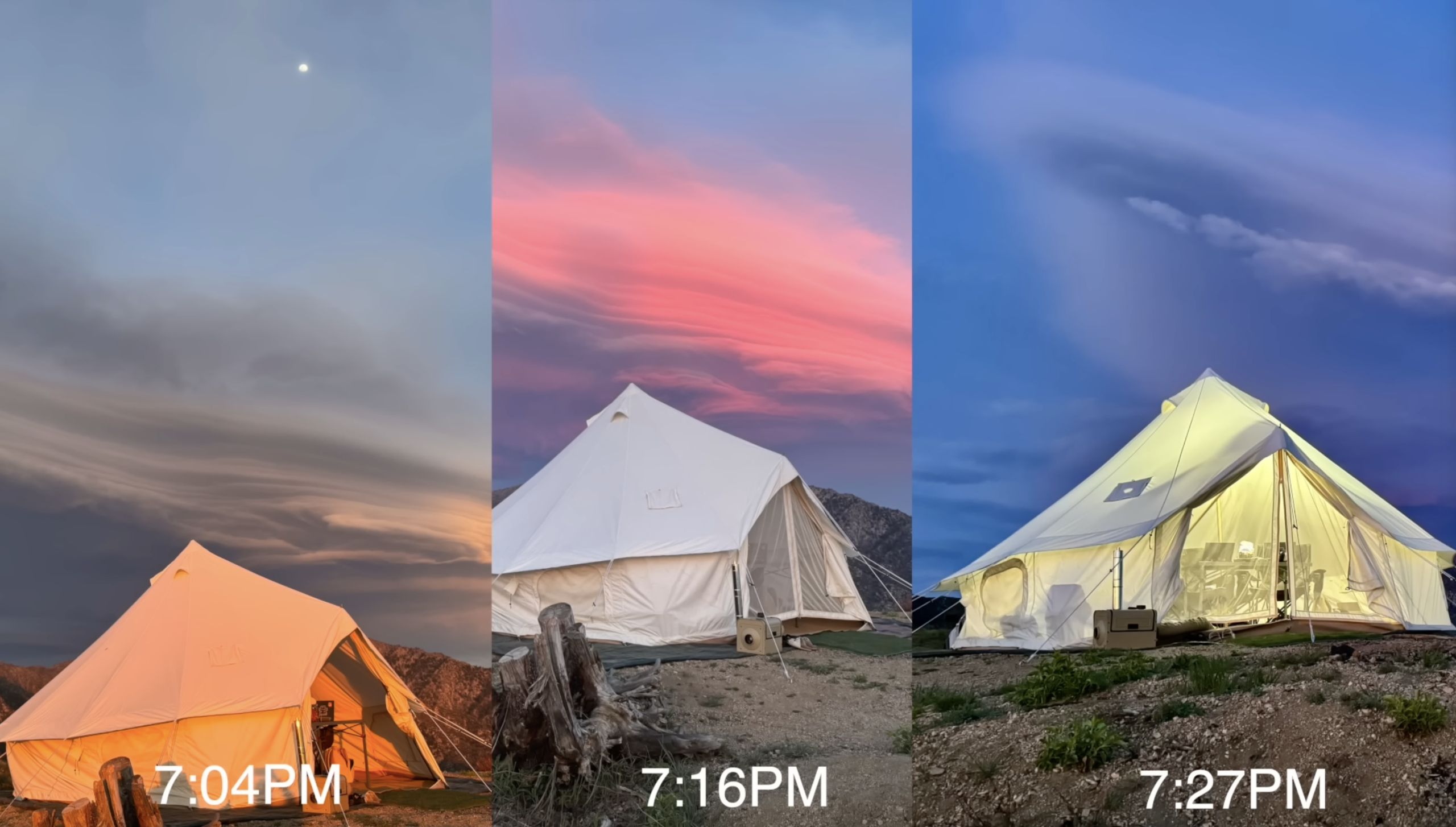
Numbers on a chart are one thing. Seeing the difference in real photos is another. I ran a simple test a couple weeks ago while shooting at a campsite in the Southern California mountains. My setup was a Canon R5 on a tripod, framed a bell tent against the mountain range, and fired the shutter three times over 23 minutes. Nothing else changed. Same composition, same lens (RF 15-35mm f/2.8), same tripod position.

The first image, taken at 7:04pm, shows classic golden hour light. Warm tones hit the tent and the mountains. Solid image. If you posted this to Instagram, people would engage with it. However, this is where most photographers stop. The sun drops, the instinct kicks in, and gear starts going into bags.

At 7:16pm, twelve minutes later, the entire sky lit up pink and purple. The tent shifted from warm orange to clean white, contrasting against the saturated sky instead of blending into it. Meanwhile, the mountain picked up a cooler, moodier tone. Identical location. Same composition. Stronger image.

At 7:27pm, full blue hour. The sky shifted into layered blues and purples with a painted quality you never see during golden hour. Interior light made the tent glow, the moon appeared in the upper frame, and the whole scene felt cinematic. Consequently, the difference between these three images is not gear, skill, or post-processing. It is 23 minutes of patience.
Blue Hour Camera Settings
Blue hour photography only works if your exposure keeps up with the fading light. Your blue hour camera settings need to account for roughly 3-5 stops less light than golden hour. If you shoot on a tripod (and you should), the fix is straightforward: slow your shutter speed.
Shooting on a Tripod

Start at ISO 100, your sharpest aperture (f/5.6 to f/11 for most lenses, with f/8 being a reliable starting point), and let the shutter speed float. During early blue hour, you will likely need 2-4 second exposures. As the light continues to drop, expect 8-15 seconds toward the end of the blue hour window. Use a 2-second shutter delay or a remote trigger to eliminate camera shake. Specifically, even pressing the shutter button introduces vibration at these slow speeds.
On the Canon R5, I use Manual mode with Auto ISO turned off. I set the aperture to f/8, start with a 2-second exposure, and adjust upward every few minutes as light fades. Because the light changes continuously during blue hour, checking your histogram between shots keeps your exposure accurate.
Shooting Handheld
Without a tripod, ISO becomes your primary trade-off tool. Modern mirrorless cameras like the Canon R5, Sony A7 IV, and Nikon Z8 handle ISO 3200-6400 cleanly, which means you should widen your aperture to f/2.8 or beyond and keep shutter speeds at 1/30s or faster. In-body image stabilization stretches your options further. The Canon R5, for example, delivers up to 8 stops of IBIS when paired with stabilized RF lenses, letting you shoot at 1/8s handheld with steady technique. Even so, a tripod produces sharper results at these light levels every time.
Blue Hour White Balance: Settings and Strategy
Auto white balance fights you during blue hour. Your camera’s AWB system sees the cool blue tones and tries to warm them up, neutralizing the colors you want to preserve. Therefore, switching to manual Kelvin white balance gives you full control over the mood of your blue hour photography.
Set your white balance between 3500K and 4500K. At 3500K, you get deeper, cooler blues with a moody atmosphere. Pushing up to 4500K retains some warmth while still showing the blue shift. I typically start at 4000K and adjust the white balance based on the specific sky conditions.
If you shoot RAW (and you should for any blue hour session), blue hour white balance is fully adjustable in post-processing. Nonetheless, setting it close to your target in-camera gives you a more accurate preview on the LCD and histogram. This matters because at blue hour light levels, your LCD is often the only way to evaluate the shot in the field. A wildly incorrect white balance preview leads to bad exposure decisions.
Timing Your Blue Hour Window
Blue hour is short. Unlike golden hour, which gives you roughly 60 minutes of workable light, blue hour offers 20-40 minutes depending on your location and time of year. Planning your blue hour photography ahead of time makes the difference between capturing the peak colors and showing up too late.
Apps like PhotoPills, The Photographer’s Ephemeris, and Sun Surveyor calculate exact blue hour start and end times for your GPS location on any date. These apps show you precisely when the sun reaches 4 degrees below the horizon (blue hour start) and 8 degrees below (blue hour end). I check PhotoPills before every landscape photography session and arrive at my location at least 30 minutes before sunset.
Arriving early serves two purposes. First, it gives you time to find your composition, set up your tripod, and dial in your settings while you still have plenty of light. Second, it lets you capture the golden hour and pink transition phases before blue hour begins. For the test images in this article, I was set up and shooting by 6:45pm, which gave me a full 42-minute sequence from golden light through deep blue hour.
Golden Hour vs Blue Hour: Which Produces Better Photos?
Choosing between golden hour and blue hour comes down to what you want in the final image. Golden hour produces warm, directional light with long shadows and a contrasty look. It works well for portraits, backlit subjects, and scenes where you want visible texture and depth. However, the strong directional light also creates harsh shadow-to-highlight transitions, especially in landscape scenes with uneven terrain.
Blue hour eliminates those problems. Because the light source is indirect (scattered through the atmosphere rather than coming from a single point), blue hour produces even illumination across your entire scene. Shadows disappear. Dynamic range drops significantly, meaning your camera captures both sky and foreground in a single exposure without graduated ND filters or HDR bracketing. Additionally, the saturated blue and purple sky tones create natural contrast against any warm artificial light in your scene, like the glowing tent in my test images.
For sunset and landscape photography, I reach for blue hour over golden hour at least 70% of the time. Even light, saturated colors, and cinematic atmosphere produce images with more visual impact and fewer exposure headaches.
When to Choose Blue Hour Over Golden Hour
After years of shooting both windows, I have a clear framework for deciding which one fits the scene in front of me.
Stay for Blue Hour When…
- You are shooting landscapes, cityscapes, or travel scenes where even lighting matters
- Your scene includes artificial light sources (buildings, tents, vehicles) because warm lights contrast dramatically against the cool blue sky
- You want saturated sky colors without graduated ND filters or HDR bracketing
- You have a tripod and arrived early enough to set your composition during golden hour
- The location is crowded during golden hour; most photographers leave after sunset, giving you a cleaner scene
- You want the moon or early stars as compositional elements in your frame
Stick with Golden Hour When…
- Portraits and wildlife benefit from warm, directional light and visible texture, which golden hour delivers better
- You need to move between multiple locations quickly since blue hour’s 20-40 minute window does not allow for relocation
- Your scene lacks interesting artificial light sources, which means blue hour removes contrast without adding anything new
- You do not have a tripod, and your camera’s high-ISO performance does not produce clean files above ISO 3200
- Your subject requires fast autofocus tracking, since low light slows AF acquisition on most bodies
Final Verdict
Blue hour photography deserves a permanent spot in your shooting routine. If you photograph landscapes, cityscapes, travel scenes, or anything with artificial light elements, the 20-40 minute window after sunset consistently produces more dramatic, more evenly lit, and more colorful results than golden hour alone.
The trade-off is preparation. You need a tripod, manual white balance (3500K-4500K), and the discipline to plan your arrival 30 minutes before sunset. Autofocus slows down in low light, so pre-focusing during golden hour and switching to manual focus before blue hour begins saves you from missed shots.
After 17 years of shooting across systems from Nikon to Canon, the lesson I keep re-learning is simple: the photographers who pack up at sunset miss the best light of the evening. My test images prove it. Three frames, 23 minutes apart, same tripod. The golden hour shot is good. But the blue hour shot is the one I would print and hang on a wall.
Next time you finish a golden hour session, do yourself a favor. Stay 20 more minutes. Watch the sky. Keep shooting. Blue hour photography rewards patience, and the results speak for themselves.
Frequently Asked Questions
What is blue hour in photography?
Blue hour is the twilight period after sunset (or before sunrise) when the sun sits 4-8 degrees below the horizon. During this 20-40 minute window, the sky turns deep blue and purple, indirect light eliminates harsh shadows, and the overall scene takes on a cool, cinematic tone. It is one of the most productive times for landscape and travel photography because the even lighting reduces dynamic range and saturates sky colors naturally.
When is the blue hour?
Blue hour begins roughly 20-30 minutes after sunset and lasts 20-40 minutes depending on your latitude and season. At mid-latitudes (30-45 degrees), you get about 25-30 minutes. Apps like PhotoPills and The Photographer’s Ephemeris calculate exact blue hour times for your location. During spring and fall, the transition is slower and gives you a longer shooting window.
What are the best camera settings for blue hour?
On a tripod: ISO 100, aperture f/8 to f/11, shutter speed 2-15 seconds depending on remaining light. Use a 2-second shutter delay to prevent vibration. Handheld: open your aperture to f/2.8 or wider, push ISO to 1600-6400, and aim for 1/30s or faster shutter speed. Manual white balance between 3500K and 4500K preserves the blue tones your auto white balance will try to correct.
What is the difference between golden hour and blue hour?
Golden hour delivers warm, directional light with visible shadows and a contrasty look. It happens during the last 60 minutes before sunset. Blue hour follows 20-30 minutes later and produces cool, indirect light with no shadows. Portraits and textured scenes work well during golden hour. Landscapes, cityscapes, and scenes with artificial light sources work better during blue hour because the cool sky contrasts against warm lights.
How do I get the best blue hour photos?
Arrive 30 minutes before sunset to scout your composition and set up while light is plentiful. Shoot through golden hour and the pink transition window so you capture all three phases. Use a tripod, switch to manual white balance at 4000K, and check your histogram between shots since the light drops rapidly. Pre-focus during golden hour, then switch to manual focus before blue hour begins. The entire sequence from golden hour through blue hour takes about 45 minutes.
Is shooting during blue hour better than golden hour?
For landscape, cityscape, and travel work, blue hour produces more dramatic results in most scenarios. Even lighting, saturated sky colors, and reduced dynamic range give you images with stronger visual impact and fewer technical challenges. Golden hour remains better for portraits and scenes where directional light and warm tones are the goal. Ideally, you shoot both by arriving early and staying through blue hour. Nailing your blue hour white balance at 3500K-4500K and knowing when is blue hour for your location are the two keys to consistent results.

