


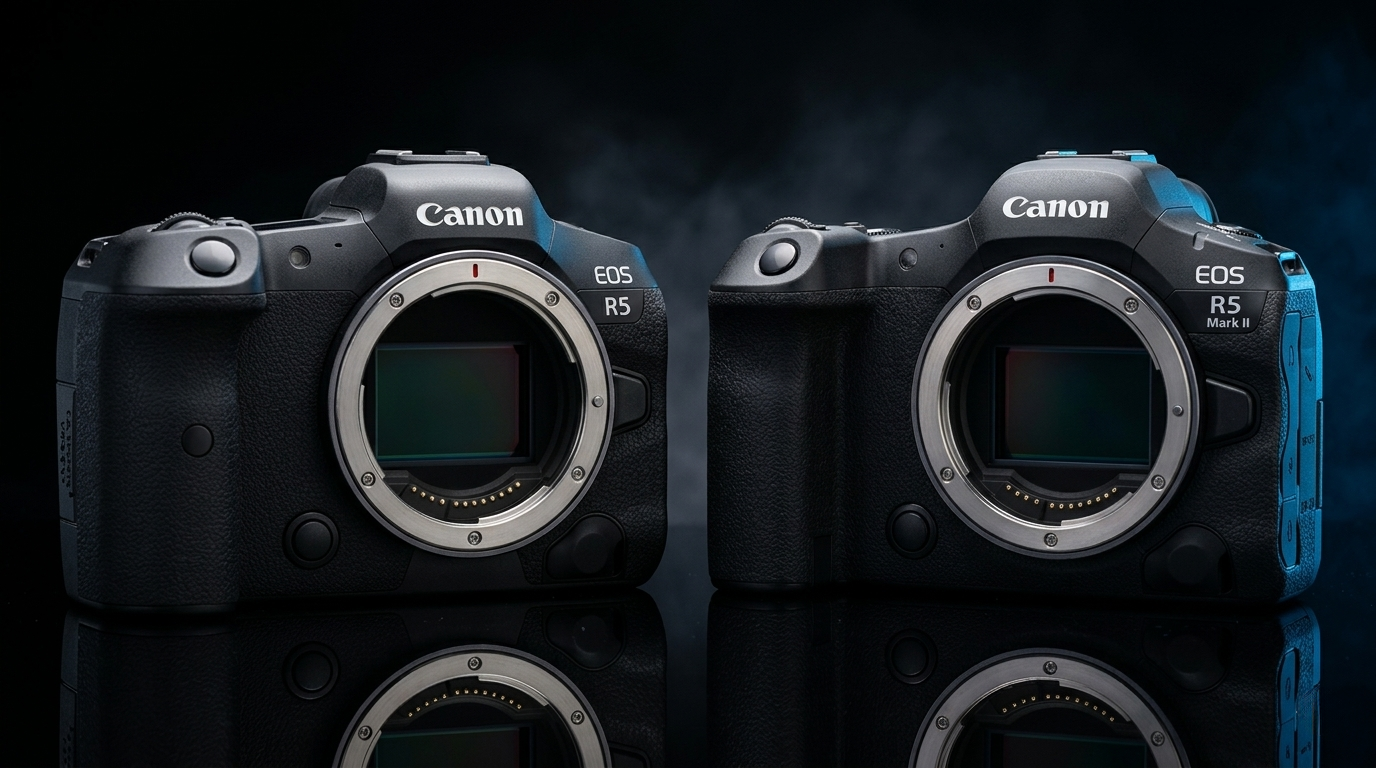
Quick Verdict: After five years of daily studio shooting, the Canon R5 vs R5 Mark II comparison comes down to one question: do you need 8K/60p and Eye Control AF? If not, the original R5 at $1,800-2,300 used on MPB delivers 95% of the imaging performance at roughly half the cost of the Mark II ($4,299 new). For video-heavy shooters who record long sessions, the Mark II’s active cooling system and stacked sensor solve real overheating problems. Everyone else benefits from an original R5 delivering one of the strongest full-frame mirrorless values in 2026.
Last updated: April 2026 | 10 min read
In This Review
- Why I Sold Everything for the Canon R5
- Canon R5 vs R5 Mark II: Full Specs Comparison
- Canon R5 Color Science: Five Years of Proof
- Canon R5 vs R5 Mark II Video Performance
- Autofocus and Burst Shooting
- What the R5 Mark II Adds
- Who Should Buy the Original R5 in 2026
- Pros and Cons
- Final Verdict
- Frequently Asked Questions
Why I Sold Everything for the Canon R5

I shot Nikon for 17 years. Landscapes, portraits, events, commercial work. My Nikon glass collection was extensive, my muscle memory locked into the Nikon ergonomic philosophy. However, I also shot Sony for video projects and owned a Panasonic GH5 for dedicated filmmaking. Three systems, three sets of batteries, three bag configurations. When Canon announced the EOS R5 in 2020, I saw something no other manufacturer offered: a single camera body combining 45-megapixel stills with 8K video recording and Canon’s legendary color rendering. Consequently, I sold every Nikon body, every Sony body, and the GH5. I went all-in on Canon’s RF ecosystem.
Five years later, was it the right call? Absolutely. This camera has been the most satisfying body I have ever owned across 26 years of professional photography. It handles landscapes with the resolution I need, shoots studio video with color accuracy requiring minimal grading, and focuses with precision surpassing anything my Nikon D850 or Sony A7R III delivered. Notably, when people ask whether the newer Mark II replaces the original, my answer surprises them: the R5 remains an extraordinary tool in 2026.
This Canon R5 review reflects five years of daily use, not a two-week press loan. I have shot weddings, studio product videos, landscape sessions in the Sierra Nevada, and corporate headshots with this body. My shutter count sits above 180,000 actuations, while Canon rates the R5 shutter at 500,000 cycles. Is the canon r5 still worth it after all those frames? Every single one confirmed the answer is yes. Consequently, this review covers real ownership: firmware updates, battery degradation, and the overheating controversy from year one.
Canon R5 vs R5 Mark II: Full Specs Comparison
Before exploring real-world performance, here is the full specification breakdown. These numbers come directly from Canon’s official documentation and reflect both current models as of 2026.
| Specification | Canon EOS R5 | Canon EOS R5 Mark II |
|---|---|---|
| Sensor | 45MP Full-Frame CMOS | 45MP Back-Illuminated Stacked CMOS |
| Processor | DIGIC X | DIGIC X + DIGIC Accelerator |
| Burst Rate (Electronic) | 20 fps | 30 fps |
| Burst Rate (Mechanical) | 12 fps | 12 fps |
| Max Video | 8K/30p RAW (~20 min limit) | 8K/60p RAW (8K/30p 120+ min with fan) |
| 4K Slow Motion | 4K/120p (cropped) | 4K/120p (full sensor readout) |
| IBIS | Up to 8 stops (with IS lens) | Up to 8.5 stops (with IS lens) |
| AF Low-Light Limit | -6 EV | -6.5 EV |
| Eye Control AF | No | Yes |
| Pre-Burst Capture | No | Yes (0.5 sec before shutter) |
| Rolling Shutter | Standard | Up to 40% less than R5 |
| Card Slots | CFexpress Type-B + SD UHS-II | CFexpress Type-B + SD UHS-II |
| Active Cooling | No | Optional fan accessory |
| Weight (body + battery) | ~738g | ~746g |
| Price (New) | Discontinued (~$2,799 clearance) | $4,299 |
| Price (Used on MPB) | $1,800 – $2,300 | $3,419 – $3,699 |
The spec sheet reveals a clear pattern: the R5 Mark II improves video recording duration, burst speed, and AF intelligence. However, the fundamental imaging DNA remains identical at 45 megapixels. For photographers shooting stills or short-form video clips, the original R5’s sensor delivers the same resolution and dynamic range at roughly half the cost.
Featured on MPB
Canon EOS R5 from $1,800
Used bodies in Excellent and Like New condition. Free 6-month warranty included with every purchase. Free shipping.
Canon R5 Color Science: Five Years of Proof
You hear photographers talk about Canon color science, and I will confirm: it is real and it delivers. After shooting Nikon for nearly two decades and dabbling with Sony’s color profiles, the R5 produces skin tones and natural color rendering requiring significantly less post-processing time. Specifically, my studio video workflow dropped from 45 minutes of color grading per project on the GH5 to roughly 15 minutes on the R5. Therefore, the camera’s color output looks correct straight from the sensor.
Testing published by PetaPixel in 2021 showed the R5 produces color accuracy surpassing several medium-format cameras costing three to four times as much. Across studio portrait sessions, outdoor landscape work, and product photography, my experience confirms this finding. Skin tones render warm and natural without adjustment. Similarly, greens in landscape shots maintain separation between subtle shade variations. Blue skies also transition smoothly from horizon to zenith without banding.
Compared to the R5 Mark II, recent testing reveals the original carries a slight red/warm cast in its color rendering. In contrast, the Mark II produces more neutral, balanced output. If you need clinical accuracy in commercial or fashion work, the Mark II addresses this concern. However, the R5’s warm rendering flatters portraits and landscapes without correction. I have shot over 200 studio video sessions with my Canon R5 used as my primary camera, and clients consistently comment on how polished the footage looks with minimal grading.
Canon R5 vs R5 Mark II Video Performance

Video is where the Canon R5 vs R5 Mark II gap widens most noticeably. The original launched with an overheating controversy: 8K recording limited to approximately 20 minutes before thermal shutdown. Canon addressed this through firmware updates, and in my studio (air-conditioned, 72°F), I consistently record 4K/60p for 45-60 minutes without overheating. Because I shoot 5-15 minute interview segments and product walkthroughs, the thermal limits have never interrupted a paid session.
The Mark II solves overheating definitively with an optional active cooling fan accessory and a stacked sensor design generating less heat during readout. Consequently, it records 8K/30p for over 120 minutes continuously with the fan accessory, and 8K/60p for extended sessions well beyond the original’s limits. It also shoots 4K/120p from the full sensor width (the original R5 crops at 4K/120p). Additionally, the Mark II adds 2K/240p for extreme slow motion.
Practical Video Differences for Working Photographers
Long-form content creators (weddings, conferences, live events) will appreciate the Mark II’s thermal headroom. Conversely, short-form studio creators, social media producers, and photographers with occasional video needs will find the original R5’s 4K capabilities more than sufficient. My 99% studio video use case has never required more output. Pairing the Canon RF 50mm f/1.2L with the R5 produces cinematic footage rivaling dedicated cinema cameras costing $6,000 or more.
Autofocus and Burst Shooting

The R5’s Dual Pixel CMOS AF II system covers 100% of the frame and tracks eyes, faces, and animals with consistent accuracy. After five years of firmware refinements, AF performance has improved noticeably since launch. Specifically, bird eye detection and vehicle tracking were added through firmware 1.5 and 1.6 updates. In practice, I achieve sharp focus on approximately 95% of frames when shooting moving subjects at 12fps mechanical shutter.
Meanwhile, the Mark II advances the AF system with Dual Pixel Intelligent AF, Eye Control AF (you select focus points by looking at subjects through the viewfinder), and improved subject recognition across more categories. It also focuses in light as dim as -6.5 EV, versus -6 EV on the original. Consequently, event photographers working in dark reception halls benefit from this half-stop improvement.
Burst shooting increases from 20fps (electronic) on the R5 to 30fps on the Mark II. Additionally, the Mark II adds pre-burst capture, recording 0.5 seconds of frames before you fully press the shutter. Wildlife and sports shooters gain a meaningful advantage from these features. However, portrait, landscape, and studio photographers will find 20fps on the original R5 exceeds practical requirements. If you are considering this Canon R5 review as a potential buyer, your shooting discipline determines whether 30fps matters at all.
Trade Up on MPB
Sell or Trade Your Old Gear
Get an instant quote for your current camera. Apply the value toward an R5 or R5 Mark II. Free insured shipping on trade-ins.
What the R5 Mark II Adds (and Whether It Matters)
Beyond the specs table, several practical differences between the two models affect daily shooting decisions:
First, the stacked sensor in the Mark II reduces rolling shutter distortion by up to 40%. If you shoot electronic shutter with fast-moving subjects or pan rapidly during video, this improvement eliminates the “jello effect.” However, studio and landscape shooters will find rolling shutter rarely presents problems on either body.
Second, Eye Control AF lets you select focus points by looking at subjects in the viewfinder. In practice, other photographers report mixed results depending on eye physiology and shooting glasses. Therefore, it works well for some and frustrates others. It is a convenience feature, not a necessity.
Third, the DIGIC Accelerator co-processor enables computational photography features including in-camera upscaling and advanced noise reduction. These processing improvements specifically help photographers who deliver JPEGs directly or shoot in challenging light without post-processing RAW files. Is canon r5 still worth it without these features? For RAW shooters who process in Lightroom or Capture One, the answer is yes because these in-camera processing features become irrelevant.
Who Should Buy the Original Canon R5 in 2026

The Canon R5 used market offers extraordinary value for specific shooter profiles. At $1,800-2,300 on MPB, the original makes sense for portrait and wedding photographers needing 45MP resolution with reliable AF tracking. Similarly, landscape shooters wanting IBIS, high resolution, and weather sealing benefit from this price point. Studio video creators producing short-form content under 30 minutes per clip also get excellent performance. Additionally, photographers upgrading from older Canon bodies (5D Mark IV, EOS R, R6) gain a meaningful resolution and feature jump without spending $4,299.
Conversely, the Mark II justifies its $4,299 price tag for videographers recording long-form content requiring extended record times. Wildlife and sports shooters also benefit from 30fps and pre-burst capture at this price tier. Commercial video professionals who need 8K/60p or full-width 4K/120p will appreciate the thermal improvements. If your work does not fall into these categories, is Canon R5 still worth it over the Mark II? Absolutely, because the original delivers the same 45MP image quality at roughly half the investment.
Pros and Cons
Pros
- 45MP sensor delivers gallery-quality files at ISO 100-3200
- Canon color science reduces post-processing time by 50-70% versus competitors
- 8-stop IBIS enables handheld shooting at 1/4 second for stills
- Dual Pixel AF tracks eyes, animals, and vehicles across 100% of frame
- 4K/60p and 4K/120p video with 10-bit C-Log output
- CFexpress + SD dual slot covers speed and backup needs
- Weather-sealed magnesium alloy body survives 180,000+ actuations
- Used prices ($1,800-2,300) represent half the Mark II cost for 95% of the imaging quality
Cons
- 8K recording limited to ~20 minutes before thermal shutdown in warm conditions
- 4K/120p applies a 1.6x crop, limiting wide-angle video capabilities
- 45MP files average 50-60MB per RAW, demanding fast storage and large drives
- CFexpress Type-B cards cost $150-300 for quality options
- Battery life rated 320 shots CIPA; real-world mixed shooting yields 500-700 per charge
- No active cooling option (Mark II accessory does not fit the original)
Final Verdict
After five years and over 180,000 shutter actuations, the R5 remains one of the finest cameras I have ever used. It is the camera convincing me to sell 17 years of Nikon glass, and I have never once regretted switching. The combination of 45MP stills, reliable AF tracking, 8-stop IBIS, and Canon’s color rendering creates a shooting experience few systems match even today.
Value and Recommendation
At $1,800-2,300 on MPB with a 6-month warranty included, the original R5 represents one of the strongest values in the full-frame mirrorless market. You get a camera surpassing most competitors in color accuracy, matching them in resolution, and delivering video performance exceeding dedicated cinema cameras from five years ago. Notably, the Nikon Z7 II offers comparable resolution at a similar Canon R5 used price, but it does not match the video capabilities or AF subject tracking variety.
Ultimately, choosing between these two Canon bodies comes down to your shooting discipline. Video professionals recording long-form content benefit from the Mark II’s thermal improvements. Everyone else gets 95% of the experience at roughly 50% of the price by purchasing used. My one piece of direct advice: pair this camera with quality RF glass, because the sensor resolves detail a lesser lens will limit. Start with the Canon RF 50mm f/1.2L or the RF 24-70mm f/2.8L for maximum optical performance.
Ready to Buy?
Canon R5 on MPB from $1,800
Every used camera includes a 6-month warranty, free shipping, and MPB’s quality grading system. Returns accepted within 14 days.
Frequently Asked Questions
Is the Canon R5 still worth buying in 2026?
Yes. After five years, the R5 delivers 45MP resolution, 8K video, 8-stop IBIS, and Dual Pixel AF for $1,800-2,300 used. Is canon r5 still worth it at those prices? Without question. Image quality has not degraded since launch, and firmware updates have improved AF tracking and thermal management. For photographers who do not need 8K/60p or 30fps burst, the original R5 remains a top-tier full-frame mirrorless option at a fraction of its original $3,899 MSRP.
What is the biggest difference between the Canon R5 and R5 Mark II?
The stacked back-illuminated sensor in the R5 Mark II enables 8K/30p recording for 120+ minutes with the fan accessory (versus ~20 minutes on the original), 30fps electronic shutter burst (versus 20fps), Eye Control AF, and up to 40% less rolling shutter. For stills-focused photographers, image quality differences are minimal since both share 45MP resolution.
Does the Canon R5 overheat during video recording?
In 8K mode, the R5 limits recording to approximately 20 minutes in warm conditions. At 4K/60p, most users report 45-60+ minutes of continuous recording in air-conditioned environments. Multiple firmware updates since launch improved thermal management. For studio and short-form video work, overheating rarely interrupts sessions.
Pricing and Upgrade Questions
How much does a used Canon R5 cost on MPB in 2026?
Used R5 bodies on MPB range from $1,800 to $2,300 depending on condition grade (Good, Excellent, Like New). Every purchase includes a free 6-month warranty and free shipping. The R5 Mark II runs $3,419-3,699 used on the same platform.
Should I upgrade from the Canon R5 to the R5 Mark II?
Upgrade if you record video longer than 30 minutes regularly, shoot sports or wildlife requiring 30fps and pre-burst, or need full-sensor 4K/120p. If your work primarily involves stills, studio video, or short-form content, the original R5 delivers equivalent image quality, and the $2,000+ upgrade cost is better spent on quality RF glass.
How does Canon R5 color science compare to Sony and Nikon?
Canon’s color rendering produces warm, natural skin tones requiring less grading time than Sony’s cooler output or Nikon’s slightly flatter profiles. After switching from Nikon to Canon five years ago, my average color correction time per image dropped by roughly 60%. For video, Canon’s C-Log profile provides excellent dynamic range while maintaining pleasing skin tone rendering straight from the camera.
Editorial disclosure: This article contains affiliate links to MPB. All opinions and experiences in this review reflect five years of personal daily use.

