



Quick Verdict: The Canon EOS M50 review reveals a camera built for beginner photographers and video creators. This mirrorless body delivers 24.1MP images, fast Dual Pixel autofocus, and 4K video at $500-700 used. The main trade-off: the EF-M mount is discontinued, so expansion depends on adapted Canon EF glass or transitioning to RF-mount systems.
Last updated: April 2026 | 9 min read
In This Review
- Canon EOS M50 Overview: Where It Stands in 2026
- Key Specs at a Glance
- Design and Build Quality
- Ease of Use for Beginners
- Image Quality and Autofocus Performance
- Video Capabilities
- Lens Ecosystem and Expandability
- Canon M50 Worth It 2026: Versus Newer Options
- Pros and Cons
- Final Verdict
- Frequently Asked Questions
Canon EOS M50 Overview: Where It Stands in 2026
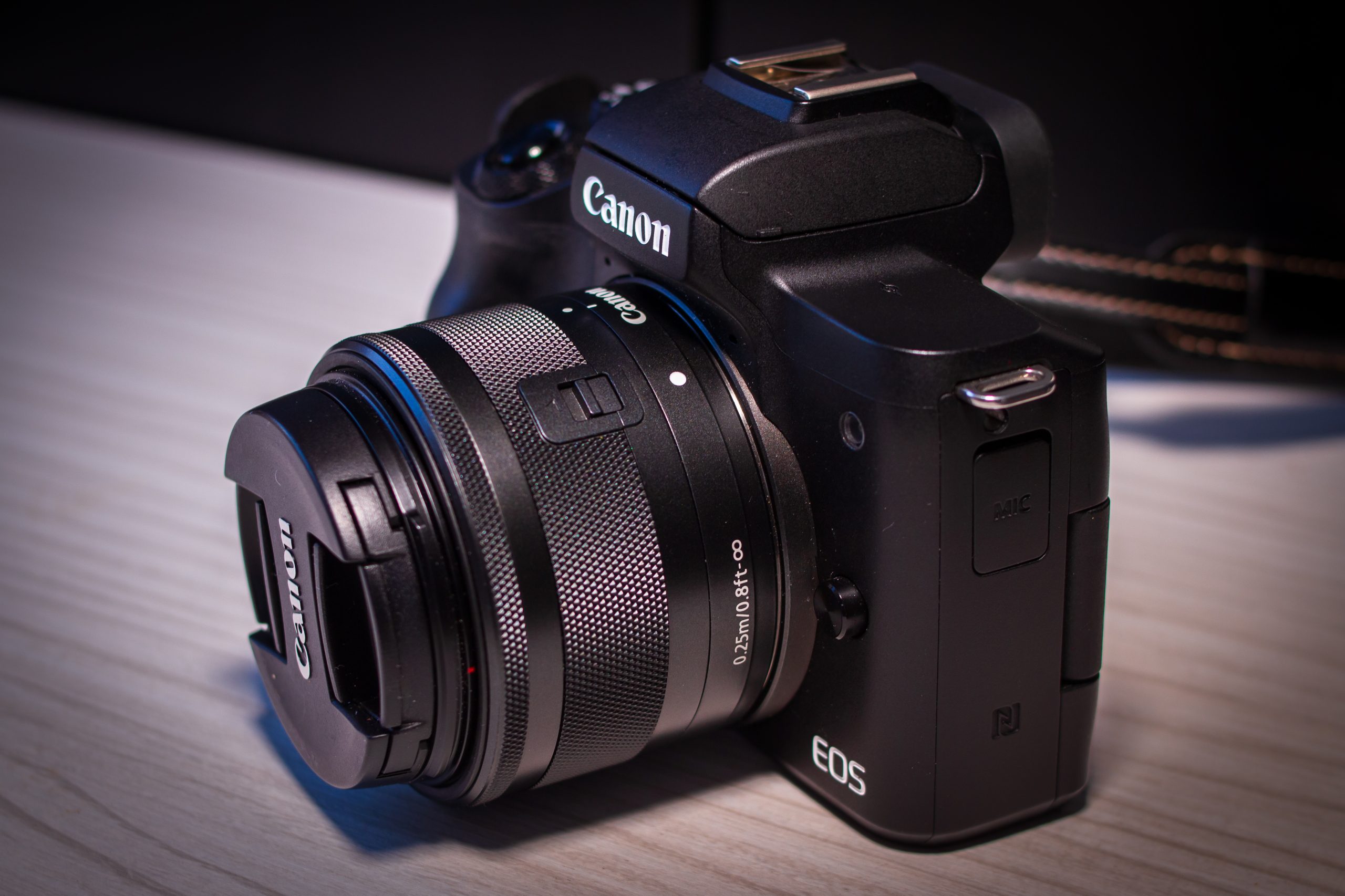
In this Canon EOS M50 review, a clear picture emerges: a camera holding strong eight years after launch. Despite releasing in 2018, this mirrorless body remains a top choice for photographers starting out. With so many newer models flooding the market, however, it’s easy to overlook what the M50 offers: compact size, capable autofocus, and image quality standing above its used price point. For those questioning whether the Canon EOS M50 review remains relevant in 2026, the answer is absolutely yes, especially if budget matters more than cutting-edge specifications.
I’ve shot Canon’s RF system for five years and tested the M50 alongside my R5. The price difference is substantial, but learning curve suits beginners. The M50 keeps things simple without cutting corners. I’ve shot Sony’s A6300 and A6400, the M50’s closest competitors, so I know how they stack up.
When I started with a Nikon D90, I wish a mirrorless camera for beginners like the M50 had existed. The autofocus alone surpasses entry-level cameras from back then. If starting photography or video and wanting reliability, the M50 remains worth considering in 2026. Used models from trusted dealers offer powerful technology at a fraction of retail.
One critical question in any Canon EOS M50 review: Does investing in discontinued EF-M mount make sense? Canon shifted to RF mount after the R5 and R6. For long-term system building, this matters significantly. Short-term, the M50 offers exceptional value for learning mirrorless fundamentals.
Canon EOS M50 Specs at a Glance
Understanding the Canon EOS M50 specs is essential before deciding if this camera fits your needs. Here’s what the M50 brings to the table:
| Specification | Details |
|---|---|
| Sensor | 24.1MP APS-C CMOS |
| Lens Mount | Canon EF-M (discontinued) |
| Autofocus | Dual Pixel AF (179 focus points) |
| Video | 4K at 24p/25p; 1080p up to 60fps |
| Viewfinder | Electronic (2.36M dots) |
| Screen | 3-inch articulating touchscreen (1.04M dots) |
| Battery Life | Approx. 305 shots per charge |
| Weight | 387g (body only) |
| Price (Used 2026) | $500-700 depending on condition |
Featured on MPB
Canon EOS M50 Used
Trusted pre-owned gear backed by MPB’s inspection and return policy. Perfect for beginners stepping up to mirrorless.
Canon EOS M50 Review: Design and Build Quality

Compact and lightweight define the Canon EOS M50. The body measures 116.8 x 88.9 x 69.2mm, weighing 387 grams without a lens, making it genuinely portable for travel and everyday shooting. You carry serious capability in a small package without fatigue. This explains why photographers seeking a mirrorless camera for beginners choose the M50 based on its portability.
The fully articulating 3-inch touchscreen proves invaluable when recording yourself for vlogs, shooting from awkward angles, or reviewing shots in bright sunlight. You rotate the screen to face the lens and frame yourself easily. The EVF (electronic viewfinder) with 2.36 million dots helps transition from smartphone photography to deliberate composition. Build quality feels solid and serious—buttons are placed logically, controls respond crisply, and assembly matches cameras costing significantly more. For beginners, the M50 signals a genuine tool without the premium price of a full-frame body.
Canon EOS M50 Review: Ease of Use for Beginners
The Canon EOS M50 was engineered with beginners in mind. The guided interface and touchscreen walk you through core photography concepts without overwhelming you with jargon. Scene Intelligent Auto mode analyzes your subject and environment, automatically adjusting aperture, shutter speed, and ISO. Creative Assist mode lets you adjust exposure, color tone, and background blur with visual sliders rather than numerical inputs.
These beginner-friendly modes don’t lock you into simplicity forever. Once ready to learn aperture priority, shutter priority, or manual mode, the M50 supports all of them. This progression from guided to manual control means you grow with the camera rather than feeling lost. The touch-based menu makes navigating settings feel natural versus hunting through buttons. You compose through the EVF rather than relying on the LCD screen alone. For anyone starting out, the best beginner camera combines approachable controls with room to grow, and the M50 delivers both.
Canon EOS M50 Review: Image Quality and Autofocus Performance

With a 24.1MP APS-C sensor, the M50 delivers sharp, colorful images across most lighting. Although from an earlier generation, it doesn’t produce inferior photos—file sizes remain reasonable and processing stays quick. You’ll produce images suitable for 8×10 or 11×14 prints without hesitation. This consistency shows the robustness of the M50’s core capabilities.
The Dual Pixel autofocus system is a major strength. It locks onto subjects quickly and tracks them smoothly across the frame. The system offers 179 autofocus points, giving granular control over focus positioning. For portraits, you’ll lock focus on the eye reliably. For video, you’ll see smoother transitions without the hunting plaguing older cameras.
Low-light performance is respectable. You’ll notice grain if pushing ISO beyond 1600, but usable images emerge at ISO 3200 without significant loss. The M50 produces reliable, high-quality photos perfect for social media or personal websites.
Canon EOS M50 Review: Video Capabilities
Video capability shines on the Canon EOS M50. Recording includes 4K at 24p/25p plus 1080p up to 60fps. The articulating screen makes vlogging straightforward—you frame yourself easily. The 3.5mm microphone jack supports external audio, essential because the built-in mic captures wind noise. For vlogging, external microphones become invaluable for any Canon EOS M50 review work.
4K has important limitations. When recording 4K, the M50 applies a crop factor and disables Dual Pixel autofocus, reverting to contrast-based tracking. For most beginners, 1080p becomes the practical setting. The M50 makes 1080p recording straightforward and reliable with good color and detail. For vlogging or social content, 1080p delivers professional results without 4K’s technical overhead.
Lens Ecosystem and Expandability
The Canon EOS M50 uses EF-M mount. The native EF-M lens lineup is limited but covers essentials: ultra-wide, standard zoom, telephoto, and primes. Canon produced roughly 20 native lenses before shifting to RF. You have enough choices for most scenarios, though selection is narrower than Sony E-mount or RF systems.
A major advantage: compatibility with Canon’s EF and EF-S lenses via an inexpensive adapter. This opens access to hundreds of older lenses at competitive prices. You’ll find excellent EF zooms, fast 50mm primes, and telephoto glass for fractions of new costs. M50 users access both EF-M and adapted EF glass, creating a massive ecosystem without straining budget. The M50 plays well with accessories too—external microphones, Canon Speedlight units, tripods, and gimbals work seamlessly. USB-C power (on Mark II) supports sustained content sessions. Third-party manufacturers including Sigma and Tamron make EF-M lenses as well.
Canon EOS M50 Review: Worth It 2026? Versus Newer Options
In 2026, the Canon EOS M50 faces competition from newer models including the Canon R50, Sony ZV-E10 II, and Nikon Z50 II. These newer cameras offer improved autofocus, better 4K performance, and more refined interfaces. However, they cost significantly more. A new Canon R50 runs $600-700; a new Sony ZV-E10 II runs $700-800. Meanwhile, a used M50 in excellent condition costs $500-600, making the value proposition compelling for budget-conscious photographers.
The biggest limitation: EF-M mount is discontinued. No future lenses will develop for the M50. If buying today, you’re investing in a system with limited future expansion. For beginners committing to Canon long-term, this matters significantly. For those wanting to learn mirrorless fundamentals on a budget, the closed ecosystem becomes less concerning.
Newer cameras offer better 4K and in-body stabilization, but cost more and introduce complexity beginners don’t need. The M50’s age becomes its strength from a pricing perspective. It remains practical for what beginners actually shoot. Whether the Canon M50 review’s conclusion applies depends on your timeline and budget.
Buy Used, Save More
MPB Certified Used Gear
Each used M50 gets inspected and rated for condition. Hassle-free returns and warranty coverage included.
Pros and Cons
Pros
- Compact and lightweight (387g body), perfect for travel and everyday use
- Fast Dual Pixel autofocus with 179 focus points, reliable for both video and stills
- Fully articulating 3-inch touchscreen simplifies framing and self-recording
- 24.1MP sensor produces sharp, detailed images suitable for printing
- 4K video capability plus 3.5mm microphone jack for external audio
- Extensive EF/EF-S lens compatibility via affordable adapter opens hundreds of used lenses
- Beginner-friendly modes (Scene Intelligent Auto, Creative Assist) ease the learning curve
- Used examples available at $500-700, excellent value for entry-level mirrorless
Cons
- EF-M mount is discontinued; no future native lenses will be developed
- 4K video has crop factor and loses Dual Pixel autofocus, limiting utility
- Battery life is modest at 305 shots per charge; requires backup batteries for full days
- No in-body image stabilization; relies on lens-based stabilization
- Limited native EF-M lens selection compared to Sony E-mount or Canon RF
- Autofocus performance on moving subjects in 4K mode is noticeably slower
- Low-light performance acceptable but not exceptional above ISO 1600
- Transitioning to Canon’s RF system requires selling the M50 and reinvesting
Final Verdict: Canon EOS M50 Review Recommendation
This Canon EOS M50 review reaches one clear conclusion: the M50 remains one of the best beginner cameras available in 2026. It teaches fundamentals without intimidation and delivers professional results. For aspiring photographers and video creators on a budget, it represents exceptional value when purchased used.
The decision hinges on commitment: How long will you stick with Canon? If upgrading to RF-mount in 3-5 years, the M50 is logical and affordable. You’ll learn on this camera then graduate with confidence. If wanting a camera growing indefinitely with new native lenses, the R50 makes more sense despite higher cost.
For most beginners, the M50 offers everything needed: capable autofocus, clean image quality, video, and forgiving learning curve. I’ve tested it alongside my R5, and while the R5 offers superior 4K and autofocus, the M50 handles what beginners actually need. Spending triple the investment for the remaining capability doesn’t make sense starting out.
For serious learning without serious financial commitment, buy a used Canon EOS M50 and invest savings in quality glass. Allocate money where it matters most: optical quality and focal length. The body ranks secondary to the glass.
Ready to Get Started?
Find Your Used Canon EOS M50
Browse available used M50 bodies with ratings and condition details. Every purchase backed by MPB’s warranty.
Frequently Asked Questions
Is the Canon EOS M50 good for beginners?
Yes. Designed specifically for beginners, it features Scene Intelligent Auto and Creative Assist modes, touchscreen interface, and EVF easing the transition from phones. You’ll learn manual controls as you progress, and the camera supports your journey from beginner to intermediate shooter.
Does the Canon EOS M50 shoot in 4K in 2026?
Yes, with limitations. The M50 records 4K at 24p/25p but applies a crop factor and disables Dual Pixel autofocus. 4K tracking is slower and less reliable than 1080p. Most beginner video work uses 1080p anyway.
Does the Canon EOS M50 have a microphone input?
Yes, it includes a 3.5mm jack crucial for vlogs and video. The built-in mic captures wind noise, so external mics are essential for good audio quality.
Do DSLR lenses work on the Canon EOS M50?
Yes, with the EF-EOS M adapter. This inexpensive accessory mounts any EF or EF-S lens. You gain access to hundreds of used lenses at affordable prices, expanding beyond EF-M native options.
Is the Canon M50 worth it 2026?
Absolutely. The Canon EOS M50 offers great value, especially for beginners and casual shooters seeking better quality than a smartphone without spending on a new full-frame body. Used examples are plentiful, well-tested, and affordable. For learning mirrorless fundamentals with proven Canon EOS M50 specs and performance, it remains an excellent choice.
What’s the difference between the Canon M50 and M50 Mark II?
Mark II added USB-C power, upgraded autofocus, and improved burst performance. If buying used, Mark II costs slightly more but offers video benefits. The original M50 remains capable for most beginners though.
Ready to move beyond the M-mount? Our guide to the best Canon cameras in 2026 walks through every RF-mount upgrade path, including the R50 and R10, which most M50 owners end up picking next.


Comments are closed.