


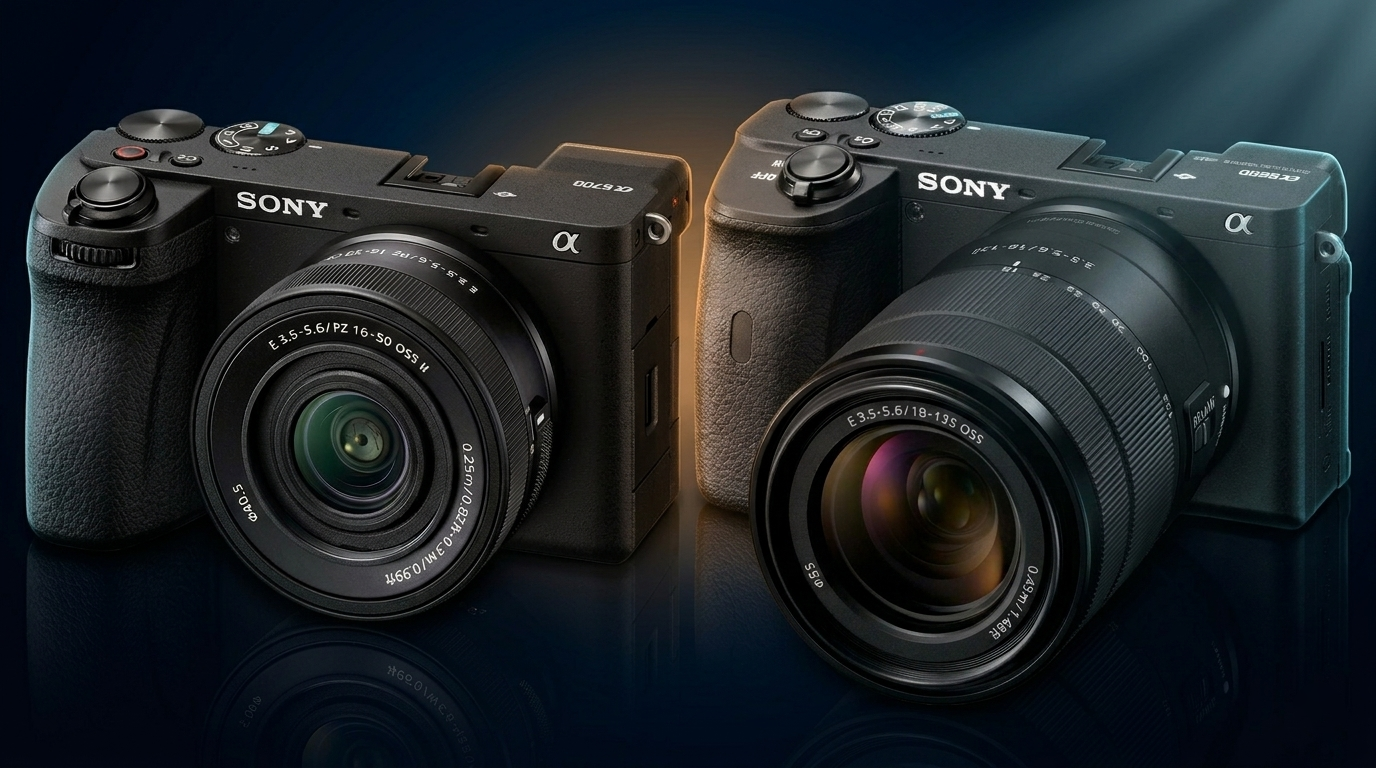
Quick Verdict: In the Sony a6600 vs a6700 matchup, the a6700 wins on nearly every technical measure, with a 26MP BSI sensor, 759-point AI autofocus, 10-bit 4K 120p video, and a fully articulating screen. However, the a6600 still holds strong as a value pick with longer battery life (720 shots vs 550) and near-identical IBIS performance. For most hybrid shooters in 2026, the a6700 is the stronger buy. Meanwhile, bargain hunters and stills-first photographers will get solid results from a used a6600 at roughly half the a6700’s price.
Last updated: April 2026 | 14 min read | By Alex Schult, PhotographyTalk
In This Review
- Which is better, Sony a6600 or a6700?
- Sony a6600 vs a6700: Key differences at a glance
- Sensor and image quality: Does the a6700 outperform the a6600?
- Autofocus: Is the a6700 better than the a6600?
- Video capabilities: Does the a6600 shoot 4K 120p?
- Build, ergonomics, and battery life
- Best camera for each use case
- Price and value: new vs used in 2026
- Pros and cons
- Is the Sony a6700 worth the extra money?
- Who should buy the Sony a6600 instead?
- Final verdict and ratings
- Frequently asked questions
- Related questions
Which is better, Sony a6600 or a6700?
The Sony a6700 is the better camera on paper and in real shooting, because it pairs a new 26MP BSI sensor with a dual BIONZ XR processor and a dedicated AI processing unit. However, the Sony a6600 still delivers strong stills performance, longer battery life, and a more affordable price on the used market. In short, the Sony a6600 vs a6700 debate comes down to this: the a6700 wins on autofocus, video, and overall responsiveness, while the a6600 wins on price-per-feature and stamina.
Specifically, I have personally shot with the entire modern Sony APS-C lineup, starting with the a6300, then the a6400, then the a6600, and finally the a6700. Sony kept the form factor close across every generation, so the muscle memory carries over from one body to the next. Inside, however, the a6700 is a completely different camera. Notably, the processing speed, the autofocus intelligence, and the video pipeline all represent a generational leap over the a6600.
For example, my a6600 traveled with me all over Southern California, including multiple weekends up in Big Bear, and it earned a spot in my bag alongside the Nikon Z7 during a trip to Istanbul. Since then, the a6700 has taken its place on trips to the Lofoten Islands in Norway and countless coastal shoots along the California coast. Both are tough, nimble cameras. Still, if I had to pick one today as my primary APS-C body, it would be the a6700 (no surprise!).
Sony a6600 vs a6700: Key differences at a glance
Here is a compact spec comparison to anchor the rest of the article. Every specification below comes from verified Sony data or hands-on testing.
| Specification | Sony a6600 | Sony a6700 |
|---|---|---|
| Released | August 2019 | July 2023 |
| Sensor | 24.2MP Exmor CMOS | 26MP Exmor R BSI CMOS |
| Processor | BIONZ X | Dual BIONZ XR + AI unit |
| Autofocus points | 425 phase-detect | 759 phase-detect (93% coverage) |
| Max video | 4K 30p 8-bit 4:2:0 | 4K 120p 10-bit 4:2:2 |
| LOG profiles | S-Log3, HLG | S-Log3, S-Cinetone, HLG |
| IBIS (CIPA) | 5-axis, 5 stops | 5-axis, 5 stops |
| Continuous burst | 11 fps | 11 fps |
| EVF | 0.39″ OLED, 2.36M dots | 0.39″ OLED, 2.36M dots |
| LCD | 3.0″ 921K dots, 180° tilt | 3.0″ 1.04M dots, fully articulating |
| Battery (stills) | NP-FZ100, 720 shots CIPA | NP-FZ100, 550 shots CIPA |
| Weight | 503g | 493g |
| USB port | Micro USB | USB Type-C 3.2 Gen 2 |
| Card slots | 1x SD UHS-II | 1x SD UHS-II |
| Lens mount | Sony E-mount | Sony E-mount |
Notably, both cameras share the Sony E-mount, so every E-mount APS-C lens in your kit works on either body. As a result, stepping up from the a6600 to the a6700 does not require you to rebuild your glass collection.
Sensor and image quality: Does the a6700 outperform the a6600?

Yes, the Sony a6700 produces cleaner, more detailed files at higher ISOs because its 26MP back-side illuminated Exmor R sensor gathers more light per pixel than the a6600’s front-illuminated 24.2MP chip. Specifically, the bump to BSI design matters most in low light and when you push shadows in post.
From my own shooting, the difference shows up most around ISO 3200 and above. For example, skin tones hold together longer on the a6700, and shadow recovery in RAW files feels one stop stronger before color noise gets ugly. However, for daylight and well-lit studio work, both sensors deliver results most clients will never tell apart. In the Sony a6600 vs a6700 sensor comparison, the 1.8MP resolution bump is small; the tonal difference at high ISO is the real win.
Dynamic range also favors the newer body in the Sony a6700 vs a6600 matchup. Specifically, the a6700 holds roughly 14 stops in its base ISO range, while the a6600 sits a fraction below it. For landscape work, the extra headroom in the highlights means cleaner recoveries when you shoot into the sun on a coastal cliff or a snow-heavy scene like the ones I captured in the Lofoten Islands.
Color science is another subtle a6700 win. Notably, Sony tuned the newer processor for better skin rendering and pulled in S-Cinetone directly from the Cinema Line bodies. If you grade video, this matters immediately. For stills, on the other hand, the JPEG engine is slightly warmer and more neutral out of the camera.
Autofocus: Is the a6700 better than the a6600?
Yes, autofocus is where the Sony a6700 pulls furthest ahead of the a6600 because it borrows the AI-based subject recognition from the flagship a7R V and FX3. Specifically, the a6700 runs 759 phase-detection points covering 93% of the sensor, while the a6600 uses 425 points across a smaller coverage area.
In practice, this means the a6700 recognizes and tracks human eyes, animal eyes, bird eyes, insects, cars, trains, and airplanes with a dedicated AI processing unit. Meanwhile, the a6600 uses Sony’s older Real-Time Tracking algorithm, which works well on humans and animals but lacks the subject-specific modes. For instance, when I shot birds in flight at Big Bear Lake, the a6700 locked onto eye detail on eagles from distance with a consistency the a6600 never matched.
Low-light AF is also better on the a6700 at roughly -3 EV sensitivity, compared to -2 EV on the a6600. Consequently, one stop of low-light AF pickup translates to reliable focus under dim interior light for wedding and event shooters, where missed focus kills the shot.
For hybrid creators, the a6700 also tracks subjects through video in a way the a6600 struggles with. Therefore, if your work involves moving subjects, sports, or wildlife, the Sony a6700 vs a6600 autofocus gap is the single strongest reason to upgrade.
Featured on MPB
Shop the Sony a6700 and a6600 used
MPB inspects, rates, and warranties every body. Six-month warranty, 14-day returns, and free shipping on both models.
Video capabilities: Does the a6600 shoot 4K 120p?

No, the Sony a6600 does not shoot 4K 120p. Specifically, the a6600 tops out at 4K 30p with 8-bit 4:2:0 internal recording, while the a6700 records 4K 120p in 10-bit 4:2:2 internally. For video-focused shooters, this single spec often settles the a6600 vs a6700 video debate.
Additionally, the a6700 brings 1080p at 240fps, giving you 10x slow motion without the heavy crop and quality drop the a6600 applies above 120fps. S-Cinetone arrives on the a6700 as a native color profile tuned by Sony’s Cinema Line team. Combined with 10-bit internal recording, the a6700 produces footage with grading flexibility the a6600 will not match.
Recording time limits also favor the newer body. For example, the a6700 runs 4K 30p for over two hours and 4K 60p for 40-plus minutes without overheating, while the a6600 hits thermal limits much sooner on hot days. Consequently, if you shoot weddings, interviews, or events in warm conditions, the thermal headroom alone is worth the upgrade.
One more video-first win: the a6700 picks up a fully articulating screen, while the a6600 sticks with a tilt-only design. Notably, for vloggers and solo creators filming themselves, the a6600’s screen flipping over the top hot shoe creates rigging headaches. In contrast, the a6700’s side-flip screen sidesteps the problem entirely. This gap defines the a6600 vs a6700 video experience more than any other single feature.
Build, ergonomics, and battery life

The a6600 wins battery life with 720 CIPA-rated shots per charge, while the a6700 rates 550 shots. However, both cameras use the same NP-FZ100 battery, so the a6600’s advantage comes from more efficient power draw, not a bigger cell. For travel and documentary shooting where outlets are scarce, the a6600’s stamina edge is real. On my Lofoten trip with limited charging access, a single a6600 battery carried me through a full day of landscape and wildlife shooting. Under identical conditions, the a6700 would have needed a midday top-up.
Ergonomics are close, but the a6700 gets meaningful refinements. Specifically, Sony added a front control dial to the a6700, which brings the APS-C body closer to a full-frame a7-series feel for aperture and shutter control. Additionally, the grip is slightly deeper, which helps when you mount heavier lenses like the Sigma 18-50mm f/2.8 or a G Master zoom.

Both cameras skip weather sealing at the level of the full-frame Alpha bodies, so I would not rely on either in steady rain without a rain cover. From my experience shooting in the Lofoten Islands in light snow, both held up with basic care, but neither is rated for serious weather duty. Therefore, bring a cover or a dry bag.
Weight-wise, the a6700 is 10g lighter at 493g versus the a6600’s 503g, which is a rounding error in the hand. Similarly, the a6700 is slightly bigger at 122 x 69 x 75mm vs the a6600’s 120 x 67 x 69mm, a product of the thicker grip and deeper heat management.
Best camera for each use case
Picking between the Sony a6600 and a6700 comes down to how you shoot. Specifically, here is how I would steer a photographer friend based on the work they do most.
Best for hybrid photo and video creators: The Sony a6700. For instance, 10-bit 4:2:2 internal, S-Cinetone, AI autofocus, and the articulating screen together make it the stronger hybrid tool by a wide margin.
Best for video-first creators and vloggers: The Sony a6700. Specifically, 4K 120p, 1080p 240fps, better thermal limits, and the flip-out screen are all meaningful upgrades over the a6600.
Best for wildlife and sports: The Sony a6700. Notably, the AI autofocus with bird, animal, and vehicle recognition pulls further ahead the more you shoot subjects in motion.
Best for travel photography: The Sony a6600. Specifically, longer battery life, lighter kit when paired with small primes, and used pricing around $900 make it a traveler’s value pick. In fact, I took mine to Istanbul alongside a Nikon Z7 and never worried about topping up the battery mid-day.
Best for stills-first photographers on a budget: The Sony a6600. The image quality gap at daylight ISOs is minor, and you save roughly $500 to $600 going used.
Best for B-roll alongside another primary system: The Sony a6600. For example, I used mine as a B-roll body while shooting Nikon as my A-camera, and the small form factor plus E-mount flexibility made it ideal for the role. Nimble, fast to deploy, and quiet.
Best on the used market: The Sony a6600 offers the biggest new-to-used savings. Meanwhile, used a6700 bodies still trade close to new pricing because of the 2023 release date.
Price and value: new vs used in 2026
When comparing Sony a6600 vs a6700 pricing, the a6700 sells new for around $1,498 body-only at major retailers in April 2026, while the a6600 runs roughly $1,198 new at Adorama with limited inventory since Sony shifted focus to the a6700. Used pricing tells the more interesting story.
| Retailer | a6600 Used Price | a6700 Used Price | Verdict |
|---|---|---|---|
| MPB | $869 to $994 (Excellent) | ~$1,519 (Like New) | a6600 saves ~$500 |
| KEH | $826 to $1,043 | $1,395 to $1,451 | a6600 saves ~$450 |
| B&H Used | Variable inventory | Minimal used discount | a6600 better used value |
Three takeaways emerge for value shoppers. First, the a6600 used market is where the savings live: expect to pay $850 to $1,000 for a clean body, which is 30% to 40% below new pricing. Second, the a6700 used premium will shrink in 2027 and 2028 as more bodies enter the secondhand supply. Finally, if you are buying the a6700 today, consider new: the $100 to $150 used discount currently available rarely justifies giving up the full warranty.
Pros and cons
Sony a6700 Pros
- 26MP BSI sensor with one-stop low-light gain over the a6600
- 759-point AI autofocus with bird, animal, and vehicle recognition
- 10-bit 4:2:2 internal 4K recording up to 120p
- Fully articulating LCD ideal for vlogging
- USB Type-C 3.2 Gen 2 for faster file transfer and tethered shooting
- Front control dial matches full-frame Alpha ergonomics
- S-Cinetone color profile for graded-looking video out of camera
- Improved thermal handling for long 4K recording sessions
Sony a6700 Cons
- Battery life drops to 550 shots CIPA from the a6600’s 720
- New price around $1,498 sits $300 above a6600 new pricing
- Single UHS-II card slot means no backup writing
- No viewfinder upgrade over the a6600’s 2.36M-dot EVF
- Used market premium remains high through at least 2027
- Micro HDMI instead of full-size for rigged video work
Sony a6600 Pros
- Longer battery life at 720 shots CIPA per charge
- Strong 24.2MP stills performance in daylight
- Compact body at 503g with a deep grip for APS-C class
- Used pricing around $870 offers strong value
- Same 5-axis 5-stop IBIS as the a6700
Sony a6600 Cons
- 4K caps at 30p with 8-bit 4:2:0 internal only
- No AI subject recognition for autofocus
- Screen tilts 180° rather than fully articulating
- Micro USB port feels dated for 2026 workflows
- No S-Cinetone profile for video
Is the Sony a6700 worth the extra money?
In the Sony a6600 vs a6700 value analysis, the a6700 is worth the extra money if you shoot video, sports, wildlife, or any subject where autofocus performance and 10-bit grading flexibility matter. However, for still-only photographers on a tight budget, the answer tilts toward no: the a6600 delivers 85% of the a6700’s stills experience at 60% of the price on the used market.
The price gap sits at roughly $500 to $600 on the used market, or $300 new-to-new. For the premium, you receive a better sensor, a dramatically smarter autofocus system, a complete video rewrite, and a modernized control layout. Notably, if video is anywhere in your workflow, the a6700 pays for itself in a single commercial shoot from the 10-bit latitude alone.
For wedding and event photographers, the low-light AF gain of one stop and the bird and animal tracking capability close the gap on full-frame bodies for indoor ceremony work. Meanwhile, for travel shooters who want lighter gear with better video, the a6700 is the kit I would pack today.
Who should buy the Sony a6600 instead?
Buy the Sony a6600 if your work is stills-first, your budget caps around $1,000, and you want Sony’s widest APS-C lens selection without breaking your wallet. Notably, within the Sony a6600 vs a6700 debate, the a6600 remains a strong camera in 2026, especially at current used prices.
Additionally, the a6600 suits photographers building a Sony E-mount kit for the first time. For example, with $500 saved over the a6700, you roll the difference into a 70-350mm telephoto zoom or a Sigma 18-50mm f/2.8, both of which have bigger impact on your images than the processor upgrade from the a6600 to the a6700 for most shooting scenarios.
Wedding second-shooters and B-roll operators working alongside another primary system also get strong value from the a6600. Specifically, the form factor is nimble, the E-mount lens ecosystem is deep, and the 720-shot battery life means you rarely swap mid-ceremony. In fact, I used mine in exactly this role during my Nikon shooting years, and it earned its keep every time.
Final verdict and ratings

In the Sony a6600 vs a6700 showdown, the a6700 is the stronger camera in nearly every technical category and the right buy for hybrid shooters, video creators, wildlife photographers, and anyone who wants the latest AI autofocus in an APS-C body. Notably, it is the camera I reach for today after moving through the a6300, a6400, and a6600 in sequence. The generational leap is real.
However, the a6600 remains a strong stills-first camera in 2026 and a genuine value pick on the used market. Specifically, its weaknesses show up only when you push it into fast-action autofocus or serious video production. For photographers shooting landscapes, portraits, street, or travel on a budget, the a6600 still delivers images most viewers will never distinguish from a6700 output.
Both bodies share Sony’s deep E-mount lens ecosystem, identical IBIS performance, and a compact form factor I would happily carry from Big Bear to the Lofoten Islands. Whichever you pick, you are getting a capable APS-C camera with a long shooting life ahead of it. Therefore, my personal recommendation for most photographers reading this in 2026 is the Sony a6700, with the a6600 as a smart second choice when budget is the deciding factor.
PhotographyTalk Ratings:
Sony a6700: 9.2 out of 10. Best-in-class APS-C for hybrid creators and one of the strongest sub-$1,500 cameras on the market.
Sony a6600: 8.4 out of 10. Still a strong stills performer with the best battery life in the lineup, and a smart value pick at used prices.
Ready to buy?
Find your Sony a6600 or a6700 at MPB
Every used body is inspected, graded, and covered by a six-month warranty. Check current pricing and inventory now.
Frequently asked questions
What is the price difference between the Sony a6600 and a6700?
In the Sony a6600 vs a6700 price comparison, the a6700 sells new for around $1,498 body-only, while the a6600 runs roughly $1,198 new. However, on the used market, the gap widens: expect $870 to $1,000 for a used a6600 versus $1,395 to $1,519 for a used a6700. Net difference on used pricing sits around $500 to $600 in favor of the a6600.
Should I buy the Sony a6600 used or the a6700 new?
If video or wildlife autofocus matters to your work, buy the a6700 new for the warranty and the full spec advantage. On the other hand, if you shoot mostly stills and want the biggest value per dollar, a used a6600 from MPB or KEH at around $900 is the smarter buy. Specifically, the decision hinges on whether you will use 10-bit video and AI autofocus within the first year.
Does the Sony a6700 shoot 4K 120p?
Yes, the a6700 records 4K up to 120 frames per second internally in 10-bit 4:2:2. Meanwhile, the a6600 maxes out at 4K 30p in 8-bit 4:2:0, so anyone needing slow-motion 4K will not get it from the a6600.
Does the Sony a6600 have better battery life than the a6700?
Yes, the a6600 rates 720 shots CIPA per charge compared to 550 shots on the a6700. Although both use the same NP-FZ100 battery, the a6600 draws less power due to its simpler processor. In real-world mixed shooting, expect roughly 30% longer runtime from the a6600.
What is the sensor difference between the Sony a6600 and a6700?
The a6700 uses a 26MP back-side illuminated Exmor R CMOS sensor, while the a6600 uses a 24.2MP front-illuminated Exmor CMOS sensor. Specifically, BSI design gives the a6700 roughly one stop of low-light advantage and stronger shadow recovery. However, daylight differences are subtle outside of RAW shadow pushing.
Are the Sony a6600 and a6700 weather sealed?
Sony does not publish weather sealing specifications for either body at the level of its full-frame Alpha line. Although both bodies handle light moisture with care, neither should be relied on in steady rain without a rain cover. Treat both as splash-resistant rather than weather-sealed.
How much does the Sony a6700 weigh compared to the a6600?
The a6700 weighs 493g body-only, making it 10g lighter than the a6600’s 503g. In practice, the difference is imperceptible when a lens is mounted. Moreover, both bodies sit in the compact APS-C class and pack easily for travel.
Do a6600 lenses work on the a6700?
Yes, every Sony E-mount lens works on both bodies. Specifically, the a6600 and a6700 share the E-mount, so your existing APS-C glass or any full-frame FE lens carries over without adapters. Upgrading does not force a lens overhaul.
Which Sony APS-C is better for wildlife photography?
The a6700 is the stronger wildlife camera because of its AI-based subject recognition, specifically the bird, animal, and insect modes. Additionally, its 759-point AF array covers 93% of the sensor, making it easier to track off-center subjects. However, the a6600’s 425-point system handles general wildlife but misses more birds in flight.
Which camera is better for video creators?
The a6700 is the clear winner for video. Specifically, its 10-bit 4:2:2 internal recording, 4K 120p, S-Cinetone profile, and fully articulating screen make it a complete hybrid video tool. Meanwhile, the a6600’s 4K 30p 8-bit pipeline feels dated for 2026 video standards.
Which Sony APS-C is best for vlogging?
The a6700 wins for vloggers because of the side-flip articulating screen, superior AI face and eye tracking, and cleaner low-light video. Specifically, self-recording is far easier on the a6700 than on the a6600’s top-tilt screen, which gets blocked by hot shoe accessories like microphones.
Is the Sony a6600 still worth buying in 2026?
Yes, the a6600 is still worth buying in 2026 if you shoot primarily stills and want to save roughly $500 over the a6700. Notably, its image quality, IBIS, battery life, and build all hold up. However, skip it only if video, wildlife AF, or AI tracking are central to your work.
Related questions
Beyond the core Sony a6600 vs a6700 comparison, here are quick answers to the follow-up questions photographers ask most.
What about the Sony a6700 vs the a7 IV?
The a7 IV gives you a 33MP full-frame sensor, dual card slots, and a bigger viewfinder, while the a6700 offers a more compact body, lighter weight, and nearly identical AI autofocus. Specifically, pick the a7 IV for full-frame low-light and print quality, or the a6700 for travel-friendly size and lower total kit cost.
Does the Sony a6700 work with a6600 lenses?
Yes. Both cameras use the Sony E-mount, so every lens in your a6600 kit works on the a6700 without an adapter or firmware update. Full-frame FE lenses also work on both bodies with an APS-C crop.
Should I upgrade from the a6400 to the a6700?
Upgrade to the a6700 if you want IBIS, AI autofocus, 10-bit video, and the articulating screen. Specifically, the a6400 lacks in-body stabilization and caps out at 8-bit 4K 30p, so the jump is significant for hybrid creators. However, stills-only photographers with a tight budget get most of the a6400 experience while saving $700.
Is the a6700 better than the a6400 for video?
Yes, significantly. For example, the a6700 adds IBIS, 10-bit 4:2:2, 4K 120p, S-Cinetone, and a fully articulating screen over the a6400’s 8-bit 4K 30p pipeline. Therefore, for any serious video creator, the a6700 is worth the extra investment.
Is the Sony a6600 still a strong buy in 2026?
Yes, especially at used prices around $870 to $1,000. Notably, the a6600 remains a strong stills camera with the longest battery life in the lineup. However, avoid it if video, AI autofocus, or 10-bit recording are priorities for your work.

