


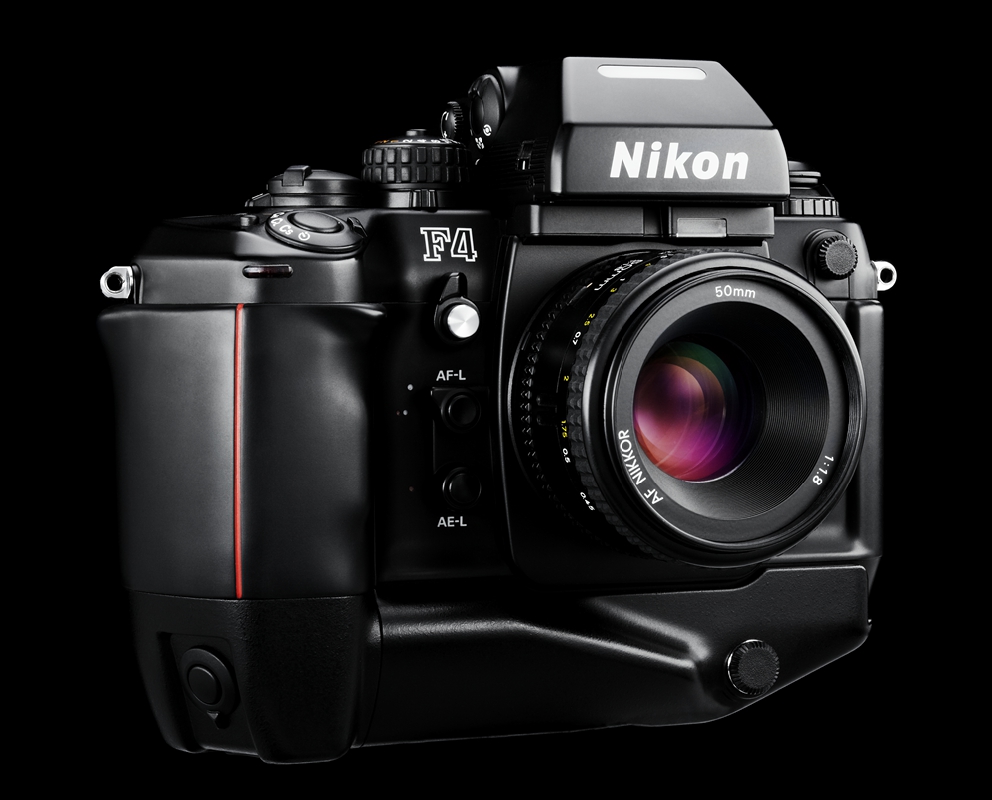
Quick Facts:
- Camera: Nikon F4 (also F4s and F4e variants)
- Production: 1988 to 1997 (F4e arrived 1991)
- Top shutter speed: 1/8000 sec
- Flash sync: 1/250 sec
- Frame rate: 4 fps (F4) to 5.7 fps (F4s)
- Autofocus: single-point AM200 module, first-generation Nikon pro AF
- Lens mount: Nikon F (works with AI, AI-S, AF, AF-D, most AF-S)
- Body weight: 1,090 g (F4 body, no batteries) to 1,400 g (F4e with MB-23)
- 2026 used price: $180 to $300 for a clean working body
- Best for: film shooters who want a pro Nikon body without paying F5 money
10 min read
In This Guide
Nikon F4 Buying Guide Overview: The Pro Body Nobody Wanted
When Nikon launched the F4 in 1988, the company expected working pros to retire their F3 bodies and switch over. They refused. Photographers stuck with the F3 for 13 more years, keeping the older body in production until 2001, a full four years after Nikon discontinued the F4 itself. For modern film shooters, the rejection is the entire reason this nikon f4 buying guide exists in 2026: an F4 still sits among the best used buys on the market today, and the pro snub is the reason it stays affordable.
Their refusal is also the angle behind every recommendation here. We cover what a nikon f4 used body should cost, current nikon f4 price ranges across MPB and KEH, the nikon f4 worth it equation for hobbyists and pros alike, which of the three F4 variants fits your shooting, which lenses still work, what to inspect before you hand over the money, and where to buy with a return policy. The F4 is a flagship-class pro body you bring home for under $300 in clean condition. Few 35mm bodies offer this much capability per dollar.
The angle here is value, not nostalgia. A camera ahead of its time, rejected by pros for two specific reasons (no manual advance lever, slow first-generation autofocus), now sits at hobbyist prices despite being built like a tank. Moreover, if you want a serious 35mm SLR with autofocus, motor drive, matrix metering, and weather sealing, no other body in this price range competes. For broader context on the used market, see our companion piece on buying used cameras.
Nikon F4 Key Specs at a Glance
| Specification | Details |
|---|---|
| Year released | 1988 (F4 and F4s), 1991 (F4e) |
| Format | 35mm film, SLR |
| Shutter | Vertical Copal Square, 30 sec to 1/8000 sec |
| Flash sync | 1/250 sec |
| Frame rate | 4 fps (MB-20) / 5.7 fps (MB-21) |
| Autofocus | Single point, AM200 module |
| Metering | Matrix, center-weighted, spot |
| Viewfinder | Interchangeable, DP-20 standard prism |
| Body | Die-cast aluminum chassis, weather sealed |
| Designer | Giorgetto Giugiaro |
Shop Used Nikon at MPB
Find a Used Nikon F4 at MPB
MPB inspects every camera, lists shutter count, and ships with a six-month warranty and free returns. Browse current Nikon film and DSLR inventory.
Why Pros Refused the Nikon F4 (And Why You Should Buy One Now)
The first-generation F4 autofocus had a single focus point in the center of the frame. In low contrast, it hunted. Sports shooters used to F3 motor-drive bursts kept finding the AF too slow for tracking. Photojournalists used to advancing film manually for silent operation lost the option when Nikon ditched the lever. Consequently, these two complaints, AF speed and the missing lever, killed the F4’s pro adoption.
Weight also factored in. The F4s with the MB-21 motor pack hits 1,280 grams. The F3 with motor drive is lighter. For a war photojournalist or a wedding shooter carrying two bodies all day, the difference matters. In hindsight, Nikon was ahead of the curve and pros simply were not ready. Eight years later the F5 arrived with five-point AF, faster tracking, and a built-in motor at 8 fps.
By then the F4 had been quietly proving itself on Space Shuttle missions (NASA modified an F4 into its Electronic Still Camera in 1991, one of the first digital cameras ever flown) and in studios where AF speed never mattered. Today, none of the original objections apply. You are not shooting a war zone with a flagship film SLR in 2026. Instead, you are shooting portraits, landscapes, street, or weddings on film for the look. As a result, the F4’s “slow” 1/8000 sec shutter, “weak” single-point AF, and “missing” manual lever stop being problems and start being the reason this camera is undervalued.
Nikon F4 vs F4s vs F4e: Which Variant to Buy

Nikon shipped the F4 in three configurations across its 1988 to 1997 production run, differentiated by the motor pack bolted to the bottom plate. The same chassis sits underneath all three. Notably, nikon f4 price differences between the variants tend to be modest, often $30 to $80, so the variant choice should be driven by features rather than budget.
First, the F4 (body only) uses the MB-20, a slim grip holding four AA batteries. Frame rate maxes at 4 fps. This is the lightest configuration at 1,090 grams body-only without batteries. Choose this if you shoot single frames, prefer a compact body, or already own modern AA-powered lights and want battery compatibility.
Second, the F4s adds the MB-21 motor pack, which holds six AAs and unlocks the headline 5.7 fps burst. Body plus pack lands near 1,280 grams. The MB-21 is the most common variant on the used market and the best all-around pick for most buyers in 2026. KEH and MPB list F4s bodies more often than the plain F4. Similarly, eBay sold listings skew F4s heavily.
Finally, the F4e (released 1991) uses the larger MB-23 pack. The MB-23 added NiCd pack compatibility (irrelevant in 2026, since original NiCd packs are dead) and a terminal for the MF-24 bulk film back. Body weight rises to roughly 1,400 grams.
Our recommendation: buy the F4s unless you have a specific reason to go lighter (F4) or you find an F4e in mint condition at the same price. Specifically, the MB-21’s 5.7 fps is the F4’s signature spec, and it costs no more on the used market.
F-Mount Lens Compatibility on Pro Film Bodies
Nikon’s commitment to backward compatibility is why the F-mount line has lasted since 1959. The F4 sits at a sweet spot: it works with the broadest range of Nikon glass of any pro body Nikon ever made. Notably, the F4 retains the AI tab for stop-down metering of pre-AI glass, a feature dropped on later digital bodies.
First, manual focus AI and AI-S lenses work with full matrix metering, aperture priority, and manual exposure. Second, autofocus AF-D and AF lenses work fully, including screw-drive AF. AF-S lenses with built-in motors also work for autofocus and exposure. However, VR (vibration reduction) does not function on the F4. The lens still operates normally otherwise.
What Modern Lenses Lose Here
G-type lenses (no aperture ring) work in program and shutter priority modes only. Without an aperture ring, you lose aperture priority and manual exposure control. For most G lenses this restriction is workable for casual shooting but limits creative control. Notably, E-type lenses (electromagnetic aperture) do not function on the F4. The aperture stays wide open. Therefore, skip any modern lens with an “E” in its name, such as the AF-S 70-200mm f/2.8E.
The practical takeaway: if you already own F-mount glass for a Nikon DSLR, your AF-D and most AF-S lenses move straight to an F4 with no adapter. This compounds the value case for buying an F4 if you have an existing F-mount kit gathering dust. For more on why used glass is the smartest line item in any camera budget, see our analysis of how lenses hold their value better than bodies.
Save on Pro Nikon Bodies
Browse the MPB Nikon Catalog
Filter by film or DSLR, see condition grades, and lock in a body backed by MPB’s six-month warranty. Pair it with affordable AF-D glass while you are there.
What to Check Before You Buy
The F4 is rugged but no electronic camera from 1988 is bulletproof. Six checks separate a $250 working body from a $250 paperweight.
First, inspect the LCD on the top plate and inside the finder. Aged liquid crystal bleeds. Light bleed at the edges is acceptable. Heavy bleed across the displays makes the camera unusable. If the seller’s photos do not show the LCD clearly, ask for a fresh shot before bidding.
Second, listen to the motor. With AAs loaded, fire a few frames. The MB-21 should sound smooth and consistent. Grinding, clicking, or hesitation signals a worn motor costing more to service than the camera is worth.
Third, check the back. Pop it open and look at the light seals along the door channel and around the hinge. Crumbling foam is normal on a 35-year-old body and replaceable for under $20 in materials. However, heavy oxidation on the pressure plate or hinge corrosion is a walk-away.
Fourth, verify all metering modes. Set matrix, center-weighted, and spot. Each should produce a different reading. A dead metering cell is repairable but adds $100 to $200 to your total cost.
Fifth, test the autofocus. Mount any AF-D lens, point at high contrast, and listen. The screw-drive AF should engage smoothly without screeching. If the body’s AF motor sounds rough, the screw coupling is worn.
Sixth, check the finder for de-silvering. The DP-20 prism finder is removable, and aged units develop dark patches in the eyepiece. A clean finder is non-negotiable for any pro-grade body. For more on inspecting older gear before you buy, see our full used camera inspection checklist.
Nikon F4 vs F5 vs F100: Picking the Right Pro Film Body
If you are choosing between the three pro Nikon film bodies still circulating on the used market, here is the short version. First, the F4 wins on price and on F-mount compatibility. Specifically, sub-$300 entry, the broadest range of lens support, and retention of the AI tab for pre-AI glass.
Second, the F5 (1996) wins on autofocus and frame rate. Five-area AF, 8 fps with the integrated motor, and a more refined matrix meter built around a 1,005-pixel RGB sensor. Expect to pay $400 to $700 for a clean body. By contrast, the F100 (1999) wins on weight and ergonomics. With a magnesium-alloy body and plastic film back, the F100 borrows F5 internals in a lighter package. Used prices run $200 to $400, often less than an F5 and similar to an F4.
Our pick for most buyers in 2026 is still the F4. Here is why: at roughly half the nikon f4 price of an F5, you give up sports-grade AF tracking you do not need on film anyway, and you gain the deeper lens-compatibility window with manual-focus pre-AI glass. However, the F100 is a tempting alternative for shooters who want a lighter body and modern AF, although it lacks the F4’s interchangeable finders and pre-AI compatibility.
For tracking sports or birds in flight on film (a niche group), buy the F5. For everyone else, the F4 is the smarter buy. Looking for the modern equivalent? Compare what a similar budget buys you in digital with our used Nikon D850 buyer’s guide.
Final Verdict
A nikon f4 used body in 2026 is the most camera per dollar in 35mm film. The body shoots everything from studio portraits to handheld documentary. Matrix metering, 1/8000 sec top shutter, 1/250 sec flash sync, interchangeable finders, broadest F-mount compatibility of any pro Nikon, weather-sealed magnesium chassis. All for the price of a mid-range zoom lens.
The trade-offs are real. Autofocus is single-point and slow by 2026 standards. In addition, the MB-21 motor pack adds noticeable weight. LCD bleed is a roll of the dice with any unit older than 30 years. However, if you need fast continuous AF or want a featherweight body, look at the F100 or stay digital with a used Nikon Z7 II.
Why the F4 Stays Cheap While Other Classics Climb
Value-wise, the F4 sits in a sweet spot the camera market rarely produces. Pros rejected it on launch. Meanwhile, collectors largely ignore it because it lacks the cult status of the F3. Casual film shooters skip past it for an FM2 or FE2. Consequently, a flagship pro body now sits at hobbyist prices while everything else from the era keeps climbing in value. For shooters wondering whether the nikon f4 worth it equation works on a tight budget, the answer is yes more often than for the F5 or F6.
If you shoot film for the look, want autofocus, and own any F-mount glass, the F4 is one of the strongest used pickups on the 35mm market right now. Specifically, pick an F4s in clean condition for under $300, source it from a dealer with a return policy, and pair it with a 50mm f/1.8 AF-D for the cleanest entry into pro nikon f4 film camera shooting.
Ready to Buy?
Check Today’s Price on a Used Nikon F4
MPB ships inspected gear with a six-month warranty and free returns. Listings rotate fast on classic film bodies, so check current stock before pulling the trigger.
Nikon F4 Buying Guide FAQ
How much should I pay for a used Nikon F4 in 2026?
Plan on $180 to $300 for a clean F4 or F4s body in working condition. MPB lists F4s bodies most often in the $200 to $280 range. KEH typically runs $180 to $250 for body-only F4 examples in their EX condition grade. Walk away from any listing over $400 unless it includes original boxes, papers, and a service receipt.
Is the Nikon F4 worth buying today?
Yes for most film shooters in 2026. The F4 offers matrix metering, autofocus, motor drive, and weather sealing at hobbyist prices. The trade-off is single-point AF and a heavier body with the MB-21. If you shoot portraits, landscapes, street, or weddings on film, the nikon f4 film camera delivers professional capability without the F5’s $200 to $300 price premium.
What’s the difference between the F4, F4s, and F4e?
The chassis is identical across all three. Only the motor pack differs. An F4 with the MB-20 motor (four AAs) maxes at 4 fps. By contrast, the F4s (MB-21, six AAs) hits 5.7 fps and is the most common variant on the used market. Meanwhile, the F4e (MB-23, released 1991) added NiCd pack compatibility (irrelevant in 2026) and a terminal for the MF-24 bulk film back. Most buyers should pick the F4s.
Will modern Nikon lenses still mount and work?
Mostly yes. AI, AI-S, AF, AF-D, and AF-S F-mount lenses all work, although VR does not function on the F4. G-type lenses work in program and shutter priority modes only. E-type lenses (electromagnetic aperture) do not work; the aperture stays wide open.
What batteries does the Nikon F4 use, and is drain still an issue?
The F4 (MB-20) takes four AAs. The F4s (MB-21) and F4e (MB-23) take six AAs. Use lithium AAs in cold weather for a roughly 30 percent longer run. Original NiCd packs for the F4e are dead in 2026. Stick to alkaline or lithium AAs and you avoid the historic drain complaints entirely.
What are the common problems with a used Nikon F4?
Three issues to watch for. First, LCD bleed on the top and finder displays (rejection-grade if heavy). Second, MB-21 motor wear or grinding. Third, light-seal foam failure (a cheap fix at under $20 in materials). De-silvering on the DP-20 prism finder also turns up on older units, so check the eyepiece for dark patches before paying.

