


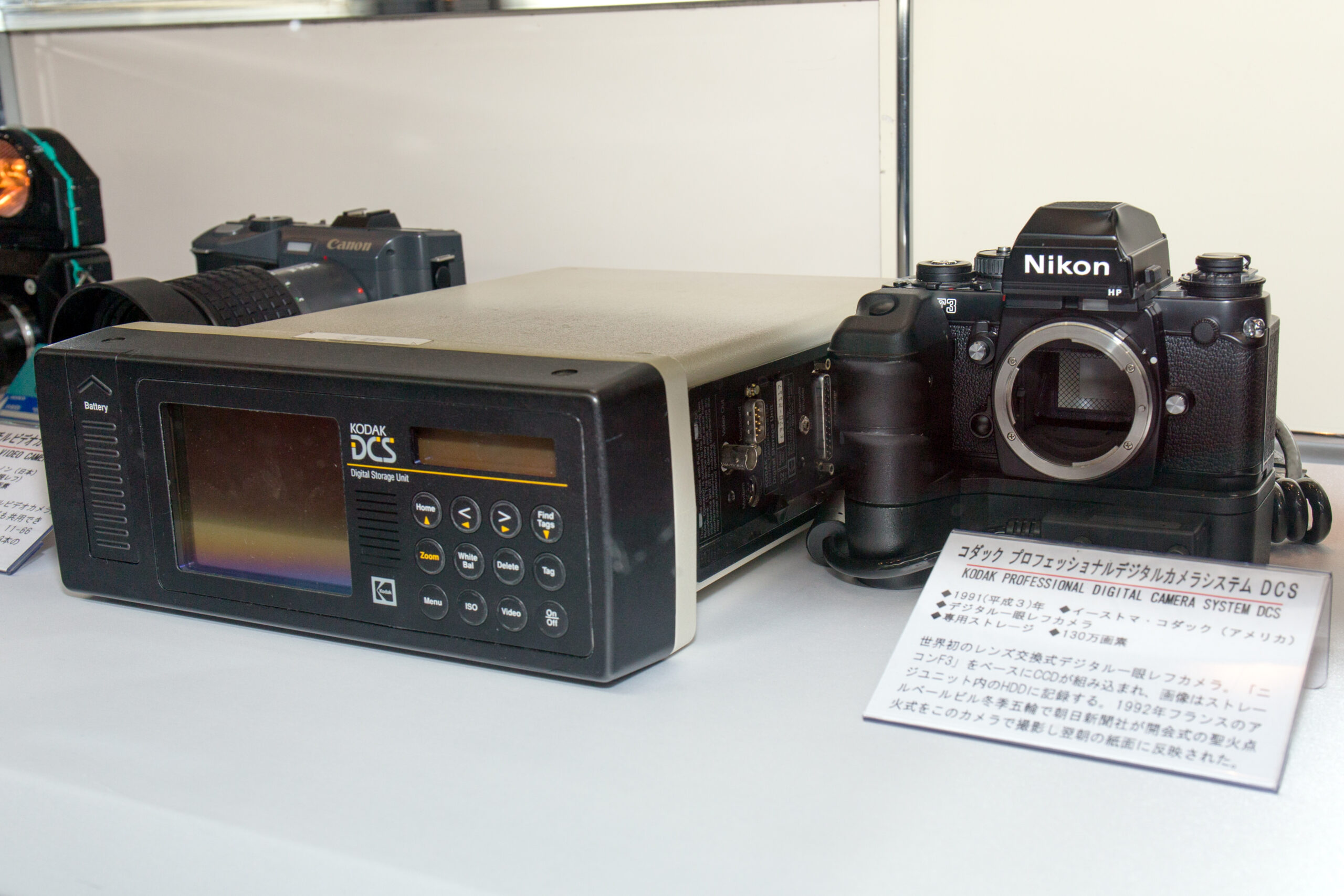
Quick Facts:
- Product: Kodak DCS 100
- Released: 1991
- Claim to fame: The first commercially available DSLR
- Camera body: Nikon F3 with a Kodak digital back
- Sensor: 1.3-megapixel CCD
- Storage: Tethered Digital Storage Unit, 200MB drive, worn on the shoulder
- Price: Around $20,000 for the system
- Production: Reportedly about 987 units
- Best for: Collectors and students of digital camera history
6 min read
In This Article
Kodak DCS 100 Overview: Where the DSLR Era Began
The Kodak DCS 100 holds a title every modern photographer should know: it was the first commercially available DSLR. Released in 1991, it proved a digital single-lens reflex camera would work as a real product, not merely a lab experiment. Because so few were built, most people have never seen one.
This was not a sleek, self-contained body. Instead, it split into two pieces, a modified Nikon film camera up front and a heavy storage box you wore on a strap. The whole system cost about as much as a new car, so only a narrow group of professionals ever used one.
If you care about how digital imaging began, this camera is the starting line. It sits at the head of a story running straight to the mirrorless body in your bag today. For anyone tracing the history of digital photography, the DCS 100 is where the modern era opens.
Specs at a Glance
| Specification | Details |
|---|---|
| Model | Kodak DCS 100 |
| Released | 1991 |
| Camera body | Nikon F3 with Kodak digital back |
| Sensor | 1.3-megapixel CCD |
| Back options | Color or monochrome |
| Storage | Tethered Digital Storage Unit, 200MB hard drive |
| Capacity | About 156 uncompressed images |
| Price | Around $20,000 |
| Production | Reportedly about 987 units |
Why the Kodak DCS 100 Counts as the First DSLR
The DCS 100 earns the first DSLR title because it married a real reflex camera to a digital sensor in a product sold on the open market. Earlier digital cameras existed as prototypes and experiments, yet none reached buyers as a working SLR system. This one did, in 1991.
A DSLR needs three things: a reflex mirror and pentaprism, interchangeable lenses, and a digital sensor in place of film. The DCS 100 delivered all three. As a result, it set the template Nikon, Canon, and others would refine for the next two decades.
Its specs look tiny now, of course. A 1.3-megapixel sensor captures far less detail than any modern phone. Still, the leap from film to a working digital SLR mattered more than the numbers, because it showed the whole industry where photography was heading.
A Nikon F3 With a Kodak Digital Back
Kodak did not build the DCS 100 from scratch. Instead, the company started with a trusted Nikon professional film body. It then replaced the film path with a Kodak digital back holding the CCD sensor. This hybrid approach let Kodak focus on the sensor and electronics rather than the whole camera.
The F3 base brought real advantages. Photographers already trusted its shutter, its viewfinder, and its huge range of F-mount lenses. Because the front of the camera felt familiar, a working pro picked it up and shot without learning a new system.
The trade-off lived around the back and below. Its digital hardware added bulk and weight. The smaller-than-35mm sensor also made lenses appear more telephoto than their markings suggested. Even so, the core shooting experience stayed pure Nikon.
The Shoulder-Worn Digital Storage Unit
The strangest part of the DCS 100 was where it kept the pictures. Memory cards did not yet exist for this job, so Kodak built a separate Digital Storage Unit, carried by the photographer on a shoulder strap. A cable ran from the camera to the box.
Inside the box sat a 200MB hard drive, which held roughly 156 uncompressed images. The unit also carried the battery and a small screen for reviewing shots. For 1991, storing 156 frames digitally felt impressive, even if the gear weighed down your shoulder all day.
This split design now looks almost comical, yet it solved a genuine problem. No compact storage existed, so the camera carried its own. The shoulder-worn drive helps explain why the DCS 100 belongs among the strangest cameras ever made.
Who Paid $20,000 for It
At around $20,000 for the full system, the DCS 100 was never a consumer product. The price put it out of reach for hobbyists, so its buyers came from a small professional world with a real need for instant digital images.
News and press shooters led the group. A photojournalist able to transmit a digital file on deadline gained a huge edge. Rivals still waited on film and darkroom time. For a wire service or major newspaper, this speed justified the cost.
Government agencies and research labs made up the rest, using instant digital images for documentation and analysis. Today those same rare bodies attract collectors, the demand lifting broader vintage camera values. For everyone else, film remained the only sensible choice in 1991.
How the Kodak DCS 100 Compares to Later Cameras
Measured against later gear, the DCS 100 looks rudimentary, and this is exactly the point. Kodak refined the DCS line for more than a decade, ending with the 13.5-megapixel DCS Pro SLR/n and SLR/c in 2004. Each step shrank the hardware and raised the resolution.
The bigger shift came when storage moved inside the camera. Once memory cards arrived, the shoulder-worn drive vanished, and digital bodies became self-contained. By the time the Canon EOS-1D and Nikon D1 matured, the DSLR had become a single, practical tool rather than a tethered rig.
So the DCS 100 reads as the rough first draft of everything after it. It belongs on any honest list of the best cameras of all time, less for its specs than for proving the idea would work at all.
Final Verdict
The Kodak DCS 100 matters far more for what it started than for what it did. As the first commercial digital SLR, it turned a lab concept into a working tool and pointed the entire industry toward digital. For students of camera history, it is a true landmark.
As a camera to use, the verdict is simple. A 1.3-megapixel sensor, a $20,000 launch price, and a hard drive on a strap make it impractical by any modern measure. Surviving units belong in collections and museums, not in working kit bags.
Even so, the DCS 100 rewards anyone curious about how digital photography grew up. It captured the exact moment film began to give way to sensors. If the story leaves you wanting to shoot something classic instead, our look at the unusual digital camera from Sigma offers a far more usable starting point.
Frequently Asked Questions
When did the Kodak DCS 100 come out?
Kodak released the DCS 100 in 1991. It is widely recognized as the first commercially available DSLR, arriving years before digital cameras reached mainstream buyers.
What made it the first DSLR?
The DCS 100 paired a reflex camera body and interchangeable lenses with a digital sensor in a product sold to the public. Earlier digital cameras stayed in the prototype stage, so this was the first DSLR sold commercially.
How many megapixels was the DCS 100?
The sensor captured 1.3 megapixels. This figure looks tiny today, yet it powered a serious professional tool in 1991, long before high-resolution digital imaging arrived.
How much did it cost?
The full system cost around $20,000. This price kept the Kodak DCS 100 limited to news agencies, government users, and other professionals who needed instant digital files.
What camera body was it based on?
Kodak built the DCS 100 on a Nikon F3 film body and added a Kodak sensor module. The familiar Nikon controls and F-mount lenses made it easier for working photographers to adopt.
How many Kodak DCS 100 units were made?
Reports put production at about 987 units. This small number, combined with its place in DSLR history, makes surviving examples sought-after collector pieces today.

