


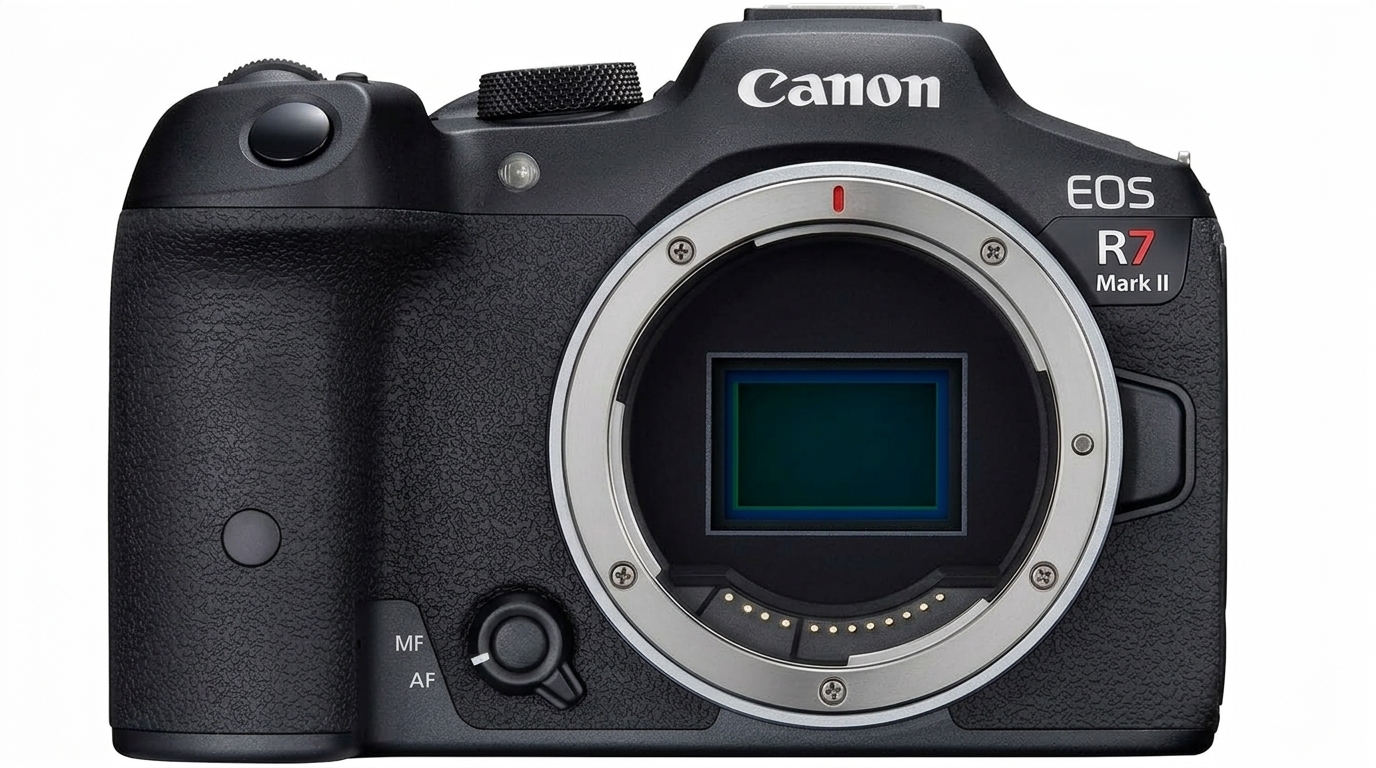
Quick Facts:
- Body: Canon EOS R7, APS-C mirrorless, RF mount
- Sensor: 32.5MP APS-C CMOS, DIGIC X processor
- Video: 4K 60p 10-bit, uncropped 4K 30p
- Burst: 15 fps mechanical, 30 fps electronic
- Stabilization: 5-axis in-body, up to 8 stops
- Storage: Dual UHS-II SD card slots
- Launch price: $1,499 in June 2022
- Used price (MPB): around $1,200 to $1,380
- R7 Mark II status: delayed, now expected early 2027
- Best for: wildlife, birding, and sports shooters who want reach on a budget
8 min read
In This Article
- Canon EOS R7 Mark II Delay: What APS-C Shooters Need to Know
- Canon EOS R7 Key Specs at a Glance
- Why Canon Pushed the R7 Mark II to 2027
- What the Rumored Canon EOS R7 Mark II Specs Tell Us
- Who the Canon EOS R7 Still Serves Best
- Buy the R7 Now vs. Wait for the Canon EOS R7 Mark II
- Final Verdict
- Frequently Asked Questions
Canon EOS R7 Mark II Delay: What APS-C Shooters Need to Know
The Canon EOS R7 Mark II will not arrive in 2026. After multiple rumor cycles pointed to a spring or summer launch, sources cited by Canon Rumors now place the announcement ahead of the CP+ show in February 2027. For APS-C wildlife and sports shooters who held off all year, the wait stretches into a fifth year since the original R7 landed in June 2022.
This news changes the math for anyone sitting on the fence. You have two clear paths. First, you wait roughly a year for a pricier, higher-spec body. Second, you buy the proven R7 today and start shooting reach-limited wildlife and sports right away.
The original R7 remains one of the strongest crop-sensor values Canon has built. Its 32.5MP sensor and 1.6x crop give telephoto reach full-frame bodies cannot match at the price. Now the successor has slipped, and used R7 prices have softened. The window for a real bargain has opened.
Below, we break down why Canon delayed the camera, what the leaked specs suggest, and which buyer should wait instead of buying now. For a deeper hands-on take, see our full Canon EOS R7 review.
Canon EOS R7 Key Specs at a Glance
Here is how the shipping R7 compares to the rumored R7 Mark II. Treat the right column as unconfirmed, since Canon has announced nothing official.
| Specification | Canon EOS R7 (available now) | R7 Mark II (rumored) |
|---|---|---|
| Sensor | 32.5MP APS-C CMOS | 39MP BSI stacked |
| Readout speed | Standard CMOS | Near R5 Mark II level |
| Electronic burst | 30 fps | 40 fps |
| Pre-capture | No | Yes (rumored) |
| Card slots | Dual UHS-II SD | SD + CFexpress Type B |
| Battery | LP-E6NH | LP-E6P |
| Price | $1,499 new, ~$1,200 used | “Much higher,” est. $2,000+ |
Skip the Wait
Grab a Used Canon EOS R7 at MPB
MPB lists inspected, warranty-backed R7 bodies from around $1,200, well below the $1,499 launch price. Stock moves fast.
Why Canon Pushed the R7 Mark II to 2027
Canon Rumors first reported the shifted timeline, and the reasons below come from its sources. Canon has confirmed nothing publicly. Three explanations stand out, and each one fits Canon’s recent behavior.
First, Canon wants its higher-margin full-frame bodies to reach buyers ahead of the crop line. The 32.5MP sensor seen in the R6 Mark III and C50 heads to the EOS R8 Mark II next. Canon is expected to launch the R8 Mark II in late August or early September 2026. Because Canon is already tooled for the sensor, more full-frame units lower production cost per unit.
Second, supply-chain and memory pressures returned across the wider tech market. Stacked sensors and CFexpress support raise component demand, and a delay gives Canon room to scale production before launch.
Third, a source notes Canon will revamp most of its APS-C lineup in 2027 rather than this year. A new APS-C video-first body sits in the same plan too. Therefore the R7 Mark II release date now anchors to a broader crop-sensor reset, not a standalone drop. APS-C buyers feel sidelined, and the forum reaction shows it.
What the Rumored Canon EOS R7 Mark II Specs Tell Us
The leaked spec sheet points to a serious step up, not a minor refresh. A 39MP BSI stacked sensor leads the list, paired with readout speed near the R5 Mark II and a DIGIC Accelerator to feed the data. A 40 fps electronic burst and pre-capture round out the action-shooting upgrades.
Those two additions matter most for wildlife. Pre-capture buffers frames before you fully press the shutter, so you keep the wingbeat you would otherwise miss. The current R7 lacks this feature, and owners name it as the single biggest gap when shooting birds in flight.
However, the same leaks signal a much higher price. The R7 launched at $1,499, while forum estimates for the successor cluster between $2,000 and $2,700. A stacked APS-C body would sit near the Fujifilm X-H2S and OM-1 Mark II on price, both of which list above $2,000. As a result, the Mark II reads less like a budget reach machine and more like a premium crop flagship.
Save Hundreds Today
A Used R7 Costs Half the Rumored Mark II
Why pay an estimated $2,000-plus next year when MPB has condition-graded R7 bodies now? Each one ships with a six-month warranty.
Who the Canon EOS R7 Still Serves Best
The R7 earns its reputation with wildlife and bird photographers first. Its 1.6x crop turns an RF 100-400mm into a 160-640mm equivalent field of view. This reach normally costs full-frame owners far pricier glass. The pairing also weighs less than many Micro Four Thirds kits, and it costs less too.
Many owners and reviewers find the R7 plus RF 100-400mm close to an R5 Mark II with the RF 100-500mm for perched birds and insects. For a budget APS-C wildlife camera, the gap to flagship results stays small in good light. To match the body with glass, see our guide to the best lenses for the R7.
Sports and action shooters also gain from the 32.5MP resolution and 30 fps electronic burst. Autofocus tracking handles court and field work well, though it trails Canon’s stacked-sensor flagships. Fast, erratic subjects expose the readout limit. Still, for most enthusiast sports work, the R7 keeps pace.
Video creators get uncropped 4K 60p in 10-bit, which suits hybrid shooters who switch between stills and clips. The compact body travels easily for run-and-gun work. For a hybrid shooter on a budget, the used R7 covers both jobs today without the Mark II premium.
Buy the R7 Now vs. Wait for the Canon EOS R7 Mark II
The decision comes down to budget, timing, and how you shoot. Buying a used Canon R7 now costs around $1,200 to $1,380 at MPB, against a launch price of $1,499. You start shooting this season instead of waiting through another rumor cycle.
Waiting for the Mark II buys you a stacked sensor, 40 fps, and pre-capture, but at an estimated $2,000 or more and no firm ship date before early 2027. If birds in flight define your work and budget is flexible, the wait has merit. For everyone else, the price gap is hard to ignore. The cheaper Canon EOS R10 covers tighter budgets, while the R7 stays the better reach tool.
History also favors patience-with-limits. Canon kept selling the original R5 well over a year after the R5 Mark II arrived. Therefore a new R7 Mark II would not erase the original overnight, and used R7 prices should hold reasonable value. For the wider lineup view, see the best Canon cameras in 2026.
Final Verdict
The Canon EOS R7 Mark II delay frustrates APS-C fans, yet it hands today’s buyer a clear opening. If you shoot wildlife, birds, or enthusiast sports and want telephoto reach without full-frame cost, the original R7 still answers the brief in 2026. Its 32.5MP sensor and 1.6x crop remain a reach bargain.
Buyers with deep pockets and a birds-in-flight focus have reason to wait. Pre-capture and a 40 fps stacked sensor would lift hit rates on erratic subjects. However, the rumored $2,000-plus price and a launch no sooner than early 2027 ask a lot of patience for uncertain timing.
On value, the used R7 wins for most readers. A condition-graded body near $1,200 undercuts the new launch price and roughly halves the rumored successor cost. You also gain a year of shooting you would otherwise lose to waiting.
Our recommendation: buy a used R7 now and pair it with the RF 100-400mm for wildlife. Keep the body as a backup later if the Mark II tempts you. New owners should start with a first-day R7 setup guide to dial in autofocus and stabilization fast.
Ready to Buy?
Check Today’s Price on the Canon EOS R7
MPB inspects every body, grades its condition honestly, and backs each sale with a six-month warranty and free shipping.
Frequently Asked Questions
When will the Canon EOS R7 Mark II be released?
Sources now point to an announcement ahead of the CP+ show in February 2027, with a first-quarter 2027 reveal as the working estimate. Earlier reports targeted 2026, but the timeline shifted. Canon has confirmed no R7 Mark II release date officially.
Why did Canon delay the R7 Mark II?
Sources cite three reasons: Canon prioritizing higher-margin full-frame bodies first, renewed supply-chain and memory pressure, and a wider APS-C lineup revamp moved to 2027. None of these come from Canon directly, so treat them as informed speculation.
Is the Canon EOS R7 still worth buying in 2026?
Yes, for wildlife, birding, and enthusiast sports. The 32.5MP sensor and 1.6x crop deliver telephoto reach at a low price. As an APS-C wildlife camera, it still outperforms most rivals near its cost. With the successor delayed, a used Canon R7 near $1,200 is one of the strongest crop-sensor values available.
How much will the Canon EOS R7 Mark II cost?
Canon has set no price. The R7 launched at $1,499, while leaks describe the Mark II as “much higher.” Forum estimates cluster between $2,000 and $2,700, in line with stacked-sensor rivals like the Fujifilm X-H2S and OM-1 Mark II.
Should I buy the Canon EOS R7 now or wait for the Mark II?
If budget matters and you want to shoot this season, buy the R7 now. If pre-capture and a 40 fps stacked sensor define your wildlife work and budget is flexible, the wait has merit. Most buyers come out ahead with the used R7.
Is the used Canon EOS R7 a good deal?
A used Canon R7 from a graded seller like MPB runs around $1,200 to $1,380, below the $1,499 launch price. Each body ships inspected and warranty-backed, so the risk stays low compared with private sales.

