


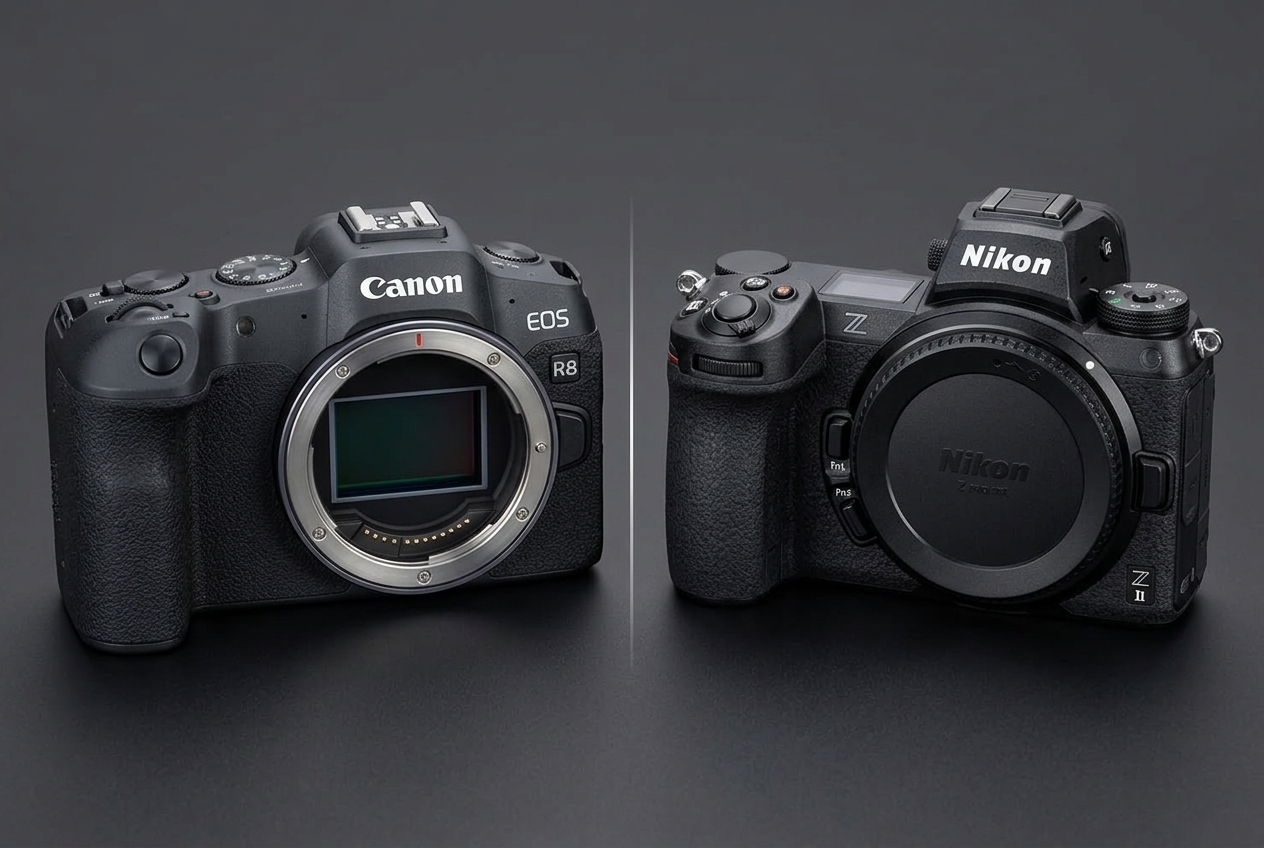
Quick Facts:
- Cameras: Canon EOS R8 vs Nikon Z5 II
- Sensor: R8 24.2MP CMOS / Z5 II 24.5MP BSI CMOS
- In-body stabilization: R8 none / Z5 II rated 7.5 stops
- Burst: R8 up to 40 fps electronic / Z5 II 11 fps mechanical, 30 fps JPEG
- Video: Both shoot 4K up to 60p (Z5 II crops 1.5x at 60p)
- Card slots: R8 single UHS-II SD / Z5 II dual UHS-II SD
- Weight with battery: R8 461g / Z5 II about 700g
- Price (new, 2026): R8 around $1,449 / Z5 II around $1,597
- Best for: Anyone weighing the Canon R8 vs Nikon Z5 II for a first full-frame body
8 min read
In This Comparison
Canon R8 vs Nikon Z5 II Overview: Two Roads Into Full Frame
The Canon R8 vs Nikon Z5 II question lands on every beginner’s shortlist in 2026, because both bodies put a 24-megapixel full-frame sensor within reach of first-time buyers. Canon aims the EOS R8 at photographers who want one of the lightest, fastest bodies for the money. Nikon, on the other hand, built the Z5 II around features once reserved for pricier cameras, including in-body stabilization and a brighter viewfinder.
These two cameras chase the same shopper, yet they solve the problem in opposite ways. The R8 strips weight and adds speed, while the Z5 II layers on hardware comfort and stability. For full transparency, I shot Nikon for 17 years before moving to Canon in 2020. I love my Canon bodies and their color science, although I still respect what Nikon engineers keep delivering at this price.
This guide lays out the specs side by side so you reach your own verdict. Rather than crown a single winner, I will show where each camera pulls ahead. Both rank among contenders for the best entry-level full frame camera on sale in 2026. If you want broader context first, our roundup of the best mirrorless cameras for beginners frames where these two sit in the wider market.
Key Specs at a Glance
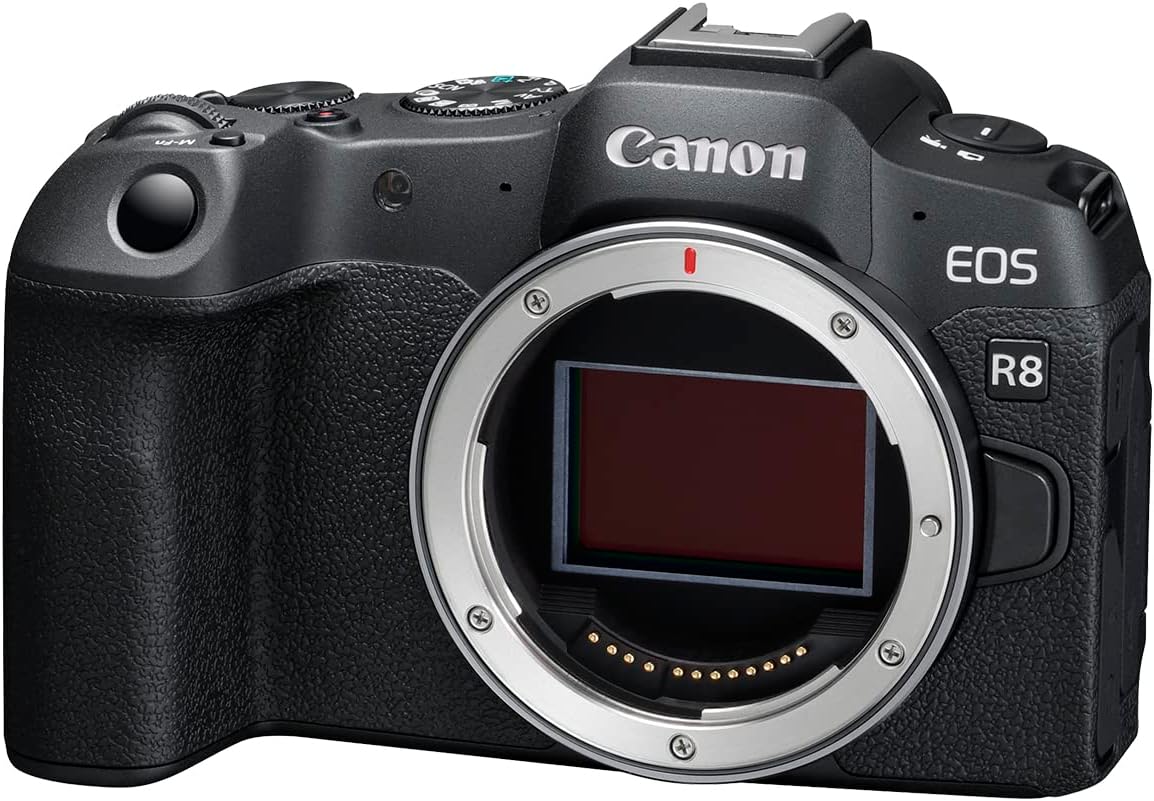
Before the deep dive, here is the side-by-side picture. The table below pulls the headline numbers buyers compare first. For a full breakdown of the Canon EOS R8 specs, our dedicated full Canon EOS R8 review goes further than this summary. The Nikon Z5 II specs sit in the same column for direct comparison.
| Specification | Canon EOS R8 | Nikon Z5 II |
|---|---|---|
| Sensor | 24.2MP full-frame CMOS | 24.5MP full-frame BSI CMOS |
| Processor | DIGIC X | EXPEED 7 |
| In-body stabilization | None | 5-axis, rated 7.5 stops |
| Burst (electronic) | Up to 40 fps | Up to 30 fps JPEG / 15 fps raw |
| Burst (mechanical) | 6 fps (electronic 1st curtain) | 11 fps |
| Video | 4K up to 60p, uncropped, 10-bit C-Log3 | 4K up to 60p (1.5x crop), 10-bit N-Log |
| Viewfinder | 2.36M-dot, 0.70x | 3.69M-dot, 0.8x, up to 3000 nits |
| Card slots | Single SD (UHS-II) | Dual SD (UHS-II) |
| Battery / CIPA | LP-E17, about 220-370 shots | EN-EL15c, about 330-380 shots |
| Weight (with battery) | 461g | About 700g |
| Price (new, 2026) | Around $1,449 | Around $1,597 |
Shop Used and Save
Find the Canon EOS R8 at MPB
MPB lists graded used and refurbished R8 bodies with a six-month warranty, often well below the new price.
Sensor and Image Quality
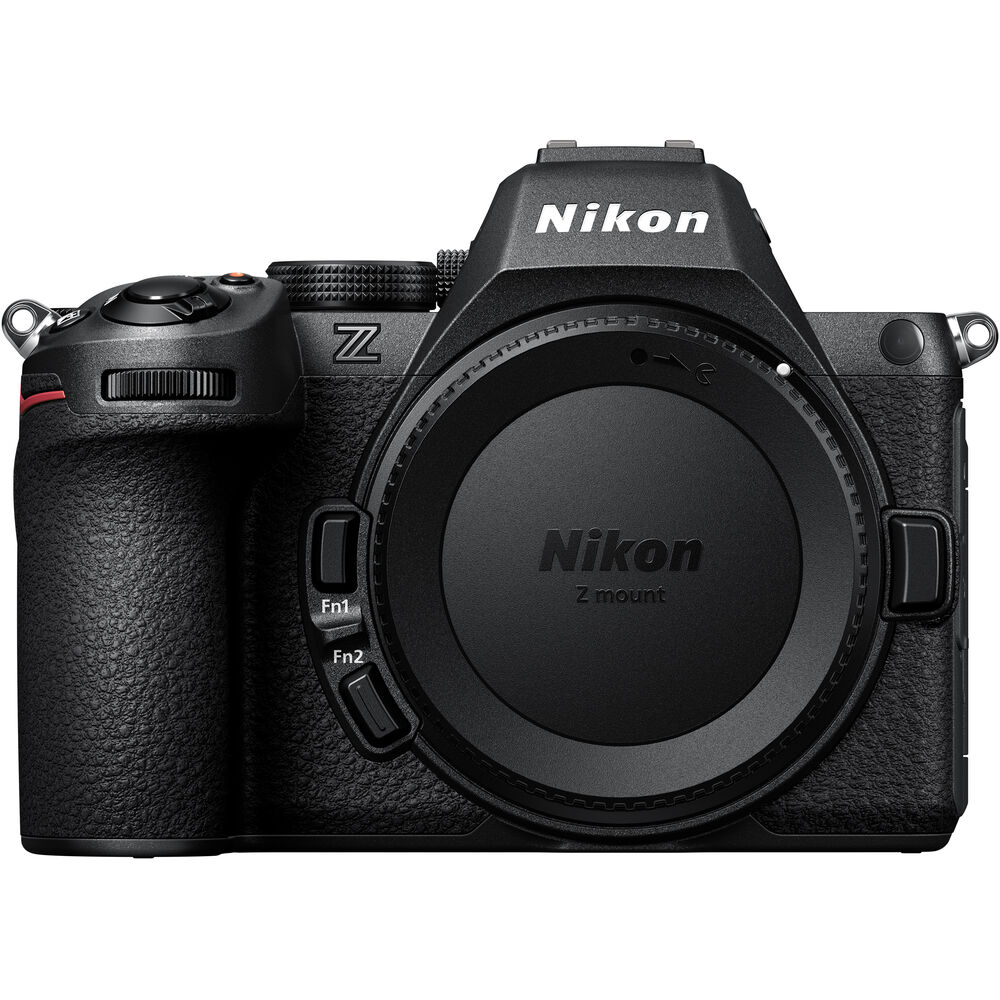
Image quality starts close to even. The R8 carries the same 24.2MP sensor found in Canon’s pricier EOS R6 Mark II, so files hold strong detail and clean shadows up to ISO 6400. Canon’s color science also gives skin tones a warm rendering many portrait shooters prefer straight out of camera.
Nikon answers with a 24.5MP backside-illuminated sensor paired to the EXPEED 7 processor from the Z8 and Z9. Because the design is backside-illuminated, the Z5 II gathers light efficiently and delivers wide dynamic range for landscapes. In side-by-side raw files, the two trade tiny advantages rather than separate by a wide margin.
For most prints and web work, you will struggle to pick a winner on resolution alone. Therefore the decision rarely turns on the sensor. On paper the Canon EOS R8 specs and the Nikon Z5 II specs read nearly identical for resolution. Instead, the features wrapped around each sensor settle the contest, as the next sections show. Budget shoppers should still weigh the Nikon Z5 II price against the R8 before deciding.
Autofocus and Burst Speed
Autofocus is where both cameras flex modern technology. Canon’s Dual Pixel CMOS AF II covers nearly the full frame and locks onto people, animals, and vehicles with quick, confident tracking. The R8 also pushes up to 40 fps with its electronic shutter, which suits sports and wildlife bursts when light allows.
Nikon built the Z5 II around the same deep-learning autofocus engine as the flagship Z8. As a result, it recognizes nine subject types and tracks erratic motion with impressive stickiness. Mechanically it shoots 11 fps, and the electronic mode reaches 30 fps for JPEG capture.
Speed numbers favor the R8 on paper, yet the Z5 II often feels steadier in practice because of its deeper buffer and dual-slot write speed. For a fast-moving toddler or a backyard bird, either body keeps pace. Action shooters who chase frame rate lean Canon, while those who value subject-recognition consistency lean Nikon.
Stabilization and Video
Stabilization marks the single biggest split between these two. The Nikon Z5 II includes 5-axis in-body image stabilization rated up to 7.5 stops, so handheld shots at slow shutter speeds stay sharp. Canon, by contrast, gives the R8 no in-body stabilization at all, leaving correction to the lens or to digital cropping in video.
This gap matters most for handheld low-light stills and run-and-gun video. With the Z5 II, you steady a half-second exposure of a dim interior without a tripod. With the R8, you lean on a stabilized RF lens or raise ISO instead.
Video specs run closer than you might expect. Both cameras record 4K up to 60p with 10-bit log profiles for grading. Notably, the R8 keeps its 4K/60 footage uncropped, while the Z5 II applies a 1.5x crop at 60p and shoots full-width only at 30p. Vloggers who hold the camera at arm’s length still favor the Z5 II, since its sensor stabilization smooths walking footage the R8 cannot match without a gimbal. Independent testing at DPReview notes the same crop and rolling-shutter trade-offs.
Today’s Best Deal
Browse the Nikon Z5 II at MPB
Compare graded Z5 II bodies and save on a stabilized full-frame kit with MPB’s used inventory and warranty.
Handling, Battery, and Storage
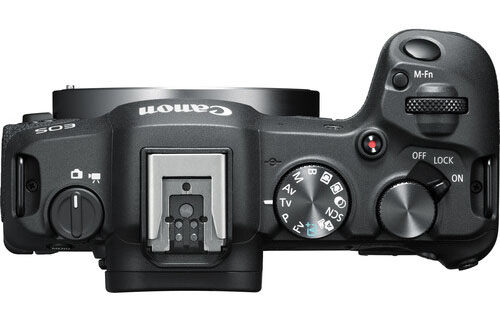
Handling separates these bodies in the hand. The R8 weighs only 461g with a battery and card, so it disappears in a small bag for travel. However, its slim grip and single command setup feel cramped for shooters with larger hands or heavy lenses.
The Z5 II tips the scale near 700g, yet the extra mass buys a deeper grip, more direct controls, and a brighter 3.69M-dot viewfinder rated up to 3000 nits. Because of the brighter panel, you frame clearly in harsh sunlight where the R8’s dimmer finder struggles.
Storage and power also favor Nikon. The Z5 II writes to dual UHS-II SD cards, which gives instant backup for weddings or paid work. Meanwhile the R8 uses a single SD slot and the smaller LP-E17 battery, so spare cells become essential on a full day out. The Z5 II’s EN-EL15c lasts noticeably longer between charges.
Canon R8 vs Nikon Z5 II: Which Should You Buy?

The Canon R8 vs Nikon Z5 II choice comes down to three trade-offs: weight, stabilization, and budget. The R8 wins on portability and burst speed, and it costs less. For a hiker, a street shooter, or a second body, those wins carry real weight.
The Z5 II answers with in-body stabilization, dual card slots, a brighter viewfinder, and longer battery life. For event work, handheld low light, or video, those features justify the higher price and the extra grams. The current Canon EOS R8 price sits around $1,449 new. Meanwhile the Nikon Z5 II price runs near $1,597, so roughly $150 separates them before lens choices.
Lens ecosystems factor in too. Canon’s RF lineup is broad but limits third-party autofocus options, whereas Nikon’s Z mount now welcomes Sigma and Tamron glass. If you already own one brand’s lenses, brand loyalty often outweighs every spec on the chart.
Pros and Cons
Here is each camera distilled to its strongest selling points and its real drawbacks. Use these grids as a fast gut check against your own shooting style.
Canon EOS R8
Pros
- Compact and light at 461g with battery and card
- Proven 24.2MP sensor from the EOS R6 Mark II
- Up to 40 fps electronic burst for action
- Uncropped 4K/60 video with 10-bit C-Log3
- Lower price, around $1,449 new in 2026
Cons
- No in-body image stabilization
- Short battery life from the small LP-E17
- Single card slot limits instant backup
- Lower-resolution 2.36M-dot viewfinder
Nikon Z5 II
Pros
- 5-axis IBIS rated up to 7.5 stops
- Z8-derived autofocus with nine subject types
- Dual UHS-II SD slots for backup
- Bright 3.69M-dot viewfinder up to 3000 nits
- Longer battery life from the EN-EL15c
Cons
- Heavier body near 700g with battery
- 1.5x crop when shooting 4K at 60p
- Higher price, around $1,597 new
- Video autofocus less dependable than stills
Final Verdict
The Canon EOS R8 fits the photographer who prizes a light kit and fast frames above all else. If you hike, travel, or shoot street work where every gram counts, its 461g body and 40 fps burst make a compelling case. Its lower price leaves room in the budget for a quality RF lens.
The Nikon Z5 II suits the shooter who wants stability and security baked in. With 7.5 stops of IBIS, dual card slots, and a brighter viewfinder, it handles handheld low light and paid events with confidence the R8 cannot match. Those gains cost about $150 more and roughly 240 extra grams.
On pure value, the Z5 II delivers more hardware per dollar, while the R8 delivers more speed per gram. Neither choice is wrong, since both produce excellent full-frame files from a 24-megapixel sensor. Your shooting style, not the spec sheet, should settle the decision.
If you remain unsure, read our hands-on Canon EOS R8 review and our Nikon Z5 II vs Sony A7C II comparison for deeper context before you commit.
Ready to Buy?
Check Today’s Price on the R8 and Z5 II
Compare graded used bodies for both cameras at MPB, each backed by a six-month warranty and free shipping.
Frequently Asked Questions
Is the Nikon Z5 II better than the Canon R8?
It depends on your needs. The Z5 II adds in-body stabilization, dual card slots, and a brighter viewfinder, so it suits event and low-light work. The R8 is lighter and cheaper, which favors travel and fast bursts.
Does the Canon R8 have in-body image stabilization?
No. The R8 has no in-body stabilization and relies on stabilized RF lenses or digital correction in video. The Nikon Z5 II includes 5-axis IBIS rated up to 7.5 stops, a clear advantage for handheld shooting.
What is the price difference between the Canon R8 and Nikon Z5 II?
In 2026 the Canon EOS R8 price sits around $1,449 new, while the Z5 II runs near $1,597. Roughly $150 separates them before lenses. Used bodies at MPB narrow the gap further.
Which is better for travel photography?
The Canon R8 leads for travel because it weighs only 461g with a battery and slips into a small bag. However, the Z5 II’s stabilization helps if you shoot handheld at night or want steadier video on the road.
Which camera is the best entry-level full frame camera for video?
Both shoot 4K up to 60p with 10-bit log profiles. The R8 keeps 4K/60 uncropped, while the Z5 II crops 1.5x at 60p but stabilizes footage in-body. Handheld vloggers favor the Z5 II; rig and gimbal users favor the R8.
How does battery life compare between the R8 and Z5 II?
The Z5 II lasts longer thanks to its larger EN-EL15c battery, rated around 330 to 380 shots. The R8 uses the smaller LP-E17 and rates roughly 220 to 370 shots, so spare batteries help on long days.

