


Quick Facts:
- Patent: Canon RF 50mm F1.2 patent application P2026101032
- Published: June 22, 2026 (filed December 10, 2024)
- Lenses shown: 50mm F1.2, 80mm F1.2, 35mm F1.4, 20-40mm F4 zoom, 100-400mm zoom
- Core tech: Composite optical elements (glass with aspherical resin layers)
- 50mm F1.2 length: 96.19mm optical total length
- 80mm F1.2 length: 117.62mm optical total length
- Mount: Presumed RF full-frame (21.64mm image height)
- Status: Patent application, not an announced product
- Best for: Canon RF shooters tracking future fast primes
8 min read
In This Article
- Canon RF 50mm F1.2 Patent Overview
- What the Filing Describes
- How Composite Resin Elements Cut Weight
- The 50mm F1.2: Shorter Than Today’s L
- An 80mm F1.2 Would Be New Territory
- Canon RF 50mm F1.2 Patent vs the Current L Lens
- Patent vs Product: How Likely Is a Release?
- What This Means for Canon Shooters
- Frequently Asked Questions
Canon RF 50mm F1.2 Patent Overview: What Canon Filed
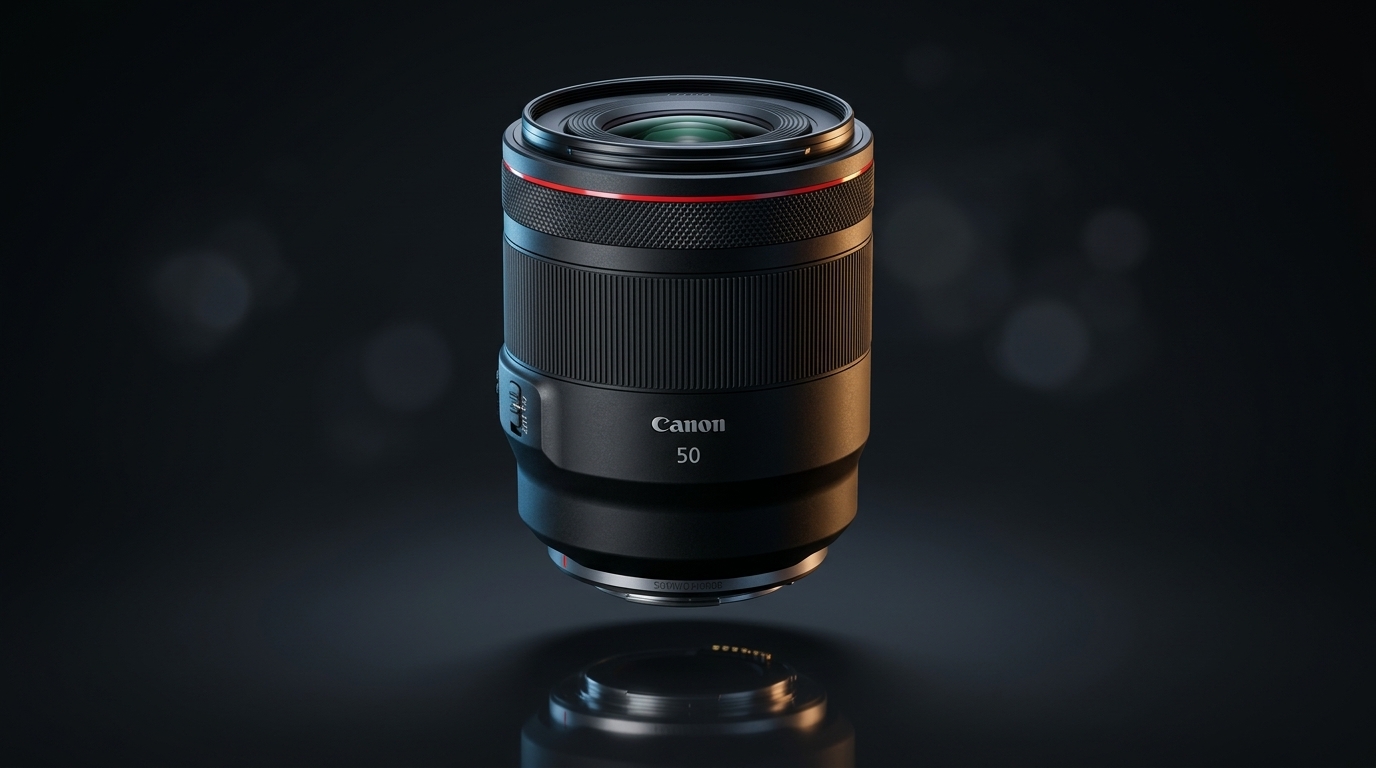
A new Canon RF 50mm F1.2 patent has surfaced, and it points toward lighter, more compact fast primes for the RF mount. Canon filed the application on December 10, 2024, and the Japan Patent Office published it on June 22, 2026 as application P2026101032. The Japanese camera site asobinet reported it first.
The filing covers several optical designs. Among them sit a 50mm F1.2, an 80mm F1.2, a 35mm F1.4, a wide 20-40mm F4 zoom, and a long 100-400mm zoom. Each design uses the same core idea: a composite optical element built from glass and an aspherical resin layer. Canon points to this construction as a route to shorter, lighter lenses.
For RF shooters, the 50mm and 80mm F1.2 examples stand out most. Both reach a true F1.24 aperture in the patent data. Both also fill a full-frame image circle, since the image height of 21.64mm matches Canon’s full-frame sensors. The patent never names the mount. Still, full-frame coverage plus Canon’s current lineup makes RF the obvious target.
What the Filing Describes
Canon frames the problem in plain engineering terms. Designers want shorter, lighter optical systems. To get there, they strengthen the refractive power of each element. Stronger elements introduce aberrations, so aspherical surfaces correct the errors. Specifically, a composite optical element adds an aspherical resin layer onto a glass lens to deliver this correction.
The filing also sets a quality rule for these elements. Both the object-side resin lens and the image-side resin lens should carry aspherical surfaces. Splitting the asphericity across two surfaces keeps the shape of any single surface modest. As a result, the element resists deformation when temperature or humidity shifts. For a fast prime, this added stability protects sharpness in the field.
Below are the headline numbers from the most relevant embodiments. Remember, these figures describe optical total length, measured from the front surface to the image plane, rather than the finished barrel length.
| Embodiment | Focal length | F number | Optical total length | Back focus |
|---|---|---|---|---|
| 50mm F1.2 (Ex. 1) | 51.70mm | 1.24 | 96.19mm | 37.67mm |
| 80mm F1.2 (Ex. 5) | 80.80mm | 1.24 | 117.62mm | 42.06mm |
| 35mm F1.4 (Ex. 8) | 34.80mm | 1.45 | 117.82mm | 22.13mm |
| 20-40mm F4 zoom (Ex. 9) | 20.6-38.8mm | 4.1-6.2 | 101.91mm | 22.06mm |
| 100-400mm zoom (Ex. 13) | 102.6-388mm | 5.8-8.2 | 179.9-258.7mm | 38.5-102.1mm |
Shop Used at MPB
Want a Canon RF 50mm F1.2L Today?
Skip the wait for a patent and buy the current RF 50mm F1.2L USM used. MPB prices sit well below new, and every lens includes a six-month warranty.
How Composite Resin Elements Cut Weight
Those numbers come from one core idea. First, a composite optical element bonds a thin resin layer onto a glass lens, then molds an aspherical profile into the resin. The glass supplies the base curvature and durability. Meanwhile, the resin shapes the precise aspherical surface needed for correction. This pairing reaches a complex profile without grinding a large block of optical glass.
In addition, weight follows from the material choice. Optical resin weighs far less than the equivalent volume of high-index glass. Because the resin handles the demanding aspherical shape, designers lean on fewer or smaller heavy glass aspheres. Fewer big glass elements lower the overall mass of the lens.
Length benefits too. Stronger, well-corrected elements bend light over a shorter distance, so the optical stack shrinks. The patent pairs both goals openly: shorter total length and reduced weight. For an F1.2 prime, where glass volume climbs fast, those savings matter the most. To learn how Canon already applies specialized optics to fix color errors, see our explainer on how Canon’s BR optics work.
The 50mm F1.2: Shorter Than Today’s L
The 50mm embodiment is the headline act. Its optical total length reads 96.19mm, measured from the front element to the sensor. By comparison, the current Canon RF 50mm F1.2L USM ships in a 108mm barrel and weighs roughly 950 grams. These two figures are not identical measures, so treat the gap with care. Even so, a 96mm optical stack leaves little room for a barrel longer than today’s lens, which points to a more compact build.
Weight tells a similar story, though with a caveat. The patent does not list a finished weight for any example. Instead, it states weight reduction as a design goal and shows the composite-element method for reaching it. So the lighter framing rests on Canon’s own stated intent plus the resin construction, not on a published gram figure.
A shorter, lighter RF 50mm F1.2 would address the main complaint about the current lens. Many shooters love its rendering yet leave it at home because of bulk. For more on the size trade-off at this aperture, read our take on whether an f/1.2 lens is overkill. If you want the full picture on the current optic, our RF 50mm f/1.2L USM review covers its strengths in detail.
An 80mm F1.2 Would Be New Territory
Meanwhile, the 80mm F1.2 example raises eyebrows for a different reason. Canon already sells an RF 85mm F1.2L USM, a portrait favorite near 1,195 grams and 117mm long. An 80mm focal length would be new ground for the RF system, sitting slightly wider than the 85mm classic.
The patent lists a 117.62mm optical total length for the 80mm F1.2. On paper, the length sits close to the existing 85mm L. The focal difference is small, yet meaningful. Portrait shooters often prize the extra working room of 85mm, while event and wedding shooters sometimes prefer the tighter framing flexibility of a slightly shorter tele.
Whether Canon ships an 80mm rather than refreshing the 85mm remains open. For now, the example proves the composite method scales up to a short telephoto F1.2 design. If you want to understand why this focal range earns so much love, our guide on reasons you need an 85mm lens breaks down the portrait case.
Canon RF 50mm F1.2 Patent vs the Current L Lens
The clearest way to read the Canon RF 50mm F1.2 patent is side by side with the lens it might replace. The current RF 50mm F1.2L USM is a superb but heavy optic. The patent design targets the same aperture with a leaner build. Below sits a direct contrast of the headline figures.
| Spec | Patent 50mm F1.2 | RF 50mm F1.2L USM |
|---|---|---|
| Aperture | F1.24 | F1.2 |
| Length | 96.19mm (optical) | ~108mm (barrel) |
| Weight | Not listed (goal: lighter) | ~950g |
| Key tech | Composite resin aspheres | Ground glass aspheres, UD element |
Notably, two differences drive the story. First, the patent length trends shorter even before barrel hardware. Second, the composite method aims to trim weight where the current lens carries the most glass. Together, they sketch a 50mm F1.2 built for travel and long shooting days, not only studio work.
One honest unknown clouds the comparison. Optical performance at the extremes of an F1.2 design is hard to judge from patent tables alone. The current L lens sets a high bar for bokeh and corner control. So a lighter successor would still need to match the current rendering before most owners trade up.
Trade Up With MPB
Shopping Canon RF Fast Primes?
Compare used prices on the RF 50mm F1.2L and RF 85mm F1.2L at MPB. Selling your old glass first helps offset the cost.
Patent vs Product: How Likely Is a Release?
Patents demand a reality check. Camera makers file far more optical designs than they ship. A Canon lens patent like this one protects ideas or tests approaches with no product behind them. So the Canon RF 50mm F1.2 patent proves research interest, not a launch date.
Several signals still raise the odds here. Canon grouped five practical focal lengths under one method, from a 35mm F1.4 to a 100-400mm zoom. Broad coverage hints at a platform technology rather than a one-off experiment. Moreover, the weight problem at F1.2 is real and well known, so a lighter solution carries clear market value.
Treat timing with caution all the same. Published filings often date back 18 months or more by the time we read them. Even a serious program needs years from filing to store shelves. For now, watch the rumor channels and treat any ship date as speculation.
What This Means for Canon Shooters
This Canon RF 50mm F1.2 patent matters because it targets the single biggest knock against fast Canon primes: weight. The composite resin element method offers a credible path to shorter, lighter optics without dropping to a slower aperture. For anyone who admires the look of F1.2 yet resents the heft, the direction is encouraging.
Temper the excitement with patience. No weight figure appears in the Canon lens patent, no mount is confirmed, and no product has been announced. The 80mm F1.2 in particular might never reach a catalog, since Canon already covers the portrait slot with the RF 85mm F1.2L.
Value sits in the signal, not a purchase decision. Canon is actively working on lighter F1.2 glass, and the engineering looks sound. If you shoot RF and crave a travel-friendly fast fifty, this is the most promising hint in a while.
My advice is simple. Keep using your current glass, and avoid holding out for a lens with no release date. Should Canon ship a sub-900-gram 50mm F1.2, revisit the math then. Until then, the current RF 50mm F1.2L USM remains the real-world choice for Canon’s fastest standard prime.
Frequently Asked Questions
What is the Canon RF 50mm F1.2 patent?
It is Canon patent application P2026101032, published June 22, 2026 and filed December 10, 2024. The filing describes fast prime and zoom designs built with composite resin optical elements. A 50mm F1.2 with a 96.19mm optical total length is the headline example.
Is the Canon RF 80mm F1.2 a real product?
No. The Canon RF 80mm F1.2 appears only as a patent embodiment, not as an announced lens. Canon already sells an RF 85mm F1.2L USM, so an 80mm version might stay a design study. Still, the filing proves the method works at this focal length.
Will the new lenses be lighter than the current RF 50mm F1.2L?
The patent states weight reduction as a goal and shows the method, but it lists no finished weight. The 96.19mm optical length trends shorter than the current lens. So lighter looks likely in principle, though no gram figure is confirmed yet.
What is a composite optical element?
A composite optical element bonds an aspherical resin layer onto a glass lens. The glass gives base curvature and strength, while the resin forms the precise aspherical surface. This approach reduces weight and helps shorten the optical design.
Is a new RF 50mm F1.2 coming soon?
Not necessarily. A Canon lens patent shows research, not a release date. Canon files many designs it never sells. Published filings also lag the original filing by a year or more, so any timeline is speculation for now.
Which mount do these lenses use?
The patent does not name a mount. Each example fills a full-frame image circle with a 21.64mm image height, which matches Canon’s full-frame sensors. RF is the logical target given Canon’s current mirrorless lineup.
Source: asobinet patent report (Japan Patent Application P2026101032).

