


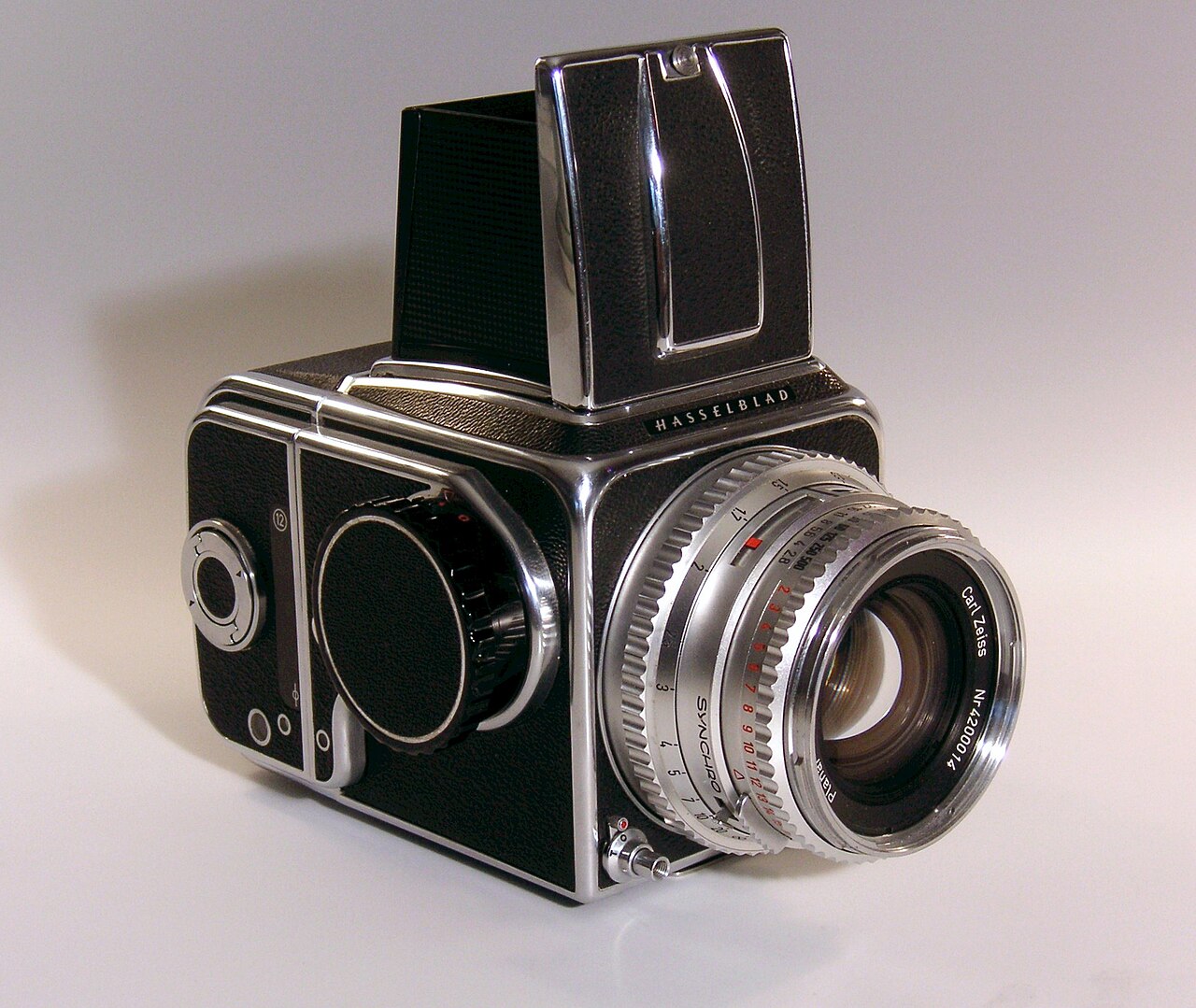
Quick Facts:
- Product: Hasselblad 500C “Space Camera”
- Owner: Astronaut Walter “Wally” Schirra
- Flew: Mercury-Atlas 8 (Sigma 7), October 1962
- Lens: 80mm Carl Zeiss Planar f/2.8
- Modifications: Leatherette stripped, metal painted matte black
- Bought: Off the shelf at a Houston camera shop
- Significance: Began the long Hasselblad-NASA partnership
- Sold for: $281,250 with buyer’s premium (2014)
6 min read
In This Article
Hasselblad 500C Space Camera Overview: The Camera That Went to Orbit
The Hasselblad 500C “Space Camera” is rare for a reason no production number can capture. It went to space. Astronaut Walter “Wally” Schirra carried this medium format Hasselblad into Earth orbit aboard the Mercury-Atlas 8 mission in 1962, and that single flight turned an off-the-shelf camera into a historic artifact.
What makes the story remarkable is how ordinary the camera started out. Schirra did not receive a custom NASA instrument. He walked into a Houston camera shop and bought a standard 500C with an 80mm Zeiss Planar lens, then prepared it himself for the conditions of spaceflight.
That decision shaped the next sixty years of space photography. The flight began Hasselblad’s long association with NASA, a partnership that later put the brand’s cameras on the Moon. Among the rarest and most storied cameras ever made, this one earns its place through history rather than scarcity.
Specs at a Glance
| Specification | Details |
|---|---|
| Model | Hasselblad 500C |
| Type | 6×6 medium format SLR |
| Lens | 80mm Carl Zeiss Planar f/2.8 |
| Shutter | Leaf shutter in lens |
| Astronaut | Walter “Wally” Schirra |
| Mission | Mercury-Atlas 8 (Sigma 7), 1962 |
| Modifications | Leatherette removed, body painted matte black |
| Auction price | $281,250 with premium (2014) |
Why the Hasselblad 500C Space Camera Is Rare for Where It Went
Most cameras on this list are scarce because few were built. This one is different. Hasselblad produced the 500C in large numbers from 1957 onward, so the model itself is not hard to find. Its value comes entirely from provenance.
Provenance is the documented history of an object, and this camera has the best kind. It can be tied to a specific astronaut, a specific mission, and a specific moment in the history of spaceflight. That chain of evidence is what separates a $1,000 collectible from a six-figure one.
Collectors treat space-flown hardware as a category of its own. An object that left the planet and came back carries a weight no factory rarity can match. In any ranking of the most significant cameras ever made, the first Hasselblad in orbit stands apart for what it witnessed.
How Schirra Prepped the Hasselblad 500C Space Camera
The changes Schirra made were practical, not glamorous. He stripped the leatherette covering off the body, then painted the exposed metal matte black. Both steps had the same goal: cut down reflections that could bounce around the cramped capsule and ruin photographs through the window.
Weight and simplicity guided the rest. A spacecraft cabin has no room for bulk, so a stripped camera was easier to handle in a pressurized suit and a confined space. The leaf shutter built into the Zeiss lens also helped, since it ran smoothly without the mirror slap of a focal-plane design.
The approach reflected the era. Early Mercury missions improvised hardware that later programs would formalize, so an astronaut modifying a store-bought camera by hand fit the moment perfectly. The medium format negative, far larger than 35mm, gave NASA the detail it wanted from those first orbital frames.
Aboard Sigma 7 in 1962
Schirra flew the camera on Mercury-Atlas 8, the mission he named Sigma 7, in October 1962. He was the fifth American in space and one of the original Mercury 7 astronauts, and his flight focused on engineering precision over spectacle.
Photography was part of the plan. Schirra used the Hasselblad to capture views of Earth from orbit, adding to a small but growing body of images that showed the planet from above. Those frames helped prove that a quality camera could deliver scientific and public value from space.
The camera’s service did not end with Schirra. Reports tie the same 500C and lens to astronaut Gordon Cooper, who flew the following Mercury mission, Mercury-Atlas 9. That continued use deepened the camera’s place in the early record of human spaceflight, a thread worth setting against the broader history of photography.
The Hasselblad 500C Space Camera and the NASA Partnership
This flight opened a long relationship. NASA saw what the Swedish medium format system could do, and Hasselblad cameras became a fixture of the space program through Gemini and Apollo. The choice that began with one astronaut and one store-bought body grew into an institutional standard.
The collaboration produced some of the most famous photographs ever taken. Hasselblad cameras recorded the lunar surface during the Apollo landings, and the brand’s name is now permanently linked to that imagery. The partnership’s roots, though, trace back to a 500C bought in Texas.
That origin story is part of the camera’s appeal. It shows how a single practical decision can ripple outward for decades. The first Hasselblad in orbit was not designed for the role it ended up playing, which makes its influence all the more striking.
The $281,250 Hasselblad 500C Space Camera Sale
The camera surfaced on the collector market through RR Auction, which specializes in space and historical artifacts. When it crossed the block in 2014, it drew the kind of attention reserved for genuine flown hardware with clear provenance.
The result confirmed its status. The Hasselblad sold for a hammer price of $275,000, which came to $281,250 once the buyer’s premium was added, and it went to a collector in the United Kingdom. For a camera anyone could have bought new for a modest sum in 1962, that is a remarkable return.
The price tracked the story, not the specs. Buyers were paying for a documented piece of spaceflight history, complete with its mission link and supporting records. That premium on provenance runs through the wider market, where even earthbound classics command rising sums, as our look at vintage camera values explains.
Final Verdict
The Hasselblad 500C Space Camera proves that history can outweigh rarity. The model was common, yet this single example is priceless in cultural terms because of where it traveled and what it began. For collectors of spaceflight and photography alike, few objects carry a stronger story.
The lesson for camera lovers is a hopeful one. The hardware that made history was not exotic. It was a well-built, widely sold medium format camera, prepared with a knife and a can of black paint, then trusted to do a serious job in an unforgiving place.
That blend of the ordinary and the extraordinary is what makes the camera endure. It links a Houston camera shop to the edge of space and the surface of the Moon. Among rare and remarkable cameras, the first Hasselblad in orbit holds a place that no production figure could ever buy.
Frequently Asked Questions
What is the Hasselblad 500C Space Camera?
It is the Hasselblad 500C medium format camera that astronaut Wally Schirra carried into orbit on the Mercury-Atlas 8 mission in 1962. It is considered the first Hasselblad flown in space and the start of the brand’s NASA partnership.
Why is the camera so valuable?
Its value comes from provenance rather than scarcity. The 500C was a common model, but this specific example can be tied to a documented astronaut and mission, which makes it a rare piece of spaceflight history.
What modifications did Schirra make?
Schirra stripped the leatherette from the body and painted the bare metal matte black. Both changes reduced reflections inside the spacecraft, which helped produce cleaner photographs of Earth through the capsule window.
What lens did it use?
The camera carried an 80mm Carl Zeiss Planar f/2.8, the standard lens for the 500C. Its in-lens leaf shutter operated smoothly without the vibration of a focal-plane design, which suited the conditions of spaceflight.
How much did it sell for?
It sold through RR Auction in 2014 for a hammer price of $275,000, or $281,250 with the buyer’s premium included. The winning bidder was a collector based in the United Kingdom.
Did this camera lead to the Hasselblads used on the Moon?
Yes. This 1962 flight began the Hasselblad-NASA relationship that continued through Gemini and Apollo. Hasselblad cameras went on to record the lunar surface during the Apollo landings.

