


Quick Facts:
- Topic: How to store camera gear long-term and protect it from damage
- Ideal humidity: 35% to 50% relative humidity, kept below 60% at all times
- Ideal temperature: Cool and stable room temperature, away from heat and sunlight
- Battery storage: 40% to 50% charge, removed from the body
- Tools needed: Hygrometer, silica gel or a dry cabinet, front, rear, and body caps
- Cost: Silica gel from a few dollars; an electronic dry cabinet from around $250
- Biggest risk: Lens fungus and condensation
- Best for: Photographers storing gear for weeks, months, or a full off-season
8 min read
In This Guide
- How to Store Camera Gear Long-Term Without Wrecking Resale Value
- Storage Conditions at a Glance
- Humidity: The Number-One Threat to Stored Gear
- Heat, Cold, and the Condensation Trap
- Silica Gel vs. Dry Cabinet: Picking Your Setup
- Batteries, Sensors, and Memory Cards
- Storage Mistakes Ruining Sensors and Lenses
- My Routine to Store Camera Gear Long-Term
- Frequently Asked Questions
How to Store Camera Gear Long-Term Without Wrecking Resale Value

When you store camera gear long-term, the threats are slow and quiet. A lens looks fine in October and shows a web of fungus by spring. So the goal is simple: control humidity, control temperature, and keep dust out. Do those three things and your sensors and lenses survive months of downtime in great shape.
I have shot for more than 17 years, from Nikon bodies across Norway and the Swiss Alps to a Canon R5 today. My gear lives in Southern California, where coastal damp and desert heat swing hard between seasons. Because my kit often sits idle between trips, I learned storage the expensive way before I learned it the right way.
This guide is for anyone parking a kit for a season, a deployment, a move, or a long break. It also matters if you plan to sell. Buyers and trade-in platforms inspect for fungus, haze, and corrosion, so good storage protects both your images and your resale value. For peace of mind on top of storage, it helps to understand insuring your camera gear as well.
Storage Conditions at a Glance
Before the detail, here are the target numbers you need to store camera gear long-term. Keep this table handy and your long-term camera storage will avoid the common failure points. Each value comes from manufacturer guidance and dry-storage specialists.
| Condition | Target |
|---|---|
| Relative humidity | 35% to 50%, never above 60%, rarely below 30% |
| Temperature | Cool, stable room temperature; avoid heat and direct sun |
| Battery charge | 40% to 50%, removed from the camera body |
| Lens caps | Front and rear caps on; body cap on the camera |
| Location | Climate-controlled living space, not attic, basement, or garage |
| Check-in cadence | A 10-minute inspection once a month |
Gear Sitting Idle?
Sell or Trade It Before It Degrades
Bodies and lenses you no longer shoot lose value while they sit. Get a free instant quote from MPB with zero seller fees, free insured shipping, and payment within days.
Humidity: The Number-One Threat to Stored Gear
Humidity is the quiet threat behind most stored-gear damage, and the cause is fungus. Spores live everywhere, and they need only moisture, warmth, and darkness to grow on glass. Above 60% humidity, growth speeds up fast, and indoor temperatures between 50 and 95 degrees suit it perfectly.
Sony states plainly: lens fungus forms when dust and moisture reach the interior elements, and it looks like web-like threads spreading across the glass. Left untreated, it permanently lowers performance by etching the coatings. Worse, fungus is not covered under warranty, so the repair comes out of your pocket. To see why those interior coatings matter so much, it helps to review how camera lenses are built.
What Fungus Costs to Fix
Professional fungus cleaning usually runs roughly $75 to $400 per lens, depending on the lens and the severity. Light etching might leave only a small image hit, while heavy growth lowers contrast and adds flare for good. Never open a lens yourself. Web patterns under the glass mean you should call a technician, as confirmed by Sony support guidance on lens fungus.
So the fix is prevention. Hold your storage space between 35% and 50% relative humidity, and the fungus triangle never completes. A small hygrometer, which costs around ten dollars, tells you where you stand. Pair it with protecting your camera from moisture in the field, and your glass stays clear for years.
Heat, Cold, and the Condensation Trap
Temperature works alongside humidity. Heat is the quiet killer, because it ages the lubricants and adhesives inside a lens. A camera baked on a sunny windowsill or left in a hot car cooks those internal oils, and the cement between glass elements weakens over time. For this reason, a hot trunk is one of the worst places to leave a kit.
Cold itself rarely harms gear, yet the move from cold to warm creates condensation. When a chilled camera enters a warm, humid room, moisture beads on every surface, including the sensor chamber. I learned this in Norway, where stepping into a heated cabin fogged my gear instantly. The cure is patience: leave the camera sealed in its bag until it warms to room temperature, then unpack it dry.
This same rule applies whenever you bring gear indoors after a cold shoot. If you photograph outdoors in winter, the habits in our guide to shooting in cold weather carry straight into storage season. Above all, store gear in a stable, cool room rather than a space with wild temperature swings.
Silica Gel vs. Dry Cabinet: Picking Your Setup
With temperature handled, the humidity side of storing camera gear long-term comes down to two tools, and your choice depends on budget and kit size. Silica gel is the cheap, flexible option. An electronic dry cabinet is the set-and-forget upgrade. Both work, so the question is how much gear you protect and how hands-on you want to be.
Silica gel adsorbs moisture from a sealed box. Indicating silica gel changes color when saturated, which signals time to recharge it by baking it dry or swapping a rechargeable canister. A simple airtight bin, a couple of desiccant packs, and a hygrometer create a working dry box for under twenty dollars. Check the packs monthly, since a saturated desiccant protects nothing.
An electronic dry cabinet holds a set humidity automatically with a built-in dehumidifying unit and gauge. You set it to 45%, and it stays there with almost no maintenance. The Ruggard 80-liter cabinet sells for around $290, and brands like Eureka Dry Tech cover a 25% to 55% range. For a growing kit, the consistency justifies the cost. Camera lens storage scales from a simple desiccant bin to a powered cabinet as your collection grows.
Batteries, Sensors, and Memory Cards

Batteries need their own plan when you store camera gear long-term. Store lithium-ion cells at roughly 40% to 50% charge, not full and not empty, because a full charge combined with heat speeds degradation. Battery research from Chalmers University found storing cells at a 50% state of charge increases their lifespan. Pull every battery out of its body, store the cells cool and dry, and top them up every few months since they self-discharge.
Still, sensors worry photographers more than they should. Plain dust on a sensor is cosmetic and cleanable, and it does not scratch the surface during normal use. The real storage threat is moisture, because high humidity and condensation slowly corrode the sensor cover glass over time. Keep the body cap on, hold the humidity in range, and the sensor stays safe.
Finally, memory cards round out the kit. Store them in a protective case, cool and dry, away from heat, humidity, and direct sunlight. The same controlled environment you build for bodies and lenses works for cards. Label the case so a stored card never gets mistaken for a blank one.
Storage Mistakes Ruining Sensors and Lenses
Most damage traces back to a handful of avoidable habits. Knowing the conditions is half the battle; the other half is dodging these traps during months of downtime.
- Sealing the kit in a bag or case for months. A closed bag is dark and traps moisture, which feeds fungus. In an airtight case, fungus on one lens spreads to its neighbors.
- Leaving gear in a hot car or trunk. Summer heat cooks lubricants and adhesives, so a trunk becomes an oven for your lenses.
- Choosing the basement, attic, or garage. These spaces swing in temperature and humidity, and damp corners breed mold.
- Leaving the battery inside the body. A cell left for months self-discharges and risks leakage against the contacts.
- Packing damp gear after a humid shoot. Wet straps and cloths trap moisture, so let everything air out for an hour first.
- Trusting old foam and gaskets. Cracked case foam and worn seals give false confidence while letting moisture in.
Notice the pattern. Darkness, trapped air, and swinging conditions cause the trouble. Fix those, and most storage damage never starts.
My Routine to Store Camera Gear Long-Term
Here is the exact process I follow to store camera gear long-term between trips. First, I clean every piece. A blower clears grit, then a soft cloth wipes each lens and body. Clean glass gives fungus less to feed on, and it also means I unpack ready-to-shoot gear next season.
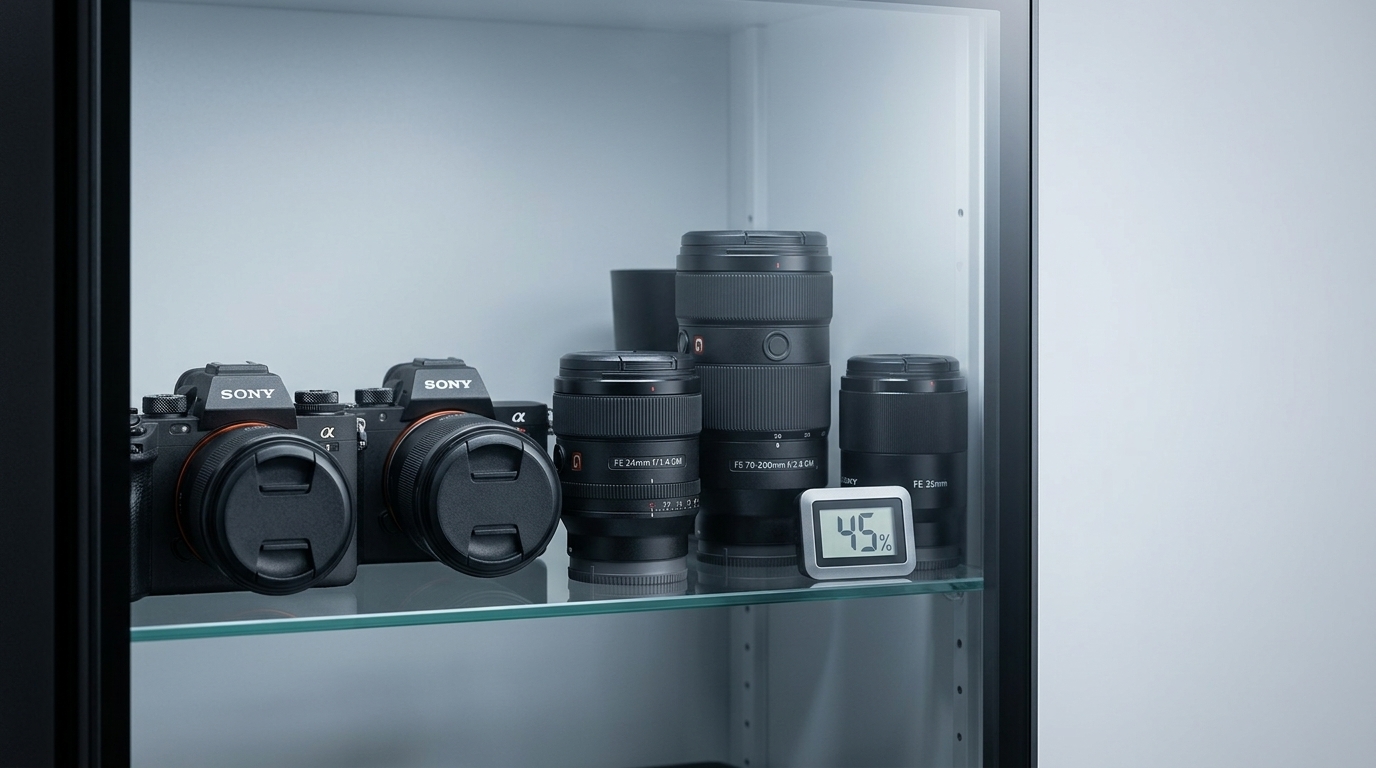
Second, I cap everything. Front and rear caps go on each lens, and a body cap protects the mount and sensor chamber. Third, the lenses themselves: good camera lens storage means standing them upright in an electronic dry cabinet set to 45%, with bodies beside them and batteries pulled to half charge in a separate tray. A see-through door lets in light, which discourages fungus further.
Finally, I run a monthly check. Ten minutes with a flashlight reveals any web-like threads or haze early, and I confirm the hygrometer still reads in range. This rhythm has kept my glass clear across four camera systems. If a body or lens no longer earns its shelf space, I move it on rather than let it sit and lose value. When buying used to replace it, the habits in our guide to inspecting a used camera before you buy mirror the same fungus and sensor checks.
Filling a Gap in Your Kit?
Buy Quality Used Gear From MPB
Shop thousands of used cameras and lenses, every item MPB Approved and backed by a free warranty. Inspected condition ratings mean no fungus surprises.
Frequently Asked Questions
What humidity is best for long-term camera storage?
Aim for 35% to 50% relative humidity. Above 60%, fungus grows quickly on lens glass, while dropping below 30% for months dries out lubricants and shrinks rubber gaskets. A ten-dollar hygrometer lets you confirm the range inside your dry box.
How do I store camera gear without a dry box?
Use an airtight bin with indicating silica gel and a hygrometer. Place the kit inside with all caps on, keep the bin in a cool, stable room, and recharge the desiccant when it changes color. This setup mirrors a dry cabinet at a fraction of the price.
Does lens fungus affect image quality?
Yes, once it spreads. Light early growth might show little change, but established fungus etches the coatings, lowers contrast, and adds flare. Because it permanently damages glass, prevention through humidity control beats any repair.
How should I store camera batteries long-term?
Charge lithium-ion batteries to around 40% to 50%, then remove them from the body. Keep the cells cool and dry, and top them up every couple of months because they slowly self-discharge. A full charge held in heat shortens their lifespan.
Should I store my camera in its bag for months?
Avoid it. A closed bag is dark and traps moisture, the exact conditions fungus needs. For short trips a bag is fine, but for long-term camera storage move the kit into a ventilated dry box or cabinet with controlled humidity.
Where is the worst place to store camera gear?
The basement, attic, garage, and a hot car top the list. These spaces swing in temperature and humidity, which invites mold and cooks internal lens oils. A climate-controlled living space protects gear far better, which matters most when you store camera gear long-term.

