


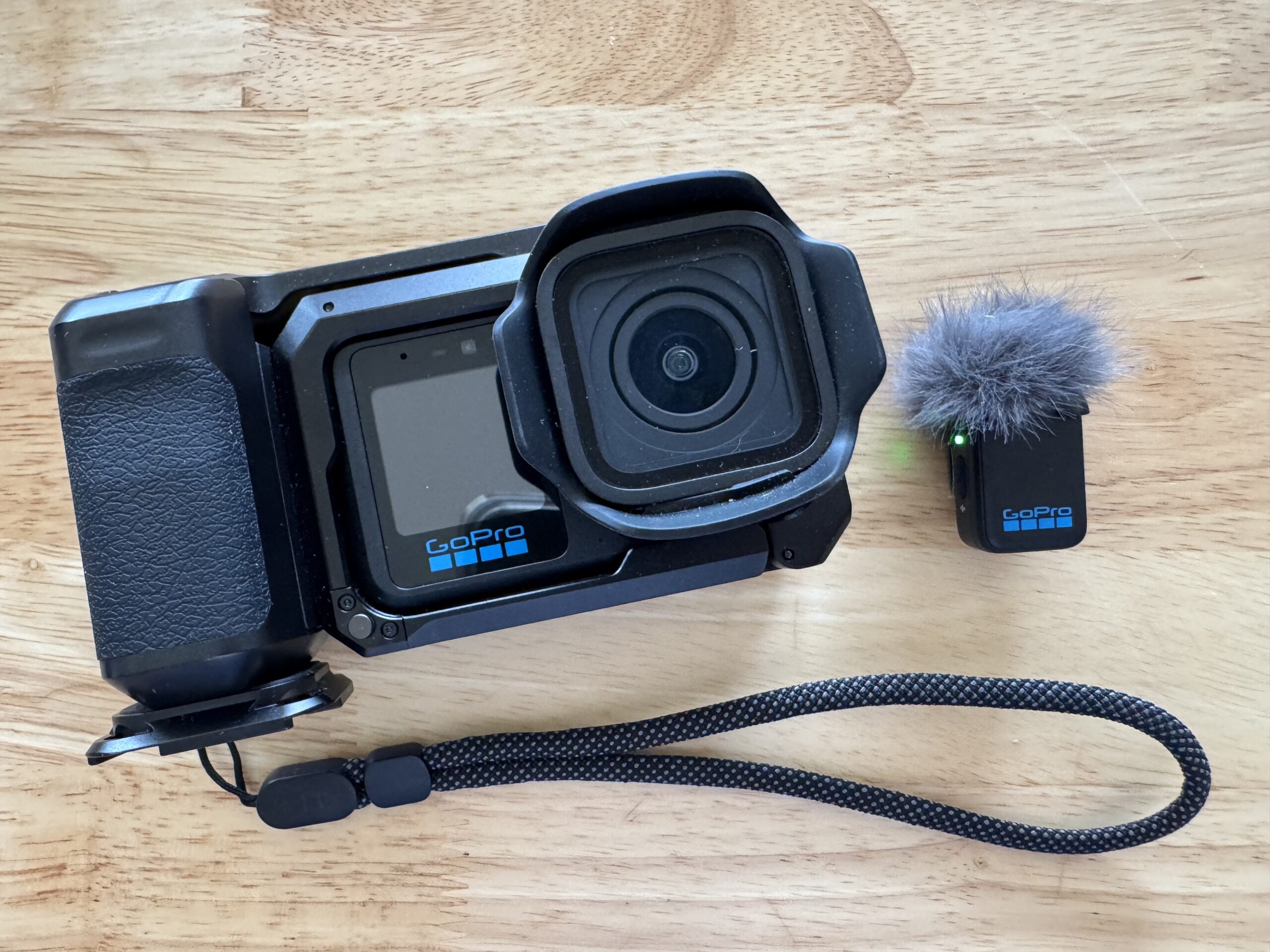
Quick Facts:
- Product: GoPro Wireless Mic System (Complete Kit, AWMIC-010)
- Transmitter Weight: 10g (13.9g with magnet and windscreen)
- Audio: 24-bit / 48kHz through the TRS or USB receiver
- Range: 150m via receiver, 100m via Bluetooth
- Battery: 6.5 hours per transmitter, up to 20 hours with the case
- Noise Control: Dynamic Noise Reduction plus Safety Track
- Compatibility: MISSION 1 GoPros, DSLR and mirrorless, USB-C phones
- Price: $159.99 (Complete Kit)
- Best for: GoPro shooters who want a wireless mic for GoPro and other cameras
8 min read
In This Review
- GoPro Wireless Mic Overview: Why This Launch Matters
- Key Specs at a Glance
- Size and Form Factor: Tiny, Clippable, Magnetic
- Sound Quality After Weeks of Field Testing
- Range, Battery, and All-Day Runtime
- Works With GoPros, DSLRs, and Phones
- Super Wideband Bluetooth and MISSION 1
- GoPro Wireless Mic vs. DJI Mic 2: Which Should You Buy?
- Pros and Cons
- Final Verdict
- Frequently Asked Questions
- About the Author
GoPro Wireless Mic Overview: Why This Launch Matters
In my Mission 1 Pro review, I flagged one real frustration. With the Point-and-Shoot Grip on, you had no way to plug in an external mic. I wrote then the gap would close once the wireless kit shipped. The GoPro Wireless Mic is here. After weeks of clipping it on for real shoots, it closes the gap and pushes further than I expected.
This review reflects hands-on use, not a spec-sheet rewrite. Moreover, GoPro built a complete system for $159.99. The Complete Kit ships with two 10g transmitters, a TRS receiver, a USB-C receiver, and a charging case. For GoPro shooters, hybrid vloggers, and interview creators, the value here is hard to ignore.
The nearest rival is the DJI Mic 2, a proven system at $349. GoPro therefore undercuts it by nearly half. Throughout this review, I compare the two head to head, because most readers weighing a wireless mic for GoPro also look at DJI. By the end, you will know which one fits your workflow.
My test setup ran the mic across walk-and-talk vlogs, a sit-down interview, and outdoor B-roll narration. I also paired it with the Mission 1 Pro over Bluetooth and with a mirrorless body through the TRS receiver. Both setups held clean audio. Below, I break down where it shines and where DJI still leads.
Key Specs at a Glance

Here are the core specs, pulled directly from GoPro’s official spec sheet.
| Specification | Details |
|---|---|
| Product | GoPro Wireless Mic System (AWMIC-010, Complete Kit) |
| Transmitter dimensions | 20 x 18 x 28 mm |
| Transmitter weight | 10g (13.9g with magnet and windscreen) |
| Polar pattern | Omnidirectional |
| Frequency range | 20Hz to 20kHz |
| Max SPL | 120 dB SPL |
| Equivalent noise | 26 dBA |
| Signal-to-noise ratio | 70 dBA |
| Bit depth / sample rate | 24-bit / 48kHz (receiver); 16-bit / 32kHz (Bluetooth) |
| Transmission range | 150m via receiver; 100m via Bluetooth |
| Transmitter battery life | 6.5 hours; up to 20 hours with charging case |
| Noise reduction | Dynamic Noise Reduction plus Safety Track (-6dB) |
| Connectivity | TRS 3.5mm receiver, USB-C receiver, Bluetooth (HFP 1.9 SWB) |
| Compatibility | MISSION 1 GoPros, GoPros with Media Mod, DSLR/mirrorless, USB-C phones |
| Price | $159.99 (Complete Kit) |
Buy Direct From Amazon
Get the GoPro Wireless Mic
The Complete Kit ships with two transmitters, both receivers, and the charging case for $159.99.
Size and Form Factor: Tiny, Clippable, Magnetic

The first thing you notice is the size. Each transmitter weighs 10g, or 13.9g with the magnet and windscreen. By comparison, a DJI Mic 2 transmitter weighs 28g. The GoPro unit nearly disappears on a collar.
GoPro designed the mic to clip on or mount with the included magnet. The magnet grips through fabric, so you attach it cleanly inside or outside a shirt. During a sit-down interview, it held a lapel position for a full hour with no droop or sag. For run-and-gun vlogging, the low weight keeps the mic out of frame and off your mind.
Form factor matters more than spec sheets admit. A mic you forget you are wearing is a mic you keep using. As a result, after weeks of clipping it on, the GoPro transmitter became the unit I reached for first.
Sound Quality After Weeks of Field Testing
Sound is where this mic earns its keep. The system records 24-bit audio at a 48kHz sample rate through either receiver. You get clean, full speech with room to edit. Across my walk-and-talk clips, voices stayed warm and intelligible, with none of the thin, boxy tone cheap wireless mics produce.
GoPro rates the mic at 120 dB SPL with 26 dBA of self-noise and a 70 dBA signal-to-noise ratio. The DJI Mic 2 posts a lower 21 dBA self-noise, so DJI runs a touch quieter on paper. In real rooms, however, the difference stayed subtle. For interviews and vlogs, both deliver broadcast-usable audio.
Two features stood out in the field. First, Dynamic Noise Reduction trimmed traffic hum on a busy street without gutting my voice. Second, Safety Track records a backup mono track 6dB lower, so a sudden laugh or shout will not ruin a clip. DJI answers with 32-bit float internal recording, a deeper safety net I cover in the comparison below.
Range, Battery, and All-Day Runtime

Range held up to GoPro’s claims. The wired receivers reach 150m line of sight, while the Bluetooth link to a MISSION 1 camera reaches 100m. On an open beach shoot, I walked my subject past 120 meters from a locked-off camera, and the track stayed clean with no dropouts. DJI rates the Mic 2 at 250m, so DJI wins outright distance.
Battery life carried a full day. For example, each transmitter runs 6.5 hours on a charge. With the charging case topping them off, total runtime reaches 20 hours. During a long shoot day, I never drained a transmitter before the case refilled it. In addition, the case doubles as storage, so the kit travels as one tidy package.
Works With GoPros, DSLRs, and Phones
Versatility surprised me. This system works far beyond GoPro cameras. For instance, the TRS receiver feeds any camera with a 3.5mm mic port. I ran it on my Canon R5 with no menu fuss and clean levels on the first take. Meanwhile, the USB-C receiver plugs into phones and USB-C cameras for clean mobile audio.
For GoPro owners, MISSION 1 cameras pair over Bluetooth with no receiver needed. In addition, older GoPros connect through the Media Mod. If you shoot a GoPro Hero 13 alongside a mirrorless rig, one mic kit covers both. This cross-device reach makes it a strong wireless mic for GoPro shooters who also own other cameras.
Super Wideband Bluetooth and MISSION 1
The Bluetooth link is the feature I was waiting for. Connect a transmitter straight to a MISSION 1 Series camera and skip the receiver entirely. GoPro uses Hands-Free Profile 1.9 with Super Wideband Speech at 16-bit and 32kHz. As a result, the voice comes through rich and detailed, with a 100m wireless reach.
This solves the exact problem I raised in my Mission 1 Pro review. With the grip on, you now get wireless audio and zero cables. For solo creators narrating action shots, the GoPro Mission 1 workflow finally feels complete.
Save on the Kit
GoPro Wireless Mic Complete Kit
Two transmitters, both receivers, and a charging case ship in one package at $159.99.
GoPro Wireless Mic vs. DJI Mic 2: Which Should You Buy?

Here is the head-to-head most buyers want. The GoPro Wireless Mic and DJI Mic 2 target the same creator, yet they split on three big points: price, weight, and internal recording.
GoPro wins price and size. At $159.99, it undercuts the $349 DJI Mic 2 by $189. Each GoPro transmitter weighs 10g against DJI’s 28g. For GoPro shooters and budget-minded vloggers, the math favors GoPro.
DJI wins on two pro features. The Mic 2 records 32-bit float audio to 8GB of internal storage, a near-unkillable backup for unpredictable sound. It also reaches 250m and accepts an external lavalier. GoPro counters with Safety Track and direct MISSION 1 Bluetooth, though it offers no internal recording or lav input. For high-stakes interviews with no second backup, therefore, DJI still earns the nod. For everyone else, GoPro delivers most of the performance for far less. PhotographyTalk has covered these GoPro and DJI spec battles before, and this one lands closer than the price gap suggests.
| Specification | GoPro Wireless Mic | DJI Mic 2 |
|---|---|---|
| Price (kit) | $159.99 | $349 |
| Transmitter weight | 10g | 28g |
| Bit depth / sample rate | 24-bit / 48kHz | 24-bit / 48kHz |
| Internal recording | None (Safety Track -6dB) | 32-bit float, 8GB (~11 hrs) |
| Max range | 150m receiver / 100m BT | 250m |
| Self-noise | 26 dBA | 21 dBA |
| Max SPL | 120 dB | 120 dB |
| Lavalier input | No | Yes |
| Direct camera Bluetooth | Yes (MISSION 1, no receiver) | To phone only |
| Transmitter battery | 6.5 hrs (20 hrs with case) | 6 hrs (~18 hrs with case) |
| Receiver outputs | TRS 3.5mm, USB-C | TRS 3.5mm, USB-C, Lightning |
| Best for | GoPro and hybrid creators, value | Pro interviews, backup-critical work |
Pros and Cons
Pros
- Tiny 10g transmitters vanish on a collar
- Clean 24-bit/48kHz audio through both receivers
- Direct Bluetooth to MISSION 1 cameras, no receiver needed
- 150m wired range covers most shoots
- 20-hour total runtime with the charging case
- $159.99 undercuts the DJI Mic 2 by $189
- Works with GoPros, DSLR/mirrorless, and USB-C phones
Cons
- No internal recording, only a -6dB Safety Track
- Self-noise of 26 dBA trails DJI’s 21 dBA
- 150m range falls short of DJI’s 250m
- No external lavalier input on the transmitter
- Older GoPros need the Media Mod to connect
Final Verdict

The GoPro Wireless Mic is the accessory I wished for through years of GoPro shooting. Notably, the size is small, the form factor feels premium, and the audio out of it is genuinely good. For GoPro creators, hybrid vloggers, and anyone who wants clean wireless sound without cables, it earns a permanent spot in the bag.
The trade-offs are honest. Because it offers no internal recording and no lav input, high-stakes interview shooters with zero margin for error should weigh the DJI Mic 2. DJI’s 32-bit float backup and 250m range remain the safer pick for professional, backup-critical work.
On value, however, GoPro is hard to beat. At $159.99 for a two-transmitter system with two receivers and a case, it delivers most of the DJI experience for $189 less. For the creator who lives in the GoPro ecosystem, the choice is simple.
My full video review is coming, so stay tuned for sound samples and side-by-side footage. For now, the GoPro Wireless Mic System is the easiest accessory I have recommended for any MISSION 1 owner. If you shoot GoPro and want wireless audio today, buy it. If you need bulletproof interview backup, look at the DJI Mic 2 first.
Ready to Buy?
Check Today’s Price on the GoPro Wireless Mic
The Complete Kit ships now with two transmitters, both receivers, and a charging case.
Frequently Asked Questions
How much is the GoPro mic?
The Complete Kit costs $159.99. It includes two transmitters, a TRS receiver, a USB-C receiver, and a charging case. In addition, GoPro sells a single-transmitter USB Kit and a standalone transmitter for less.
Does the GoPro mic have internal recording?
No. The mic records to your camera, not to onboard storage. Instead of internal recording, it offers Safety Track, a backup mono track 6dB lower to protect against clipping. By contrast, the DJI Mic 2 offers true 32-bit float internal recording.
Does the GoPro mic work with phones and DSLRs?
Yes. The USB-C receiver plugs into phones and USB-C cameras, while the TRS receiver feeds any camera with a 3.5mm mic port. For example, I ran it on my Canon R5 and an iPhone with clean results.
Is the GoPro Wireless Mic better than the DJI Mic 2?
It depends on your needs. The GoPro option wins on price and size at $159.99 and 10g per transmitter. Conversely, the DJI Mic 2 wins on 32-bit float recording, 250m range, and a lavalier input. For GoPro creators and value, GoPro leads.
Does the GoPro mic work with older GoPros?
Yes, through the Media Mod. MISSION 1 Series cameras pair directly over Bluetooth with no receiver. Older models, including the GoPro Hero 13, connect through the Media Mod accessory.
How long does the GoPro mic battery last?
Each transmitter runs 6.5 hours on a single charge. With the charging case, total runtime reaches 20 hours. Therefore, a full shooting day rarely drains the GoPro Mission 1 audio setup.
About the Author
Alex Schult has been a professional photographer for more than two decades. Though his specialty is landscapes, he has worked across portraits, macro, street, and event photography. He founded PhotographyTalk to keep photography open and accessible for shooters of every skill level, and he tests gear hands-on, in the field, before recommending it.

