


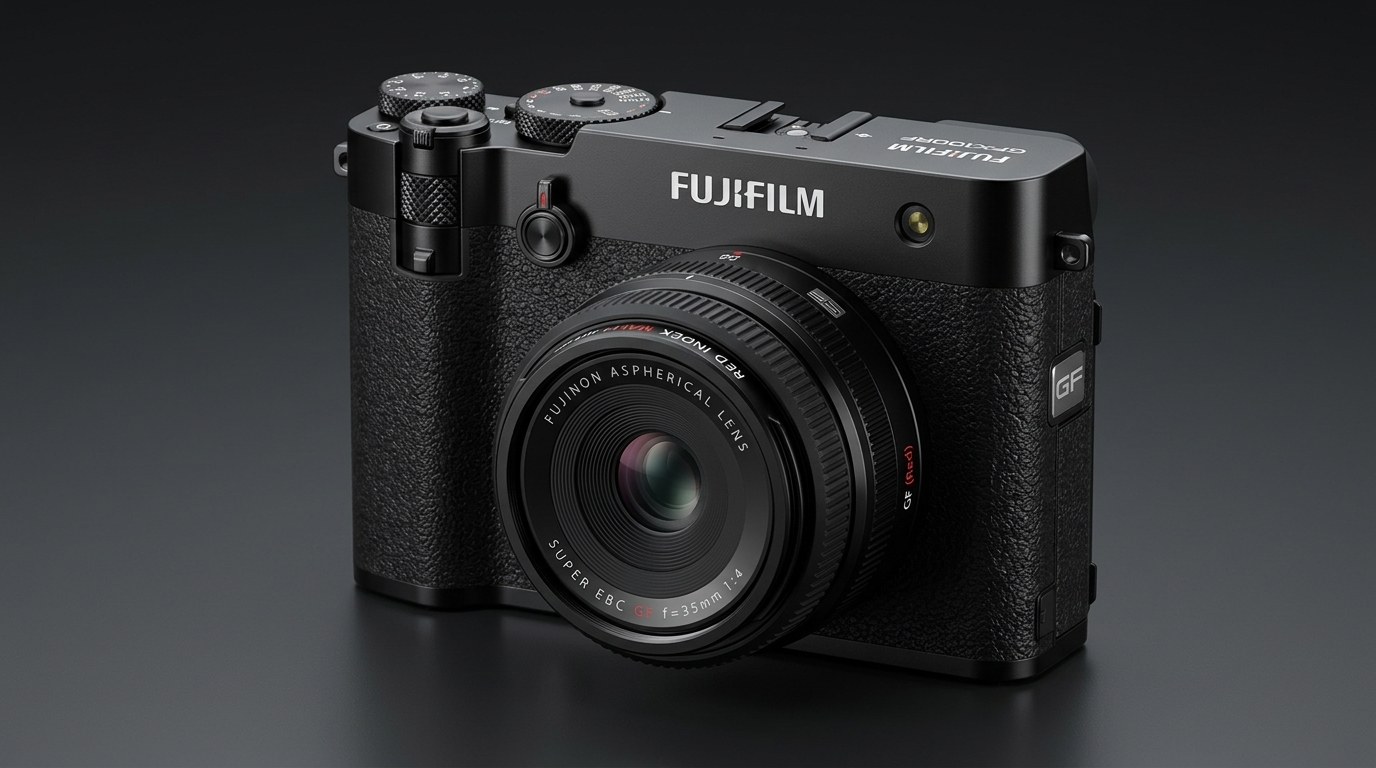
Quick Facts:
- Camera: Fujifilm GFX100RF
- Award: Photographic Society of Japan 2026 Technical Award
- Sensor: 102MP medium format, 43.8 x 32.9mm (about 1.7x the area of a 35mm frame)
- Lens: Fixed 35mm f/4 (28mm full-frame equivalent)
- Body weight: About 735g, the lightest in the GFX series
- Launch price: About $4,899
- Best for: Travel, street, and landscape shooters who want medium format detail in a compact body
6 min read
In This Article
The Fujifilm GFX100RF Award and Why It Matters
The Fujifilm GFX100RF has won a 2026 Technical Award from the Photographic Society of Japan. This honor goes to people and products behind outstanding technical achievements in photography and related fields. The recognition lands a little over a year after the camera reached buyers.
Most readers first met the story through Fuji Rumors, which published the full Fujifilm press release on June 15, 2026. Because the award rarely makes mainstream headlines, early coverage matters for anyone tracking the GFX series.
A juried prize matters for one reason: it rewards engineering, not marketing. When a national photographic body singles out one camera, it signals the design solved a hard problem. In this case, the problem was fitting a medium format sensor into a body you want to carry all day.
Some history explains the win. The GFX series launched in 2017 as Fujifilm’s push into medium format, aimed at studio and landscape professionals. Since then, each model has chipped away at the size and price barrier. The Fujifilm GFX100RF extends the arc by dropping the interchangeable mount entirely, which trims weight and seals out dust. For a juried panel, such design discipline reads as engineering progress rather than a gimmick.
Key Fujifilm GFX100RF Specs at a Glance
Before the analysis, here are the core Fujifilm GFX100RF specs. These numbers explain why the camera drew the committee’s attention.
| Specification | Details |
|---|---|
| Sensor | 102MP medium format CMOS, 43.8 x 32.9mm |
| Sensor area | About 1.7x the area of a 35mm full-frame sensor |
| Lens | Fixed 35mm f/4, 28mm full-frame equivalent |
| Optical design | Two aspherical elements, Nano-GI coating |
| Stabilization | No in-body image stabilization |
| Body weight | About 735g, lightest in the GFX series |
| Signature controls | Aspect ratio dial, digital teleconverter lever |
| Launch price | About $4,899 |
What the Award Committee Said
The Photographic Society of Japan published a short rationale with the prize. According to the selection committee, the GFX100RF reaches the lightest and most compact body in the GFX series despite its fixed lens, thanks to optimized lens and body design.
The committee also praised the optics. Specifically, the lens uses two aspherical elements and a Nano-GI coating to hold resolution from the center to the edges of the frame. Edge sharpness on a 102MP sensor is hard, so the panel treated it as a real engineering win.
Two controls earned a mention as well. The aspect ratio dial lets you switch framing without menus, while the digital teleconverter lever extends reach from the single focal length. As a result, the committee concluded, more shooters than before gain medium format quality across a wider range of scenes.
What the Technical Achievement Means for Photographers

Underneath the ceremony, the award points at one idea: access. Fujifilm markets the GFX line as large format, though the industry calls its 43.8 x 32.9mm chip medium format. For decades, this sensor class meant heavy bodies and steep prices. The GFX100RF breaks the pattern by pairing a big sensor with a body near the weight of a pro full-frame camera.
Sensor size drives the payoff. A larger surface gathers more light per frame, which supports wider dynamic range and smoother tonal gradation. For landscape and architecture work, those qualities show up in shadow recovery and fine texture. The same strengths put medium format atop many best cameras for landscape photography roundups. Moreover, the extra resolution leaves room to crop hard while keeping print-ready detail.
The fixed 35mm f/4 lens is the trade-off. You give up zoom and a wide aperture, yet you gain a corrected, purpose-built optic and a slimmer package. The Nano-GI coating reduces flare in backlit scenes, which helps when you shoot toward the sun. This is the same medium format philosophy behind Fujifilm’s GFX medium format line, now compressed into a fixed-lens body.
One caveat deserves attention. The GFX100RF ships without in-body stabilization, so handheld work at slow shutter speeds needs care. Because the sensor resolves so much detail, small movements become visible. Therefore many owners lean on faster shutter speeds, higher ISO, or a tripod.
Fujifilm GFX100RF vs X100VI: Which Fixed-Lens Camera Fits You?
Many readers frame this as GFX100RF vs X100VI, since both are premium fixed-lens cameras built around a single prime lens. The two cameras share a design language, yet they target different shooters and different focal lengths. Here the GFX100RF gives a 28mm-equivalent view, while the X100VI sits at a classic 35mm-equivalent.
Resolution is where they truly separate. The GFX100RF carries a 102MP medium format chip, while the X100VI uses a 40MP APS-C sensor. As a result, the GFX resolves far more detail and holds wider dynamic range, though file sizes grow with it. The X100VI stays nimble and quick to share.
On handling and price, the two diverge sharply. The X100VI adds in-body stabilization rated up to 6 stops, pairs it with a faster f/2 lens, and weighs about 521g at roughly $1,599. By comparison, the GFX100RF skips stabilization, uses an f/4 lens, weighs about 735g, and lists near $4,899. So the X100VI suits run-and-gun street and travel, while the GFX100RF rewards deliberate, detail-first shooting. Anyone weighing a body-and-lens system should also look at the interchangeable-lens GFX 100S.
Credit Where It Is Due: Fuji Rumors Broke the Story
This article exists because Fuji Rumors surfaced the announcement and reproduced the Fujifilm press release in full. The site, run by Patrick, has tracked Fujifilm news for years and often posts official documents before larger outlets notice them.
Award news like this seldom trends. Without dedicated coverage, most photographers would never learn why a national society honored the camera. So when a niche outlet does the legwork, it deserves a clear citation rather than a quiet rewrite. If you follow Fujifilm closely, Fuji Rumors belongs in your reading list.
Camera makers often issue regional press releases in Japanese, and English coverage lags or skips technical awards entirely. Because Fuji Rumors translates and posts these documents quickly, photographers outside Japan learn the full reasoning behind a decision like this one. Credit for surfacing the award belongs with Patrick and his readers.
Final Take on the Fujifilm GFX100RF Award

The 2026 Technical Award fits the camera well. The Fujifilm GFX100RF set out to make medium format portable, and a national photographic body agreed the engineering succeeded. For travel, street, and landscape shooters who prize resolution, the recognition confirms what early GFX100RF review coverage suggested.
The trade-offs remain real, though. No stabilization, a single fixed focal length, and a near-$4,899 price keep this camera in specialist territory. If you want flexibility or low-light reach, the X100VI or a body-and-lens GFX setup will serve you better.
Seen in context, the award rewards a direction as much as a product. Fujifilm is pushing medium format toward everyday use, and the industry is taking note. Whether a second-generation model adds stabilization will shape how far the idea travels. For now, the Fujifilm GFX100RF stands as proof the concept works.
Frequently Asked Questions
What award did the Fujifilm GFX100RF win?
The GFX100RF won a 2026 Technical Award from the Photographic Society of Japan. Specifically, the prize recognizes outstanding technical achievement in photography. Fujifilm received it for the camera’s compact medium format design.
Does the GFX100RF have IBIS?
No. The GFX100RF ships without in-body image stabilization. Because the 102MP sensor resolves fine detail, many owners use faster shutter speeds or a tripod for sharp handheld results.
How big is the GFX100RF sensor compared to full frame?
The sensor measures 43.8 x 32.9mm, which gives it about 1.7 times the area of a 35mm full-frame sensor. This larger surface supports higher resolution and wider dynamic range.
How does the GFX100RF vs X100VI decision break down?
The choice comes down to detail versus agility. Where detail wins, the GFX100RF offers a 102MP medium format sensor, while the X100VI adds stabilization, a faster f/2 lens, and a lower price for everyday carry.
Is the GFX100RF worth the price?
At about $4,899, the GFX100RF targets shooters who need medium format detail in a compact body. If resolution and portability top your list, the value holds. For a deeper GFX100RF review of the fixed-lens trade-offs, weigh the missing stabilization first.
What is a fixed-lens medium format camera?
A fixed-lens medium format camera pairs a sensor larger than full frame with a permanently attached lens. The GFX100RF is one example, combining a 102MP medium format sensor with a built-in 35mm f/4 optic for a slimmer, lighter package.

