


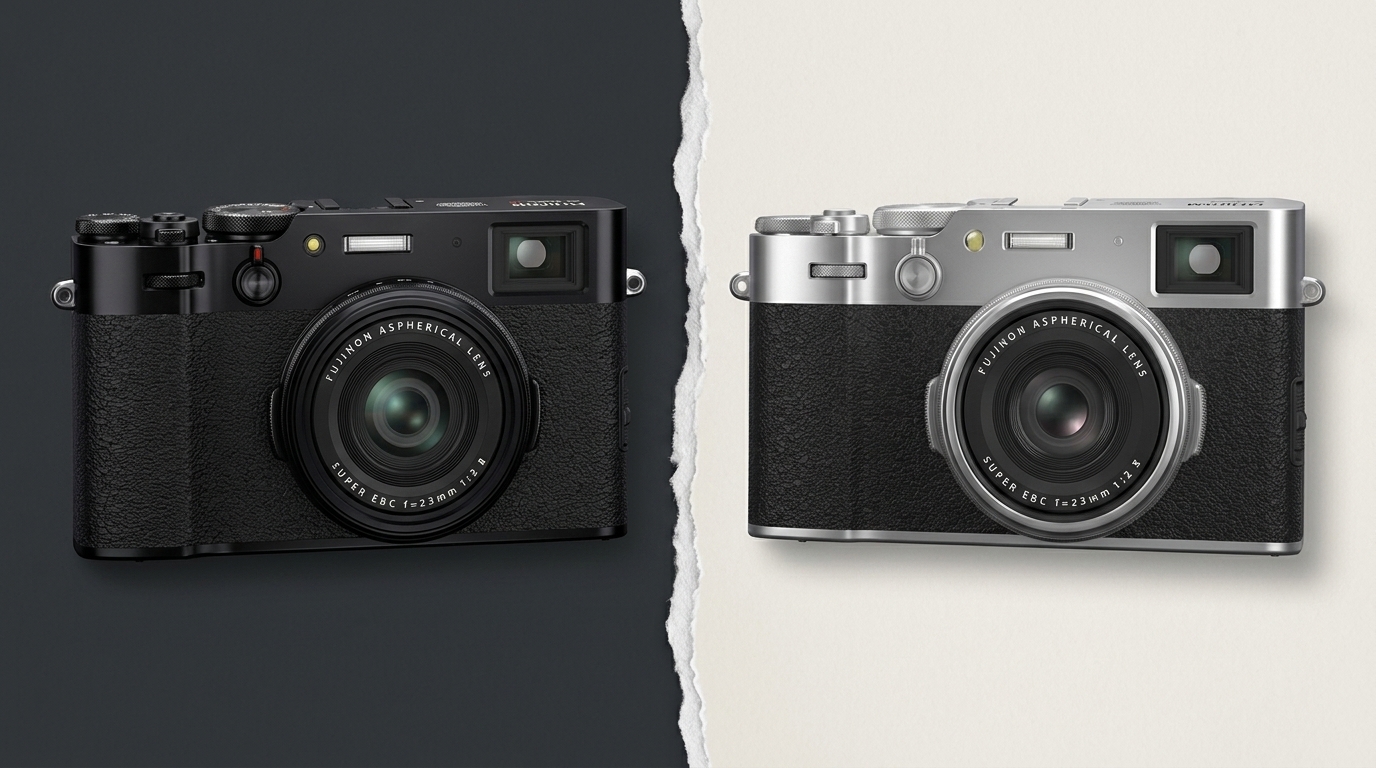
Quick Facts:
- Cameras: Fujifilm X100V vs X100VI
- Sensor: 26.1MP (X100V) vs 40.2MP (X100VI)
- Stabilization: None vs 6-stop in-body IBIS
- Video: 4K/30p vs 6.2K/30p and 4K/60p
- Film simulations: 17 vs 20
- Weight: 478g vs 521g
- Price (2026): Used X100V $1,779-$1,899; X100VI $1,599 new
- Best for: Photographers choosing a premium 35mm-equivalent compact
6 min read
In This Guide
Fujifilm X100V vs X100VI Overview: Which Compact Fits You
The Fujifilm X100V vs X100VI decision comes down to one surprising fact: the older camera often costs more. Both are premium APS-C compacts with a fixed 23mm f/2 lens and a hybrid viewfinder. However, the X100VI adds a 40-megapixel sensor and in-body stabilization, while the discontinued X100V now trades at a collector premium. Specifically, this guide breaks down the specs, the real differences, and which body earns your money in 2026.
Both cameras suit street and travel shooters weighing a pocketable, characterful camera. Fujifilm built both models around the same idea: a discreet body, tactile dials, and film simulations straight out of camera. For everyday carry, either one also delivers images with a distinct look. Both also sit near the top of most best compact cameras of 2026 lists, so neither is a wrong pick.
Price context matters here. Fujifilm launched the X100V in 2020 at $1,399, then stopped production after demand outstripped supply. In contrast, the X100VI arrived in 2024 at $1,599 new. Today a used X100V sells for $1,779 to $1,899 at MPB, above the newer model’s retail price. Because of this inversion, the value math flips from a normal upgrade comparison.
Fujifilm X100V vs X100VI Specs Compared Side by Side
First, here is the Fujifilm X100V vs X100VI spec sheet in one view. Notably, the two share the same 23mm f/2 lens, hybrid viewfinder, and 4-stop neutral density filter. The differences cluster around the sensor, processor, stabilization, and video.
| Specification | Fujifilm X100V | Fujifilm X100VI |
|---|---|---|
| Sensor | 26.1MP APS-C X-Trans CMOS 4 | 40.2MP APS-C X-Trans CMOS 5 HR |
| Processor | X-Processor 4 | X-Processor 5 |
| Lens | 23mm f/2 (35mm equivalent) | 23mm f/2 (35mm equivalent) |
| In-body stabilization | None | 5-axis IBIS, 6.0 stops |
| ISO range (native) | 160-12800 | 125-12800 |
| Autofocus | Face and eye detection | AI subject detection plus face and eye |
| Video | 4K up to 30p, 8-bit internal | 6.2K/30p, 4K/60p, 10-bit 4:2:2 |
| Film simulations | 17 | 20 |
| Viewfinder | Hybrid OVF/EVF, 3.69M-dot | Hybrid OVF/EVF, 3.69M-dot |
| Rear screen | 3.0-inch two-way tilting touchscreen | 3.0-inch two-way tilting touchscreen |
| Battery life (OVF, CIPA) | Approx. 420 shots | Approx. 450 shots |
| Dimensions | 128 x 74.8 x 53.3 mm | 128 x 74.8 x 55.3 mm |
| Weight (with battery) | 478g | 521g |
| Launched | February 2020 (discontinued) | 2024 |
| Price (2026) | Used $1,779-$1,899 | $1,599 new |
Shop the X100VI at MPB
Find a Used Fujifilm X100VI
MPB regularly lists inspection-graded X100VI bodies with a free six-month warranty and free shipping. Stock rotates daily, so set an alert if a listing shows sold out.
Sensor and Image Quality: 40MP vs 26MP
Resolution is the headline upgrade. The X100VI uses a 40.2-megapixel X-Trans CMOS 5 HR sensor, the same 40MP sensor as the X-T5. In contrast, the X100V carries a 26.1-megapixel X-Trans CMOS 4 chip. As a result, the X100VI resolves roughly 1.5 times more detail, which helps with heavy cropping and large prints.
Does the extra resolution widen the X100V vs X100VI image quality gap in practice? At base ISO, the X100VI pulls ahead on fine texture. However, the 26-megapixel X100V still produces clean, sharp files with the same rich color. Still, for social feeds and prints up to A3, most viewers will not spot the difference. Above ISO 6400, the two sensors stay close, with a slight edge to the newer chip. According to Fujifilm’s official specifications, both cameras use identical 23mm f/2 optics, so lens rendering stays consistent between them.
Stabilization and Video: What the X100VI Adds

In-body stabilization is the biggest functional split. The X100VI includes 5-axis IBIS rated at 6 stops, while the X100V has none. For handheld low-light stills and walking video, stabilization steadies the frame and widens your usable shutter-speed range. In practice, street shooters at dusk feel this benefit most.
Video also separates the two bodies. The X100VI records 6.2K at 30p and 4K up to 60p in 10-bit 4:2:2, plus F-Log2 for grading. Meanwhile, the X100V tops out at 4K 30p with 8-bit internal capture. Therefore, the newer model doubles as a compact vlog camera for hybrid creators. Still, neither body aims to replace a dedicated cinema rig.
Autofocus, Handling, and Film Simulations
Autofocus sees a quiet but real upgrade. The X100VI adds AI subject detection for animals, birds, and vehicles, borrowed from Fujifilm’s flagship line. By comparison, the X100V relies on face and eye detection alone. As a result, the newer system locks on faster and holds tracking longer on moving subjects.
Handling feels nearly identical between them. Both bodies measure 128mm wide and share the same dial-led control layout. The X100VI weighs 521g against 478g for the X100V, a 43-gram gap from the added IBIS unit. On film simulations, the X100VI offers 20 recipes to the X100V’s 17, adding REALA ACE and Nostalgic Neg. Consequently, photographers who shoot JPEG straight out of camera will notice the extra looks.
Price and Availability: Why the Used X100V Costs More

Supply drives this story. Fujifilm discontinued the X100V, yet demand never cooled, so used prices climbed. For example, at MPB the X100V runs $1,779 to $1,899 with more than ten bodies in stock. The X100VI sells new at $1,599, though inventory clears fast at most retailers.
Why does the older camera command more? Scarcity. Collectors and street shooters keep demand high for the discontinued body, especially in silver. Supply of the X100VI, by contrast, has improved since launch. When you shop either model secondhand, buying used gear safely protects your money through graded conditions and warranties. Budget-minded shooters should also scan used mirrorless cameras under $1,000 for capable X-series alternatives.
Fujifilm X100V vs X100VI: Which Should You Buy?
The Fujifilm X100V vs X100VI choice splits along three lines: resolution, stabilization, and price. On resolution and IBIS, the X100VI wins clearly. On price today, the X100V paradoxically costs more, so it loses the value argument outright.
Pick the X100VI if you want the sharpest files, IBIS, and stronger video in one pocketable body. Choose the X100V only when you find one near or below $1,500, or if you prefer its slightly lighter weight. For most buyers weighing X100V vs X100VI differences, the newer model is the smarter spend. The Fujifilm X100VI vs X100V feature gap simply outweighs the small size penalty.
Final Verdict
For most photographers, the X100VI is the camera to buy. Its 40-megapixel sensor, 6-stop IBIS, and 6.2K video make it the most capable X100 ever, all in the same loved shell. At $1,599 new, it also undercuts current used X100V prices.
The X100V still earns a place for specific buyers. Its 26-megapixel files look gorgeous, and its 478-gram body sits lighter in a jacket pocket. However, paying a premium over the X100VI is a hard sell on specs. Collectors and finish-focused buyers are the main exception.
On value, the newer model leads comfortably. Specifically, you gain resolution, stabilization, and video for less than a used predecessor. This gap makes the X100VI the easier recommendation for first-time buyers.
Shop the X100V at MPB
Check Today’s Price on a Used X100V
The discontinued X100V lives on through the used market. MPB grades every body by condition and backs each one with a six-month warranty and free shipping.
Final recommendation: buy the Fujifilm X100VI for the best mix of image quality, features, and price. Consider the X100V only at a genuine discount, or step down to the X100F for a cheaper entry into the series. Either current model rewards you with a camera you carry every day.
Frequently Asked Questions
Is the X100VI worth it over the X100V?
Yes, for most buyers. The X100V vs X100VI differences favor the newer body on resolution, stabilization, and video, and it costs less than a used X100V in 2026. Only choose the X100V at a real discount or for its lighter weight.
Why does a used X100V cost more than the X100VI?
Fujifilm discontinued the X100V, and steady demand pushed used prices up. In the Fujifilm X100VI vs X100V market, scarcity now outweighs age, so a used X100V sells for $1,779 to $1,899 while the X100VI stays at $1,599 new.
Does the X100V have image stabilization?
No. The X100V ships without in-body stabilization. The X100VI adds 5-axis IBIS rated at 6 stops, which steadies handheld stills and video. For low-light shooting, this feature marks a meaningful upgrade.
Is the X100VI image quality better than the X100V?
At the pixel level, yes. The X100V vs X100VI image quality gap favors the 40-megapixel X100VI for detail and cropping room. However, the 26-megapixel X100V still delivers sharp, colorful files most viewers rate as excellent.
Are the X100V and X100VI the same size?
Almost. Both share a 128mm-wide body and the same control layout. The X100VI is 2mm deeper and 43 grams heavier because of its stabilization unit. In a jacket pocket, the two feel nearly the same.
Which Fujifilm X100 should a beginner buy?
A beginner gets the best value from the X100VI at $1,599 new. It offers stabilization and subject-detection autofocus, which help newer shooters nail focus. For a lower entry price, the older X100F is worth a look on the used market.

