


360Quick Facts:
- Product: Insta360 Luna Ultra dual-lens gimbal camera
- Lenses: 20mm f/1.8 wide (1-inch sensor) and 60mm f/2 telephoto (1/1.3-inch sensor), both Leica-tuned
- Video: 8K/30, 4K up to 120fps, 1080p up to 240fps, 10-bit I-Log
- Screen: Detachable 2-inch touchscreen, 1,000 nits, built-in mic, 20m remote range
- Battery: Internal, 2h47m recorded at 4K/24; USB-C power and optional add-on battery
- Storage: 47GB built in, plus microSD up to 1TB
- Weight: Pocket-sized handheld body
- Price: $769.99 (Standard bundle)
- Best for: Solo vloggers, travel shooters, and creators who want telephoto reach
8 min read
In This Review
Insta360 Luna Ultra Review: First Impressions

This Insta360 Luna Ultra review comes after 10 days of daily shooting, not a weekend of unboxing. The Luna Ultra is Insta360’s first pocket gimbal camera, and it lands straight against the DJI Osmo Pocket line. For creators in the United States, the timing matters, because DJI’s competing Pocket models remain hard to buy here right now.
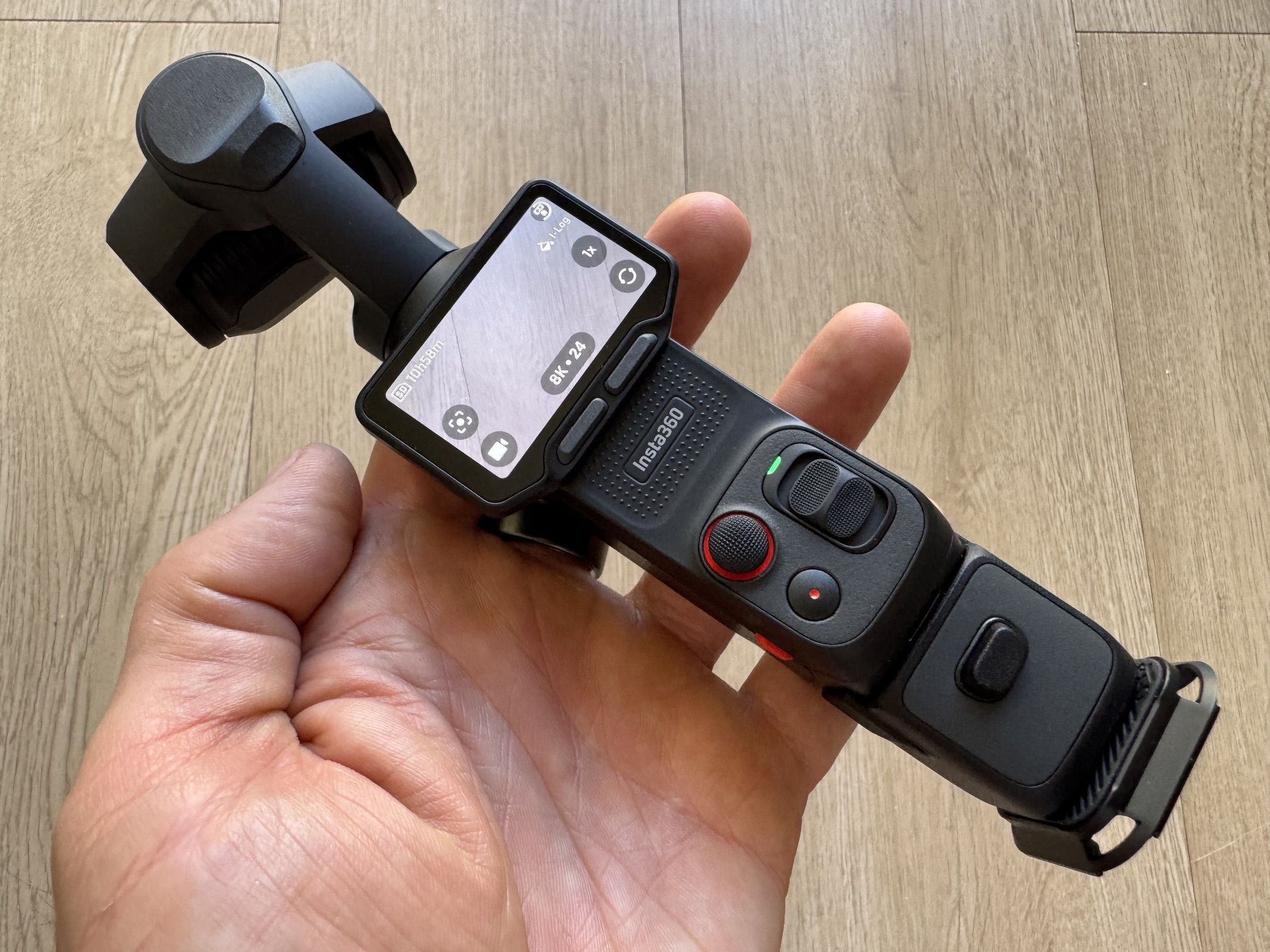
Insta360 built this around two Leica-tuned lenses on a three-axis gimbal. You get a 20mm wide view for vlogging and a 60mm telephoto for tighter, more cinematic framing. Both sit behind a body small enough to carry all day. The headline price is $769.99 for the Standard bundle, which puts it in premium compact territory.
So who should look at it? Solo vloggers benefit most, since the camera tracks you and frames you without a second operator. Travel shooters also gain from the size and the telephoto reach. Over my testing window, the Luna Ultra earned a spot in my bag because of three strengths the spec sheet undersells: battery life, ergonomics, and build quality. I will cover each in detail below.
Key Specs at a Glance
| Specification | Details |
|---|---|
| Wide camera | 20mm equivalent, f/1.8, 1-inch sensor |
| Telephoto camera | 60mm equivalent, f/2, 1/1.3-inch sensor |
| Video resolution | 8K/30, 4K/24 to 120, 1080p to 240 |
| Color and codec | 10-bit I-Log, H.265 compression |
| Photo | 9MP standard, up to 37MP UltraPhoto, RAW supported |
| Screen | Detachable 2-inch, 1,000 nits, built-in mic |
| Remote range | Up to 20 meters with the front plate removed |
| Storage | 47GB internal, microSD up to 1TB |
| Power | Internal battery, USB-C charging, optional add-on cell |
| Price | $769.99 Standard, $879.99 Endurance, $969.99 Creator |
Today’s Best Deal
Check the Insta360 Luna Ultra on Amazon
The Standard bundle ships with the camera, protective case, and mounting hardware. Stock moves fast on new releases.
Image Quality and Dual-Lens Reach
The wide camera does the heavy lifting. Its 20mm f/1.8 lens sits over a 1-inch sensor, so footage looks clean and holds detail in shadows. In I-Log at 4K, high-contrast scenes stayed noticeably less noisy than the same shot captured in 8K. For most work, I settled on 4K and rarely felt limited.
The second lens is where the Luna Ultra separates from a single-lens pocket cam. Its 60mm telephoto compresses the background and gives movement a different feel. Because the reach is optical rather than a crop, close-up shots keep their bite. For interviews and detail work, I reached for this lens far more than I expected.
Digital zoom tells a more mixed story. The camera pushes to 6x and 12x, yet quality softens well before the long end. At 6x in 4K, footage starts to look thin, so I treated 3x as the practical ceiling. Similarly, 1080p at 240fps trades a lot of sharpness for slow motion, though the effect still works for short accents.
Low light held up better than I predicted. The dedicated Pure Video mode limits you to 4K at 60fps, and it cleans up dim scenes with less grain than a flagship phone. For small venues and evening streets, the Luna Ultra delivers usable footage where a smartphone would smear.
Battery Life and Ergonomics

Battery life is the first attribute I want to praise, because it outperformed my expectations across the week and a half. It covered full mornings of travel filming on one charge without a top-up. Documented bench testing backs up my experience, clocking 4K/24 at two hours and 47 minutes on a single internal charge. For a body this small, the runtime is excellent.
When you do need more, two options help. First, the USB-C port powers the camera while you shoot, so a small power bank extends a session indefinitely. Second, Insta360 sells an add-on battery for the base of the handle. Between the two, I never lost a shot to a dead cell, which is rare for me with compact gear.
Ergonomics is the second strength worth calling out. The handle fills your palm without cramping, and the weight sits low, so the camera feels planted rather than top-heavy. My thumb reached every primary control without shifting grip. After long handheld days, my wrist felt fine, which matters more than any spec when you shoot solo for hours.
Build Quality and the Detachable Screen
Build quality rounds out my top three. The Luna Ultra feels dense and deliberate in hand, with tight seams and a lens cover snapping over both cameras for transit. Nothing creaks or flexes. Over 10 days of bags, benches, and rock ledges, it picked up no rattles, and the gimbal cradle held its alignment throughout.
The detachable front plate is the feature people ask about most, and it earns the attention. You pull the 2-inch screen off the body and use it as a remote monitor up to 20 meters away. Because it carries a microphone and camera controls, you frame yourself, start recording, and hear clean audio while the camera films unmanned.
The screen itself is bright at 1,000 nits, so outdoor framing stays visible. Still, at 564 by 318 pixels, confirming critical focus is hard. For manual settings and a histogram, I paired the phone app, which gives a larger and more responsive display. Used together, the little screen and the app cover almost every shooting scenario.
Save on the Luna Ultra
Compare Luna Ultra Bundles
The Endurance and Creator kits add extended power and a pro mic. See which bundle fits your workflow and budget.
Luna Ultra vs DJI Osmo Pocket
The obvious rival is the DJI Osmo Pocket line, which defined this category. DJI’s newest Pocket bodies push higher slow-motion frame rates, including 4K at 240fps, while the Luna Ultra tops out at 4K/120. If extreme slow motion drives your work, DJI still leads on this single number.
The Luna Ultra answers with two things DJI’s single-lens models lack. First, the true telephoto lens gives framing variety a crop cannot match. Second, the detachable remote screen turns the whole camera into a self-filming rig. For solo creators, those advantages outweigh a slow-motion frame-rate gap.
Availability seals the decision for many buyers. Because DJI’s competing Pocket cameras stay difficult to purchase in the United States, the Luna Ultra becomes the realistic premium choice here. At $769.99, it is not cheap, though the dual lenses and remote workflow justify the spend for working creators.
Where the Luna Ultra Falls Short

No camera earns a spot in my bag without trade-offs, and the Luna Ultra carries three worth your attention. The first is heat. In demanding modes, the body runs warm in the hand, which I noticed on longer clips. Documented bench testing put 4K/120 at about 44 minutes and 8K/24 at roughly 49 minutes before an overheat stop. For short bursts, this never bothered me. For a locked-off 8K interview angle, plan around it.
The second is subject tracking at the extremes. Deep Track keeps you framed nicely at normal speeds and wide focal lengths. However, at higher zoom or a brisk walking pace, the gimbal lagged behind me and needed a beat to catch up. For fast action, I switched to manual framing rather than trusting the tracker.
The third is the little screen. At 564 by 318 pixels, confirming critical focus by eye is hard, and dialing in manual settings on it grew fiddly. For precise work, I leaned on the phone app and its larger display. Keep your phone handy when exposure matters.
Pros
- Excellent battery life; 2h47m recorded at 4K/24 on one charge
- Comfortable ergonomics for all-day handheld shooting
- Dense, rattle-free build quality with a protective dual-lens cover
- Detachable 2-inch screen doubles as a 20m remote monitor with a mic
- True 60mm telephoto adds framing variety beyond a single lens
- Clean 10-bit I-Log footage; 4K holds detail from 24 to 120fps
- Pure Video mode delivers strong low-light 4K
Cons
- Runs hot; 4K/120 stops near 44 min, 8K/24 near 49 min
- Deep Track lags at high zoom or a fast walking pace
- 2-inch screen is too small to confirm critical focus
- Digital zoom softens well before the 12x maximum
Pros and Cons in Practice
The pattern above is consistent with how the camera felt day to day. Its strengths are the ones you touch constantly: the grip, the runtime, the solid shell, and the remote screen. These are the things keeping you shooting instead of fiddling, and they are why the Luna Ultra stayed in my bag.
The weak points cluster around edge cases and first-generation software. Heat limits and tracking lag surface only when you push hard, and the small screen sends you to the phone app for precise focus. For a first attempt at this category, the balance leans clearly toward the positives for everyday creators.
Final Verdict
The Insta360 Luna Ultra is the compact camera I would hand a solo creator who wants image quality above a phone and a workflow built for filming yourself. Its biggest strengths are the trio I tested hardest: long battery life, comfortable ergonomics, and confident build quality. Add the dual lenses and the remote screen, and you get a genuinely capable travel rig.
The trade-offs are real, so weigh them against your work. Heavy 8K and 4K/120 shooters will meet thermal limits, and fast-action creators should not lean on the tracker at full zoom. If those describe your daily shooting, a larger camera or a dedicated action cam might serve you better.
On value, $769.99 is a premium ask, yet the feature set backs it up for working vloggers. Few compact cameras pair a real telephoto with a detachable monitor at this size. For the target buyer, the price reflects genuine capability rather than novelty.
My recommendation is simple. If you film yourself, travel light, and want telephoto reach in your pocket, buy the Luna Ultra with confidence. If extreme slow motion tops your list, watch for a US-available DJI Osmo Pocket instead, since this remains DJI’s strongest single advantage.
Ready to Buy?
Check Today’s Price on the Luna Ultra
Buy through Amazon for fast shipping and easy returns while launch stock lasts.
Frequently Asked Questions
Is the Insta360 Luna Ultra good for vlogging?
Yes. The wide 20mm lens, subject tracking, and detachable screen make solo vlogging simple. You frame yourself from up to 20 meters away and record clean audio through the built-in mic while the camera films unmanned.
How long does the Luna Ultra battery last?
In a controlled test, the internal battery recorded 4K/24 for two hours and 47 minutes on one charge. Demanding modes like 8K drain faster. You extend runtime through USB-C power or an optional add-on battery on the handle base.
Does the Insta360 Luna Ultra overheat?
It runs warm in high-bitrate modes. In testing, 4K/120 lasted about 44 minutes and 8K/24 about 49 minutes before stopping. Standard 4K/24 recorded for hours without a warning, so most everyday shooting stays safe.
Insta360 Luna Ultra vs DJI Osmo Pocket: which is better?
The Luna Ultra adds a true telephoto lens and a detachable remote screen. DJI’s Pocket line offers higher slow-motion frame rates. For solo creators in the United States, the Luna Ultra wins on features and availability.
How much is the Insta360 Luna Ultra?
The Standard bundle costs $769.99. The Endurance bundle runs $879.99, and the Creator bundle with a pro mic runs $969.99. Check current Amazon pricing, since launch promotions shift week to week.

