


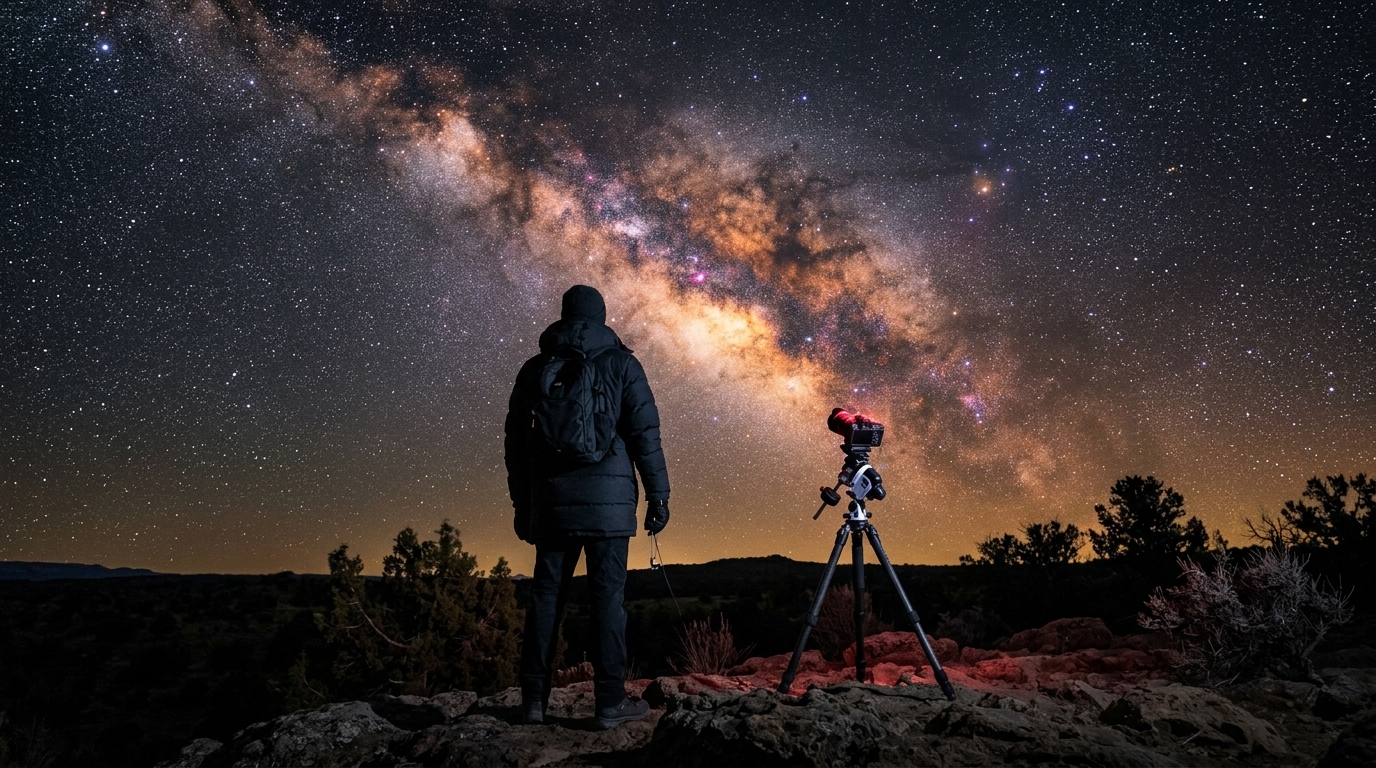
Quick Verdict
Light pollution doubles globally every 8 years according to peer-reviewed data. Regulators have over 1 million satellites on file. By 2046, roughly 30 to 50 percent of long-exposure wide-field images will show visible satellite trails. A Bortle 4 backyard becomes Bortle 6 by 2056. Narrowband imaging shifts from a stylistic choice to a baseline requirement. The hobby does not end. It shifts toward photographers willing to drive farther, filter harder, and stack more.
Read time: 12 minutes
Table of Contents
- How Bad Is Light Pollution Right Now in 2026
- The Two Studies Behind the Numbers
- What 9.6 Percent Per Year Means by 2046 and 2056
- The Satellite Problem That Made It Worse
- Bortle Scale Math for Your Backyard
- What Astrophotographers Will Lose Over the Next 30 Years
- What to Do Right Now
- Final Thoughts
- Frequently Asked Questions
Quick Facts
| Annual sky brightness increase | 9.6 percent globally (Kyba et al. 2023, Science) |
| Doubling time | Every 8 years at current rate |
| Active Starlink satellites (March 2026) | 10,000-plus |
| Total satellites filed with regulators | Well over 1 million (Rubin Observatory) |
| Hubble images crossed by satellites | 2.7 percent of typical exposures (Kruk et al. 2023) |
| Population under skyglow | 80 percent globally, 99 percent in US and Europe |
I have been chasing dark skies with a camera and various telescopes for years. I have frozen my fingers off wrestling with a star tracker, fought condensation on a refractor at 4 a.m., and watched the Milky Way pour over high desert ridgelines. So when I read the Kyba paper showing the night sky doubles in brightness every 8 years, the data hit me twice. Once as a guy who has driven hours to chase darkness. Once as someone who runs a photography site.
If you photograph the night sky, you need to see the math behind the astrophotography light pollution trend. Below I work through the studies, run the compounding numbers out 20 and 30 years, and lay out what your astrophotography practice looks like in 2046 and 2056. Citations point to peer-reviewed papers in Science, Monthly Notices of the Royal Astronomical Society, and Nature Astronomy.
How Bad Is Light Pollution Right Now in 2026
The 2016 World Atlas of Artificial Night Sky Brightness, published by Falchi and colleagues in Science Advances, established the baseline most photographers still cite. At that point, 80 percent of the world population lived under light-polluted skies. In the United States and Europe, the figure climbed to 99 percent. One-third of humanity, including 80 percent of Americans, already lost sight of the Milky Way.
Notably, that was a decade ago. Since then, two factors accelerated the problem. First, the global LED transition. Cities replaced sodium-vapor streetlights with cooler, bluer LEDs, which human eyes perceive as brighter than satellites detect. Second, satellite mega-constellations started crossing the sky in trains visible to the naked eye.
As a result, city dwellers see a view today resembling what a Bortle 8 sky looked like 20 years ago. Meanwhile, suburban backyards at Bortle 5 now read closer to Bortle 6. Even photographers in remote areas notice skyglow domes from cities 100 miles away. A decade ago, those domes did not appear. Our existing guide to working around light pollution covers practical mitigation steps. This article focuses on the math driving the trend.
The Two Studies Behind the Numbers
Specifically, two research streams drive the recent headlines. They disagree, and the gap between them is where your future sky lives.
VIIRS satellite radiance (the 16 percent figure): NOAA’s VIIRS satellite measures upward radiance from Earth at night. Studies using this data found global artificial light emissions rose roughly 16 percent between 2014 and 2022. That equals about 1.87 percent per year compounded. Indeed, this is the conservative number. However, VIIRS has a critical blind spot. The instrument misses blue wavelengths, exactly the spectral range where modern LED outdoor lighting peaks. As a result, VIIRS systematically undercounts the fastest-growing source of light pollution.
Kyba et al. 2023 in Science: Christopher Kyba of the German Research Centre for Geosciences and his team analyzed more than 50,000 citizen science observations from the Globe at Night project. The dataset spans 2011 to 2022. Volunteers compared visible stars in known constellations against a brightness model. Importantly, the numbers stunned researchers. Global sky brightness increased 9.6 percent per year on average. Europe ran at 6.5 percent annually. North America hit 10.4 percent.
Why the gap between VIIRS at 1.87 percent and Globe at Night at 9.6 percent? Because Globe at Night captures what astrophotographers see in the field. Horizontal light from windows, billboards, and lit facades. Shorter wavelength LED emissions. Atmospheric scattering. Skyglow as your sensor records it. Kyba noted the human eye sees a broader spectrum than VIIRS. The satellite instrument fails to detect LED-driven skyglow.
For astrophotography forecasting, the Kyba figure matters more. It maps to what your camera sees.
Astrophotography Light Pollution Projections: What 9.6 Percent Per Year Means by 2046 and 2056
Compounding gets nasty over decades. Here is the math.
First, take any current location and call its sky brightness 1.00 on an arbitrary scale. Apply 9.6 percent annual growth. After 20 years, you multiply by 1.096 raised to the 20th power. The result equals about 6.25. Your sky is more than six times brighter in 2046 than it is today. After 30 years, the same compounding hits roughly 15.64. The 2056 sky is approximately 16 times brighter than the 2026 baseline.
Even at the conservative VIIRS rate of 1.87 percent per year, the 20-year projection gives you a 45 percent brighter sky by 2046. By 2056, the sky runs 74 percent brighter.
Therefore, the realistic range depends on which study you weight more. It brackets between roughly 1.5 and 16 times current brightness 30 years from now. A spread that wide should bother you. Here is the catch. DarkSky International and the broader astronomy community treat the citizen science number as closer to ground truth. Documentation shows VIIRS undercounts LED emissions. As such, your camera operates in the same wavelength bands as your eyes, so plan for the aggressive end of the range.
For context, NOIRLab and University of Arizona astronomers summarizing the Kyba findings put it this way. A child born today where 250 stars are currently visible would see only about 100 stars by their 18th birthday. The math tracks the 9.6 percent rate compounded over 18 years.
The Satellite Problem That Made It Worse

The two big light pollution studies measured ground sources. They did not factor in satellites. Satellites are a separate body of research, and the findings are worse.
Kocifaj and colleagues published a 2021 paper in Monthly Notices of the Royal Astronomical Society Letters. Sunlight reflected off space objects already raises diffuse night sky brightness by approximately 10 percent above natural levels. Notably, the figure exceeded the 1979 IAU threshold for a site to qualify as light polluted. The crucial detail is geographic reach. In contrast, ground-based light pollution falls off with distance, which is why dark sky sites exist. Satellite skyglow does not. It covers the entire planet. Driving away from it does not work.
Hubble Trail Data and the Kruk 2023 Study
Then come the trails, the part most of us already cuss about under our breath when a Starlink train slices through a 4-minute sub. Kruk and colleagues published a 2023 study in Nature Astronomy using machine learning to scan the Hubble archive from 2002 to 2021. They found satellites crossed 2.7 percent of typical Hubble exposures. The probability of trails in Hubble images grew about 50 percent over the study period. Rates climbed from 3.7 percent in 2002 to 5.9 percent in 2021. Hubble currently sits at approximately 515 km, with orbit decaying from its original 615 km altitude due to atmospheric drag. Ground-based wide-field telescopes face significantly worse conditions.
Rubin Observatory Simulations and the LSST Future
The Vera C. Rubin Observatory in Chile, scheduled for first light during the LSST era, simulated the impact of 40,000 LEO satellites against its 10-year survey cadence. The result alarmed researchers. Roughly 10 percent of all LSST images would contain at least one satellite trail. The majority of twilight images would carry streaks. During a 30-second LSST exposure, a single LEO satellite leaves a 15-degree streak across the entire 3.5-degree field of view.
Current Satellite Counts and 1 Million Filings
As of March 2026, Starlink alone has over 10,000 active satellites in low Earth orbit. In addition, total tracked space objects number in the tens of thousands. According to the Rubin Observatory’s own published data, planned commercial satellites filed with regulators exceed 1 million objects. Moreover, some next-generation designs approach 0th visual magnitude, brighter than most stars in the sky.
The Kocifaj 10 percent skyglow figure reflects the satellite population in 2021. Multiply that population by 50 to 100 over the next two decades. The diffuse satellite contribution then becomes the dominant skyglow source for many photographers.
Bortle Scale Math for Your Backyard

The Bortle scale runs from class 1 (true dark sky, Milky Way casts shadows) to class 9 (inner-city sky, only the brightest stars visible). Generally, each class roughly approximates a doubling of sky brightness, though the scale is descriptive rather than strictly logarithmic. At the 9.6 percent annual growth rate, your sky drops one Bortle class roughly every 7.5 years.
Here is what the math means for a few common starting points.
Bortle 2 site today (rural, clear Milky Way visible): By 2046, you are looking at Bortle 4. By 2056, Bortle 5. The Milky Way fades from a structured band of stars into a soft smudge across the sky.
Bortle 4 backyard (small town outskirts): Drops to Bortle 5 or 6 by 2046, and Bortle 6 to 7 by 2056. Consequently, the Milky Way becomes barely detectable to the naked eye. Therefore, camera captures require heavy stacking and aggressive filtering to pull out structure.
Consequently, by that point, true Bortle 1 sites disappear from the contiguous United States entirely, except inside formally protected dark sky reserves. The drive from a typical suburb to a Bortle 2 location currently runs about 90 minutes for many photographers. By the late 2040s, the same drive expands to three or four hours.
As a result, this shifts the cost structure of the hobby. Travel time, fuel, and lodging at remote sites become bigger line items than the camera body itself. So does gear handling short windows of clear weather.
What Astrophotographers Will Lose Over the Next 30 Years
On one hand, some targets survive the brightening sky. Others fade.
Targets That Survive the Brightening Sky
The Moon, planets, bright globular clusters like M13, the Orion Nebula, brighter open clusters, and lunar features stay accessible from almost any location. These targets emit or reflect enough light to overcome skyglow. Lunar and planetary work benefits from urban or suburban shooting because you stay home and image during shorter weather windows.
Additionally, bright nebulae viewed through narrowband filters also survive. H-alpha emission from hydrogen-rich regions passes through spectral windows where light pollution does not dominate. Targets include the North America Nebula, the Heart and Soul nebulae, and the Veil Nebula. A 7-nanometer or 3-nanometer narrowband filter strips out most skyglow. You image these nebulae from a Bortle 5 or even Bortle 6 sky.
Targets That Fade Under Astrophotography Light Pollution
Galaxies. This is the part I hate writing. Galaxies are why a lot of us got into deep-sky imaging. Faint galaxies and broadband targets depend on broad-spectrum light overlapping with skyglow. Currently the naked eye picks up the Andromeda Galaxy from dark sites. Within 20 years, only cameras will record it across most of the United States. Faint galaxy groups like the Virgo Cluster require longer integration times every year to pull the same signal out of brighter background. Reflection nebulae, which scatter starlight rather than emit at narrow wavelengths, fade in the same way.
Milky Way Landscape Photography in 2046
Wide-field Milky Way landscapes change too. The artistic style defining the genre, where the galactic core stands out against a mountain or desert foreground, requires a sky dark enough to see the core. By 2046, the same style demands travel to formally protected areas. The casual “drive 30 minutes outside town” Milky Way shoot disappears for most readers.
Satellite Streaks Across Wide-Field Integrations
Streaks are the next problem. Starlink trains were a novelty in 2019. By 2046, hundreds of thousands of satellites will sit overhead. A 30-minute integration on any wide-field target almost certainly contains visible trails on multiple sub-exposures. If you have not learned sigma-clipping rejection by then, you are stacking the wrong way.
What to Do Right Now

The forecast looks bleak. Your weekend plans do not have to be.
Photograph Dark Skies While You Have Them
. First, Bortle 1 and 2 sites near you are wasting assets. Burn the gas now while the sky is still worth the drive. Every dark sky shoot you do in 2026 captures a sky not existing in the same form 20 years from now. The Milky Way images you capture this year will outlive any equivalent shot from the same location in 2046.
Build a Filter Stack Now
. Specifically, a solid broadband light pollution filter handles general skyglow. Narrowband filters in H-alpha, OIII, and SII open up emission nebula targets from compromised skies. If you want to learn imaging fundamentals first, my beginner astrophotography guide walks through the basics.
Master Stacking and Computational Recovery
. For instance, DeepSkyStacker, PixInsight, Siril, and AstroPixelProcessor all offer outlier rejection handling satellite trails. If you have never run median or sigma-clipping rejection on a stack, learn the workflow this winter. The first time you see Starlink trails vanish from a clean integration, you will not go back. Frame count beats single long exposures from here on. Shoot more 60-second frames instead of fewer 10-minute frames.
Invest in a Tracking Mount
. In short, the shorter your individual exposures, the smaller the percentage of frames a satellite trail will ruin. A simple star tracker like the Sky-Watcher Star Adventurer or iOptron SkyGuider Pro lets you shoot 30-second to 2-minute frames at long focal lengths without trailing. Pair the mount with the 500 rule for shutter speed calculations to maximize what your gear delivers.
Scout Dark Sky Reserves and Visit Them Regularly
. Specifically, the DarkSky International program certifies parks and reserves meeting strict lighting standards. These sites remain the only locations for true dark sky work. If a reserve exists within driving range, become a regular. Many reserves run public observing nights and partner with local astronomy clubs.
Support Lighting Policy Locally
. Importantly, light pollution responds to policy faster than CO2 does. Meanwhile, cities adopting full-cutoff fixtures and reducing overnight lighting see measurable sky improvements within months. The DarkSky International Five Principles for Responsible Outdoor Lighting offer a template most municipal codes adopt without raising costs.
Finally, refine your composition for the new reality. Foreground elements, longer focal lengths on bright targets, and creative use of light pollution gradients become tools rather than obstacles. My piece on astrophotography composition. The DarkSky International resource hub also tracks current astrophotography light pollution research covers techniques translating well to compromised skies.
Final Thoughts
The data hit me hard. Doubling every 8 years is the kind of number you read twice to make sure you have not misread it. Yet the figure sits at the bottom of a Science paper while the average photographer hears nothing about it. Add a million satellites overhead. The night sky my kids inherit will look fundamentally different from the one I grew up watching.
Despite this, astrophotography survives this future. The lane gets narrower, the gear gets heavier, the drives get longer. Photographers who learn the techniques now, while the sky is still relatively dark, build skills mattering even more 20 years from now. In contrast, those who wait end up chasing a sky already changed.
Clear night this week, full tank of gas, go shoot. Andromeda is not waiting on you. For more on the foundational gear and approach, the budget astrophotography guide and pinpoint stars tutorial will get you started. The full astrophotography learning hub covers the rest.
Frequently Asked Questions
How fast is light pollution increasing?
Christopher Kyba and colleagues published a 2023 study in Science. The study showed global sky brightness rises 9.6 percent per year. The figure draws from more than 50,000 Globe at Night citizen science observations between 2011 and 2022. At the same rate, total sky brightness doubles every 8 years. Satellite-based VIIRS measurements show roughly 1.87 percent annual growth. However, VIIRS misses blue-spectrum LED light, so the citizen science number is more relevant for what your camera sees.
Will satellite mega-constellations end astrophotography?
No, but they reshape the hobby significantly. The Kocifaj 2021 paper in MNRAS Letters showed space objects already raise diffuse sky brightness by 10 percent above natural levels. Regulators have on file over 1 million satellites per Rubin Observatory data. Wide-field astrophotography then requires aggressive trail rejection, more frames, and shorter exposures. Narrowband, lunar, and planetary work suffers least.
What happens to my Bortle 4 site over the next 30 years?
Under the Kyba 9.6 percent annual growth projection, a Bortle 4 location today shifts toward Bortle 5 within 10 to 15 years. Bortle 6 follows within 25 to 30 years. The Milky Way fades from clear visibility to a faint smudge for unaided eyes. Broadband galaxy targets like Andromeda require significantly longer integration times.
Which astrophotography techniques become more important?
Narrowband imaging through H-alpha, OIII, and SII filters grows in importance, along with computational stacking using sigma-clipping rejection. Light pollution filters for broadband work, longer drives to certified dark sky reserves, and tracked mounts with high frame counts round out the toolkit. Lunar and planetary work also grows in popularity because the targets tolerate compromised skies.
Will the Milky Way still be visible from suburbs in 2046?
Probably not in the way you do today. Suburban Bortle 5 sites moving to Bortle 7 will lose Milky Way visibility for unaided eyes. The result produces washed-out core captures even with filters. Drives to true dark skies become standard. The casual “30 minutes outside town” Milky Way shoot largely disappears.
Are there places where the night sky is getting darker?
Yes, but they are rare. Specific cities adopting full-cutoff lighting and reducing overnight illumination, including some European municipalities, recorded localized darkening. International Dark Sky Reserves and certified dark sky communities also slow or reverse the trend within their boundaries. These remain exceptions to the global pattern.
What is the best single thing to do as an astrophotographer?
Photograph the sky you have access to today. The skies of 2026 will not be the skies of 2046 in the same locations. Beyond that, build a narrowband filter set, master stacking software with outlier rejection, and support local lighting policy. Photographers who lock in those skills now stay productive as conditions worsen.
Where to track current sky brightness and satellite traffic
Light pollution maps from organizations like Light Pollution Map and Dark Site Finder give you current Bortle estimates. The European Space Agency’s Space Environment Statistics page tracks active satellites. The IAU Centre for the Protection of the Dark and Quiet Sky publishes ongoing research and recommendations. DarkSky International maintains the certified dark sky reserve directory.
About the author: Alex Schult is the founder of PhotographyTalk.com and a longtime astrophotography enthusiast. He has owned multiple high-power telescopes over the years. He has spent many nights under dark skies capturing images of the cosmos. The data in reports like the Kyba 2023 Science paper struck him personally and prompted this analysis.

