


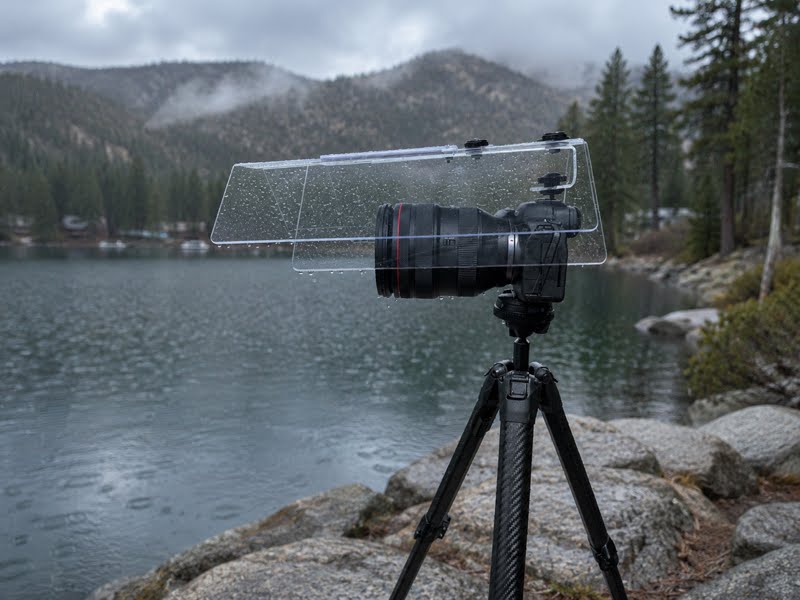
There is something most photographers never see, not because it doesn’t exist, but because they are inside when it happens. The moments after a storm front rolls through, when the streets are still wet, and the clouds are breaking apart at the edges, when fog sits in the valley floor, and the light turns strange and sideways: these are the conditions serious landscape and street photographers will drive an hour to find. Rain doesn’t ruin a scene. It transforms one. A wet sidewalk doubles a city into itself. A snowfall strips every background to clean white. Overcast light eliminates the harsh shadows that photographers spend hundreds of dollars on diffusion gear trying to recreate in a studio. Bad weather isn’t an obstacle to great photography. For the photographer willing to be outside in it, bad weather is the whole point.
The problem has never been the weather. It has been the gear. For decades, the standard solution was a rain sleeve: a plastic bag cinched around the camera with your hands stuffed inside it, operating dials and buttons through wet plastic while your composition drifted and your fingers lost all feel for the controls. I started shooting in the early 1990s, hiding my camera under my jacket and hoping the lens stayed dry. Later came the sleeves, which solved the moisture problem by creating a different one. What photographers needed was protection that didn’t cost them control of the camera, a cover they could forget was even there. That is exactly what the Camera Canopy delivers, and it is why the conditions that used to send me inside are now the ones I head out specifically to shoot.
Quick Verdict: Bad weather photography is one of the most reliable ways to capture images with mood, drama, and atmosphere. Rain creates mirror-like reflections, snow strips a scene to its essential shapes, and overcast skies produce diffused light flattering every subject. The biggest barrier is gear protection, and solving it with a device like the Camera Canopy transforms rain and snow from obstacles into genuine creative advantages.
Last updated: May 2026 | 7 min read
In This Article
- Why Bad Weather Produces Better Photos
- Quick Facts: Bad Weather Photography
- Rain as a Creative Tool: Reflections, Mood, and Drama
- Snow Photography: When the World Goes Silent
- Protecting Your Gear Without Losing Camera Control
- Camera Canopy: A Better Approach to Wet Weather Shooting
- Practical Techniques for Bad Weather Photography
- Final Thoughts
- Frequently Asked Questions
Why Bad Weather Photography Produces Better Images

Photo by Adam Wilson on Unsplash (license)
Bad weather photography is one of the most reliable ways to separate your images from the thousands of identical sunny-day shots filling social feeds every hour. When it rains or snows, most photographers head inside, the crowds disappear, and the landscape transforms into something charged with atmosphere and emotion. Overcast skies deliver soft, diffused light that ranks among the most flattering light available to any photographer, because clouds function as a massive natural softbox, eliminating harsh shadows and evening out contrast across an entire scene.
I started shooting outdoors in the early 1990s, and my go-to rain solution back then was jamming my camera under my jacket and hoping for the best. Over the years, rain sleeves became my tool of choice, though the protection they offered came at a steep cost. My hands were trapped inside a wet plastic sleeve, and I lost tactile control over every dial and button. Reframing or adjusting exposure became a small ordeal every single time.
The images I missed because of gear anxiety outnumber the ones I made. However, bad weather photography changed entirely when I found a smarter approach to camera rain protection, and it opened conditions I had essentially written off. This article covers why bad weather is a creative asset, rain photography tips for getting the most from wet conditions, and how solving the gear protection problem lets you shoot freely when conditions are most compelling.
Quick Facts: Bad Weather Photography
| Topic | Key Detail |
|---|---|
| Light quality in overcast conditions | Soft and diffused; eliminates harsh shadows across the entire scene |
| Rain reflections | Wet pavement and puddles mirror the scene above, effectively doubling your composition |
| Snow exposure correction | Add +1 to +2 stops of exposure compensation to prevent grey-looking snow |
| Freezing raindrops | Use a shutter speed of at least 1/500s to capture individual droplets sharply |
| Rain sleeve limitation | Inserting hands into a wet plastic sleeve eliminates direct access to camera controls |
| Camera Canopy compatibility | Fits any camera with a hot shoe; adjustable shield covers lenses up to 500mm |
| Camera Canopy weight | Original: slightly over 2 lbs; Mini: 14.2 oz |
| Camera Canopy price | Original: $119 + $9.99 shipping; Mini: $89.00 + $9.99 shipping |
Gear Protection by Camera Canopy
Shoot in the Rain. Keep Full Control.
The patented Camera Canopy attaches to your hot shoe and keeps your hands free to operate every dial, button, and function. No sleeves. No fumbling. No missed shots.
Rain as a Creative Tool: Reflections, Mood, and Bad Weather Photography Atmosphere
Wet streets and rain-soaked surfaces rank among the most powerful compositional assets in outdoor photography. A puddle becomes a second sky, a neon sign doubles in a glossy sidewalk, and an entire cityscape reflects in a flooded parking lot. Filmmakers have understood this for decades, which is why productions routinely wet down streets and surfaces even on dry days, specifically to add depth, color, and visual complexity to a shot. As a photographer, rain hands you the same effect for free.
Beyond reflections, rain fundamentally changes the emotional quality of a scene. Subjects photographed in rain carry weight. A person walking under an umbrella, a cyclist powering through a downpour, a cathedral emerging from grey mist: each of these images communicates something a clear-sky version of the same subject never achieves. Atmosphere becomes part of the story, and rain introduces texture into scenes otherwise flat and uneventful. At its best, shooting in bad weather is not about fighting conditions; it is about reading them and responding.
Working with Raindrop Detail
Capturing individual raindrops in motion requires a shutter speed of at least 1/500s. Backlighting from a streetlamp, car headlights, or an off-camera flash dramatically increases the visibility of each droplet against a darker background. Alternatively, photographing the surface of a still puddle at a slower shutter speed reveals the circular impact patterns where each drop lands, adding a completely different kind of texture. Both approaches reward photographers already outside and working, rather than waiting indoors for better conditions.
Snow Photography: When the World Goes Silent

Photo by Creative Travel Projects via Shutterstock
Snow transforms a landscape in ways rain cannot replicate. A heavy snowfall removes clutter, simplifies backgrounds, and strips a scene to its essential shapes. Trees become graphic silhouettes, fences become clean lines, and roads lead the eye through an all-white foreground. For photographers working in compositional terms, snow is one of the most useful weather conditions available, because it does the editing work for you before the shutter fires. Snow photography is a discipline where the conditions actively improve your results.
The technical challenge in snow photography is exposure. A camera’s built-in light meter reads a snowy scene as too bright and systematically underexposes, which renders white snow as flat, dingy grey. The correction is straightforward: dial in positive exposure compensation between +1 and +2 stops, and the snow renders white as intended. White balance is a second consideration, since automatic settings often pull snowy scenes blue. Switching to the shade preset or manually setting a warmer white balance gives snow a cleaner, more accurate appearance in the final image.
Snowfall itself adds motion and depth to a frame. Slower shutter speeds blur falling snow into soft streaks, communicating weather and movement. Faster shutter speeds freeze individual flakes mid-air, especially effective when the background is darker. Both approaches produce images unavailable on any clear day, which is precisely why getting outside in snowfall rewards photographers willing to prepare for it.
Protecting Your Outdoor Photography Gear Without Losing Camera Control

Photo by alexkoral via Shutterstock
The biggest barrier to bad weather photography is not technical knowledge or creative skill. Specifically, it is the anxiety of exposing expensive equipment to moisture. Most photographers address this in one of three ways: they stay home, they use a rain sleeve, or they work extremely fast between stretches of shelter. Each approach costs something. Staying home costs images. Working fast costs composition time. Rain sleeves, however, cost something more fundamental: control of your camera.
In practice, a rain sleeve is essentially a fitted plastic bag placed around the camera and lens. Your hands go inside the sleeve, you grip the camera through the plastic, and you attempt to adjust aperture, shutter speed, or ISO. In light mist, a sleeve is manageable. In actual rain, where the sleeve itself becomes wet and slippery, operating the camera through it is slow, imprecise, and frustrating. Photography in rain demands quick adjustments as light and conditions shift; a rain sleeve makes those adjustments feel laborious enough that many photographers stop attempting them.
The practical result is often a photographer locked into a single exposure setting at the start of a shoot, reluctant to change it because adjusting feels like too much effort. In dynamic weather, where light shifts constantly, and scenes evolve quickly, this rigidity is a serious creative limitation. Good outdoor photography gear for wet conditions protects your equipment without making it harder to use. Camera rain protection should add nothing to your workflow except confidence.
Camera Canopy: A Better Approach to Wet Weather Shooting
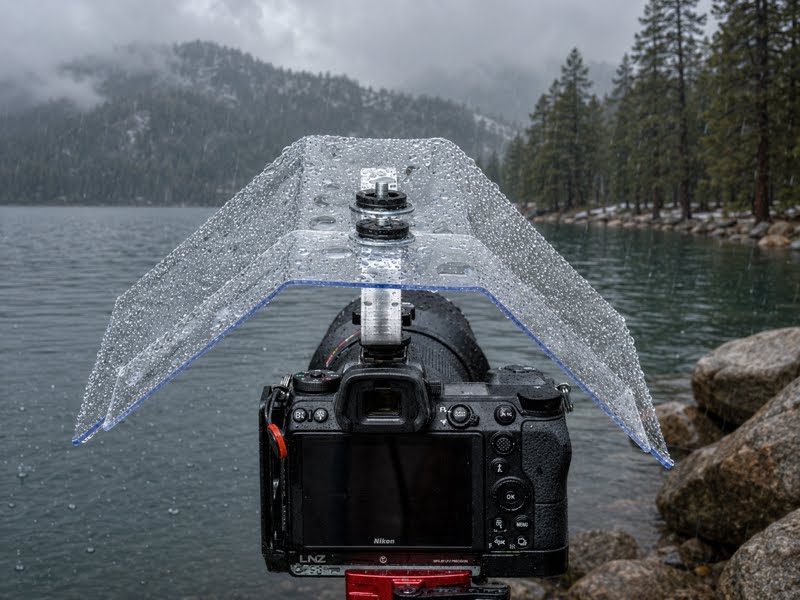
The Camera Canopy takes a fundamentally different approach to protecting your gear in wet weather. Instead of enclosing your hands with the camera inside plastic, it functions as an overhead shield mounted directly to the hot shoe. The patented, clear device keeps rain and snow off your camera and lens from above, while your hands remain completely outside, free to operate every control exactly as you normally would. As a result, there are no sleeves, no plastic obstructing your grip, and no reduction in tactile access to your dials and buttons.
The clear construction, moreover, matters significantly. Because the Camera Canopy is transparent, you retain full visibility of your camera’s top-panel display, lens markings, and all settings at a glance. Nothing is hidden behind opaque material, and nothing requires guessing at settings you cannot see. This is one of the critical differences between a purpose-built wet weather camera cover and improvised solutions such as plastic bags or generic rain sleeves.
Specifications and Fit
The original Camera Canopy weighs slightly over two pounds and adjusts to accommodate lenses up to 500mm telephoto. In its standard position, the unit measures 14 inches long by 11 inches wide by 4 inches high; when fully extended, it reaches 18 inches. A detachable rear tripod shield is included with every unit, adding back-of-camera coverage specifically for tripod work. The device attaches and detaches via the hot shoe and fits any camera body equipped with one. A weather-resistant drawstring carry bag is also included.
For mirrorless shooters and photographers working with smaller lenses, the Mini Camera Canopy delivers the same protection at a lighter 14.2 ounces and a 13-inch profile, priced at $89.00 plus shipping. The original Camera Canopy is priced at $119 plus $9.99 shipping. Both versions support off-camera flash setups through a flash bracket and sync cord, available at most photography retailers for under $20.
Ready to Shoot in Any Weather?
Camera Canopy: Original ($119) | Mini ($89)
Both versions include the rear tripod shield and carry bag. Fits any camera with a hot shoe, from DSLRs to mirrorless systems, with lenses up to 500mm.
Practical Rain Photography Tips for Wet Conditions

Photo by Octavio Fossatti on Unsplash (license)
Beyond gear protection, knowing how to read and work with bad weather conditions is what separates effective bad weather photography from merely competent snapshots. Specifically, several techniques consistently produce stronger results in rain and snow.
Work With What the Weather Gives You
First, the instinct to fight against weather conditions produces weaker images. Working with what is in front of you, however, consistently yields something worth keeping. Overcast skies deliver soft, even light with no hard shadows, particularly effective for portraits, wildlife, and any subject where skin or fur texture matters. Fog and mist compress distance, simplify backgrounds, and add immediate depth to landscape frames. Also, post-storm light, when clouds begin breaking and sunlight cuts through at a low angle, produces some of the most dramatic landscape conditions of the year, and it rewards photographers who are already outside when it arrives.
Composition Adjustments for Photography in Rain and Snow
In rain, look for puddles, wet pavement, and any still water surface. Position yourself so the reflection becomes a usable compositional element rather than background noise. In snow, identify your strongest leading line, whether a road, fence row, river, or tree line, and let it draw the viewer’s eye through the simplified white landscape. Storm clouds overhead are frequently the most dramatic element in the entire scene; consequently, do not hesitate to tilt the camera up and give them significant frame space. These specific decisions separate a compelling rain or snow image from a flat, grey snapshot.
Camera Settings for Moving Weather
In bad weather, conditions shift constantly, and reacting quickly is half the skill. For photography in rain, 1/500s or faster freezes individual drops; for snow, 1/250s often captures falling flakes without turning them to blur. In both cases, boosting ISO to maintain a workable shutter speed is preferable to underexposing the scene. A tripod, moreover, opens up slower exposures, blurring rain or snow into long streaks of motion, which produces a completely different and equally effective look. The Camera Canopy’s rear tripod shield, specifically designed for tripod work, provides added back-of-camera coverage in this configuration.
Final Thoughts on Bad Weather Photography

Photo by Eugene_Photo via Shutterstock
Bad weather photography rewards photographers willing to show up for it. Rain, snow, and overcast conditions produce images with atmosphere, mood, and emotional weight clear skies cannot match. The techniques are straightforward once you understand them, and the compositional opportunities, specifically reflections, simplified backgrounds, dramatic skies, and post-storm light, are genuinely unavailable on any ordinary clear day.
However, the obstacle for most photographers is not creativity or technique. It is gear protection, specifically the frustration of solutions protecting equipment by making it harder to operate. Rain sleeves address moisture at the cost of camera control, a trade-off serious photographers eventually become unwilling to accept. A wet weather camera cover designed to keep your hands free changes the experience of photography in rain from something you endure to something you seek out.
The Camera Canopy solves the problem directly. It mounts to the hot shoe, stays clear so your settings remain fully visible, and adjusts to accommodate lenses up to 500mm on the original version. At $119 for the original and $89 for the Mini, the cost is less than most camera straps and a fraction of what even an entry-level lens costs to repair after moisture damage. The rear tripod shield and carry bag are included with both versions, and both fit any camera with a hot shoe, including the full range of DSLRs and mirrorless systems.
If bad weather has kept you indoors on the days when conditions are most interesting, the problem is solvable. The shots available in rain and snow are unlike anything a clear day produces. With the right gear beneath your hands, shooting in rain and snow becomes one of the most productive and creatively satisfying ways to spend time behind the camera.
Frequently Asked Questions
Is bad weather photography safe for my camera?
Most modern DSLRs and mirrorless cameras handle light mist and brief rain exposure without damage, particularly bodies with weather sealing. However, extended exposure to rain or snow without protection risks moisture entering the camera through buttons, dials, and the lens mount. A purpose-built wet-weather camera cover like the Camera Canopy provides reliable protection in normal rain conditions, though neither it nor any rain cover offers complete protection in wind-driven, heavy downpours, a limitation Camera Canopy addresses directly on its FAQ page.
What are the best rain photography tips for capturing raindrops?
To capture individual raindrops as sharp, distinct shapes, use a shutter speed of at least 1/500s. Backlighting from a streetlamp, car headlights, or an off-camera flash makes individual drops far more visible against a darker background. Alternatively, photographing the surface of a still puddle or calm stream reveals the circular impact patterns where each drop lands, producing a completely different and equally compelling texture in the final image.
Why does snow look grey in my photos?
A camera’s built-in light meter attempts to expose every scene as a medium tone. Because snow reflects so much light, the meter underexposes the image to bring it closer to a middle value, rendering snow as dingy grey rather than white. The correction is positive exposure compensation between +1 and +2 stops, which overrides the meter and renders snow at its actual brightness. Adjusting white balance away from auto also prevents the blue cast overcast light frequently introduces in snowy scenes.
Will the Camera Canopy fit my camera and lens?
The Camera Canopy fits any camera body equipped with a standard hot shoe, which includes virtually all DSLRs and most mirrorless systems. The original Camera Canopy’s retractable shield adjusts to accommodate telephoto lenses up to 500mm. The Mini Camera Canopy provides 12 inches of front coverage and suits mirrorless bodies and smaller lenses; a separate extendable shield kit is available for super-zoom lenses needing additional reach.
What is the difference between the Camera Canopy and the Mini Camera Canopy?
The original Camera Canopy weighs slightly over two pounds, measures 14 inches in standard position, and extends to 18 inches to cover telephoto lenses up to 500mm. It is priced at $119 plus $9.99 shipping. The Mini Camera Canopy weighs 14.2 ounces, measures 13 inches, and is designed for mirrorless cameras and smaller-lensed DSLRs. It is priced at $89 plus $9.99 shipping. Both versions include a detachable rear tripod shield and a weather-resistant drawstring carry bag.
Does the Camera Canopy work on a tripod?
Both versions of the Camera Canopy include a detachable rear tripod shield providing additional back-of-camera coverage when the camera is tripod-mounted. Several customers have also reported using the rear shield while hand-holding, because it keeps eyeglasses dry during shooting. Additionally, both versions are fully compatible with off-camera flash setups using a flash bracket and sync cord, available at most photography retailers for under $20.
Friendly disclaimer: Our articles may contain affiliate links that support us without costing you more, and sometimes we spice things up with sponsored content—but only for products we truly stand behind!

