


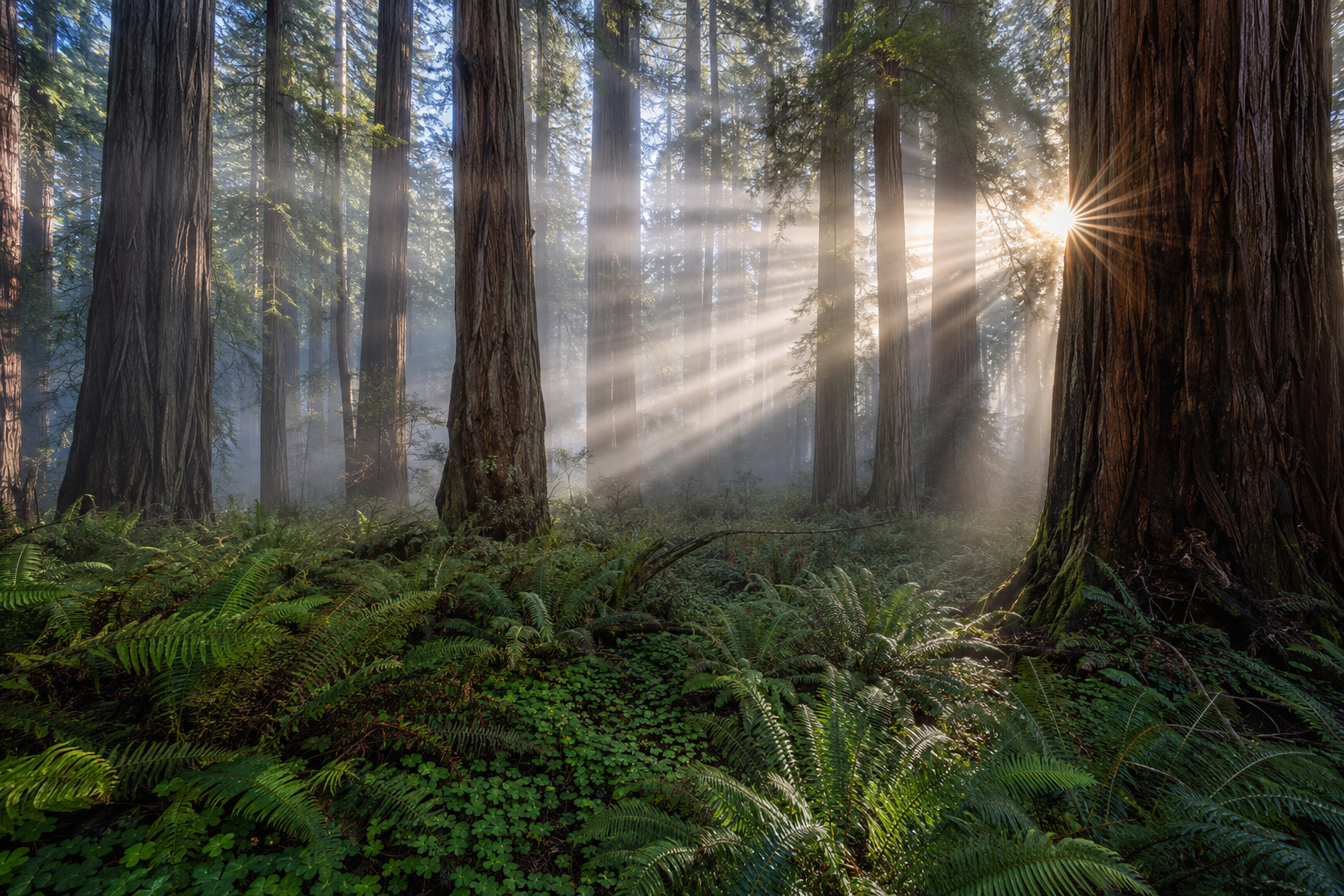
Quick Verdict: To photograph light rays in landscape photography, shoot at f/16 against a dark backdrop. Position yourself within 1 to 2 hours of sunrise or sunset. Look for suspended particulates from forest mist, marine layer fog, or post-storm humidity. The strongest crepuscular rays appear when low sun angle meets a scattering medium and exposure bracketing protects highlight detail across roughly 1.67 stops. After 17 years shooting landscapes, I have learned beam visibility lives or dies on atmospheric conditions, not gear.
Updated: 05/2026 | 11 min read
In This Guide
- Light Rays in Landscape Photography Overview
- Key Facts at a Glance
- Aperture Starburst Settings for Sharper Beams
- Forest Fog and Beam Visibility
- Weather Timing for Light Rays
- Atmospheric Conditions and Light Scattering
- Camera Settings and Filter Choices
- Printing Your Light Ray Landscapes
- Light Rays vs. Lens Flare
- Pros and Cons of Sunbeam Shooting
- Final Verdict
- Frequently Asked Questions
Light Rays in Landscape Photography Overview: Why Sunbeams Reward Patience

Light rays separate flat landscape frames from the kind of image you print on metal and hang above a fireplace. After 17 years photographing deserts, ridgelines, and coastal forests across Southern California and another 14 countries, I have learned the same truth on every shoot. Beams of sun appear when atmosphere, angle, and timing line up for roughly 20 to 30 minutes. Miss those minutes and the scene reverts to ordinary haze. This guide walks you through the field decisions you need to make before you press the shutter.
The audience here is a working landscape photographer or serious enthusiast with a tripod, a wide-angle lens between 14mm and 35mm, and patience for early mornings. You will find specific aperture numbers, weather indicators, and atmospheric science you need to consistently produce visible sunbeams. Generic advice like “shoot during golden hour” produces generic photographs. Specific atmospheric setups and aperture choices produce frames worth printing.
However, light rays appear most often when three conditions overlap. First, the sun sits low enough to send rays through a long atmospheric path, typically within an hour of sunrise or sunset. Second, suspended particulates such as fog, mist, dust, or pollen scatter incoming photons into a visible beam. Third, a dark element behind the rays creates the contrast your sensor needs. A shadowed tree line or a storm cloud both work well.
Key Facts at a Glance
| Element | Field Value |
|---|---|
| Best aperture for starburst | f/16 to f/22 on full-frame |
| Time window after sunrise | First 60 to 90 minutes |
| Time window before sunset | Final 60 to 90 minutes |
| Atmospheric path at horizon | Roughly 40x the noon path |
| Sensor dynamic range | 10 to 15 stops typical |
| Bracket spacing for high contrast | 1.67 stops apart |
| Best scattering medium | Light fog, mist, smoke, or dust |
| Required backdrop | Dark trees, shadow, or storm cloud |
| Aperture blade ray rule | Even blades = blade count rays; odd = double |
| Recommended file format | 14-bit RAW, never JPEG |
Featured on Lumaprints
See Your Sunbeams the Way They Were Meant to Be Seen
A 30-inch metal print resolves the gradient from beam to shadow no phone screen ever will. Lumaprints ships canvas, metal, and fine art paper prints in 2 to 3 business days from California or Kentucky.
Aperture Starburst Settings for Sharper Beams
Aperture starburst is the spike effect you see radiating from the sun when you stop down a wide-angle lens. The physics here is diffraction: light bends around the edges of your aperture blades, and the smaller the opening, the more visible those diffraction spikes become. On most full-frame landscape lenses, the sweet spot for sharp starburst sits between f/16 and f/22. Shooting at f/16 gives you well-defined points. Pushing to f/22 maximizes the dramatic effect, with slight overall softening as the cost.
How Aperture Blade Count Sets Your Star Points
The number of points in your starburst follows a simple rule. An even number of aperture blades produces the same number of rays as blades. So a 10-blade aperture renders a 10-pointed star. An odd number of blades produces double the spikes, because each blade refracts light into two visible points. Therefore a 7-blade aperture renders a 14-pointed star and a 9-blade aperture renders an 18-pointed star.
For example, my Canon RF 15-35mm f/2.8 uses a 9-blade aperture, so every sunburst I capture at f/16 shows 18 distinct points. Compare this to older Nikon glass like the AF-S 14-24mm f/2.8 with its 9-blade design, which produces the same 18-point pattern. If you shoot the Sony 16-35mm f/2.8 GM with its 11-blade aperture, you will see 22-point bursts. The Sony 12-24mm GM uses a 9-blade design and produces an 18-point pattern. Specifically, blade count is fixed by the lens, so check your lens specs before shooting if symmetry matters to you.
Wider focal lengths produce more pronounced starburst at the same f-stop because the physical aperture diameter is smaller. At f/16, a 16mm lens has a much narrower opening than an 85mm portrait lens at f/16, which means stronger diffraction and crisper rays. For light rays in landscape photography, you should default to your widest prime or zoom and stop down aggressively. Shoot at f/16 first, then climb to f/22 if you want more drama at the cost of resolution. Aperture choice handles the geometry of the sun in your frame. However, the beams themselves only appear when the air carries the right particles. The next three sections cover where to find them.
Forest Fog and Beam Visibility
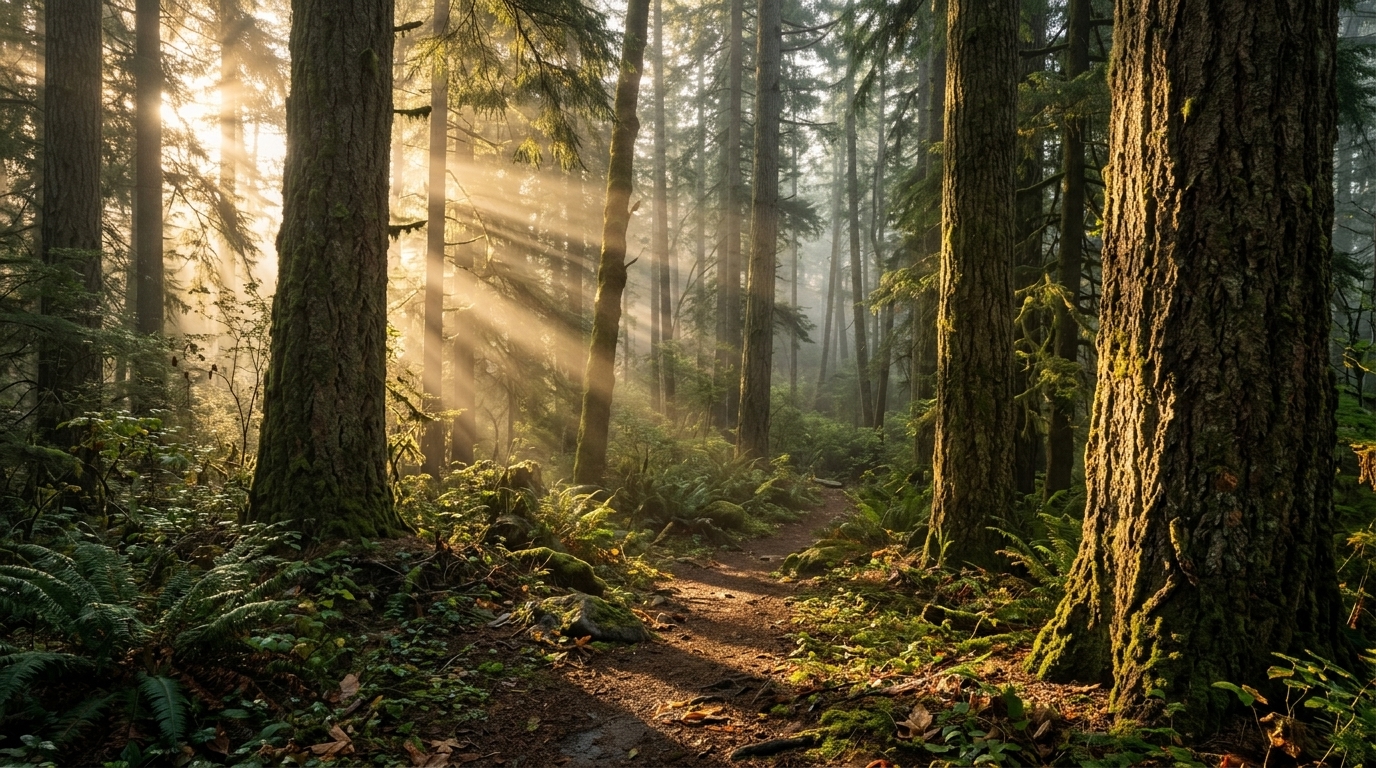
Forest fog is the most reliable producer of dramatic light rays because conifers and old-growth trees create the dark vertical backdrop your sensor needs to render the beams. The principle is the Tyndall effect: when light passes through a medium with suspended particles, the photon path becomes visible to your eye and lens. Water droplets in fog are large enough to scatter light through Mie scattering. The result: visible beams instead of the diffuse blue glow of Rayleigh scattering you see in clear sky.
Reading Fog Density and Sun Position
Light fog produces the best results. However, heavy fog blocks too much sun and flattens contrast. As a rule, if you observe crisp tree silhouettes 100 feet ahead but the trees 300 feet out look soft, you are in optimal beam territory. Marine layer along the Pacific coast burns off mid-morning. As a result, the 30 minutes before it lifts often deliver the strongest fog beams in California.
Position matters. Specifically, backlit composition is the rule, with the sun behind your subject trees and you facing into the light. Side-lit fog produces softer luminosity, yet rarely renders distinct beams. Move slightly off-axis from the sun. Place a thick trunk over the disc to control flare. The beams will fan out from behind the trunk in clean parallel lines.
Old-growth redwoods and coastal pine forests are the textbook setting, but eastern hardwood forests after a humid summer storm produce equally strong beams. The most consistent fog beam location in my own portfolio is the ridge above Muir Woods. I have shot it more than 30 times across 17 years. It fails roughly once every 4 visits. For more on shooting through tough weather, my colleague Sean Simpson covered the practical side of bad weather photography. His piece pairs well with this guide. The point is to chase moisture and contrast, not the calendar.
Weather Timing for Light Rays

Weather timing is where most photographers waste their effort. Golden hour is necessary but not sufficient. The hour after sunrise gives you a low sun angle. However, if the air is dry and clear, no aperture setting will save the shot. You need humidity, particulates, or both, plus the dark backdrop discussed above.
Post-storm windows are gold. The 30 to 60 minutes after a thunderstorm clears delivers lifted moisture, dramatic broken clouds, and shafts of sun punching through gaps. Specifically, watch for cumulus breakup on weather radar and start driving toward your composition while the storm is still 20 minutes from passing. Once the rain stops, you have a tight window before the air dries out. For sunrise and sunset technique generally, this guide on capturing stunning sunrise and sunset photos covers the foundation work for beam shooting.
Cold front passages create another reliable opportunity. As a front pushes through, humidity drops and visibility sharpens, but the leading edge often carries blown dust or pollen aloft. Those particulates linger for hours after the front clears, providing the scattering medium without the heavy haze. I use the Windy app and Clear Outside to monitor frontal timing and PhotoPills to plan exact sun position relative to my chosen ridgeline.
Marine layer behavior is region-specific but predictable. Along the California coast, the layer thickens overnight and burns off between 9 and 11 a.m. depending on season. Photograph the dissolving edge from above. Good vantage points include Mount Tamalpais at 2,571 feet. Likewise, the higher Marin Headlands ridges between 600 and 1,200 feet work, as does any coastal ridge above the inversion. From those elevations you will catch beams projecting through the fog gaps as the sun cuts down through the layer.
Atmospheric Conditions and Light Scattering
Atmospheric conditions decide whether your beams render at all. Two scattering mechanisms govern the visible result. Rayleigh scattering happens when light interacts with particles smaller than the wavelength, mostly air molecules, and produces the blue color of clear sky. Mie scattering happens when particles are roughly equal to or larger than the light wavelength. Fog droplets, smoke, dust, and pollen all qualify. The result is the white or yellow visible beams photographers chase.
Counterintuitively, slightly dirty air outperforms perfectly clean air for sunbeam visibility. Coastal salt spray, agricultural dust, post-storm pollen, and even controlled-burn smoke all increase Mie scattering and make beams more visible. The catch is wildfire smoke, which produces strong scattering but introduces health risks and orange color casts you should typically avoid. If you photograph through wildfire smoke, wear a respirator and accept the warm tone in your final files.
Humidity sweet spot ranges from roughly 60 to 85 percent relative humidity. Below 60 percent, the air carries too few water droplets to scatter light visibly. Above 85 percent, the medium becomes thick enough to attenuate the beam and flatten contrast. Check your local weather station readings the morning of a planned shoot. A jump from 55 percent to 70 percent humidity is the difference between a flat scene and a printable beam image.
The horizon path length explains why low sun angle matters so much. When the sun sits at the horizon, photons travel through roughly 40 times more atmosphere than at solar noon. As a result, more particles intercept and scatter the light, which makes the beam itself visible to your sensor. Above 30 degrees of solar elevation, the atmospheric path shortens and beam contrast collapses, so plan your shoot before the sun climbs above 30 degrees.
Camera Settings and Filter Choices
Camera settings for light rays follow a tight protocol. Shoot at base ISO, usually 100, to maximize dynamic range and minimize noise in the deep shadows where beams meet trees. Set aperture to f/16 for the starburst effect we covered earlier, then use shutter speed to balance the exposure. On a tripod, your shutter speed becomes whatever the meter calls for, typically 1/30 to 1/4 second depending on the scene.
Bracket aggressively. Because the contrast between a bright sun, illuminated beams, and shadowed forest floor exceeds the dynamic range of every current sensor, a single frame will fail. I bracket five frames at 1.67 stops apart, which covers about 8.35 stops of total range. Merge the brackets in Lightroom or Photoshop. The resulting file holds detail in the sun disc, the visible beams, and the deepest tree shadows. For more on managing this exposure problem, the foundational reading is dynamic range explained, which lays out why RAW is non-negotiable here.
Filter Choice and Lens Flare Control
Filter choice trips up many shooters. A circular polarizer reduces glare and saturates blue sky. However, in field testing across hundreds of beam shoots, it also reduces beam contrast. The reason is simple: the scattered light photographers want to capture is partially polarized. Skip the CPL when shooting beams. A 2 to 3 stop graduated ND filter helps balance bright sky against dark foreground, though proper exposure bracketing makes the grad ND optional. Likewise, a 6-stop solid ND used for long exposures in landscape work opens creative options for blurred fog motion within the same frame.
Lens flare control matters when you point a wide-angle lens near the sun. Remove any UV filter before shooting; even premium UV glass adds reflective surfaces. Use the lens hood. Shade the front element with your hand or a hat from outside the frame. Then shoot two or three near-identical frames and pick the cleanest in post. The clean frame will have crisp beams and minimal ghosting; the rejects will have green or magenta blobs you cannot remove.
Printing Your Light Ray Landscapes
Why Light Ray Photos Belong on a Wall
Sunbeam landscapes are the kind of work you cannot evaluate on a phone screen. The dynamic range, the depth, the way the beam dissolves into shadow only reads correctly at print scale. Two substrates serve light ray imagery best. Brushed metal works for the high-contrast luminosity of the beam itself. Fine art paper handles misty forest work where subtle tonal gradations matter most.
Lumaprints offers both, with dual-coast manufacturing in California and Kentucky and 2 to 3 day shipping nationwide. Photographers running print-on-demand storefronts also benefit from their Shopify, Etsy, and WooCommerce integrations. Bulk discounts apply at 5-plus units, which makes building a print product line around your strongest beam frames financially feasible.
Before you print, prep the file correctly. Soft proof in Adobe RGB at 300 DPI. Tag the embedded ICC profile your print lab requests. Inspect at 100 percent for any sharpening halos around the beam edges. For the full capture-to-print workflow, my colleague Sean Simpson wrote a detailed walkthrough on capturing and creating stunning landscape prints. His piece covers gear, sharpening, and substrate selection in depth.
Light Rays vs. Lens Flare: Know the Difference
Light rays and lens flare both involve sun in the frame, but they work against each other photographically. Crepuscular rays are real atmospheric phenomena. They form when parallel sunlight becomes visible through Mie scattering on suspended particles. The beams render as fan-shaped shafts from a hidden or partially blocked sun. Lens flare is an optical artifact. It comes from stray light bouncing inside the lens elements, producing colored ghosts, hazy contrast loss, or veiling glare.
You want the rays. Flare you usually do not want. Both coexist when shooting near the sun, so technique matters. Block the sun disc with a tree trunk, ridgeline, or cloud edge to suppress flare while preserving the beams originating beyond the obstruction. Anti-reflective lens coatings on modern wide-angle glass help but do not eliminate flare, which is why blocking the disc consistently outperforms relying on coatings alone.
For light rays in landscape photography, the practical test is simple. If your final frame shows distinct beams against a darker backdrop with clean color and minimal contrast loss, you have rays without flare. When the image shows a hazy wash, low contrast, and round colored blobs near the sun, flare won. Reposition by 6 inches, reframe, and reshoot until the rays read clean.
Pros and Cons of Sunbeam Shooting
Pros
- Dramatic frames with limited gear: a wide-angle and a tripod cover most situations
- Print-worthy results because beams read at 30-inch scale and beyond
- Differentiation: roughly 5 percent of landscape photographers consistently produce strong beam work
- Atmospheric storytelling beyond simple “pretty light”
- Works with any lens system: Canon RF, Nikon Z, Sony E, Fuji X all produce excellent results at f/16
- Reusable locations: a forest with the right exposure produces beams across multiple seasons
Cons
- Shooting window runs roughly 20 to 30 minutes per session before sun angle or air moisture shifts
- Conditions are weather-dependent and skip 70 percent of planned shoots
- Sensor stains visible at f/16 require thorough cleaning before every outing
- Lens flare risk grows with cheaper or older glass without modern coatings
- Dynamic range demands bracketing skills and post-processing time
- Forest hiking and pre-dawn arrivals add physical demands not present in roadside shooting
Final Verdict
Light rays in landscape photography reward photographers willing to study atmospheric science and arrive with intent. The technical recipe is straightforward: f/16 aperture, base ISO, exposure bracketed at 1.67 stops, dark backdrop, low sun angle, suspended particulates. Memorize those six elements and your hit rate climbs from occasional luck to consistent production.
For working photographers, the trade-off centers on time. You will plan more shoots than you execute, and you will execute more shoots than produce keepers. Across 17 years of landscape work, my keeper rate on planned beam shoots sits near 30 percent. The rest of the outings produce decent fog or sunrise frames, but not the beams I drove to capture. Accepting the ratio is part of the discipline.
For value, the gear bar is low. A wide-angle lens you already own at f/16, a tripod, and a 5-frame bracket sequence cover 95 percent of the technique. The remaining 5 percent comes from showing up at the right place at the right time. Doing so requires the weather research and atmospheric awareness this guide outlined.
If you are choosing between chasing light rays and chasing more conventional golden hour work, my recommendation is to chase rays. The frames stand out in portfolios. Moreover, they print well and teach you to read weather like a meteorologist, not a photographer who waits for the magic hour. Pair this practice with a print discipline through Lumaprints or your preferred lab, and you will build a body of landscape work worth showing.
Featured on Lumaprints
Ready to Print Your Best Beam Frame?
Canvas, metal, fine art paper, framed options. Orders ship in 2 to 3 business days from California or Kentucky with free returns on quality issues.
Frequently Asked Questions
What aperture creates the best starburst for light rays?
For light rays in landscape photography, f/16 produces clean starburst points on most full-frame lenses, while f/22 maximizes drama with slight diffraction softening. Wider focal lengths between 14mm and 24mm produce more pronounced spikes at the same f-stop because the physical aperture diameter is smaller.
When is the best time of day to photograph god rays?
God rays appear most reliably within the first 60 to 90 minutes after sunrise and the final 60 to 90 minutes before sunset. At those low sun angles, light travels through roughly 40 times the atmospheric path of solar noon. Above 30 degrees of solar elevation, beam contrast collapses and the effect disappears.
How do you photograph crepuscular rays in fog?
Backlight the scene with the sun behind your subject trees. Position yourself in light fog rather than heavy fog. Frame against a dark trunk or shadowed area. Shoot at f/16 with bracketed exposures 1.67 stops apart on a tripod at base ISO, then merge the brackets in post.
Why are my sunbeams not showing up in photos?
Sunbeams fail to show up for three reasons: insufficient atmospheric particulates, missing dark backdrop, or excessive solar elevation. Without suspended water droplets, dust, smoke, or pollen creating Mie scattering, the beam path stays invisible. Lacking a dark tree line or storm cloud behind the rays, contrast collapses. Above 30 degrees solar elevation, atmospheric path shortens and rays fade.
Should I use a polarizing filter when shooting light rays?
Skip the circular polarizer when shooting light rays. Polarizers reduce glare by filtering polarized scatter, but polarized scatter is exactly what makes a beam visible. A graduated ND remains useful for balancing bright sky against shadowed foreground, but with bracketing the grad ND becomes optional.
What weather conditions produce the strongest light rays?
The strongest light rays appear after a passing storm when humidity sits between 60 and 85 percent. Cold fronts also work well, pushing through with lingering pollen or dust aloft. Marine layer breakup along coastal ridges is another reliable trigger. Wildfire smoke produces strong rays but introduces health and color cast issues you should weigh against the creative gain.

