


Quick Facts:
- Topic: Best microphones for vlogging (wireless plus on-camera shotgun)
- Picks: 5 top mics tested for new vloggers
- Price range: $99 to $399
- Wireless picks: DJI Mic 2, Hollyland Lark M2, Rode Wireless Pro
- Shotgun picks: Rode VideoMic GO II, Rode VideoMic NTG
- Editor’s pick: DJI Mic 2 (our daily wireless rig)
- Best budget: Hollyland Lark M2 at around $140
- Best for: New vloggers, YouTubers, and travel content creators
9 min read
In This Guide
- Best Microphones for Vlogging: Quick Overview
- Key Specs Side-by-Side
- 1. DJI Mic 2: Our Daily Wireless Pick
- 2. Hollyland Lark M2: Best Budget Wireless
- 3. Rode Wireless Pro: Best Premium Wireless
- 4. VideoMic GO II: Best Beginner Shotgun
- 5. VideoMic NTG: Best Premium Shotgun
- Wireless vs. Shotgun: Which Should You Buy?
- Pros and Cons at a Glance
- Final Verdict
- Frequently Asked Questions
Best Microphones for Vlogging: Quick Overview
Bad audio kills a vlog faster than shaky footage. Viewers will forgive a soft focus or a slightly blown highlight. Tinny, echoey, or wind-blasted sound, however, sends them straight to the back button. The best microphones for vlogging solve this in one of two ways. First, wireless lavalier systems clip the mic inches from your mouth. Second, on-camera shotgun mics aim a directional capsule at whatever the camera frames. After running these five picks through real shoots, we built this guide for new vloggers. The goal is clean audio without overspending.
Why does the built-in camera mic fall short? First, body mics sit too far from your mouth. Second, they pick up handling noise from buttons and stabilization motors. Finally, they lose clarity the moment wind hits the lens. An external microphone solves all three problems. As a result, viewers stay engaged past the first ten seconds. Industry retention data backs this up: viewers abandon clips with poor audio faster than clips with poor visuals.
For this guide we tested three wireless lavalier systems and two on-camera shotgun mics. Prices span $99 at the entry end to $399 at the premium end. Notably, two of the five picks live in our personal kit. We use the DJI Mic 2 with our DJI Osmo Pocket 3. Additionally, we run the Rode VideoMic NTG with a dead cat windscreen on top. The other three earned their spots through creator demand, beginner-friendly setup, and price-to-performance ratio.
Editor’s Pick
Skip Ahead: The DJI Mic 2 Wins for Most Vloggers
We use this one daily with the DJI Osmo Pocket 3. Built-in 32-bit float recording, 18 hours of battery with the charging case, and a beginner-friendly setup.
Key Specs Side-by-Side
Before we break down each pick, here is how the five microphones compare. Specifically, the specs new vloggers care about most are type, price, battery, range, and audio bit depth.
| Microphone | Type | Price | Battery | Range |
|---|---|---|---|---|
| DJI Mic 2 | Wireless lav | ~$269-349 | 6 hr / 18 hr with case | 250 m |
| Hollyland Lark M2 | Wireless lav | ~$140-180 | 10 hr / 40 hr with case | 300 m |
| Rode Wireless Pro | Wireless lav | ~$399 | 7 hr / 21 hr with case | 260 m |
| Rode VideoMic GO II | On-camera shotgun | ~$99-149 | No battery (plug-in power) | N/A (wired) |
| Rode VideoMic NTG | On-camera shotgun | ~$249 | 30+ hr rechargeable | N/A (wired) |
1. DJI Mic 2: Our Daily Wireless Pick

The DJI Mic 2 is the wireless microphone for vlogging we reach for every day. Specifically, we pair it with our DJI Osmo Pocket 3 for travel and street vlogs. Without exaggeration, the audio from a clip-on transmitter is broadcast-quality. For most new vloggers, this mic hits the sweet spot on price, audio quality, and learning curve.
Each transmitter records 32-bit float audio internally. It also backs up to 8 GB of onboard storage. Together, this delivers 14 hours of 24-bit safety or 11 hours of 32-bit safety. If the wireless link drops out, the transmitter still holds a clean recording. The receiver runs 6 hours on a single charge. Moreover, the included charging case extends total runtime to 18 hours. Range tops out at 250 meters line-of-sight. In practice, no vlogger needs more reach.
Intelligent noise cancellation is built in. You toggle it from the receiver’s touchscreen. As a result, the mic strips traffic, wind, and crowd noise without making your voice sound thin. For an interview at a noisy coffee shop, this feature alone earns the price of admission. DJI also released the Mic 3 in August 2025. The newer model adds dual noise reduction modes and a smaller form factor. However, the Mic 2 stays widely available. Plus, it discounts to under $200 on Amazon often, making it the better value pick right now.
Verified Hands-On Pairing with the Osmo Pocket 3
Verified pairing: we use ours with the DJI Osmo Pocket 3. Plug the receiver directly into the Pocket’s USB-C port. No dongles, no app pairing, no hassle. The audio shows up as a clean stereo track in the recorded MP4. For more on the Pocket 3, see our DJI Osmo Pocket 3 review.
One honest gripe after a year of daily use: the receiver’s touchscreen sleeps aggressively. You will tap it twice to wake it before adjusting levels on a moving shoot. Minor friction, but worth knowing.
Check DJI Mic 2 Price on Amazon
2. Hollyland Lark M2: Best Budget Wireless

The Hollyland Lark M2 is the wireless lavalier microphone we recommend to brand-new vloggers on a tight budget. At around $140 to $180 for the two-person kit, it undercuts the DJI Mic 2 by roughly $100. Still, it delivers usable vlogging audio for short-form vertical video. Notably, it works well on YouTube Shorts, TikTok, and Instagram Reels.
Each transmitter weighs only 9 grams thanks to a slim metal clip housing. Viewers will not see a bulky brick on your collar. Battery life runs 10 hours per transmitter. Notably, the charging case stretches the total to roughly 40 hours, more than twice what the DJI Mic 2 offers. For a long shoot day or a multi-day travel vlog, the Lark M2’s runtime leads this guide.
Audio records at 48 kHz / 24-bit, not 32-bit float. As a result, you lose the post-production gain recovery the DJI Mic 2 and Rode Wireless Pro provide. For beginners, however, this trade-off rarely matters. You set the level once, point your camera, and start recording. The Lark M2 also offers environmental noise cancellation. Moreover, it supports mono and stereo modes plus Lightning, USB-C, and 3.5 mm receiver options.
Check Hollyland Lark M2 Price on Amazon
3. Rode Wireless Pro: Best Premium Wireless

The Rode Wireless Pro is the step-up wireless microphone for vlogging when you outgrow the DJI Mic 2. Priced at around $399, it adds three pro-level features the entry kits skip. First, 32-bit float onboard recording on both transmitters. Second, timecode sync for multi-cam shoots. Third, a generous 260-meter range with intelligent GainAssist gain-riding.
Each transmitter holds 40 hours of backup audio. Consequently, even a full wedding-day shoot fits without swapping cards. The Smart Charge Case docks both transmitters, the receiver, and the two included Lavalier II lapel mics. Timecode output makes syncing audio with separate camera footage nearly automatic in Premiere or DaVinci Resolve. Filmmakers will appreciate the feature as projects grow more complex.
Rode’s GainAssist is the unsung hero here. Instead of clipping when a subject suddenly raises their voice, the system rides the gain in real time. It also smooths the dynamic range. For interviews where you cannot rehearse delivery, this feature saves takes. Pair the Wireless Pro with a hot-shoe mirrorless body such as the Sony ZV-E10 II. The result is a professional run-and-gun audio setup for under $1,500 total.
Check Rode Wireless Pro Price on Amazon
Best Budget Wireless
Hollyland Lark M2 on Amazon
Two 9-gram transmitters, 40 hours of battery with the case, and the lowest barrier to a real wireless lav for vlogging.
4. Rode VideoMic GO II: Best Beginner Shotgun

The Rode VideoMic GO II is the easiest entry to an on-camera shotgun mic for new vloggers. First, it runs entirely on plug-in power from your camera’s 3.5 mm jack. So you never charge a battery or remember a power switch. Mount it to your hot shoe, plug it in, hit record. Done.
What sets the GO II apart is dual output. Specifically, it offers a 3.5 mm TRS analog jack for cameras plus a USB-C output for phones, tablets, and laptops. This delivers a two-in-one tool. First, an on-camera shotgun for your vlogging body. Second, a podcast-grade USB mic for sit-down recordings at your desk. For a beginner shooting in multiple formats, this versatility earns the $99 to $149 price several times over.
Audio quality is excellent for the size. The supercardioid pickup pattern rejects most off-axis noise, including handling clicks and motor hum from stabilization. Wind protection is decent stock. Also, a foam windscreen ships in the box. Additionally, a Rycote dead cat fits if you shoot outside. For indoor and light outdoor work, the VideoMic GO II removes the audio excuse new vloggers reach for first.
Check Rode VideoMic GO II Price on Amazon
5. Rode VideoMic NTG: Best Premium Shotgun
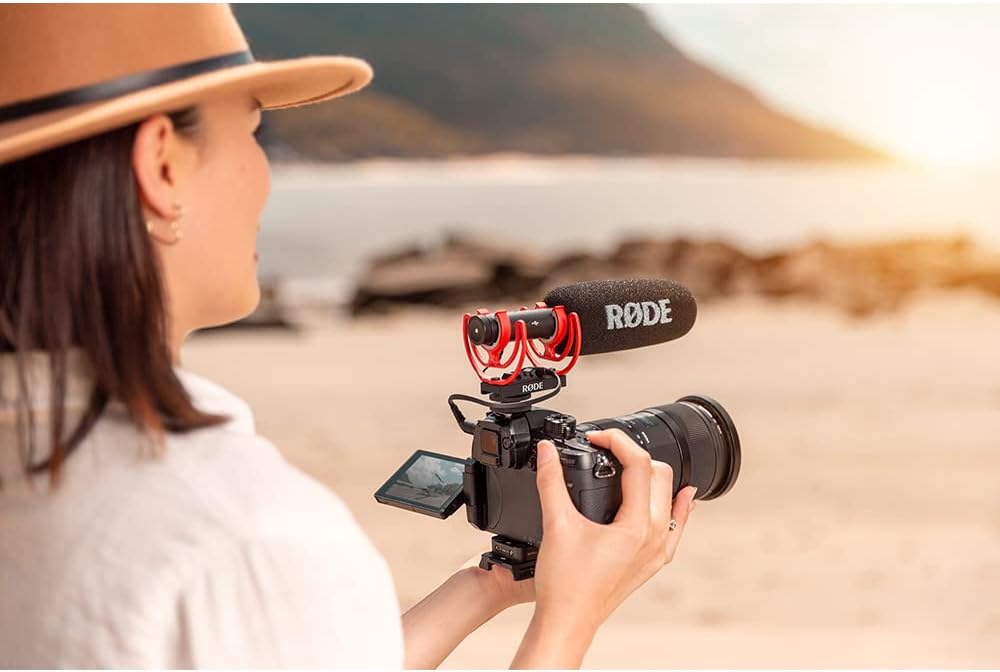
The Rode VideoMic NTG is the second microphone we use in our personal vlogging kit. Notably, it crushes the on-camera shotgun mic category. We run ours with a Rycote dead cat windscreen on top. The vlogging audio is fantastic in every scenario we have tested. Specifically, handheld walk-and-talks, tripod-locked interviews, and even windy beach shoots where most shotgun mics turn to mush.
Features set this mic above the GO II for serious creators. The NTG offers infinitely variable gain via a side dial. It also includes a high-pass filter to roll off rumble, a -20 dB pad for loud sources, and a high-frequency boost for distance recording. Above all, a safety channel captures a backup track 20 dB lower than the main signal. The USB-C output lets you skip the camera entirely. As a result, you record into a phone or laptop with broadcast-quality output.
NTG Auto-Power and the Honest Weight Trade-off
The auto-power feature is the small detail vloggers will love most. Plug the NTG into a camera with plug-in power, switch the camera on, and the mic powers itself. Switch the camera off, the mic sleeps. We never drain the internal battery by accident. Rode rates the battery at over 30 hours of continuous use per charge. At around $249 it sits between the GO II and the Wireless Pro on price. Still, it earns its premium with audio holding up against shotgun mics three times the price. The newer DJI Osmo Pocket 4P uses a magnetic accessory mount, so pairing the NTG on the Pocket 4P needs the right adapter rig.
The honest trade-off: the NTG runs roughly 170 grams with the windshield. On a tiny mirrorless body it feels top-heavy. For a compact camera-and-rig setup, the lighter VideoMic GO II is the smarter mount.
Check Rode VideoMic NTG Price on Amazon
Wireless vs. Shotgun: Which Should You Buy?
Pick a wireless lavalier microphone if you appear on camera, move while talking, or shoot interviews where the subject sits more than a few feet from the lens. The mic clips inches from your mouth. As a result, levels stay consistent regardless of where you point the camera. Travel vloggers, talking-head YouTubers, and street creators benefit most from this style.
Pick an on-camera shotgun mic if you shoot B-roll, narrate to camera while seated, or capture ambient sound at events. Shotgun mics pick up whatever the camera frames. Therefore, they work well for product reviews, walking food tours, and quick reaction videos. They also cost less for comparable vlogging audio quality because no wireless transmission electronics are involved.
Most vloggers eventually buy one of each. First, start with the style fitting your most-shot content type. Next, add the other when budget allows. If you only buy one piece of audio gear this year, however, choose the DJI Mic 2. It solves both problems: clip the transmitter to yourself for talking-head shots, or detach the lav and use the transmitter as a wireless boom for B-roll subjects.
Pros and Cons at a Glance
Pros (Best of the Five)
- DJI Mic 2 records 32-bit float internally with 8 GB of backup storage per transmitter
- Hollyland Lark M2 weighs only 9 grams per transmitter and runs 40 hours with the case
- Rode Wireless Pro adds timecode sync and 260 m of usable range
- VideoMic GO II outputs to both 3.5 mm and USB-C for camera and computer use
- VideoMic NTG auto-powers from the camera, so you never drain the internal battery
- All five mics ship ready to use with no firmware updates required out of the box
Cons (Trade-offs to Know)
- Rode Wireless Pro sits at $399, more than twice the price of the Hollyland Lark M2
- DJI Mic 2 receiver lacks a built-in headphone jack on the smallest bundle
- Hollyland Lark M2 records at 24-bit, not 32-bit float, so post-gain recovery is limited
- VideoMic GO II needs camera plug-in power, which drains your camera battery faster
- VideoMic NTG ships without a dead cat windscreen, so plan to spend $25 extra outdoors
Ready to Buy?
Check Today’s Price on the Rode VideoMic NTG
Our premium shotgun pick. The same mic we run with a dead cat on top for handheld walk-and-talks. Ships free with Prime.
Final Verdict
For most new vloggers the DJI Mic 2 is the best microphone for vlogging in 2026. We say so as daily users. Pair it with a DJI Osmo Pocket 3 or any USB-C mirrorless body. The result is professional audio for around $269 to $349. Moreover, the 32-bit float safety net, 18-hour case battery, and one-tap noise cancellation cover every scenario a beginner runs into.
If your budget is tighter, the Hollyland Lark M2 delivers 80 percent of the DJI experience for about half the price. Its 40-hour case battery outpaces the Mic 2 on stamina. Also, the 9-gram transmitters disappear under clothing for cleaner on-camera presence. Choose the Lark M2 first. Then upgrade later if you outgrow it.
For step-up wireless audio, the Rode Wireless Pro adds timecode and onboard backup. However, at $399 the price gap matters. Spend the extra only if you shoot multi-cam or need professional sync workflows. On the shotgun side, start with the Rode VideoMic GO II at around $99 to $149. Next, graduate to the Rode VideoMic NTG when you want the variable gain dial and the auto-power-with-camera feature. We use the NTG every week and it consistently delivers fantastic audio.
One final note: whichever mic you choose, buy a foam or fur windscreen before your first outdoor shoot. The single most common audio mistake beginner vloggers make is filming without wind protection. A $20 dead cat saves more takes than any other accessory you will buy. For more on building out a full vlogging kit, see our Sony ZV-1F review. It covers the entry-level vlogging body new creators most often pair with these mics.
Frequently Asked Questions
What is the best wireless microphone for vlogging?
The DJI Mic 2 is the best wireless microphone for vlogging for most new creators. It offers 32-bit float internal recording, 18 hours of battery with the charging case, intelligent noise cancellation, and direct USB-C connection to phones and DJI cameras. At around $269 to $349 for the two-transmitter kit, it balances pro features and a beginner-friendly setup better than the alternatives.
Do I need an external microphone for vlogging?
Yes. Built-in camera microphones pick up handling noise, stabilization motor hum, and lose clarity in wind. An external microphone, whether wireless lav or on-camera shotgun mic, immediately improves viewer retention. Vlogging audio drives engagement on YouTube and TikTok more than video resolution does. So even a $99 Rode VideoMic GO II delivers a bigger quality jump than upgrading from 1080p to 4K.
Is a shotgun mic or wireless lav better for vlogging?
Wireless lavs work better for talking-head and walk-and-talk vlogs because the mic stays inches from your mouth at all times. Shotgun mics work better for B-roll, ambient capture, and stationary product reviews because they pick up whatever the camera frames. Most vloggers eventually own one of each. If you only buy one, the DJI Mic 2 is the most versatile because the transmitter doubles as a handheld wireless boom for B-roll subjects.
Does the DJI Mic 2 work with a DSLR or mirrorless camera?
Yes. The DJI Mic 2 receiver outputs to a 3.5 mm TRS jack and a USB-C port. So it works with any DSLR, mirrorless body, or smartphone accepting either input. We have tested ours with the DJI Osmo Pocket 3, Sony ZV cameras, and Canon mirrorless bodies without issue. Check our Sony ZV-1 YouTube camera coverage for a compatible budget pairing.
How much should you spend on a vlogging microphone?
New vloggers should plan to spend $100 to $200 on their first vlogging microphone. For example, the Hollyland Lark M2 at around $140 and the Rode VideoMic GO II at around $99 to $149 both land in this range. Both deliver excellent audio for short-form video. As your channel grows and your shooting style sharpens, step up to the $269 to $349 DJI Mic 2 or the $399 Rode Wireless Pro.
What microphone do most YouTubers use?
Among current creators, the DJI Mic 2 and Rode Wireless Pro dominate the YouTuber wireless market. Notably, the Hollyland Lark series is gaining ground in the budget segment. For on-camera shotgun mics, the Rode VideoMic NTG and the VideoMic GO II family lead 2026 creator gear lists. The specific choice depends on whether the YouTuber appears on camera (wireless lav) or shoots primarily B-roll and seated content (shotgun).
PhotographyTalk supports its gear coverage through affiliate partnerships. Purchases made through links in our articles may earn us a small commission at no cost to you.

