


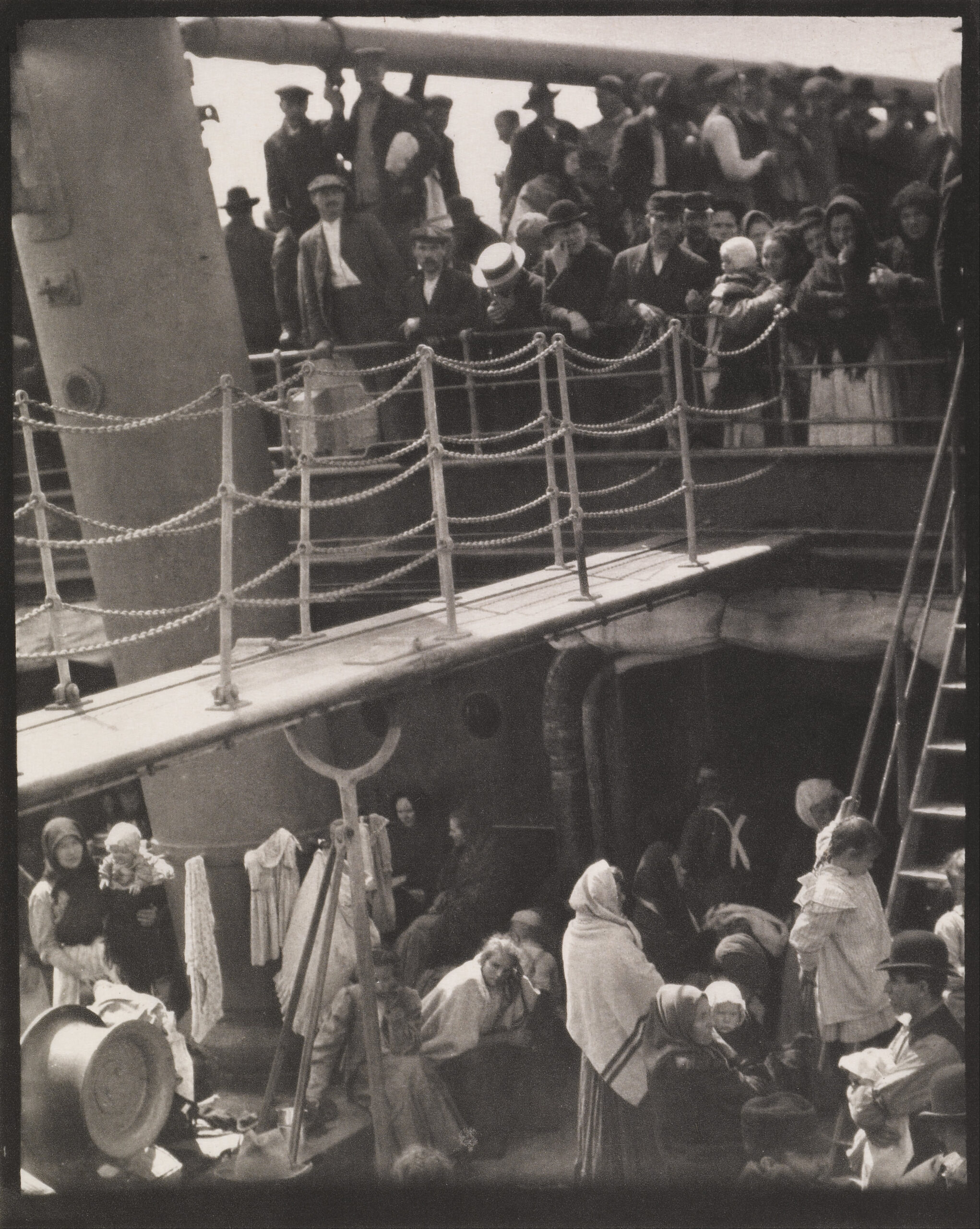
Quick Facts:
- Photograph: The Steerage
- Date taken: June 1907
- Photographer: Alfred Stieglitz
- Voyage: SS Kaiser Wilhelm II, New York to Bremen
- Subject: Steerage passengers seen from an upper deck
- Camera: A 4 by 5 inch Auto-Graflex single-lens reflex
- Print form: Photogravure
- First major publications: Camera Work No. 36 in 1911 and 291 magazine in 1915
- Holdings: Metropolitan Museum of Art, Museum of Modern Art, J. Paul Getty Museum, and others
- Rights: Public domain in the United States by age
- Best for: Readers exploring The Steerage and the modernist turn in photography
10 min read
In This Article
The Steerage Overview: How Alfred Stieglitz Made an Art-Photography Landmark
The Steerage shows a busy lower deck of a transatlantic steamship, photographed from a higher deck on a bright June day in 1907. A diagonal gangway crosses the frame, splitting the picture into two worlds. Above, figures from a higher deck in straw hats and bright shirts lean on the rail. Below, steerage passengers stand among ropes, chains, and the ship’s iron hardware. Alfred Stieglitz pressed the shutter once and produced what many critics consider the first modernist photograph in American art.
This article runs from a frustrated first-class voyage to the picture’s later life in Camera Work and 291 magazine. The story also passes through the major museum collections of New York, Los Angeles, and Washington. You will read who pressed the shutter and what camera and plate made the frame possible. You will also see why the composition broke from earlier Pictorialism. Above all, the photograph belongs on the history of photography timeline as the moment the medium turned toward modernism.
For a photography audience, The Steerage rewards careful study. It is, on one reading, a documentary photograph of working-class travelers. On another, it is a geometric arrangement of light, shape, and line. Stieglitz himself spent years pointing to it as his most important image, and he said the same thing in letters and interviews almost until his death.
At a Glance
Here are the core details. The table below sets out the frame, the photographer, the voyage, and the gear before the full story.
| Detail | Information |
|---|---|
| Title | The Steerage |
| Date taken | June 1907 |
| Photographer | Alfred Stieglitz |
| Voyage | SS Kaiser Wilhelm II, New York to Bremen |
| Camera | A 4 by 5 inch Auto-Graflex single-lens reflex |
| Plate | A single unexposed glass plate, reportedly the last one in his cabin |
| Print form | Photogravure, printed in two well-known forms |
| First publications | Camera Work No. 36, 1911; 291 magazine, 1915 |
| Holdings | Metropolitan Museum of Art, Museum of Modern Art, J. Paul Getty Museum, National Gallery of Art |
| Rights | Public domain in the United States by age |
The Moment Stieglitz Saw It
In June 1907, Alfred Stieglitz sailed from New York to Bremen on the SS Kaiser Wilhelm II of the Norddeutscher Lloyd line. He traveled first class with his wife Emmeline and their eight-year-old daughter Katherine. By the third day, the first-class society around him bored him. He left his deck to walk the rest of the ship.
From an upper deck, he looked down through a gangway at the steerage section, the cheapest accommodations on the ship. What he saw stopped him. Light fell across a tangle of ropes, chains, a smokestack, and human figures arranged in clean geometric blocks. A man on the upper rail wore a round straw hat. Below the gangway, women, men, and a child stood among the iron hardware of the lower deck.
Stieglitz ran to his cabin. He grabbed his Auto-Graflex camera and the single unexposed plate he had left. He rushed back to the upper deck and worried the scene would have changed. It had not. The man in the straw hat still leaned on the rail, the women below were still in place, and the diagonal gangway still cut across the frame the way he had remembered.
He made the exposure. Afterward, he waited until the boat reached Paris later in the trip, where he developed the plate. The result was a single negative, made in one exposure, with no time to bracket or reshoot. It became the photograph he later named as the most important of his life.
Alfred Stieglitz: From Engineering Student to Modernist Editor

Alfred Stieglitz was born on January 1, 1864, in Hoboken, New Jersey, to German-Jewish immigrant parents. As a teenager, he moved to Germany for his education. In Berlin during the 1880s, he studied photochemistry under Hermann Wilhelm Vogel, the chemist who developed early photographic sensitizers. He learned the technique from the inside out.
By 1890, Stieglitz had returned to New York. Over the next decade, he edited photographic journals, organized exhibitions, and worked to push the medium beyond a mere recording tool. He believed photography belonged in galleries beside painting and sculpture. In 1902, he and a small group of like-minded photographers founded the Photo-Secession movement to push the argument. Other founders included Edward Steichen and Gertrude Käsebier.
The Photo-Secession produced a quarterly journal called Camera Work, which Stieglitz edited from 1903 through 1917. The journal ran fifty issues. Notably, each issue included beautiful photogravure reproductions of pictorialist and modernist photography, alongside the European modern art Stieglitz championed at his gallery in New York. Photography history rests, in part, on the back of the magazine.
Even the medium’s earliest practitioners had treated the camera as a recording instrument. The makers of the first photograph ever taken and the Daguerre 1838 Boulevard du Temple stayed inside the same frame. Stieglitz was determined to treat it as an artistic one. The Steerage gave him the cleanest single image to make the case.
Aboard the Kaiser Wilhelm II

The SS Kaiser Wilhelm II was a German ocean liner of the Norddeutscher Lloyd line, launched in 1902 and put into transatlantic service in 1903. By 1907, the ship carried passengers in three classes: a polished first class at the top of the ship, second class amidships, and steerage at the lower decks. Steerage passengers, mostly European emigrants headed to America or returning home, traveled in cramped quarters at the cheapest fare on the ship.
Stieglitz had paid for first class. His own letters from the period describe a numbing round of dinners, formal dress, and small talk leaving him miserable. He later said the people in first class felt false to him, while the people in steerage felt true. The photograph he made on the third day distilled the comparison in a single frame.
The ship itself was a marvel of the era. At more than 19,000 gross tons, the Kaiser Wilhelm II briefly held the Blue Riband for fastest Atlantic crossing in 1904. By the time Stieglitz sailed in 1907, the ship was popular but no longer the speed record holder. Its upper decks gave clean lines of sight down to the steerage area, and a gangway connected the two zones for crew movement.
The Camera and the Plate
Stieglitz worked with a 4 by 5 inch Auto-Graflex single-lens reflex camera. The Auto-Graflex was a working photographer’s standard tool of the period. The camera used glass plates loaded one at a time into a removable plate holder. After each exposure, the photographer pulled the dark slide back into the holder and either reloaded or moved on.
On the morning he saw the gangway scene, Stieglitz had a single unexposed plate left in his cabin. He used it on The Steerage, which means there was no second attempt and no backup. If the focus had been soft, or the composition had shifted, or the chemistry had failed, the picture would not exist.
From Glass Plate to Photogravure
Stieglitz developed the negative in Paris later in the trip. After returning to New York, he set the plate aside. He thought about how to present it for several years before he started printing it for publication. He chose the photogravure process, which etches a photographic image into a copper plate using a gelatin tissue. Resulting prints carry a soft, ink-rich tone suiting the modernist composition.
The Steerage appeared in two well-known photogravure printings. Camera Work issue 36 of 1911 carried the first version as a tipped-in plate inside the magazine. A 1915 issue of 291 magazine ran the second, on a much larger plate showing the picture at near-print size. Both versions still survive in museum collections.
Reading The Steerage
The Steerage rewards careful looking. A diagonal gangway runs from the upper-left toward the lower-right, dividing the frame into two trapezoidal zones. Above the diagonal, the zone is sparse. A man in a round straw hat leans on the rail, a woman in a white shirt stands beside him, and the geometric cylinder of the funnel cuts across the sky. Below the diagonal, the zone is dense with figures, hats, and the iron hardware of the deck.
Light falls from the upper-right and rakes across the scene at a shallow angle. The shadow of the gangway crossbeam strikes the funnel and the upper rail. White shirts, dark suits, and pale hats become repeating shapes across both zones. A few figures lean into the photograph by chance, and a few stand still as if the camera had asked them to hold.
Stieglitz himself described the picture as a study of shapes rather than a story about emigration. In a 1942 essay titled “How The Steerage Happened,” published in Dorothy Norman’s journal Twice a Year, he said the photograph showed him the moment a new vision had become possible. Critics since have read both the human story and the geometric one out of the same frame, and both readings hold up under close examination.
Camera Work, 291, and the Photo-Secession
Photography in 1907 was still arguing with itself over what it should be. Pictorialism, the movement treating photography as a soft, painterly art form, had dominated serious photographic discussion for two decades. Pictorialist prints leaned on hand-applied processes, gum bichromate, and platinum printing to produce images looking almost like drawings. Stieglitz himself had been a leading pictorialist for years.
By the time he printed The Steerage for Camera Work in 1911, his thinking had begun to shift. The photograph used sharp focus, geometric shapes, and a strong diagonal. It looked nothing like a soft pictorialist landscape. Stieglitz placed it inside his own magazine as a quiet announcement of a new direction. Over the next several years, Camera Work increasingly featured modernist artists like Picasso, Matisse, and Brancusi alongside straight photography by Stieglitz, Steichen, and Paul Strand.
The Little Galleries of the Photo-Secession at 291 Fifth Avenue, known simply as 291, served as the public stage for the same argument. Stieglitz ran the gallery from 1905 to 1917, exhibiting photography beside modern painting and sculpture. In 1915 he launched a short-lived companion magazine, also called 291, where The Steerage ran in its largest reproduction. The print he produced for the issue carried the photograph into the world at near-original size.
Why The Steerage Still Matters
The Steerage is moderate in its first printing, about eight inches tall in the 1911 Camera Work plate, and much larger in the 1915 291 magazine version at over thirteen inches. Either way, it carries an enormous weight in the history of photography. Curators and critics name it as the first fully modernist photography landmark in America. Stieglitz himself called it his greatest image until the end of his life in 1946.
Modern collectors share the assessment. Original prints have sold at auction in the low six figures, with a notable $110,500 result in 2008. The picture appears in collector discussions of landmark photograph auctions alongside other twentieth-century frames. It also sits in many of the world’s most-visited photography collections, including the Metropolitan Museum of Art, the Museum of Modern Art, the J. Paul Getty Museum, the National Gallery of Art, and the Art Institute of Chicago.
From Pictorialism to Modernist Photography
The Steerage marked the start of a shift from pictorialism to what photographers later called straight photography. The straight approach prized sharp focus, real-world subjects, and strong composition over soft, painterly effects. Edward Weston, Paul Strand, Ansel Adams, and Imogen Cunningham all worked from variations of the same idea over the next several decades.
It also belongs to a short list of single frames changing how people see the medium itself. The Wright brothers’ first flight photo proved a camera freezes a moment of historic action. The Steerage proved a camera composes a moment of pure design. Two different roles, joined in the same medium.
For full curatorial detail, see the photograph’s Wikipedia entry, which compiles the major museum holdings and the published scholarship. Like every public-domain image in this series, The Steerage is free for any reader to study, share, and reproduce.
Frequently Asked Questions
What Is The Steerage?
The Steerage is a 1907 photograph by Alfred Stieglitz showing lower-deck passengers on the SS Kaiser Wilhelm II, viewed from a higher deck across a diagonal gangway. The ship was sailing east from New York to Bremen, so the passengers were not arriving immigrants but returning emigrants and others traveling east. It is widely cited as the first fully modernist American photograph and is held in the collections of the Metropolitan Museum of Art, the Museum of Modern Art, and other major museums.
Who Took The Steerage?
Alfred Stieglitz, the American photographer and editor of Camera Work magazine, took The Steerage in June 1907. He was traveling first class from New York to Bremen on the SS Kaiser Wilhelm II when he saw the scene from an upper deck and ran to his cabin for his Auto-Graflex camera and his last unexposed plate.
When Was The Steerage Taken?
The exposure happened in June 1907 during a transatlantic voyage. Stieglitz developed the plate in Paris later in the trip. The photograph was first published in 1911 as a photogravure in Camera Work issue 36, and again in 1915 in a larger photogravure inside the short-lived 291 magazine.
Why Is The Steerage Famous?
The Steerage is famous because it broke from the soft-focus pictorialism of its era and used sharp lines, geometric shapes, and a strong diagonal composition. Curators and critics name it as the first fully modernist American photograph, the moment photography as art moved toward what later became known as straight photography.
Where Is The Steerage Today?
Original photogravure prints of The Steerage live in major museum collections worldwide, including the Metropolitan Museum of Art in New York, the Museum of Modern Art in New York, the J. Paul Getty Museum in Los Angeles, the National Gallery of Art in Washington, and the Art Institute of Chicago. High-quality digital scans are available from each museum’s online catalog.
What Camera Did Stieglitz Use?
Stieglitz used a 4 by 5 inch Auto-Graflex single-lens reflex camera, loaded with a single unexposed glass plate. He had only the one plate left in his cabin at the time, so The Steerage was made in a single exposure, with no second attempt and no backup.

