


Quick Facts:
- Project: Lewis Hine Child Labor Photographs
- Years made: 1908 to 1924
- Photographer: Lewis Wickes Hine (1874 to 1940)
- Client: National Child Labor Committee (NCLC)
- Volume of work: More than 5,100 prints and 355 glass negatives
- Process: 5×7 Graflex single-lens reflex camera with magnesium flash powder when needed
- Subjects: Mill workers, breaker boys, newsboys, cannery workers, agricultural laborers
- Holdings: Library of Congress, NCLC Collection
- Rights: Public domain (work-for-hire for NCLC, donated to LoC)
- Best for: Readers interested in social reform photography and US labor history
9 min read
In This Article
- Overview
- How Hine Made the Photographs
- Lewis Hine: From Sociologist to Investigative Photographer
- The National Child Labor Committee Campaign
- The Best-Known Images: From Breaker Boys to Newsies
- Legacy: From Keating-Owen to the Fair Labor Standards Act
- Why the Photographs Still Matter
- Frequently Asked Questions
Lewis Hine Child Labor Photographs Overview: The Camera Behind a National Reform
Lewis Hine child labor photographs document the working lives of more than five thousand American children between 1908 and 1924. Lewis Wickes Hine made the pictures on assignment from the National Child Labor Committee. He traveled across the country to cotton mills, coal breakers, glass factories, canneries, and tenement sweatshops. The images are among the most reproduced documentary photographs in American history. They also helped move federal child labor legislation through Congress over the next three decades.
Hine worked undercover for much of the project. To enter mills and mines closed to outside photographers, he posed as a Bible salesman, an insurance agent, a fire inspector, or an industrial photographer documenting machinery. After entry, he photographed the children at their workstations. Then he recorded their names, ages, and hours worked in a small notebook hidden under his coat. The photographs belong on the history of photography timeline. They mark the moment American documentary practice took the form Dorothea Lange and Walker Evans would later refine.
The full story runs from Hine’s 1908 hire by the National Child Labor Committee in New York to the Fair Labor Standards Act of 1938. Still, for a photography audience, the project is more than a labor history footnote. It is a case study in how a camera, used with deliberate intent, becomes evidence.
How Hine Made the Photographs
Hine carried a 5×7 Graflex single-lens reflex camera, a heavy wooden tripod, and a box of glass plates from town to town. His approach to child labor photography rested on access, speed, and verifiable captions. Mills and mines were closed to outside press photographers, so he developed an undercover practice. For example, at each site he presented himself as a Bible salesman, an insurance agent, a postcard vendor, an industrial photographer, or a fire inspector. The cover story varied with the site.
Once inside, he moved fast. Magnesium flash powder gave him the light he needed in dim mills and underground coal breakers, though the flash was loud and smoky. For each frame, he set the camera, composed against a wall or work bench, asked the child to stand still, and made a single exposure. Then he asked the child for a name, an age, and the hours worked, writing the answers in a small notebook hidden in his pocket.
In addition, age verification was a problem. Children often lied to protect their jobs, and managers coached them on the answers. Hine developed a workaround. Before each exposure he counted the buttons on the child’s shirt, knowing standard shirt sizes for each age. After the exposure he measured the child against marks on his coat sleeve. The pictures and the field notes together built the case the NCLC would later use in Congress.
Camera, Film, and the Flash Powder Problem
The 5×7 Graflex used a focal-plane shutter and accepted long bellows lenses for tight portraits inside cramped factory aisles. Hine later switched to a smaller 4×5 Graflex for easier travel. Both cameras took glass plates requiring immediate care after exposure. Hine often returned to a hotel room to develop the day’s work and confirm the frames were sharp before moving on.
Indoor lighting was the constant challenge. Cotton mill floors were dim, and coal breakers were nearly dark. Magnesium flash powder solved the exposure problem, but the burn was bright and smoky. In particular, the flash drew attention, so Hine kept his exposures brief and used the powder sparingly. Several mills threw him out the moment a flash went off.
Lewis Hine: From Sociologist to Investigative Photographer
Lewis Wickes Hine was born in Oshkosh, Wisconsin, on September 26, 1874. He trained as a teacher at the University of Chicago and later studied sociology at New York University and Columbia. In 1903 he joined the faculty of the Ethical Culture School in New York. There he taught geography, nature study, and photography to high school students.
His photographic work began as a teaching exercise. For example, between 1904 and 1909 he made repeated trips to Ellis Island with his students, photographing newly arrived immigrants on the building’s processing floors. Those plates became his first published documentary series and his first encounter with the camera as a research tool.
In 1908, the National Child Labor Committee offered him a staff position. He left the Ethical Culture School and took the title Investigative Photographer, a job description he largely invented. Then he spent the next sixteen years on the road for the NCLC. His travels covered textile mills in the Carolinas, glass factories in Indiana and Pennsylvania, canneries on the Gulf Coast, and tenement sweatshops in New York. He died in poverty in Dobbs Ferry, New York, on November 3, 1940, age 66.
The National Child Labor Committee Campaign
The National Child Labor Committee was founded in 1904 at a Carnegie Hall meeting, with Edgar Gardner Murphy leading the call and Felix Adler elected as the first chairman. The group lobbied state and federal lawmakers for child labor restrictions, conducted field investigations, and published research pamphlets. However, by 1908 the committee had concluded statistics alone were not moving Congress. The board wanted a staff investigator able to produce visual evidence the public would not forget.
Hine was their answer. The committee paid his travel, his glass plates, and his hotels. In return he produced the photographs, the captions, the field notes, and often the printed pamphlet layouts. For instance, many of his images first appeared in NCLC publications like the journal The Survey, the magazine The Outlook, and the committee’s own pamphlets.
The NCLC also booked Hine for lantern slide lectures across the country. Audiences in churches, libraries, and town halls saw the pictures projected at full size while Hine narrated the field stories. For many viewers, this was the first time they had seen the faces of the children working twelve-hour shifts in their state. The lecture tour grew into a national campaign, pressuring legislators in both parties.
The Best-Known Images: From Breaker Boys to Newsies

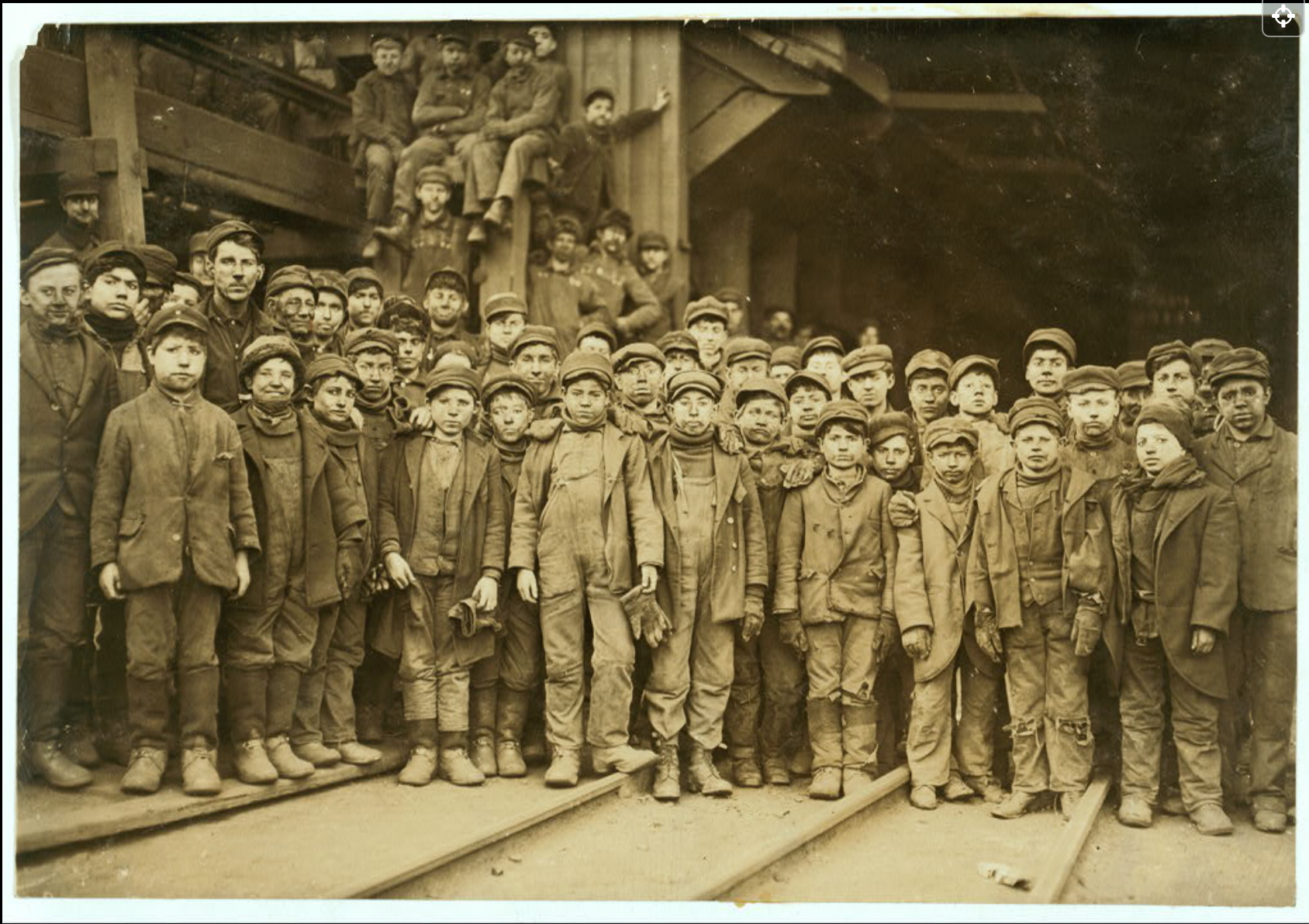
A handful of Hine’s frames have entered American visual memory. They include the breaker boys at the Ewen Breaker in South Pittston, Pennsylvania, made in January 1911. The picture shows rows of boys, some as young as eight, hunched over a chute of crushed coal. They picked out slate and rock with their bare hands. Hine listed their ages in the caption: “from 10 to 14 years.”
Another group shows the cotton mill spinners. In November 1908, Hine photographed Sadie Pfeifer at the Lancaster Cotton Mills in South Carolina. The caption reads: “48 inches high, has worked half a year.” She stands as one of dozens of small girls he captured beside spinning frames taller than they were.
The Gulf Coast canneries form another series. There children as young as five shucked oysters and picked shrimp in the cold hours before dawn. Among them was Manuel, a five-year-old shrimp picker in Biloxi, Mississippi. Hine made the picture in February 1911, and it shows a child gripping a tin pail nearly as large as he was. Today it ranks among his most reproduced single portraits.
The newsboys round out the best-known work. For this series, Hine followed paperboys through Hartford, St. Louis, Wilmington, and Newark, often before dawn and often in winter. Some were barely school age, already working street corners and dodging traffic. For many readers, these city faces made distant labor reports feel local.
Legacy: From Keating-Owen to the Fair Labor Standards Act
Hine’s photographs reached Congress in stages. The Keating-Owen Child Labor Act of 1916 prohibited the interstate sale of certain goods. Factories employing children under fourteen and mines employing children under sixteen were specifically named. Then President Woodrow Wilson signed the bill on September 1, 1916. Hine’s photographs were cited in the floor debate and in committee testimony as documentary evidence of the harm Congress aimed to address.
However, the Supreme Court struck the law down in 1918 in Hammer v. Dagenhart. The 5-4 decision ruled the federal government had overreached its commerce power. Afterward, reform advocates spent the next two decades looking for a constitutional path. Finally, they found one in the Fair Labor Standards Act of 1938. This act set a federal minimum wage, capped working hours, and finally restricted child labor on terms the Court upheld.
The NCLC photographs were used in the build-up to the 1938 act. Hine’s images, by then twenty to thirty years old, appeared in committee reports, public hearings, and the press coverage afterward. Compared to Dorothea Lange’s Migrant Mother and the FSA project a generation later, Hine’s archive set the template for federally circulated documentary photography in the United States.

The NCLC Archive and the Library of Congress
In 1954, the National Child Labor Committee donated its photographic archive to the Library of Congress. The collection holds more than 5,100 Hine prints and 355 glass negatives, plus field notes, captions, and lecture slides. Today the Library catalogs the collection under the rubric “no known restrictions on publication.” High-resolution scans are available for download from the LoC website, and the original glass plates remain in cold storage at the LoC’s Prints and Photographs Division.
Subsequently, scholars including Maren Stange, Daile Kaplan, and Alan Trachtenberg have studied the collection. Kaplan’s 1992 book Photo Story: Selected Letters and Photographs of Lewis W. Hine remains the most thorough single-volume treatment. The collection also feeds ongoing exhibitions at venues including the George Eastman Museum, the J. Paul Getty Museum, and the Brooklyn Museum.
Why the Lewis Hine Child Labor Photographs Still Matter
The Lewis Hine child labor photographs anchor American conversations about documentary intent, photographer access, and the camera as legislative evidence. Ansel Adams’s federal commission for the Mural Project followed a similar model of government-paid documentary work. Hine’s example also shaped the FSA photographers of the 1930s, including Lange, Walker Evans, Arthur Rothstein, and Russell Lee.
For working photographers, the project is a reminder: access shapes the photograph. Hine’s undercover method, his careful captions, and his field notes turned single frames into a body of evidence Congress would not ignore. By contrast, Roger Fenton’s Valley of the Shadow of Death and Gardner’s Gettysburg photograph raised earlier questions about documentary intent. Hine’s work answered them with deliberate evidentiary purpose, setting a new bar for child labor photography and social reform documentary as a federal evidence tool.
For full curatorial detail and a searchable index of the National Child Labor Committee Collection, see the Library of Congress NCLC Collection. Like every public-domain image in this series, the photographs are free for any reader to study, share, and reproduce.
Frequently Asked Questions
Who Was Lewis Hine?
Lewis Wickes Hine was an American sociologist and documentary photographer who lived from 1874 to 1940. After teaching at the Ethical Culture School in New York, he joined the National Child Labor Committee in 1908 as Investigative Photographer. Then he spent sixteen years documenting working children in mills, mines, factories, and canneries across the United States.
What Did Lewis Hine Do for Child Labor?
Hine produced more than 5,100 prints and 355 glass negatives between 1908 and 1924. His images, captions, and lantern slide lectures supplied the National Child Labor Committee with the visual evidence the public would remember and Congress would cite. The work supported passage of the Keating-Owen Act of 1916 and, later, the Fair Labor Standards Act of 1938.
What Camera Did Lewis Hine Use?
Hine carried a 5×7 Graflex single-lens reflex camera through most of the NCLC years, later switching to a smaller 4×5 Graflex for easier travel. Both used glass plates. He often used magnesium flash powder for indoor exposures in dim mills and coal breakers, although the flash drew attention and the burn was smoky.
Are Lewis Hine Photographs Public Domain?
Yes. The Lewis Hine child labor photographs were made as work-for-hire for the National Child Labor Committee, which donated the archive to the Library of Congress in 1954. The Library catalogs the collection as having no known restrictions on publication. High-resolution scans are available for free download from the LoC website.
What Is a Breaker Boy?
A breaker boy was a child laborer who worked in the coal breakers of Pennsylvania and West Virginia in the late nineteenth and early twentieth centuries. The boys sat hunched over chutes of crushed coal and picked out slate, rock, and other waste material with their bare hands. Hine photographed the breaker boys at the Ewen Breaker in South Pittston, Pennsylvania, in January 1911, in one of the most reproduced documentary series in American history.
Where Do I Find the Original Photographs?
The National Child Labor Committee Collection at the Library of Congress holds the original Hine negatives, prints, and field notes. The collection is searchable online at loc.gov, and high-resolution digital scans are available for download. Selected prints are also held by the George Eastman Museum, the Brooklyn Museum, the J. Paul Getty Museum, and the Museum of Modern Art.

