


Quick Facts:
- Rover: ERNEST (Exploration Rover for Navigating Extreme Sloped Terrain)
- Builder: NASA Jet Propulsion Laboratory
- Test site: Colorado Desert near Plaster City, California, March 2026
- Distance: 16 miles (26 km) across 37 hours of drive time
- Speed: Up to 0.6 mph, roughly 10 times faster than Perseverance
- Lighting tested: Dusk, dawn, and full night with onboard illuminators
- Destination: The Moon or Mars
- Best for photographers: Lessons in low-light imaging and dynamic range
7 min read
In This Article
What the ERNEST Desert Test Showed

The toughest audition yet for NASA’s next Mars and Moon rover arrived this spring, and the setting was not another planet. NASA ERNEST rover cameras and sensors met desert nights instead. NASA’s Jet Propulsion Laboratory drove its next-generation prototype across the Colorado Desert near Plaster City, California. The four-wheeled robot goes by the name ERNEST.
Over seven days in March 2026, the four-wheeled robot covered 16 miles, or 26 kilometers. Engineers stepped in only rarely. Because the team wanted realistic conditions, they ran ERNEST at dusk, at dawn, and deep into the night. Those low light hours matter for imaging. They also mirror the exact problems you face after sunset with a camera.
ERNEST might travel to the Moon or Mars one day. For now, the desert stands in for both. Southern California offers rock fields, steep slopes, and the harsh raking light of a low sun. Therefore the test doubles as a masterclass in low-light photography. According to NASA JPL, the rover moved at up to 0.6 mph. Still, its pace ran an order of magnitude above what Perseverance and Curiosity manage.
ERNEST at a Glance
Before the imaging lessons, here are the confirmed numbers from NASA’s field report. These specs frame why the night driving was so demanding.
| Specification | Details |
|---|---|
| Length | 4 feet (1.2 meters) |
| Mast height | 4.5 feet (1.4 meters) |
| Wheels | Four, each liftable and steerable independently |
| Test distance | 16 miles (26 km) over 37 hours |
| Top speed | 0.6 mph (1 kph) |
| Program start | 2022, hardware finished September 2024 |
| Lighting tested | Dusk, dawn, and night |
Shooting in the Dark: The Rover’s Flash

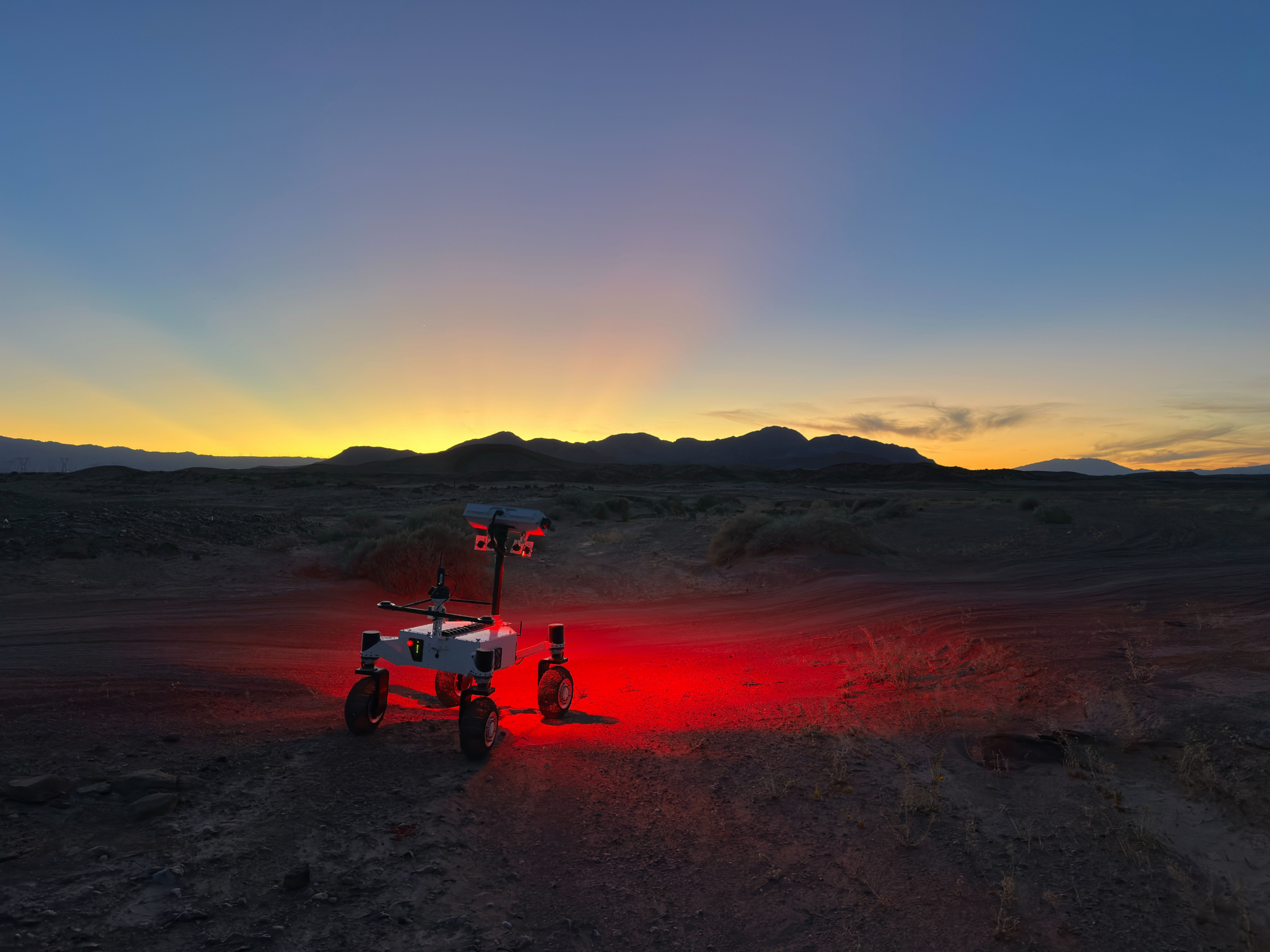
To operate before sunrise, JPL engineers set up illuminators on ERNEST by headlamp, then let the rover roll. NASA’s twilight hero image shows the machine casting a red glow across the sand. Notice the parallel to your own kit. When ambient light disappears, the rover brings its own light source, exactly like a photographer reaching for a flash or an LED panel.
Active illumination solves the same problem in both cases. Your sensor needs photons, and a moonless desert supplies almost none. Therefore the rover projects light, reads what bounces back, and builds a picture of the ground ahead. Night navigation cameras on planetary robots work on this principle. So does every off-camera strobe you have fired into a dark scene.
Sensitivity plays the other half of the equation. When light stays scarce, a photographer raises ISO to amplify the signal, and a rover boosts sensor gain for the same reason. Both moves add noise, so both demand restraint. A cleaner path pairs modest gain with more light and a longer exposure. For this reason, the rover carries its own illuminators rather than pushing the sensor alone.
The red glow is not decoration. Red light preserves your dark adaptation, a trick astronomers use at the eyepiece and a habit worth copying at a star party. Although your camera will not care about the color, your night vision will. Therefore a red headlamp keeps you working without blinding yourself or your neighbors.
Long Shadows and Brutal Dynamic Range

NASA did not pick dawn and dusk at random. The team wanted long terrain shadows like those found in the Moon’s polar regions, where the Sun sits permanently near the horizon. Consequently the rover met scenes with blinding highlights beside pitch-black shadow, all in one frame.
Photographers know this fight well. Point a lens toward a low sun and the dynamic range explodes past what any single exposure holds. Highlights clip to white while shadows crush to black. Rovers handle it with careful exposure control and, at times, multiple frames blended together, the same logic behind HDR bracketing on Earth.
Low sun also rakes across texture and exaggerates every ridge and pit. For a navigation system, a long shadow might hide a hazard or fake one. As a result, the software has to read shape from light alone. For you, the same raking light during golden hour sculpts dunes, faces, and architecture. The lesson holds on two worlds: shoot when the sun is low, then manage the contrast deliberately.
If you want to practice reading harsh light, a desert at dusk is an ideal classroom. Meter for the highlights, lift the shadows in post, and watch how the texture appears. Similar restraint keeps rover imagery usable across a punishing tonal range.
Mars Rover Camera Technology Still Sets the Standard
NASA has not published the specific cameras aboard ERNEST, so treat any exact sensor claim with caution. However, the agency has fully documented the imagers on its current Mars rovers. This Mars rover camera technology remains the clearest reference point for photographers.
Perseverance carries Mastcam-Z, a pair of cameras mounted about 9.5 inches apart to create stereo vision. Each unit shoots color at roughly 2 megapixels, with a maximum image size of 1600 by 1200 pixels. Modest resolution, yes, but paired with a true optical zoom and 3D capture. Curiosity’s Mastcam follows the same idea with two fixed focal lengths, a 34mm wide eye and a 100mm telephoto eye.
Those numbers surprise people raised on 45-megapixel bodies. Whatever the NASA ERNEST rover cameras turn out to be, expect the same priorities. Space imaging prizes reliability, radiation tolerance, and clean data over pixel count. A 2-megapixel frame reaches Earth intact, and scientists prize signal quality over bragging rights. For deeper context on how NASA frames its imagery, see our roundup of the best NASA Artemis II photos.
Engineering cameras tell the rest of the story. On Curiosity, the navigation and hazard cameras run in black and white at wider fields of view, since shape and distance matter more than color for driving. Perseverance later upgraded those helper cameras to color. The takeaway is simple: match the tool to the job, and never confuse megapixels with capability.
ERNEST vs. Perseverance and Curiosity

The biggest change with ERNEST is speed and independence. Perseverance and Curiosity creep along and lean on Earth-based drivers for many decisions. ERNEST covered 16 miles with reinforcement-learning autonomy, planning its own path around hazards while running an order of magnitude faster.
Its four wheels lift and steer separately, so the rover climbs obstacles which would stop the six-wheeled veterans. This mobility changes how a future imaging payload would work. A faster rover needs faster perception to avoid trouble at speed. In practice, quicker driving demands quicker low-light imaging. Photographers recognize the same challenge whenever a moving subject meets a dark room.
None of this retires Perseverance or Curiosity. Their proven cameras still deliver the science, while ERNEST tests the mobility and autonomy of the next era. For now, NASA ERNEST rover cameras stay undocumented, so the imaging story waits on future disclosures. Think of it as a body upgrade arriving before the lens lineup catches up.
What Photographers Learn From Rover Cameras
Strip away the spacecraft, and a rover faces the problems you meet every night shoot. Too little light, too much contrast, and a moving platform all fight image quality. NASA ERNEST rover cameras confront each one with methods you already own or soon will.
Bring your own light when the scene has none. Use low sun deliberately instead of avoiding it. Blend exposures when a single frame cannot hold the range. Stabilize the platform, since even slow motion smears a long exposure. These habits sit at the heart of good astrophotography, and they scale from a backyard tripod to a robot on the Moon.
One more parallel deserves attention: exposure time. Rovers often pause to gather light, and so should you. When you shoot stars, the 500 rule caps your shutter before the stars trail. Balancing light against motion is the whole game, on Earth and beyond.
Start small tonight. Set your camera on a tripod, add a low-power light for the foreground, and expose for the sky. Then blend a brighter frame for the land if the contrast overwhelms one shot. Keep the rig steady for sharp, pinpoint stars. Each step echoes a method NASA trusts on another world. Meanwhile, each one sharpens your night results at home.
Frequently Asked Questions
What cameras does the ERNEST rover use?
NASA has not published the specific imaging hardware aboard ERNEST. The agency confirms one detail: the rover mounts equipment on a 4.5-foot mast and relies on onboard illuminators for night driving. Any exact sensor spec for NASA ERNEST rover cameras stays unconfirmed for now.
How do Mars rovers take pictures at night?
Rovers bring their own light. Engineers mount illuminators which flood the terrain, then the night navigation cameras read the reflected light to map obstacles. The approach mirrors a photographer using a flash or LED panel in a dark scene.
Why does NASA test rovers at dawn and dusk?
Low sun creates long shadows like those in the Moon’s polar regions. Those shadows stress the imaging and navigation software, since a shadow might hide a real hazard or mimic a fake one. Dusk and dawn recreate this punishing contrast on Earth.
How is rover low-light imaging like astrophotography?
Both fight the same enemy: too few photons. Rover low-light imaging leans on active illumination, longer exposures, and steady platforms, exactly the tools which carry a night sky photographer. The physics stays identical whether the sensor sits on a tripod or a Mars-bound chassis.
Do Mars rover cameras shoot at only 2 megapixels?
Yes. Perseverance’s Mastcam-Z and Curiosity’s Mastcam both capture roughly 2-megapixel frames at 1600 by 1200 pixels. Space imaging values reliability and clean data over resolution, so Mars rover camera technology favors proven sensors over high pixel counts.
Is ERNEST going to the Moon or Mars?
Possibly both. NASA designed ERNEST as a testbed for a future long-range lunar rover, though its skills apply to Mars as well. As JPL scientist James Keane described it, this vehicle enables a science road trip across the Moon or Mars.

