


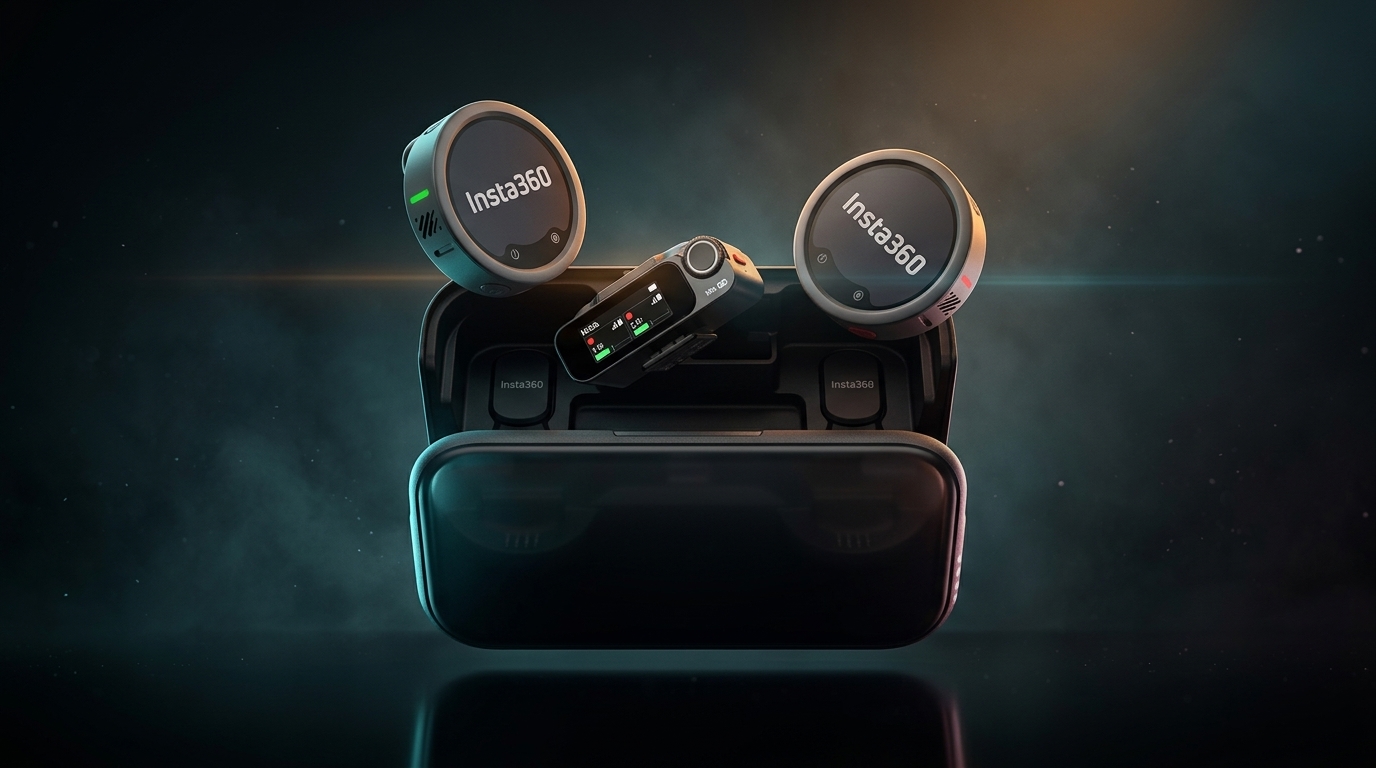
Quick Facts:
- Product: Insta360 Mic Pro wireless microphone system
- Display: 6-color E-Ink screen, 1.22 inch, 240 x 208 resolution (industry first)
- Mic Array: 3-microphone array with selectable polar patterns (omni, cardioid, figure-8, super-directional)
- Recording: 32-bit float internal recording, 48 kHz, 32GB onboard memory per transmitter
- Battery: 10 hours per transmitter, 30 hours with charging case, 5-minute fast charge for up to 1 hour of additional runtime
- Wireless Range: Up to 400 meters line-of-sight
- Compatibility: 3.5mm, USB-C, Lightning, Bluetooth direct to Insta360 cameras (X5, X4 Air, Ace Pro 2, GO Ultra)
- Price: From $329.99 (2 TX + 1 RX kit)
- Best for: Hybrid photo/video creators, filmmakers, podcasters, event shooters, Insta360 ecosystem owners
8 min read
In This Article
- Insta360 Mic Pro Launch Overview
- Key Specs at a Glance
- The Industry-First E-Ink Display
- 3-Microphone Array With Polar Patterns
- 32-Bit Float Recording and 32GB Onboard Storage
- Scalable Multi-Channel Audio Modes
- Direct Bluetooth Pairing With Insta360 Cameras
- How the Insta360 Mic Pro Compares
- Who Should Buy the Insta360 Mic Pro
- Final Verdict
- Frequently Asked Questions
Insta360 Mic Pro Launch Overview
I have shot with Insta360 cameras for years, from the X4 and X5 to the wider 360-degree X series and the Ace Pro lineup. The Insta360 Ace Pro 2 sits at the top of my action-camera list. So when Insta360 announced the Insta360 Mic Pro this week, my attention sharpened fast.
The new flagship wireless microphone is built around two industry firsts. First, every transmitter ships with a customizable E-Ink display. Second, each transmitter packs a three-microphone array with selectable polar patterns. As a result, the launch targets creators, filmmakers, podcasters, and event pros who want pro-grade audio without pro-grade complexity.
Pricing starts at $329.99 for the 2 TX + 1 RX kit. Also, availability is live now through the Insta360 Official Store, Amazon, and authorized distributors worldwide.
For context on where this product fits the wireless-lav category, see our roundup of the best wireless mics for vlogging this year. DJI and Rode currently lead the field, however the launch reshuffles the deck.
Key Specs at a Glance

| Specification | Details |
|---|---|
| Transmitter Weight | 19.7 g (without clip) |
| Receiver Weight | 29.8 g |
| E-Ink Display | 1.22 inch, 240 x 208, 6-color, 197 PPI |
| Polar Patterns | Omnidirectional, Super-directional, Cardioid, Figure-8 |
| Bit Depth | 32-bit float (internal), 24-bit (output) |
| Onboard Storage | 32 GB per transmitter |
| Max Wireless Range | 400 m line-of-sight (mic to receiver) |
| Battery Life | 10 hours TX, 11 hours RX, 30 hours with case |
| Fast Charge | 5 minutes = up to 1 hour |
| Timecode | TCXO oscillator, under 1 frame drift per 24 hours |
| Starting Price | $329.99 (2 TX + 1 RX kit) |
Together, these Insta360 Mic Pro specs cover almost every limitation in the wireless-lav category.
Shop The Launch
Insta360 Mic Pro Available Now From $329.99
The 2 TX + 1 RX launch kit ships with the charging case. So total runtime hits 30 hours per cycle.
The Industry-First E-Ink Display

Every Mic Pro transmitter ships with a 1.22 inch, 6-color E-Ink display. As an industry first for any wireless microphone, this matters more than a spec sheet line suggests. Through the Insta360 app, you upload your station logo, channel art, talent names, or any other graphic. Notably, the screen holds the image even when the unit powers off. So identification stays visible across long set days.
For broadcast crews running multiple transmitters, this solves a long-standing pain point. Instead of taping handwritten labels to each unit or guessing which mic belongs to which subject, you see the identifier at a glance.
The choice of E-Ink over OLED matters for two reasons. First, E-Ink draws power only during refresh, not while displaying a static image. Therefore, battery life on long shoots stretches further. Second, E-Ink stays sharp under direct sunlight. OLED panels, by contrast, wash out and become unreadable in the same conditions. So for outdoor productions and live events, this reliability advantage gives Insta360 a real edge over OLED-equipped competitors.
3-Microphone Array With Polar Patterns
Conventional wireless lavalier microphones rely on a single omnidirectional capsule. Notably, the pickup pattern stays fixed. As a result, users have no way to adapt to different acoustic environments without swapping hardware. However, the Mic Pro changes this with three microphones built into each transmitter.
Digital signal processing combines the input from those three capsules to emulate four distinct polar patterns. You select the pattern from the receiver or the Insta360 app. Therefore, one device adapts to each shoot. Instead of forcing you to carry multiple mics, the system flexes between scenarios.
Omnidirectional mode opens the pickup area for ambient capture. Cardioid mode, however, tightens the pickup to the front. So cardioid suits vlogging, solo livestreams, ASMR, and voiceover work. Figure-8 mode captures from both front and rear. As a result, two-person interviews work with a single transmitter. When camera-mounted, the super-directional cardioid configuration works like a shotgun mic, giving run-and-gun filmmakers precise front-focused capture.
AI noise cancellation also comes from an onboard NPU chip. Unlike basic noise reduction, which flattens vocal tone, the NPU processes audio with greater precision. So wind, crowd noise, and background interference drop. Meanwhile, voices stay clear and natural.
32-Bit Float Recording and 32GB Onboard Storage
At the core of the Insta360 Mic Pro specs is 32-bit float internal recording. Notably, conventional 24-bit recording systems clip when audio exceeds a set threshold. By contrast, 32-bit float captures a dynamic range wide enough to make clipping mathematically impossible.
In practice, a whisper and a sudden shout coexist in the same take without either being lost. For wedding vows, breaking news interviews, or live events where you cannot ride gain in real time, the safety net matters. Therefore, normalization in post replaces the stress of constant manual adjustment.
Each transmitter also records independently to 32 GB of onboard memory. So if wireless interference drops a signal or the camera battery dies mid-take, the transmitter still holds a clean copy. Notably, recordings auto-split every 30 minutes to prevent file-size errors during long takes.
Stereo internal recording, which is unique to the Mic Pro in this class, captures immersive ambient soundscapes. Specifically, you record ASMR-quality audio directly to the transmitter at up to 32-bit float quality.
Scalable Multi-Channel Audio Modes

Most compact wireless systems hard-cap at two transmitters per receiver. However, the Insta360 wireless microphone breaks the ceiling with two configurations built for demanding multi-source audio.
In 4-to-1 mode, four transmitters connect to a single receiver. Each track stays isolated. As a result, panel moderators, podcasters, and interviewers scale to four guests with no external mixer. For long-form video podcasts, this removes a meaningful gear barrier.
In 2-to-4 mode, two transmitters distribute across four receivers simultaneously. So multi-cam wedding and corporate event shooters now share clean audio across every camera body. Cables and splitter boxes are no longer needed. When connected to compatible Sony cameras through the optional Camera Adapter, four-channel 48 kHz 24-bit digital audio routes natively over the hot shoe.
Direct Bluetooth Pairing With Insta360 Cameras
For creators already in the Insta360 ecosystem, the Mic Pro pairs directly with X5, X4 Air, Ace Pro 2, and GO Ultra cameras over Bluetooth. This delivers 48 kHz high-fidelity audio without a receiver. Consequently, a piece of hardware drops out of the kit entirely.
Moreover, Insta360 confirmed dual-transmitter direct connection will arrive with upcoming camera releases. For owners of the brand’s latest Insta360 launch products, the workflow simplifies down to mic plus camera, no receiver in the bag.
By comparison, GoPro shooters still have to work around limited Bluetooth audio support. We covered this in detail in our GoPro Hero 13 audio limitations review. So if you live inside the action-camera world and you want simple wireless mic pairing, Insta360’s ecosystem advantage matters here.
Pick Your Configuration
1+1, 2+1, or Multi-Cam Bundles
Multiple Mic Pro configurations match solo vlogging, two-person interviews, and multi-cam events. Browse kits on Amazon.
How the Insta360 Mic Pro Compares
The wireless lav market has grown crowded. For example, DJI Mic 3, Rode Wireless Pro, Hollyland Lark M2, and Sennheiser Profile Wireless all sit in the same broad price range. So how does the Insta360 Mic Pro hold up?
On core audio, the system matches DJI Mic 3 with 32-bit float internal recording and 32 GB onboard storage. However, the 3-mic array with selectable polar patterns is unique to the Insta360 Mic Pro. DJI and Rode, by contrast, still ship single-capsule designs. So those competitors lock you into one pickup pattern.
The E-Ink display has no direct competitor. While DJI Mic 3 puts a small OLED screen on the receiver, OLED washes out under daylight and consumes more battery. Therefore, for outdoor shoots, Insta360’s choice gives the Mic Pro a real reliability edge.
Where the Mic Pro pulls ahead most is inside the Insta360 ecosystem. Direct Bluetooth pairing to the X5 and Ace Pro 2 removes the receiver entirely. Similarly, DJI users benefit from native pairing on the DJI Osmo Pocket 3 vlogging camera. For everyone else, the standard 3.5mm and USB-C connections keep the Mic Pro compatible with most cameras and phones in pro use today.
Who Should Buy the Insta360 Mic Pro

Because the Mic Pro covers so many use cases, it helps to break down buyer profiles by shooting style.
Insta360 ecosystem owners
If you already shoot with the X5, X4 Air, Ace Pro 2, or GO Ultra, the Mic Pro is the easiest audio upgrade you will make. Direct Bluetooth pairing skips the receiver entirely. Moreover, the 48 kHz Bluetooth feed beats the built-in mics by a wide margin. For these owners, the purchase is straightforward.
Solo content creators and vloggers
For solo work, the cardioid mode on the 3-mic array gives you a focused front pickup. Similarly, combined with NPU noise cancellation, this is the configuration most YouTubers and TikTokers want. Notably, the custom E-Ink display doubles as a brand asset on screen, which matters when your mic appears in every frame.
Wedding and event filmmakers
The 2-to-4 receiver mode solves a problem plaguing multi-cam shooters for years. Two mics on the officiant and bride or groom, four cameras pulling clean audio simultaneously, no external mixer. Combined with 32-bit float and 32 GB onboard backup, the Mic Pro fits this use case better than any compact alternative.
Podcasters and interview shows
For panel and roundtable formats, the 4-to-1 mode delivers four isolated tracks into one receiver. As a result, you scale up to four guests while keeping individual track control in post. Similarly, the figure-8 mode opens up two-person interview workflows where one mic captures both subjects.
Professional filmmakers and broadcast crews
Timecode sync via the TCXO oscillator, less than one frame drift in 24 hours, and the 400 m wireless range cover most pro production needs. Four-channel 48 kHz 24-bit output to Sony cameras through the Camera Adapter completes the workflow. So crews already invested in Sony bodies gain the most from this option.
Final Verdict
The Insta360 Mic Pro arrives as the most technically ambitious wireless lavalier system released this year. The E-Ink display, the 3-mic array, 32-bit float recording, 32 GB onboard memory, and 400 m range together cover almost every limitation in the category. Few launches deliver this many firsts at once.
For most buyers, the real question is whether you want the Insta360 ecosystem advantage. If you shoot with an X5, Ace Pro 2, or X4 Air, the answer is yes. Direct Bluetooth pairing removes friction no other brand offers out of the box. Even outside the ecosystem, the universal 3.5mm and USB-C support keeps the Mic Pro compatible with every camera and phone you own.
The Insta360 Mic Pro price sits at $329.99 for the 2 TX + 1 RX kit. So it matches the DJI Mic 3 dollar for dollar, while undercutting Rode Wireless Pro by roughly $70. Therefore, the feature gap stands out more. You get the 3-mic array and the E-Ink display without paying a premium over the closest competitor.
If the Insta360 ecosystem is not your stack, the DJI Mic 3 remains a strong pick. It integrates tightly with DJI cameras and gimbals. However, for anyone shooting Sony, Canon, Nikon, Fuji, or hybrid setups, the early Insta360 Mic Pro review consensus points to the more capable single-purchase wireless mic system on the market right now.
Ready To Buy?
Get the Mic Pro Today
Free standard shipping and the full Insta360 warranty come standard. Amazon launch stock moves fast on the 2 TX + 1 RX kit.
Frequently Asked Questions
How much does the Insta360 Mic Pro cost?
The Insta360 Mic Pro price starts at $329.99 for the 2 TX + 1 RX launch kit, which includes the charging case. Also, additional kit sizes and the Sony Camera Adapter sell separately through the Insta360 Official Store and Amazon.
Does the Insta360 wireless microphone work with Sony, Canon, and Nikon cameras?
Yes. The receiver connects to any DSLR or mirrorless camera through a 3.5mm audio cable. For phones, USB-C or Lightning adapters cover iOS and Android. For Sony bodies specifically, the optional Camera Adapter routes four channels of 48 kHz 24-bit digital audio over the hot shoe.
What is 32-bit float recording on the Insta360 Mic Pro?
32-bit float is a recording format with a dynamic range wide enough to make clipping mathematically impossible. So if a subject suddenly shouts or laughs, the take stays usable. Instead of riding gain during the shoot, you correct levels in post through normalization.
How does the Mic Pro compare to the DJI Mic 3?
Both systems offer 32-bit float internal recording and 32 GB onboard storage. However, an early Insta360 Mic Pro review on TechRadar points to two unique advantages: the 3-microphone array with four selectable polar patterns and the E-Ink display on the transmitter. The DJI Mic 3 ships with neither feature. For shooters outside the DJI ecosystem, the Mic Pro also wins on broader compatibility through 3.5mm and USB-C.
Does the Insta360 Mic Pro connect directly to an iPhone?
Yes. The Mic Pro receiver connects to iPhone through a Lightning adapter or USB-C cable on newer iPhone 15 and 16 models. For Insta360 GO Ultra and Ace Pro 2 users, Bluetooth direct pairing also routes audio without a receiver.
How long does the Insta360 Mic Pro battery last?
Each transmitter delivers 10 hours of continuous use on a single charge. The receiver runs 11 hours. With the included charging case, total runtime reaches 30 hours. Notably, a 5-minute fast charge adds up to 1 hour of recording when batteries run low between setups.

