


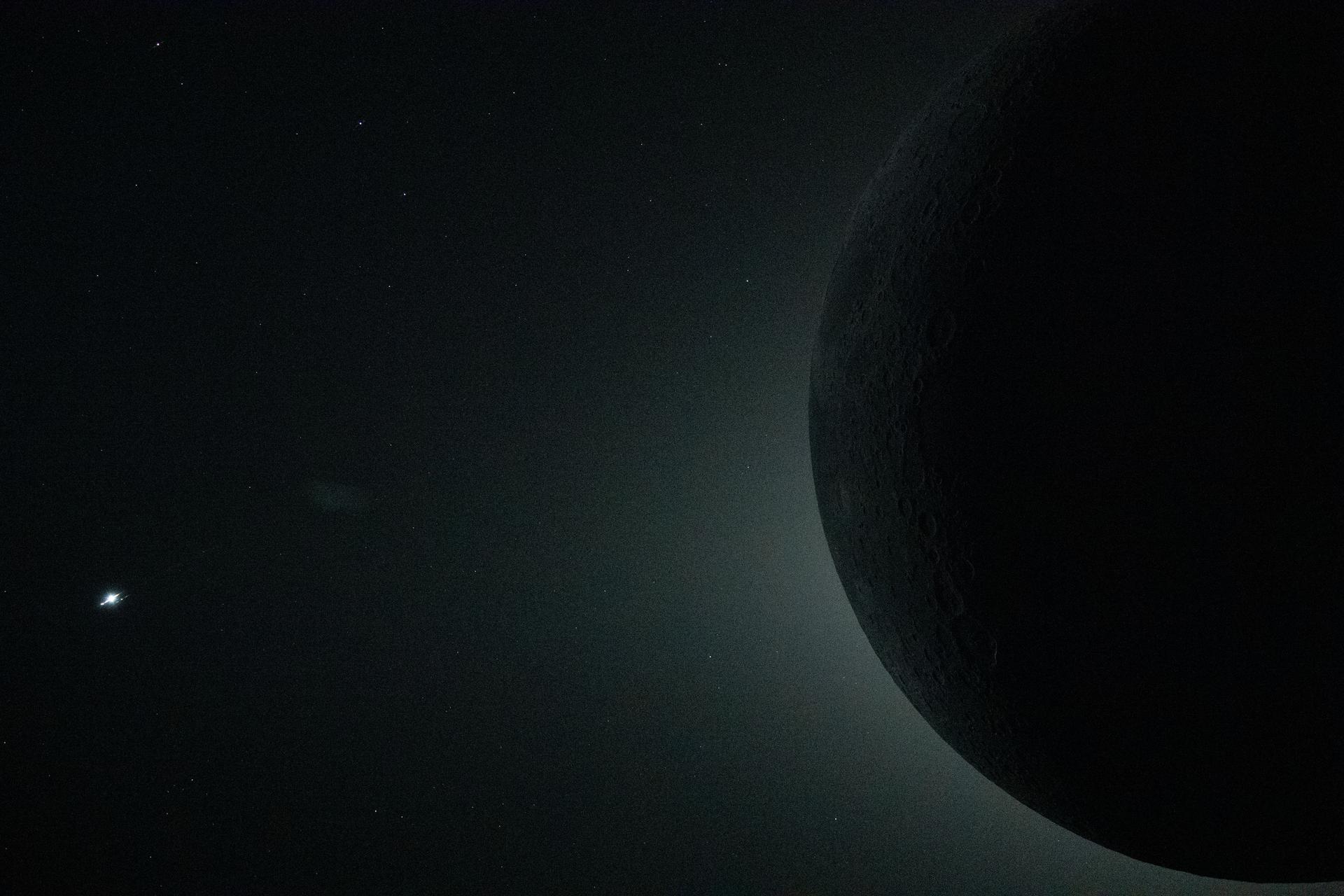
A 54-minute totality from the lunar far side, with Venus glinting at the left edge. Image: NASA, art002e009298, captured April 6, 2026.
Quick Facts: NASA Artemis II Photos
- Mission: Artemis II crewed lunar flyby
- Launch: April 1, 2026 from Kennedy Space Center
- Lunar flyby: April 6, 2026 (seven-hour pass)
- Splashdown: April 10, 2026, 8:07 p.m. EDT, off San Diego
- Crew: Reid Wiseman (Commander), Victor Glover (Pilot), Christina Koch (Mission Specialist), Jeremy Hansen (CSA Mission Specialist)
- Photos released: Roughly 12,000
- Cameras flown: Nikon D5 DSLR, Nikon Z9 mirrorless, iPhone 17
- Farthest distance from Earth: 252,756 miles
- License: NASA imagery, free to use under Creative Commons
- Official archive: NASA Gateway to Astronaut Photography of Earth
Table of Contents
NASA released roughly 12,000 Artemis II photos from the 2026 lunar flyby, opening the mission’s full image archive to the public. The crew shot the photos on a Nikon D5 DSLR, a Nikon Z9 mirrorless body, and an iPhone 17 during the seven-hour pass around the Moon on April 6, 2026. Highlights include a solar eclipse from beyond the Moon, multiple Earthset frames, close-up lunar surface detail, and intimate shots from inside the Orion capsule.
If you missed the official drop, here are 14 of the best NASA Artemis II photos pulled from the release, organized by theme. Every image is free to use under NASA’s Creative Commons policy.
What NASA Released
NASA published the full Artemis II photo set through its Gateway to Astronaut Photography of Earth and its Flickr account in early May 2026. The set totals near 12,000 frames. Many are duplicates, alternate sizes, or technical exposures used for science. Hidden inside the bulk are unreleased frames that did not make the official PR photo drops in April.
NASA’s image-publishing system spreads the files across several portals, which makes the archive harder to browse than a single gallery. The full metadata stays embedded on most files, which exposes the exact camera body, lens, focal length, and exposure used for each shot.
A Quick Recap of the Artemis II Mission
Artemis II launched April 1, 2026 from Kennedy Space Center on top of the SLS rocket. The four-person crew flew an Orion capsule on a free-return trajectory around the Moon, performed the lunar flyby on April 6, and splashed down off San Diego on April 10. The mission lasted close to 10 days and pushed the crew 252,756 miles from Earth at apogee, the farthest any humans have ever traveled from home.
It was the first crewed mission to the vicinity of the Moon since Apollo 17 in 1972. The crew documented impact craters, ancient lava flows, and surface fractures during the flyby, observed an Earthset and an Earthrise, and captured the in-space solar eclipse. They also reported six meteoroid impact flashes on the darkened lunar surface.
The Cameras That Captured the Artemis II Photos
Three cameras flew on the mission:
- Nikon D5 DSLR, a 10-year-old flagship body that proved its reliability in vacuum-rated NASA modifications. Most of the long-lens lunar surface frames came from the D5.
- Nikon Z9 mirrorless, added to the kit at the last minute. The Z9 handled the long-exposure star trail work and several wide-angle interior shots.
- iPhone 17, used for snapshots, behind-the-scenes documentation, and several of the more candid window views.
Lenses included the Nikkor 14-24mm wide-angle for cabin views and Earth-from-window shots, the 35mm prime on the Z9 for star trails and low-light composition, and the 80-400mm telephoto on the D5 for tight lunar surface detail.
14 Best NASA Artemis II Photos
Here are 14 frames pulled directly from NASA’s official galleries, grouped by subject. Each caption includes the NASA asset ID so you trace the original.
The Solar Eclipse from the Lunar Far Side
The crew watched the Sun’s corona burn behind a dark Moon during the flyby. NASA’s Earth Observatory called the result the first crewed observation of a solar eclipse from beyond the Moon, with totality lasting nearly 54 minutes from Orion’s deep-space vantage point.

First crewed observation of a solar eclipse from beyond the Moon, per NASA’s Earth Observatory. Image: NASA, art002e009301.

The Moon backlit by the Sun during the same April 6 eclipse, captured from a different angle by the Orion crew. Image: NASA, art002e009573.
Earthset and Earthrise Above the Moon
Earthset and Earthrise frames anchored the public response to Artemis II. The crew shot multiple variations across the seven-hour pass, including the first deliberate echo of the iconic Apollo 8 Earthrise from 1968.

The official Earthset captured through the Orion window at 6:41 p.m. EDT on April 6. The crescent Earth, oriented like a frown, slips behind the lunar limb. Image: NASA, art002e009288.

Earth seen through an Orion main window after the translunar injection burn. Captured by Commander Reid Wiseman on April 2, 2026. Image: NASA, art002e000191.

A deliberate echo of the Apollo 8 Earthrise from 1968, this time captured by humans for the first time in 58 years. Image: NASA, art002e021278.
Earth From Deep Space
Two frames isolate Earth from a deep-space vantage: one as a thin arc of light along the planet’s limb, the other reduced to a tiny dot beside the Moon.

A thin glowing arc as sunlight traces Earth’s curve on flight day 4. Image: NASA, art002e024014.

Earth shrinks to a dot as the Moon fills the frame. The first scale composition like this captured by humans since Apollo 17 in 1972. Image: NASA, art002e009284.
Named Features on the Lunar Far Side
The 80-400mm telephoto on the Nikon D5 pulled tight onto two named far-side features the crew documented for the lunar science team.

A close-up of Vavilov Crater on the lunar far side, a feature only visible from beyond Earth. Image: NASA, art002e009282.

Hertzsprung Basin and its two concentric rings of mountains, a far-side impact feature. Image: NASA, art002e012093.
Inside the Orion Capsule
Two frames document the photographers’ working setup inside Orion: the camera shroud system NASA built to cut window reflections, and a silhouette study of the commander at the main window.

Jeremy Hansen shooting through the camera shroud over Orion’s window 2. NASA built the shroud to cut window reflections that ruin deep-space shots. Image: NASA, art002e009295.

Commander Reid Wiseman at the main cabin window on flight day 4. His dark silhouette frames the bright Earth, isolating the subject without losing context. Image: NASA, art002e008486.
Earth at Night With Auroras From Deep Space
One of the more unusual frames in the release shows Earth lit by moonlight on the night side, with green auroras visible at both poles. The crew shot it on April 2 from the Orion window, capturing solar-charged particles glowing in the upper atmosphere from a deep-space vantage point.

Earth lit by moonlight, with green auroras glowing along both poles. Image: NASA, art002e000192.
The Crew and Their Spacecraft
The release closes with two frames that contextualize the human side of the mission: a portrait of Christina Koch with Earth in the window, and a rare exterior selfie of Orion itself, lit by the Sun in deep space.

Mission Specialist Christina Koch inside the Orion spacecraft on flight day 4. Image: NASA, art002e009206.

An exterior selfie of Orion in deep space, lit by direct sunlight. Image: NASA, art002e009566.
Where to Find the Full Artemis II Photo Archive
NASA hosts the Artemis II images across three primary portals:
- NASA Flickr (Artemis II album): flickr.com/photos/nasa2explore/albums/72177720307234654/. Browse by collection, download originals, and check Creative Commons license terms.
- NASA Artemis II multimedia hub: nasa.gov/artemis-ii-multimedia/. Includes mission video, press kits, and curated photo galleries.
- Gateway to Astronaut Photography of Earth: eol.jsc.nasa.gov. The full searchable archive with embedded EXIF data on every file.
Grab the high-res originals from any of these three sources before you publish. NASA images are free to use under Creative Commons, with credit.
Why These Artemis II Photos Matter
The archive holds the first long-exposure star trails from a crewed mission past low Earth orbit, the first solar eclipse photographed from the lunar far side, and high-resolution color imagery of far-side terrain shot on consumer Nikon bodies. The metadata on every file gives photographers a working reference for shooting in vacuum, microgravity, and extreme thermal swings.
Apollo used Hasselblad film cameras you cannot replicate without a museum loan. Artemis II used gear you rent or buy: a Nikon D5, a Z9, and an iPhone 17. Future missions will reference this archive as the visual baseline.
FAQ
How many Artemis II photos did NASA release?
Roughly 12,000. The release covers the full mission, including launch, lunar flyby, and splashdown. Many files are duplicates or alternate sizes, but the bulk includes thousands of unique frames.
What cameras shot the NASA Artemis II photos?
Three cameras flew on Orion: the Nikon D5 DSLR, the Nikon Z9 mirrorless, and the iPhone 17. NASA used vacuum-rated modifications on the Nikon bodies. EXIF data on most files identifies the camera, lens, and exposure.
Who took the Artemis II photos?
Commander Reid Wiseman, Pilot Victor Glover, Mission Specialist Christina Koch, and CSA Mission Specialist Jeremy Hansen captured the images. The crew agreed to forgo individual credits, so each photo is officially unattributed.
Are the NASA Artemis II photos free to use?
Yes. NASA imagery is released under Creative Commons. You are free to use it for editorial, educational, and most commercial purposes with credit to NASA. Always check the specific license on each portal before commercial use.
Where is the official Artemis II photo archive?
NASA Flickr hosts the curated album at flickr.com/photos/nasa2explore/albums/72177720307234654/. The full searchable archive sits at the Gateway to Astronaut Photography of Earth at eol.jsc.nasa.gov.
What is the most famous Artemis II photo?
The solar eclipse from the lunar far side has drawn the most attention, followed closely by the Earthrise frames showing a crescent Earth above the Moon’s horizon. Both views are unique to crewed deep-space photography.
How far did the Artemis II crew travel?
252,756 miles from Earth at the farthest point. That is the longest distance any humans have traveled from home, beating the Apollo 13 record set in 1970.
Bottom Line
The full NASA Artemis II photos archive is now public. Bookmark the NASA Flickr album for the curated set, dig into the Gateway to Astronaut Photography of Earth for the working files with full EXIF, and credit NASA when you publish. The 14 frames above are a starting point. The archive holds thousands more, and a careful researcher will find unreleased gems with each pass.
Tags: NASA Artemis II photos, Artemis II, NASA, space photography, Nikon D5, Nikon Z9, iPhone 17, Christina Koch, Reid Wiseman, Victor Glover, Jeremy Hansen, Earthrise, lunar eclipse, Moon photography, astrophotography

