


Quick Facts:
- Topic: CineStill 800T and the Vision3 film family
- Base emulsion: Kodak Vision3 500T, a tungsten-balanced cinema negative
- Film family: Vision3 50D, 200T, 250D, and 500T, plus Eastman Double-X black and white
- Processing: standard C-41, once the remjet layer comes off
- Rated speed: ISO 800 on the CineStill box, ISO 500 on Kodak’s own datasheet
- Format: 35mm, 36 exposures per roll
- Price: roughly $18 to $28 per roll, depending on the stock and pack size
- Best for: film shooters who want cinema-grade color without a specialty film lab
8 min read
In This Guide
- Overview
- What Is Vision3 Film?
- Why Vision3 Doesn’t Come in a Standard 35mm Canister
- Vision3 vs. CineStill 800T: Key Specs
- CineStill: The Practical Way to Shoot Vision3
- The CineStill Lineup: 800T, 50Daylight, and BwXX
- How to Shoot and Process CineStill Film
- CineStill 800T vs. Kodak Portra 800
- Should You Shoot CineStill or Hunt Down Raw Vision3?
- FAQ
Overview
CineStill 800T sits at the center of a strange corner of film photography. It started as cinema stock, then ended up in still cameras. Christopher Nolan shot large stretches of his 2026 film “The Odyssey” on Vision3 stock. The news pushed a wave of photographers toward the same emulsion family. Kodak never sold this film in a standard 35mm still canister. CineStill built a business around respooling it for cameras like yours.
This guide breaks down what Vision3 is. Retailers don’t stock it in a normal roll, and this guide explains why. It also shows how CineStill turns the same cinema emulsion into a roll you load like any other. Finally, you’ll see how CineStill 800T lines up against Kodak Portra 800, the still-photography stock it gets compared to most.
Shoot street scenes at night, neon signs, or indoor portraits under mixed lighting. This stock rewards you with saturated reds and warm highlights, a look film productions have leaned on for a decade. The next few sections show you exactly which CineStill stock to grab and how to shoot it right.
What Is Vision3 Film?
Vision3 covers four color negative stocks built for motion picture cameras: 50D, 200T, 250D, and 500T. The “D” stocks are daylight balanced, while “T” stocks are tungsten balanced for shooting under artificial light without a filter. Kodak also sells this family alongside Eastman Double-X, a black and white cinema negative, and Ektachrome 100D, a color reversal stock.
Cinematographers reach for Vision3 because of its dynamic range. The 500T variant holds close to 10.8 stops, according to lab tests from film review site Analog.Cafe. This range keeps detail in a spotlit face and a shadowed corner of the same frame. Still photographers who shoot Vision3 or its CineStill derivatives notice the same trait. Highlights hold their color instead of blowing out to white. Shadows keep a hint of detail instead of turning flat black.
Kodak never designed any Vision3 stock with a still photographer in mind. The company builds and sells this film for movie productions, television commercials, and music videos. This fact explains almost everything else in this guide, including why you won’t find a Vision3 box next to Portra and Ektar on a camera shop shelf.
Kodak’s still-photography lineup went through its own changes recently. A 2026 rebrand renamed Portra and T-Max as Ektacolor Pro and Ektapan, a shift covered in Kodak’s recent film stock rebrand. Vision3 sits in a separate motion-picture lineup, untouched by this rebrand.
Why Vision3 Doesn’t Come in a Standard 35mm Canister
Two barriers keep Vision3 out of a normal 35mm still camera box. The first is chemistry. Kodak built this stock for ECN-2 film processing, a different developing chemistry than the C-41 process used at nearly every photo lab and home darkroom setup. A lab equipped only for C-41 cannot run raw Vision3 straight out of the canister.
The second barrier sits on the film itself. Older Vision3 stock carries a carbon backing layer, which stops static discharge and light halation on a film set. This coating works well on a soundstage. It also clogs standard development tanks and stains equipment unless a lab strips it first. Kodak’s newer AHU stock, short for Anti-Halation Undercoat, bakes the same protection into the emulsion instead. Labs running standard chemistry skip the pre-bath step entirely, according to Kodak’s own AHU announcement.
Because of both barriers, Kodak sells Vision3 in cinema formats only. Think 100-foot 16mm rolls, Super 8 cartridges, and long 35mm motion picture reels meant for labs and production houses, not the 36-exposure canisters you drop into an SLR. On Amazon, a 100-foot roll of 16mm Vision3 200T lists at $79.99. The 250D version in the same length has listed around $209.95, though it currently reads as unavailable with no restock date given. Small labs have hand-rolled bulk Vision3 into standard canisters for years. Photography forums report Kodak has tightened who it sells bulk stock to, so supply stays inconsistent from one respooler to the next.
| Best for Night Light | Best for Daylight | Best for B&W | |
|---|---|---|---|
| Product | TOP PICK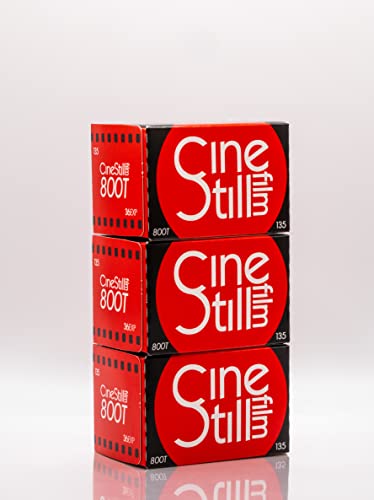 CineStill 800T CineStill 800T |  CineStill 50Daylight CineStill 50Daylight |  CineStill BwXX CineStill BwXX |
| Rating | ★★★★★ 4.7 7,543 ratings | ★★★★★ 4.8 9,312 ratings | ★★★★★ 4.8 532 ratings |
| Light Balance | Tungsten | Daylight | Black & White |
| Base Emulsion | Vision3 500T | Vision3 50D | Eastman Double-X |
| Processing | Standard C-41 | Standard C-41 | Standard C-41 |
| Price | $62.95 as of Jul 22, 6:55 am | $64.99 as of Jul 22, 6:55 am | $46.99 as of Jul 22, 6:55 am |
| Check Price → | Check Price → | Check Price → |
Vision3 vs. CineStill 800T: Key Specs
| Specification | Raw Vision3 500T | CineStill 800T |
|---|---|---|
| Rated speed | ISO 500 | ISO 800 |
| Light balance | Tungsten | Tungsten |
| Remjet backing | Present | Removed before packaging |
| Processing | ECN-2 | Standard C-41 |
| Format sold | 16mm, Super 8, cinema 35mm reels | Standard 35mm, 36 exposures |
| Price per roll | $79.99+ (100ft cinema roll) | Roughly $20 to $25 in a 3-pack |
CineStill: The Practical Way to Shoot Vision3
CineStill solved the canister problem on its own. The company buys bulk Vision3 stock, strips the carbon backing in-house, and spools the result into standard 35mm canisters. It built its name on 800T, a version of Vision3 500T with the coating washed off, so any C-41 lab develops it without a special pre-bath step.
The rated speed changed along with the processing. CineStill rates 800T at ISO 800 under tungsten light, even though Kodak ships the same emulsion at ISO 500. According to CineStill’s own FAQ, the company set this higher exposure index only after testing the sensitometric curves on its finished stock, with the backing already removed. It’s not a marketing trick built on light bouncing off the film base.
This single move opened cinema film to anyone with a 35mm camera and a local lab. You no longer need a specialty film processor, and you don’t need to pull the coating by hand at home. Load a CineStill roll like you would a roll of Portra or Ektar. Shoot it, then drop it at the same lab you already use.
The CineStill Lineup: 800T, 50Daylight, and BwXX
CineStill sells three respooled cinema stocks, and each pulls from a different Kodak or Eastman emulsion. Picking the right one comes down to your light source, and whether you want color or black and white.
CineStill 800T
Built on Vision3 500T, this is the tungsten-balanced stock behind most of the neon-lit night photography tagged with the CineStill name. Expect saturated reds, warm skin tones under artificial light, and the signature halo around bright points of light.
800T - Tungsten High Speed Color 35mm Film (36 Exposures, 3-Pack)
The go-to choice for neon signs and mixed indoor lighting, with the signature cinematic glow Nolan used.
- Saturated reds and warm skin tones
- Signature halation glow
- Proven cinema emulsion
- Standard C-41 processing
- Requires tungsten light source for best results
- Slight color cast in daylight
CineStill 50Daylight
The daylight-balanced sibling in the lineup, 50Daylight pulls from the Vision3 50D emulsion, the same fine-grain stock Kodak supplies to film productions. Grain stays nearly invisible, and colors read clean and punchy in full sun.
CineStill Film 50Daylight 35mm Film Boxed (36 Exposures, 3-Pack) Bundle (3 Items)
Cinema-grade daylight stock with the fine grain and color punch that Kodak supplies to movie productions.
- Fine-grain cinema emulsion
- Clean, punchy colors in sun
- Excellent dynamic range
- No warming filter needed
- Not optimized for tungsten light
- More expensive than consumer daylight films
CineStill BwXX
For black and white, BwXX draws on Eastman Double-X, the cinema negative Kodak has manufactured since 1959. The result sits closer to a movie frame than a typical still stock like Tri-X, with deep blacks and a classic, high-contrast edge.
CineStill Film BwXX Double-X Black and White Negative Film (35mm Roll Film, 36 Exposures) 2-Pack with Microfiber Cleaning Cloth
Eastman's cinema negative, now in standard 35mm canisters, for photographers who want the deep blacks and high contrast of movie film.
- Deep blacks and high contrast
- Eastman Double-X emulsion since 1959
- Microfiber cleaning cloth included
- Classic movie look
- Limited to black and white only
- Higher contrast than consumer B&W stocks
How to Shoot and Process CineStill Film
Load and shoot CineStill film exactly like any other 35mm stock. The differences show up in light choice, and in what you tell your lab.
Shoot 800T under tungsten bulbs, string lights, or mixed indoor lighting for the most accurate color. Outdoors, either accept a cool blue shift or add an 85B warming filter before the shutter fires. Shoot 50Daylight outdoors in bright sun for the cleanest results. A tungsten light source pushes it warm and orange without a filter.
Tell your lab you’re dropping off CineStill, since standard C-41 chemistry handles it without a pre-bath. Some labs still ask, since raw Vision3 carries a reputation for special handling in its original, backing-intact form. A quick note at drop-off saves a round trip. Prefer to develop at home? CineStill also sells a complete C-41 kit sized for small batches, no darkroom required.
Your first roll will likely show some grain in the shadows, and a slightly warmer cast than a consumer stock like Kodak Gold. Both traits soften with a small exposure boost. Rate 800T closer to ISO 500 or 640 for your first test roll if you want cleaner shadow detail.
Any working 35mm camera loads CineStill without modification. New shooters often start with a budget point-and-shoot or browse a roundup of the best 35mm film cameras to shoot today. Photographers wanting a rugged manual body often pick a budget-friendly used film SLR like the Nikon F4. It offers tough build quality and reliable metering, useful for adapting to CineStill’s odd box speed.
CineStill 800T vs. Kodak Portra 800
Photographers weighing CineStill 800T against Kodak Portra 800 are choosing between a cinema look and a still-photography look. Portra 800 was built from the ground up for people, skin tones, and color accuracy across mixed light. It processes in standard C-41 with zero prep. CineStill 800T pushes contrast and saturation harder, especially in reds. It also adds the signature halation glow around bright points of light, a side effect of its cinema roots which Portra was engineered to avoid.
Pick Portra 800 for portraits and events where accurate, flattering skin tones matter most. Choose CineStill 800T for night streets, neon signs, and any scene where you want a glowing, cinematic edge around light sources. Price sits close between the two. The decision comes down to look rather than budget.
Should You Shoot CineStill or Hunt Down Raw Vision3?
Once you know which look you want, the bigger decision is where the film comes from. For almost every still photographer, CineStill is the right call. You get the same Vision3 emulsion behind Nolan’s cinema work, packaged into a format your camera and your local lab already handle. The price sits close to other professional color negative stocks.
Raw Vision3 only makes sense if you already own a bulk loader, have access to ECN-2 film processing, or shoot 16mm or Super 8 motion picture cameras. This path costs more upfront, in loader hardware and lab search time. Kodak’s tightened bulk sales policy also makes consistent supply harder to count on.
Either way, this stock rewards patience. Expect a learning curve on exposure and color balance across your first two or three rolls, especially if you’re used to consumer color negative film. The payoff is a cinematic look, now sitting in a camera bag instead of a movie camera.
Start with a three-pack of 800T. Shoot it under mixed indoor and night light, then decide whether 50Daylight or BwXX belongs in your bag next.
FAQ
What is CineStill 800T?
CineStill 800T is Kodak Vision3 500T motion picture film with the carbon backing removed and rerated to ISO 800. It ships in standard 35mm canisters, so any C-41 lab develops it.
Is CineStill the same as Kodak Vision3 film?
CineStill starts as genuine Vision3 stock, then the company strips the carbon layer and repackages it. The base emulsion matches Kodak’s cinema film, though the processing and box speed differ from what a movie lab would use.
Can you shoot Kodak Vision3 in a standard 35mm still camera?
Yes, once the film sits in a standard 35mm canister. Raw bulk Vision3 needs a bulk film loader and access to ECN-2 film processing. CineStill’s respooled versions load and shoot like any other 35mm roll.
Does CineStill need special processing at a lab?
No. CineStill removes the carbon layer before packaging, so standard C-41 chemistry develops it without a pre-bath step or special handling.
What is remjet, and why does it need to come off?
Remjet is a carbon backing on cinema film, which blocks static and light halation on a film set. It clogs standard development tanks, so labs strip it before running raw Vision3 through C-41. CineStill removes it during manufacturing instead.
What’s the difference between ECN-2 and C-41 processing?
ECN-2 film processing is Kodak’s chemistry for motion picture film, built around lower contrast for editing flexibility. C-41 is the standard chemistry for consumer and professional color negative still film. The two use different developer formulas, so raw Vision3 needs ECN-2 or a special pre-bath before C-41 works on it.

