


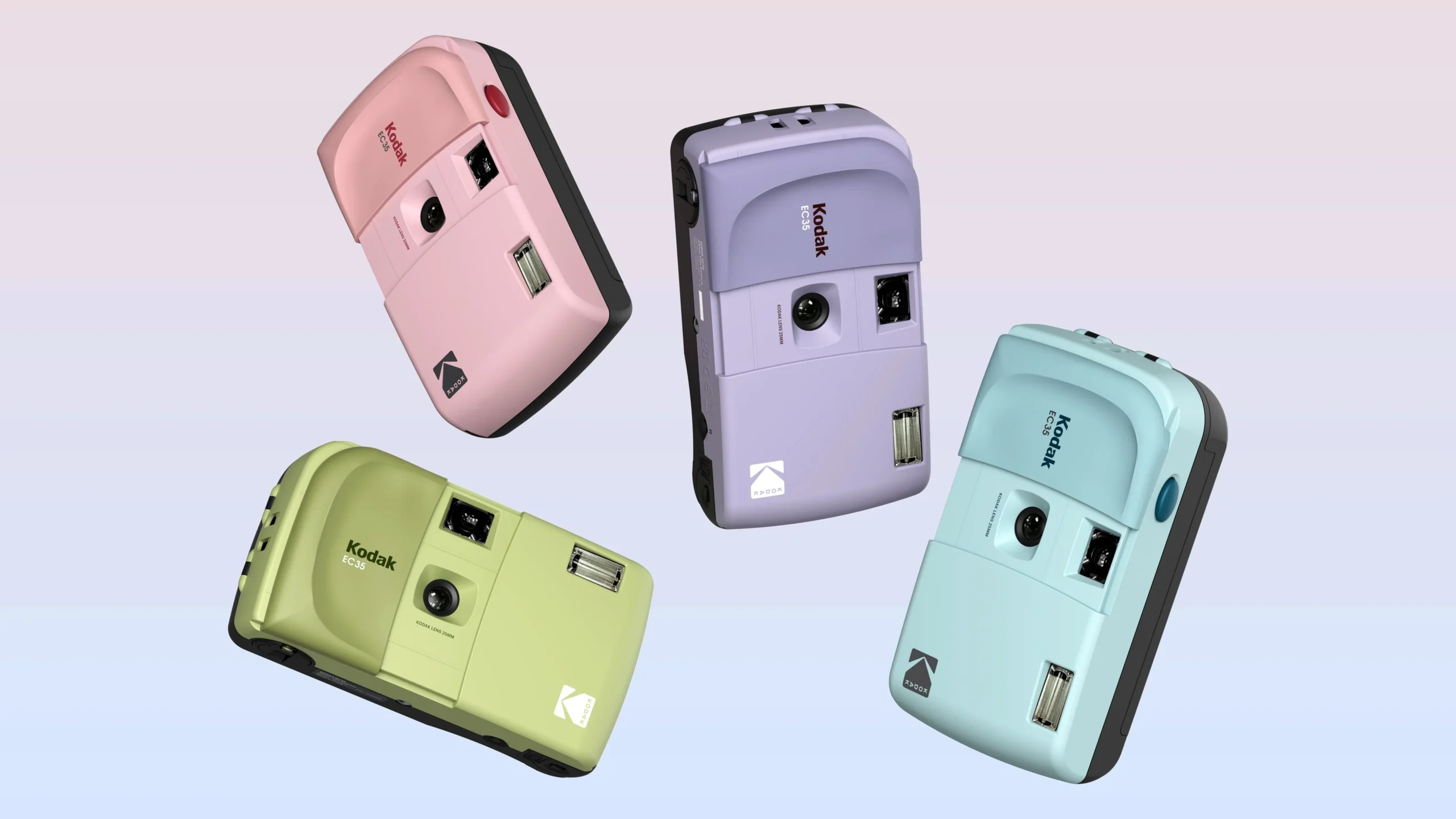
Quick Facts:
- Product: Kodak EC35 35mm film camera
- Maker: Reto, under Kodak license
- Lens: 25mm, f/10, 2-element acrylic, fixed focus
- Shutter: Fixed 1/100 second
- Power: One AA battery for the built-in flash
- Weight: 102 grams, ABS plastic body
- Colors: Seven, from Midnight Black to Avocado Green
- Price: $34.99, film and battery sold separately
- Best for: First-time film shooters who want a cheap, reloadable point-and-shoot
8 min read
In This Review
- The Kodak EC35 Brings 35mm Film Back to $35
- Kodak EC35 Specs at a Glance
- Built for Beginners: Slide Cover, Flash, and Simple Controls
- The 25mm Lens and What Your Photos Look Like
- Seven Colors in a 102-Gram Pocket Body
- What You Give Up at $34.99
- The Real Cost of Shooting Film
- Kodak EC35 vs. Used Point-and-Shoots
- Final Verdict: Is the Kodak EC35 Worth It?
- Kodak EC35 FAQ

Kodak EC35: buy it for cheap, no-fuss film fun.
The easiest way into real 35mm film for under $35, as long as you accept a plastic lens and one shutter speed.
The Kodak EC35 Brings 35mm Film Back to $35
The Kodak EC35 is a reusable 35mm film camera priced at $34.99. This figure undercuts almost every film camera worth owning, at a moment when a clean Contax T2 trades for four figures. Reto builds the EC35 under a Kodak license, and it targets first-time shooters who want real film without the sticker shock. Instead of chasing manual control, this point-and-shoot film camera strips the process down to loading film, winding on, and pressing the shutter.
The launch matters because used point-and-shoots have grown pricey. Even humble compacts now fetch triple digits, and clean cult models cost far more. Against this market, a brand-new film camera for beginners at $34.99 resets the entry price. You get a fresh body with a warranty rather than a decades-old model with worn seals.
The EC35 also revives a design detail from the film era: a tactile slide cover over the lens. When closed, it protects the optics and locks the shutter. Because the whole camera weighs 102 grams, you drop it in a pocket and forget it until a moment arrives. For anyone curious about the format, our roundup of the best 35mm film cameras shows where this budget option sits among the classics.
Kodak EC35 Specs at a Glance
The Kodak EC35 keeps its feature list short on purpose. Every number below comes from Reto’s official product page. Notably, there is no focus ring, no aperture dial, and no shutter selector to learn.
| Specification | Details |
|---|---|
| Price | $34.99 (film and battery excluded, strap included) |
| Film format | 35mm |
| Lens | 25mm, f/10, 2-element optical-grade acrylic |
| Focus | Fixed focus |
| Shutter speed | Fixed 1/100 second |
| Flash | Built-in |
| Power | One AA alkaline battery |
| Film transport | Manual wind and rewind |
| Dimensions | 119 x 65 x 41.5 mm |
| Weight | 102 grams |
| Body material | ABS plastic |
| Colors | Seven options |

KODAK EC35 35mm Film Camera 35mm, Reusable, Focus-Free, Built-in Flash, Slide Cover, Beginner Friendly (Film & AA Battery are not Included) (Single, Avocado Green)
The cheapest reloadable way to start shooting real 35mm film.
- Reloadable body shoots roll after roll, unlike a one-time disposable
- Built-in flash covers dim rooms and night shots
- Pocket-friendly at 102 grams with a slide-cover lens guard
- Seven finishes from Midnight Black to Avocado Green
- Fixed f/10 lens and 1/100 shutter need bright light or the flash
- Film and an AA battery are sold separately
Built for Beginners: Slide Cover, Flash, and Simple Controls
The Kodak EC35 removes the two things beginners fear most about film: settings and setup. Because the aperture and shutter are fixed, you never miss a shot fiddling with dials. You point, then you press. As a result, the learning curve lasts about one roll.
The slide cover does double duty. First, it shields the acrylic lens from scratches inside a bag. Second, it acts as a shutter lock, so the camera will not fire blank frames while closed. This single control tells you the camera is off or on at a glance, which makes it a friendly film camera for beginners.
The built-in flash covers the format’s weakest situations. A fixed 1/100 shutter and f/10 aperture need bright light, so indoor and evening frames lean on the flash to land exposure. You feed it one AA battery, and a rechargeable cell works too and costs less over time. For a grounding in why light drives every frame, our primer on camera basics for beginners explains the exposure triangle in plain terms.

The 25mm Lens and What Your Photos Look Like
The 25mm lens sits wider than most disposables, which usually hover near 30mm. This extra width helps in tight rooms and group shots, and it flatters street scenes. Reto markets the optic for street photography and portraits, and the fixed focus keeps everything from about a meter to infinity acceptably sharp.
Image character comes from the two-element acrylic design. Expect soft corners, gentle vignetting, and a slightly dreamy center compared with a glass compact. For many shooters, this look is the appeal, because it reads as film rather than phone. The plastic lens will not resolve fine detail like a Yashica T4; instead, grain from the film does much of the visual work.
Aperture stays locked at f/10, so depth of field runs deep. Everything in the frame tends to stay in focus, which removes the risk of a blurred subject. To push sharpness and color, load a 400-speed stock and shoot in daylight. A discreet 25mm point-and-shoot pairs well with candid work, and its wide framing rewards patient street shooting on the sidewalk.
Seven Colors in a 102-Gram Pocket Body
Reto sells the Kodak EC35 in seven finishes: Midnight Black, Vanilla White, Butter Yellow, Lavender, Powder Blue, Blush Pink, and Avocado Green. The palette leans playful, and it targets the same crowd buying pastel digital compacts. Color aside, every version shares the identical body and specs. To blend in, pick Midnight Black; brighter tones like Butter Yellow and Blush Pink read as fashion accessories.
At 102 grams and 119 by 65 by 41.5 mm, the camera disappears in a jacket pocket. The ABS shell feels light rather than premium, which fits the price. Because there is so little to grip, a wrist strap ships in the box to keep it secure. This portability is the strongest argument for carrying it daily, since a camera small enough for any pocket gets used far more than one left at home.
What You Give Up at $34.99
The low price buys simplicity, and simplicity has limits. A fixed 1/100 shutter and f/10 aperture leave no room to adapt, so dim scenes without flash come out dark. You also cannot control depth of field for portraits with a blurred background. These are the trade-offs of a fixed-exposure design.
Build quality reflects the cost too. The all-plastic body and acrylic lens will not survive abuse like a metal compact, and the viewfinder is a simple window rather than a coupled optic. Parallax error creeps into close framing as a result. None of this surprises at $34.99, yet it explains why the camera suits snapshots over critical work.
The larger expense is not the camera at all. Film and developing add up every roll, which changes the value math over a year. Rising used prices push some buyers toward new options, and our look at point and shoot film camera prices explains why the whole category costs more now.
The Real Cost of Shooting Film
The sticker says $34.99, but shooting film carries a running tab. Every roll costs money to buy and to develop, unlike a memory card you reuse. Budget for this before you commit, especially if you shoot often.
The table below uses typical United States prices in mid-2026 from major film retailers and labs. Your local costs will vary, and mail-in labs sometimes beat local shops. Still, the ranges show the real per-roll math for a cheap 35mm film camera.
| Cost Item | Typical Price |
|---|---|
| Camera (one time) | $34.99 |
| Color film, 36 exposures | $13 to $18 per roll |
| AA battery | $1 to $2 |
| Develop and scan, per roll | $12 to $20 |
| Running cost per 36 shots | $25 to $38 |
Film choice shapes both cost and look. A 400-speed color stock such as Kodak UltraMax 400 suits the fixed exposure best, since it handles daylight and flash alike. To match film to the result you want, our explainer on Kodak 35mm film explained breaks down the common stocks.
Kodak EC35 vs. Used Point-and-Shoots
The obvious rival to the Kodak EC35 is a used compact from the film era. A used Olympus or Canon compact often adds autofocus, a sharper glass lens, and auto exposure. Those features improve keeper rates, especially in low light where the EC35 struggles.
The catch is price and risk. A working autofocus compact now runs $150 to $600 or more, and it arrives with unknown wear, dead light seals, or a failing flash. The EC35 counters with a new body, a warranty, and a $34.99 tag. You trade image quality for reliability and a much lower cost of entry.
New rivals exist too. Digital compacts styled after film keep appearing, and screen-free options styled after disposables skip developing costs entirely. If you would rather avoid a lab, browse our roundup of the best compact cameras of 2026 before deciding between film and digital.
Final Verdict: Is the Kodak EC35 Worth It?
The Kodak EC35 makes sense for one clear buyer: the curious beginner who wants real film without a big outlay. At $34.99, few new options beat it as a cheap 35mm film camera, and it lowers the risk of trying the format to almost nothing. Its slide cover, built-in flash, and fixed exposure make the first roll simple, and the wide 25mm view suits everyday scenes.
The trade-offs are equally clear. Fixed focus, an f/10 aperture, and a plastic lens cap the image quality, so low-light frames and fine detail suffer. If you want sharp portraits with background blur or reliable night shots, look toward a used autofocus compact or an entry SLR instead.
Value depends on how you count it. The camera is cheap, yet the film and developing costs run $25 to $38 per roll of 36. Over a year of heavy shooting, those rolls dwarf the body price, which is worth weighing before you buy.
As a first point and shoot film camera, though, the EC35 does its job. It removes the excuses, fits any pocket, and delivers the soft film look for less than a nice dinner. Shoot a few rolls, learn what you like, and step up to a used compact such as a Yashica T4 if the habit sticks.
Kodak EC35 FAQ
Is the Kodak EC35 reusable or a disposable camera?
The Kodak EC35 is reusable. You load your own 35mm film, wind and rewind by hand, and reload it after developing. This sets it apart from a single-use disposable, which you hand over whole at the lab.
How much does the Kodak EC35 cost?
The camera sells for $34.99 from Reto, its licensed maker. Film and an AA battery cost extra, though a strap ships in the box. Expect roughly $25 to $38 more per roll for film plus developing.
What film does the Kodak EC35 use?
It takes standard 35mm film, the most common format sold today. A 400-speed color stock works best because the fixed 1/100 shutter and f/10 aperture need plenty of light. You load it the same way as any 35mm point-and-shoot.
Is 35mm film still available in 2026?
Yes, 35mm film remains widely available from camera shops, big-box stores, and online retailers. Kodak, Ilford, and others still manufacture it. Developing is available through local labs and mail-in services across the country.
Is the Kodak EC35 good for beginners?
Yes, because it removes manual settings and keeps operation to point and press. The slide cover, built-in flash, and fixed exposure suit a first-time shooter. For sharper results or low-light work, a used autofocus compact serves better.

