


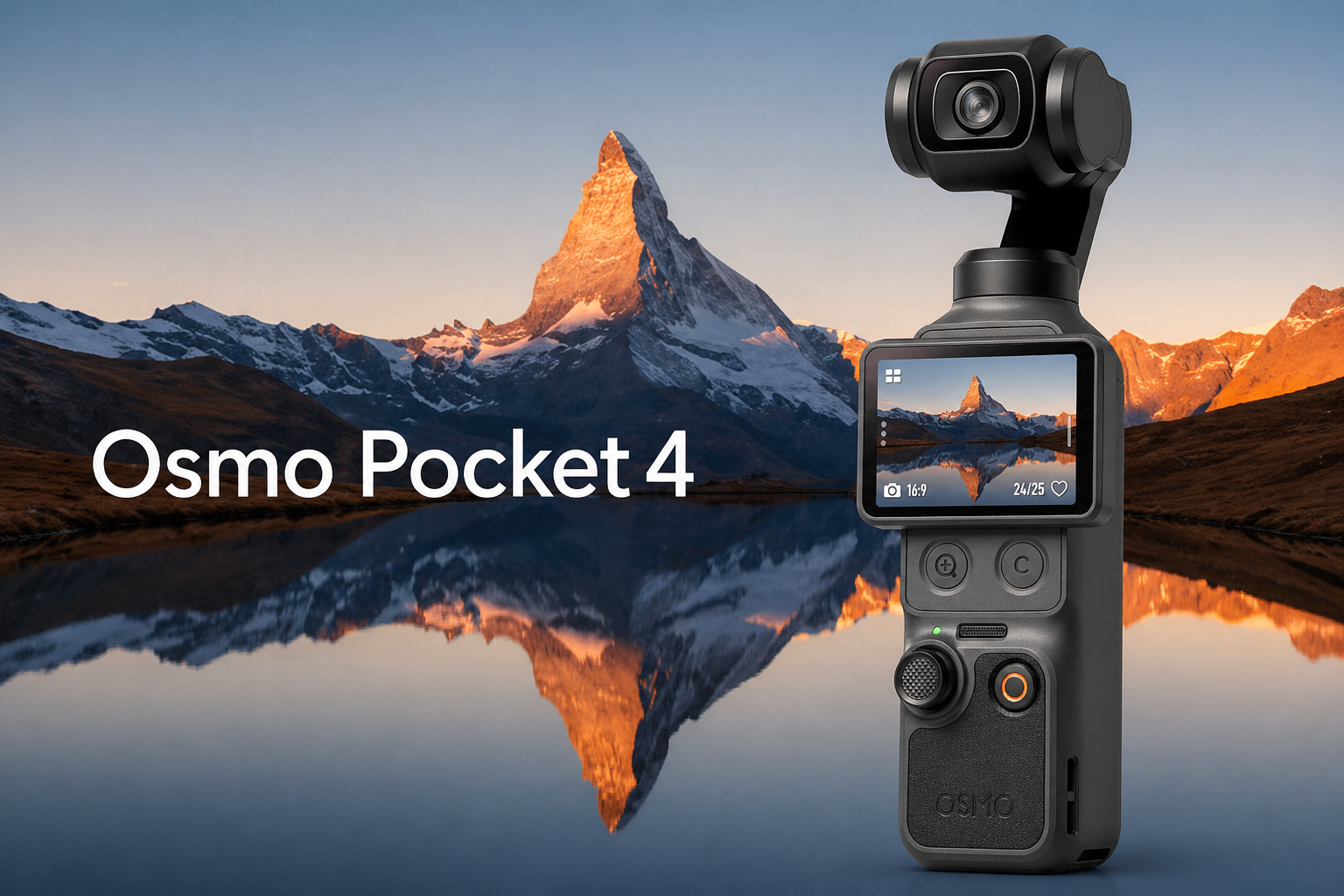
Quick Verdict: The DJI Osmo Pocket 4 US launch has been blocked by the FCC’s Covered List designation, leaving photographers and video creators without a legal way to purchase the new pocket gimbal camera through official channels. Despite a 1-inch CMOS sensor, 4K at 240fps recording, and 14 stops of dynamic range, the Pocket 4 missed the FCC’s wireless authorization window. For now, the DJI Osmo Pocket 3 remains the best legal option in the US at $799.
Last updated: April 2026 | 8 min read
In This Article
- Availability Overview
- Key Specs at a Glance
- Why the FCC Covered List Blocks the Pocket 4
- The 404 Test: Proof of the US Geo-Block
- What This Means for US Photographers
- Why the Pocket 3 Still Wins for US Buyers
- Pocket 4 vs Pocket 3
- Pocket 4 Specs vs US Availability Reality
- Final Verdict
- Frequently Asked Questions
DJI Osmo Pocket 4 US Availability Overview
The DJI Osmo Pocket 4 US launch has effectively stalled before it began. DJI announced the new pocket gimbal camera with promises of a global release, yet US photographers have no legal path to buy one through official channels. According to reporting from DroneDJ on April 17, 2026, and follow-up coverage from No Film School on April 27, 2026, the FCC’s Covered List designation blocked the device from receiving the wireless authorization required for legal sale in the United States.
For photographers and hybrid shooters who relied on the Pocket 3 for travel work, B-roll, and run-and-gun video, the news is frustrating. I have been shooting with the DJI Osmo Pocket 3 for two years as one of two action cameras in my regular field kit, and I was among the photographers waiting for the Pocket 4 to hit shelves. The Pocket 4 was positioned as the long-awaited upgrade, with a 1-inch CMOS sensor, 4K video at 240 frames per second, and 14 stops of dynamic range. Pricing in international markets sits in line with the previous generation, though no US retail price has been published.
The situation creates an unusual gap in the consumer market. Compact gimbal cameras serve a specific need, namely solo creators who want stabilized 4K footage without rigging up a mirrorless body. With the Pocket 4 unavailable, US buyers have one practical option from DJI itself, the Osmo Pocket 3, which remains legally authorized and on sale.
Key Specs at a Glance
| Specification | Pocket 4 |
|---|---|
| Sensor | 1-inch CMOS |
| Max Video | 4K at 240fps |
| Dynamic Range | 14 stops |
| Color Profile | 10-bit D-Log |
| Internal Storage | 107GB built-in |
| Battery Life | Up to 4 hours at 1080p/24fps with display off |
| Charging | Rapid charge under 20 minutes |
| Tracking | ActiveTrack 7.0 with Subject Lock |
| Audio | DJI Mic Mini direct, Mic 3 via receiver |
| US Availability | Blocked by FCC Covered List |
Available on Amazon
Osmo Pocket 3 Creator Combo
The Pocket 4 is blocked from US sale, so the Pocket 3 stands as the best legal option. Same 1-inch CMOS sensor, 4K/120fps, full FCC authorization.
Why the FCC Covered List Blocks the Pocket 4
To sell a consumer device legally in the United States, any product with Wi-Fi, Bluetooth, or radio frequency communication must hold authorization from the Federal Communications Commission. This rule covers everything from wireless mice to drones, and it applies equally to gimbal cameras. Without authorization, retailers cannot legally market or distribute the device in the country.
DJI has been placed on the FCC’s Covered List, a designation tied to national security concerns. While this does not retroactively pull existing products off shelves, it creates a major hurdle for new ones. New DJI hardware faces significant obstacles in obtaining FCC clearance, and without it, the device sits in regulatory limbo. As a result, the DJI ban now stretches from drones to gimbal cameras with no clear timeline for relief.
The Pocket 4 appears to have missed the approval window before tighter rules took effect. As a result, even third-party importers face customs and legal distribution barriers, since non-compliant wireless devices have no clear path to retail. Newer DJI hardware such as the Avata 360 secured FCC authorization before the cutoff and remains available through US channels, while several other models continue to ship through independent importers.
DJI is currently challenging its inclusion on the Covered List in court, arguing the designation lacks sufficient evidence. However, in a memo released earlier this month, the Department of Defense urged strict rejection of DJI’s petition for reconsideration. Cases like this often drag on for years, so a near-term resolution looks unlikely.
The 404 Test: Proof of the US Geo-Block in Action
The Pocket 4 block is not theoretical, and PhotographyTalk ran an original on-the-ground test to confirm the geo-block in practice. To start, from my residence in Southern California, I ran a simple search. A Google search for “DJI Osmo Pocket 4” returns DJI’s official website as the top result, exactly where you would expect to find the product page. Clicking through from a US IP address, however, lands on a 404 error. The page does not load. The product effectively does not exist on DJI’s US-facing storefront.

Google search from a California IP returns DJI’s official site as the top result for the Pocket 4.

Clicking the top result from a US IP lands on a 404 error page. The Pocket 4 has no live product page on DJI’s US storefront.
To confirm the geo-block was the cause, I ran the same test through ExpressVPN with an exit node in the United Kingdom. Google returned the identical DJI listing at the top of the results. The click-through, however, loaded the full Osmo Pocket 4 product page, complete with specs, pricing, marketing copy, and a working buy flow. The hardware exists. The marketing exists. The pocket camera simply has no path into the US market through official channels.
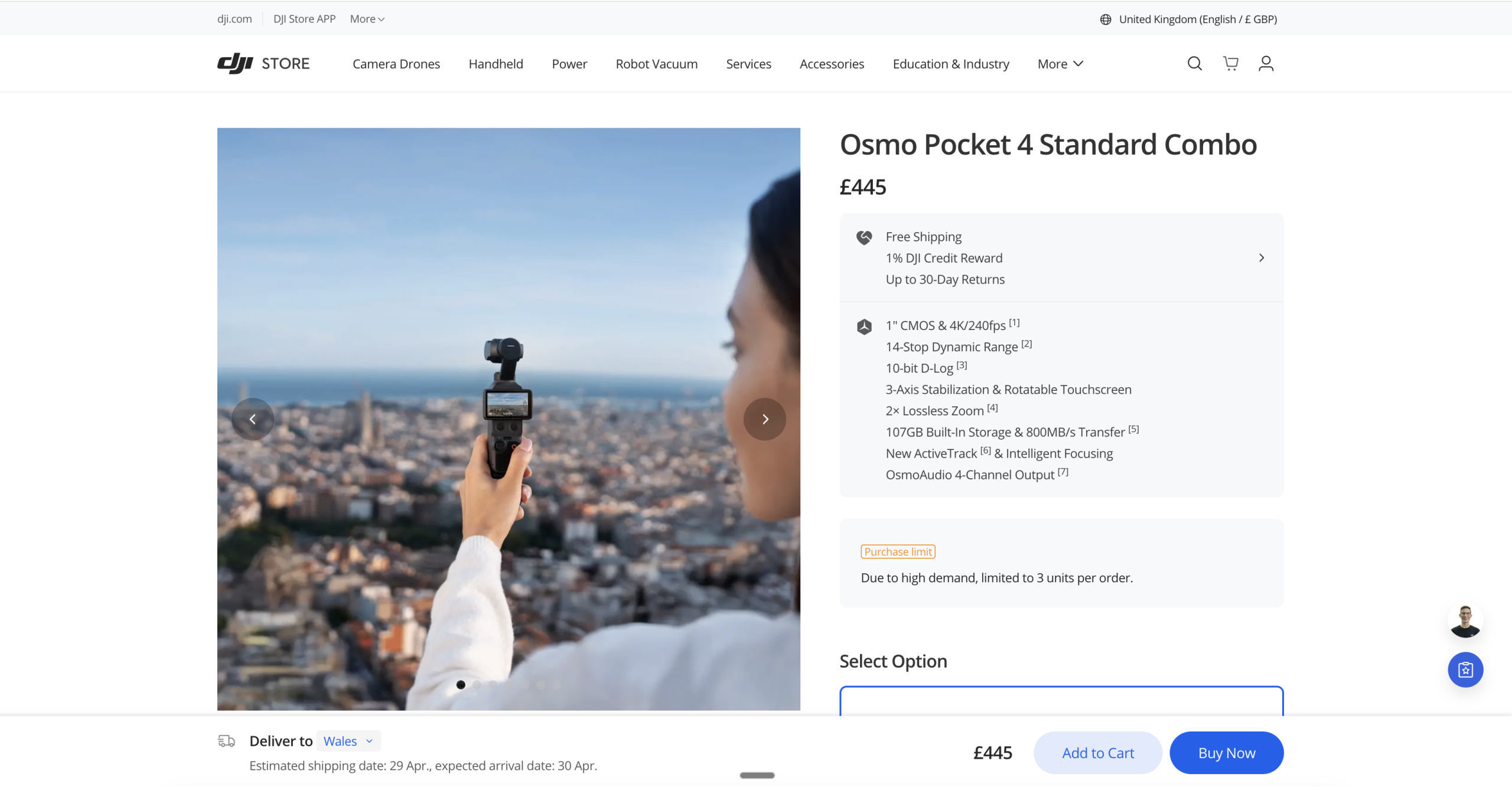
Same URL, accessed through an ExpressVPN UK exit node. The full Osmo Pocket 4 product page loads with specs, marketing, and a buy button.
This pattern matches how DJI has handled previous Covered List actions. Rather than build a US-specific “unavailable” page, the company appears to return a 404 to US IP addresses while leaving the global product page intact for international visitors. The result is a strange user experience where US shoppers find DJI’s site at the top of Google but hit a dead end the moment they click through.
What This Means for US Photographers
For solo creators, vloggers, and hybrid shooters, the practical impact is straightforward. The Pocket 4 will not appear at B&H, Adorama, or Amazon US listings. DJI’s own US storefront will not list it. Even gray market imports through eBay or international resellers carry real risk because non-compliant wireless gear has been flagged by US Customs in past enforcement actions.
If you already own a DJI drone or gimbal purchased before the Covered List took effect, you retain full legal rights to use it. The Covered List restricts new sales, not existing ownership. However, future firmware support, warranty service through US retailers, and accessory availability for blocked products remain uncertain.
For photographers planning a major travel video project, the timing is poor. The Pocket 4’s 4K/240fps slow motion and improved low-light performance would have been useful for evening street shooting and indoor work where the Pocket 3 has shown limits. Without a US release, those workflows have to rely on the Pocket 3 or move to a different form factor entirely, such as a small mirrorless body paired with a gimbal.
Travel photographers heading abroad face an interesting wrinkle. Buying a Pocket 4 in another country and bringing it home for personal use sits in a legal gray zone. While individuals carrying personal-use devices through customs are rarely stopped, importing for resale or business use carries clear risk under the Covered List rules.
Skip the Pocket 4 Headache
Osmo Pocket 3 Standard Kit
Pocket 3 owners get the same 1-inch CMOS sensor, 4K/120p 10-bit recording, and full US warranty support. No customs risk, no gray market import.
Why the DJI Osmo Pocket 3 Still Wins for US Buyers
The Osmo Pocket 3 has earned its reputation as one of the best compact video tools on the market, and not because the Pocket 4 cannot ship here. After two years of running my own Pocket 3 hard across overlanding trails, SoCal desert shoots, and travel work overseas, I rate it as one of the most reliable cameras in my field kit. It packs the same 1-inch CMOS sensor as the Pocket 4, records 4K at up to 120 frames per second after a recent firmware update, and supports 10-bit D-Log M color. For most travel and vlogging work, the difference between Pocket 3 and Pocket 4 footage is smaller than the spec sheet suggests.
Real-world reliability matters more than headline specs, and the Pocket 3 has earned trust on the trail. Specifically, after two seasons of overlanding shoots, I trust it for assignments where a reshoot is not an option. Battery life holds up through long shooting days. The compact form factor slips into a chest pocket between shots. The 1-inch sensor produces footage I am happy to color grade alongside clips from a Canon R5, which is the bar I hold any secondary camera to. Two years in, my Pocket 3 has not failed me on a single shoot.
Pricing has shifted, however. DJI raised the Pocket 3 from $519 to $799 earlier this year as tariffs began to hit US imports. While the price bump stings, the Pocket 3 remains cheaper than building an equivalent setup with a mirrorless body, gimbal, and microphone rig. For solo creators, the all-in-one design is still the fastest way to capture stabilized 4K with usable color out of camera.
The Pocket 3 also retains full US warranty support through authorized dealers. If you purchase through Amazon, B&H, or DJI’s US storefront, you get standard coverage and access to legitimate firmware updates. Gray market Pocket 4 imports offer none of this.
DJI Osmo Pocket 4 vs Osmo Pocket 3
On paper, the Pocket 4 wins on three specific upgrades. First, frame rate doubles for 4K slow motion, jumping from 4K/120 on the Pocket 3 to 4K/240 on the Pocket 4. Second, dynamic range climbs to 14 stops, an improvement worth roughly one stop over the Pocket 3 in real-world testing. Third, internal storage jumps to 107GB on the Pocket 4 versus the 16GB built-in on the Pocket 3 Standard kit, though Pocket 3 users have always relied on microSD expansion.
For most US photographers, those upgrades do not change the practical answer. Solo travel work rarely demands 4K/240 slow motion, since 4K/120 already covers most cinematic slow-mo needs. Color grading on the Pocket 3 with 10-bit D-Log M produces results indistinguishable from the Pocket 4 for typical YouTube and Instagram delivery. The Pocket 4 wins for high-end commercial work where every stop of dynamic range counts, but for hobbyists and travel creators, the Pocket 3 covers 95% of real shooting scenarios.
Price tells a similar story. The Pocket 4 was expected to launch around the same $799 price point in international markets, so even if it shipped to the US, the upgrade premium would have been minimal. Meanwhile, the Pocket 3 ships today with full US support.
Pocket 4 Specs vs US Availability Reality
The Pocket 4 looks strong on paper. However, none of these specs help US photographers since the camera has no legal sales channel here. Specifically, the grid below shows what DJI built into the hardware on the left, while the practical reality of trying to buy one in the US sits on the right.
Pocket 4 Hardware (Unavailable to US Buyers)
- 1-inch CMOS sensor for stronger low-light performance
- 4K at 240fps for 8x slow motion at full resolution
- 14 stops of dynamic range for highlight and shadow latitude
- 10-bit D-Log color profile for professional color grading
- 107GB of built-in storage, no microSD required for most shoots
- Up to 4 hours of battery at 1080p/24fps with display off
- ActiveTrack 7.0 with Subject Lock for solo shooting
US Availability Reality
- Blocked from legal US sale under the Covered List designation
- No US warranty or authorized retailer support
- Gray market imports face customs and legal distribution barriers
- DJI’s lawsuit against the FCC will likely take years to resolve
- Department of Defense urged rejection of DJI’s reconsideration petition
- Future firmware updates outside US channels carry compatibility risk
Final Verdict
The DJI Osmo Pocket 4 US situation is a clear loss for solo creators who hoped to upgrade. On paper, the Pocket 4 represents a meaningful step forward in slow motion, dynamic range, and onboard storage. In practice, US photographers have no legal way to buy one, no warranty path, and no clear timeline for when, or if, the DJI ban gets resolved.
For anyone shopping today, the math is simple. The DJI Osmo Pocket 3 remains the best legally available pocket gimbal camera in the US market. It uses the same 1-inch CMOS sensor as the Pocket 4, supports 4K/120p with 10-bit D-Log M after firmware updates, and ships with full US warranty coverage. While the recent price hike to $799 hurts, the Pocket 3 still undercuts the cost of building an equivalent stabilized rig with a mirrorless body and external gimbal. Speaking from two years of personal field use, I have no real concerns about recommending it as the buy in 2026.
Photographers chasing the absolute cutting edge in slow motion or high dynamic range workflows have two realistic options. Either wait out the DJI ban appeal, which will drag on for years, or step up to a hybrid mirrorless setup with a dedicated gimbal. Neither is a quick fix, but both produce more flexible footage than any Pocket-class camera.
For the rest of US shooters, including travel photographers, vloggers, and run-and-gun video creators, the Osmo Pocket 3 is the smart buy in 2026. It delivers 90% of the Pocket 4’s practical performance, ships legally through Amazon and B&H, and avoids every risk associated with gray market imports. If DJI eventually clears the FCC hurdle, the Pocket 4 will arrive then. Until then, the Pocket 3 stays on the desk.
Ready to Buy?
Osmo Pocket 3, FCC Authorized for US Sale
Same 1-inch CMOS sensor as the Pocket 4, full US warranty, and no Covered List risk. Check today’s pricing and available bundles on Amazon.
Frequently Asked Questions
Why is the DJI Osmo Pocket 4 not available in the US?
The Pocket 4 release was blocked because DJI sits on the FCC’s Covered List, a designation tied to national security concerns. Any consumer device with wireless features needs FCC authorization to be sold in the United States, and the Pocket 4 missed its approval window before tighter rules took effect.
Will the Pocket 4 ever ship in the US?
Possibly, but not soon. DJI is challenging the DJI ban in federal court, however the case will likely take years. The Department of Defense has urged strict rejection of DJI’s petition for reconsideration, which makes a near-term resolution unlikely.
Is it legal to import a DJI Osmo Pocket 4 from another country?
Importing a Pocket 4 for personal use sits in a legal gray zone. Non-compliant wireless devices have been flagged by US Customs in past enforcement, and importing for resale carries clear risk under Covered List rules. DJI offers no US warranty support for gray market units, so any defects fall on the buyer.
What is the best DJI pocket camera available in the US right now?
The Pocket 3 remains the best legal option in the US market. It uses the same 1-inch CMOS sensor as the Pocket 4, records 4K at up to 120fps, supports 10-bit D-Log M, and ships with full US warranty support through Amazon, B&H, and DJI’s official US storefront.
How much does the Pocket 3 cost in 2026?
The Pocket 3 currently sells for $799 in the US, up from its original $519 launch price. DJI raised the price earlier this year as tariffs began affecting US imports. Even at the higher price, the Pocket 3 remains cheaper than building an equivalent stabilized 4K rig with a mirrorless body and external gimbal.
Does owning a DJI Pocket 3 carry any risk under the FCC Covered List?
No. The Covered List restricts new sales, not existing ownership. If you already own a Pocket 3 or any DJI product purchased before regulatory tightening, you keep full legal rights to use it. Firmware updates from DJI’s official US channels remain available, and warranty service through authorized dealers stays in effect.

