


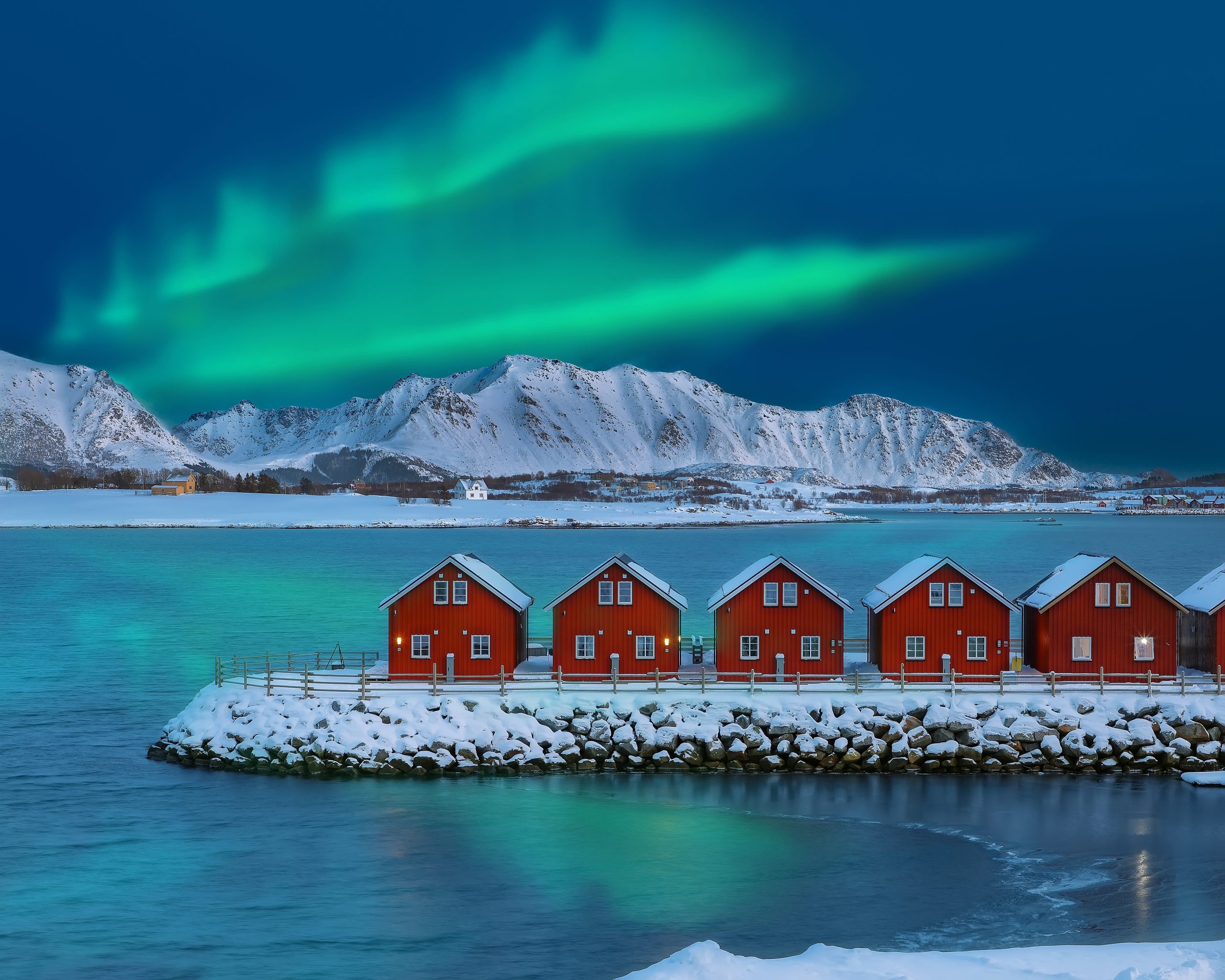
Quick Verdict: Learning how to photograph northern lights starts with a sturdy tripod, a wide-aperture lens at f/2.8 or wider, and a base exposure of ISO 3200, 8 seconds, with manual focus locked on a distant point light. Plan around a KP index of 4 or higher, drive far from city light pollution, and shoot 14-bit RAW so you keep editing headroom. After multiple trips to Norway’s Lofoten Islands and a cloud-blown run through Alaska, the gap between a green smudge and a printable frame comes down to focus discipline, foreground choice, and patience.
Last updated: April 2026 | 11 min read
In This Guide
- How to Photograph Northern Lights: My Hard-Won Lessons
- Northern Lights Camera Settings at a Glance
- Essential Aurora Photography Gear
- How to Photograph Northern Lights Step by Step
- Where and When to Find the Aurora
- Composition: Foregrounds Worth Your Frame
- Print Your Aurora on Metal
- Lofoten vs Alaska: Which Should You Pick?
- Pros and Cons of Aurora Chasing
- Final Verdict
- Frequently Asked Questions
How to Photograph Northern Lights: My Hard-Won Lessons
This guide walks you through how to photograph northern lights as a beginner, built from multiple field seasons in Norway’s Lofoten Islands and a recent run through Alaska. Aurora work sits at the crossroads of landscape and astrophotography, so you need a sky strategy and a foreground plan running in parallel. Because conditions shift in seconds, repeatable settings beat clever tricks every time.
My first Lofoten trip ran on a Nikon D850 paired with a 14-24mm f/2.8. Later trips moved to a Nikon Z7 with the Z 14-30mm f/4 S and now Canon R5 with my trusty 15-35mm f/2.8. All the bodies delivered sharp aurora frames; however, the D850’s deeper shadow recovery in 14-bit RAW gave me an extra stop of grading room on the nights when the lights stayed faint.
Lofoten sits at 68 degrees north, deep inside the auroral oval, with granite spires, fjord water, and red rorbu cabins waiting under the curtain. Alaska delivers comparable latitudes near Fairbanks and broader access through Anchorage. For a first attempt, plan a five to seven night stay because aurora activity rarely lines up with clear skies on demand.
On my most recent trip, I brought my son to Alaska, hoping to share his first aurora night. Cloud cover sealed the sky for the full window. Instead of salting the trip, we drove to Matanuska Glacier off the Glenn Highway and shot ice texture under low-angle daylight, which earned a permanent rule for every aurora plan since: always pack a daytime landscape backup.
Northern Lights Camera Settings at a Glance

Use this table as your starting point on the first night. Adjust shutter speed first when the aurora speeds up or slows down, then ISO when the histogram drifts off the right edge. Keep aperture wide open until you nail focus.
| Setting | Recommended Starting Point |
|---|---|
| Aperture | f/2.8 or wider; f/1.8 to f/2.0 if your lens supports it |
| Shutter Speed | 5 to 10 seconds for active aurora, 15 to 25 seconds for faint pulses |
| ISO | 3200 base; push to 6400 in dim conditions; drop to 1600 during strong substorms |
| Focal Length | 14mm to 24mm full-frame equivalent |
| White Balance | 3200K to 4000K, fixed in Kelvin (auto WB drifts between frames) |
| Focus | Manual, locked on a bright star or distant light using live view at 100% |
| Drive Mode | 2-second timer or remote release to remove tripod shake |
| File Format | RAW only, 14-bit lossless when available |
| Image Stabilization | Off when on a tripod |
Featured on ShinyPrints
Print Your Aurora on Metal
Aurora greens and pinks pop with depth and shimmer when printed on aluminum. ShinyPrints delivers gallery-grade metal prints built for the dynamic range your night sky frames demand.
Essential Aurora Photography Gear

Knowing how to photograph northern lights begins with a small, dependable kit. Aurora chasing rewards quality over quantity. Cold drains batteries, freezes lubricants, and shortens patience, so a leaner bag usually performs better than an overstuffed one.
For the body, full-frame sensors with strong high-ISO performance lead the field. The Nikon D850 remains a workhorse for aurora borealis photography because its 45.7MP back-side illuminated sensor pulls clean shadow detail at ISO 3200 and 6400. The Nikon Z7 matches the same sensor in a mirrorless body, with a brighter electronic viewfinder and on-sensor focus peaking, which speeds up manual focus on stars at 14mm. When comparing systems, the best camera for aurora photography is whichever full-frame body you already own paired with a fast wide lens; sensor age matters less than glass speed.
Lens choice matters more than body choice. Look for a wide-angle prime or zoom rated f/2.8 or faster. The 14-24mm f/2.8, the 20mm f/1.8, and the 24mm f/1.4 all earn their spot in the bag. A faster lens lets you drop ISO by a stop, which preserves shadow color in the foreground.
Beyond glass, four items earn space on every trip:
- A carbon fiber tripod rated for at least 8 pounds of payload, with leg warmers if you shoot below minus 10 Celsius
- A red-light headlamp so you preserve night vision while changing settings
- Four to six fully charged camera batteries kept in an interior coat pocket between shots
- An intervalometer or wireless remote to fire the shutter without bumping the rig
For broader foundation gear advice, the beginner astrophotography guide covers stabilization and remote releases in more depth.
How to Photograph Northern Lights Step by Step
Run this sequence the moment you arrive on location, before the first pulse hits.
First, mount the camera on your tripod, level the head, and switch the lens to manual focus. Switch in-body and in-lens stabilization off. Stabilization motors fight a static tripod and add subtle shake to long exposures.
Second, dial in starting exposure. Set aperture to f/2.8, shutter speed to 8 seconds, and ISO to 3200. Set white balance to 3500K. Drop the camera into RAW. These northern lights camera settings, paired with the aurora photography settings in the table above, give you a usable test frame on most KP 4 nights without further tweaking.
Third, lock focus. Aim live view at the brightest star you find. Punch in to 100% magnification, then turn the focus ring slowly until the star shrinks to a pinpoint. Tape the ring with gaffer tape so a glove bump does not throw it off. The 500 rule gives you a quick shutter-speed cap for star tracking, although aurora work tolerates slightly longer exposures because the lights themselves move.
Fourth, fire a test frame and read the histogram. If the right edge climbs into clipping, drop ISO to 1600. If the histogram piles against the left, push shutter speed to 12 or 15 seconds before raising ISO. Active substorms move fast, so shorter shutter speeds preserve curtain structure; faint pulses tolerate longer exposures.
Fifth, lock the cadence. Use a 2-second timer or intervalometer set for one frame every 10 to 12 seconds. Steady cadence creates the option to stack frames for time-lapse output later.
Where and When to Find the Aurora

Half the work in aurora borealis photography happens before you leave for the airport. Your win rate depends on three planning inputs: latitude, KP index, and local cloud cover.
For latitude, target the auroral oval, which sits between 65 and 70 degrees north on most nights. Lofoten, Tromso, Iceland, northern Finland, and the Yukon all fall inside this band. Fairbanks, Alaska sits at 64.8 degrees north, on the southern edge of the oval but still strong on KP 3 nights and above.
For activity, watch the KP index and the Bz value on a forecasting service such as the NOAA Space Weather Prediction Center. KP 3 produces visible aurora at 65 degrees north. KP 5 and above brings the lights farther south, sometimes as low as the northern United States. The Bz reading matters because a southward Bz (negative numbers) signals the solar wind is connecting with Earth’s magnetic field, which drives the curtain.
For weather, a clear sky beats a strong KP every time. Use Windy.com or your country’s meteorological service for cloud cover layers. Run a 72-hour forecast loop and pick the first night with cloud cover under 20%. The light pollution guide walks through Bortle scale planning, which applies directly to aurora locations because city glow muddies the green channel.
Best season runs late August through mid-April, with peak aurora hours between 10 PM and 2 AM. Solar maximum peaked in October 2024, and the declining phase still produces strong aurora storms through 2026, often at lower latitudes than usual. Avoid full moon weeks unless you want a moonlit foreground.
Featured on ShinyPrints
Turn Your Lofoten Frame Into a Wall Centerpiece
Aluminum surfaces hold aurora color saturation deeper than paper. Sizes from 8×10 to 40×60 inches ship ready to hang.
Composition: Foregrounds Worth Your Frame
The aurora is the star; however, your foreground decides whether the print holds attention. A great aurora frame typically has three layers: a strong foreground anchor, a middle ground with depth, and the curtain itself. The composition rules mirror standard landscape work, with one twist: the sky becomes a dynamic subject.
For Lofoten, the iconic compositions place a red rorbu cabin or a granite peak at the lower third with the curtain arching above. The waterline at Hamnoy and the bridge at Reine reflect the lights into the foreground, doubling the impact at focal lengths between 14mm and 20mm. For Alaska, frozen rivers near Fairbanks deliver mirror reflections, while spruce silhouettes along the Glenn Highway add foreground depth without competing with the sky.
Try the rule of thirds for the horizon line, although a low horizon (closer to the bottom fifth) lets the aurora dominate when the sky stays active. A high horizon works better when the foreground earns the frame, such as a glacier face or a mountain ridgeline.
About my Alaska trip with my son: the cloud deck never broke. Four nights of solid grey killed the aurora plan. Rather than waste the trip, we drove to Matanuska Glacier off the Glenn Highway and shot ice texture, meltwater patterns, and crevasse light at midday. The lesson stuck. Every aurora trip since has carried a shot list of daytime backups within a two-hour drive of the lodge, because weather wins about a third of the time even at peak season.
Print Your Aurora on Metal
The screen-only aurora rarely earns the wall space it deserves. Once your aurora photography settings deliver clean frames, the next step is the print, and metal beats every other substrate for aurora work.
Metal prints work by infusing dye into a coated aluminum sheet through dye sublimation. The process handles saturated greens and magentas better than fine art paper because aurora colors sit near the edges of the Adobe RGB gamut, where paper inks tend to clip toward grey. On aluminum, the reflective base sits under the dye layer and bounces light back through the color, which is why a printed aurora frame holds depth and shimmer paper struggles to match. The science behind metal print luminosity walks through the optics in detail.
Sizing matters. For aurora frames shot at 45MP on the Nikon D850 or Z7, prints up to 40×60 inches stay sharp at normal viewing distances. ShinyPrints offers gloss, satin, and matte finishes. Satin sits in the middle and works best for aurora because gloss creates distracting reflections in dark home lighting, while matte mutes the magenta and pink tones the aurora produces during strong substorms.
Before ordering, soft-proof the file in Lightroom or Photoshop with the lab’s ICC profile. For most aurora frames, a 5% boost to vibrance and a slight cool shift on the highlights translates well from screen to aluminum, although your edit might differ if your file already runs warm or saturated.
Lofoten vs Alaska: Which Should You Pick?

Both regions deliver world-class aurora; however, the experience and the photographic opportunities differ in three ways.
First, foregrounds. Lofoten gives you fjords, granite peaks, and red cabins inside a 30-minute drive. Alaska gives you boreal forest, frozen rivers, and glaciers, but the iconic foregrounds spread across a wider geographic area, often three or four hours apart.
Second, weather. Lofoten typically sees frequent maritime cloud cover throughout winter, often more than half the nights. Fairbanks runs noticeably drier in late winter, which gives you a higher base rate of clear sky on any given night.
Third, cost and access. Lofoten requires a connecting flight through Oslo or Bodo, plus a rental car or ferry. A typical seven-night trip runs $3,500 to $5,500 per person. Fairbanks runs slightly cheaper at $2,500 to $4,000 per person for a similar window, with direct flights from Seattle on most carriers.
Pick Lofoten if your priority is composition variety inside a small footprint. Pick Alaska if you want higher clear-sky probability and direct domestic flights.
Pros and Cons of Aurora Chasing
Pros
- Highest-impact landscape subject; a strong KP 5 frame outperforms most other night skyscapes
- Forgiving light; the aurora’s own glow lets you see and compose without auxiliary lighting
- Print-ready output at 45MP with normal exposures around 8 seconds
- Skill carryover; the discipline transfers directly to Milky Way and star landscape work
- Off-season pricing in Lofoten and Fairbanks during shoulder months (late August, early April)
- Strong community of guides, workshops, and aurora forecast tools across northern destinations
Cons
- Weather dependency; an entire trip might pass with zero clear-sky aurora hours
- Cold gear failure; battery life drops 40 to 60 percent at minus 10 Celsius and below
- Long stays required; budget five to seven nights minimum for a reasonable hit rate
- Travel cost; full-frame gear plus airfare and lodging tops $3,000 for most North American photographers
- Sleep deprivation; peak aurora hours sit between 10 PM and 2 AM
Final Verdict
If you have wondered how to photograph northern lights without spending a season figuring it out, the answer comes down to three disciplines: locked manual focus, repeatable aurora photography settings starting at f/2.8, ISO 3200, 8 seconds, and a foreground worth printing. Beginners with a Nikon D850, Nikon Z7, or any full-frame body paired with a fast wide-angle lens have everything needed for printable aurora frames.
The trade-offs are real. Cold drops battery life by half. Weather rolls in without warning. A first trip might net only one or two strong aurora windows. For photographers who would rather stay home and shoot Milky Way panoramas at 38 degrees north, aurora chasing demands a higher commitment of time, money, and patience.
Value sits in the print. A single strong aurora frame on a 24×36 metal print holds wall presence equal to a $5,000 fine art purchase. The cost of one trip averages out across years of wall display, gifts, and portfolio impact, so the math works for most photographers willing to take more than one trip.
For your first attempt, pick Fairbanks for the higher clear-sky odds and direct flights, or pick Lofoten for the foreground density. Either way, build a daytime backup shot list and bring more battery capacity than you think you need. Use these northern lights photography tips as a starting point, then refine the workflow over your next two or three trips until your settings feel automatic.
Featured on ShinyPrints
Ready to Print Your Aurora?
Upload your file, pick a size from 8×10 to 40×60 inches, and have your aurora frame on metal in under two weeks.
Frequently Asked Questions
The questions below cover the most common northern lights photography tips beginners ask after their first trip.
What ISO should I use to photograph the northern lights?
Start at ISO 3200 with a wide-aperture lens at f/2.8 and an 8-second shutter. Drop to ISO 1600 during strong substorms when the curtain saturates the histogram, and push to ISO 6400 on faint nights when shutter speeds longer than 12 seconds smear curtain detail.
What shutter speed works best for the northern lights?
Use 5 to 10 seconds for active aurora and 15 to 25 seconds for faint pulses. Faster curtains demand shorter shutter speeds because long exposures blur the curtain structure into a flat green wash.
Do I need a full-frame camera for aurora photography?
No, although full frame helps. Crop sensors with strong high-ISO performance, such as the Nikon Z50 II or Fujifilm X-T5, produce printable frames with a fast wide-angle lens. For most shooters, the best camera for aurora photography is whichever full-frame body sits in your bag, paired with a fast wide-angle lens.
How do I photograph the northern lights with my iPhone?
Modern iPhones (14 Pro and later) shoot usable aurora frames using Night Mode at 10 to 30 seconds on a small tripod. The result will not match a Nikon D850 or Z7 at base ISO; however, a phone shot is better than no shot when the aurora fires and the dedicated camera battery dies.
When is the best time of year to see the aurora?
Late August through mid-April delivers dark enough skies in the auroral oval. Peak hours sit between 10 PM and 2 AM local time. Avoid full moon weeks unless you specifically want a moonlit foreground, which adds detail but mutes the aurora color.
How do I focus my camera in the dark?
Switch the lens to manual focus, aim live view at the brightest star, and zoom to 100% magnification. Turn the focus ring slowly until the star shrinks to a pinpoint. Tape the ring with gaffer tape so a glove bump does not move it during the shoot. The hyperfocal distance guide covers the underlying focus theory in more depth.

