


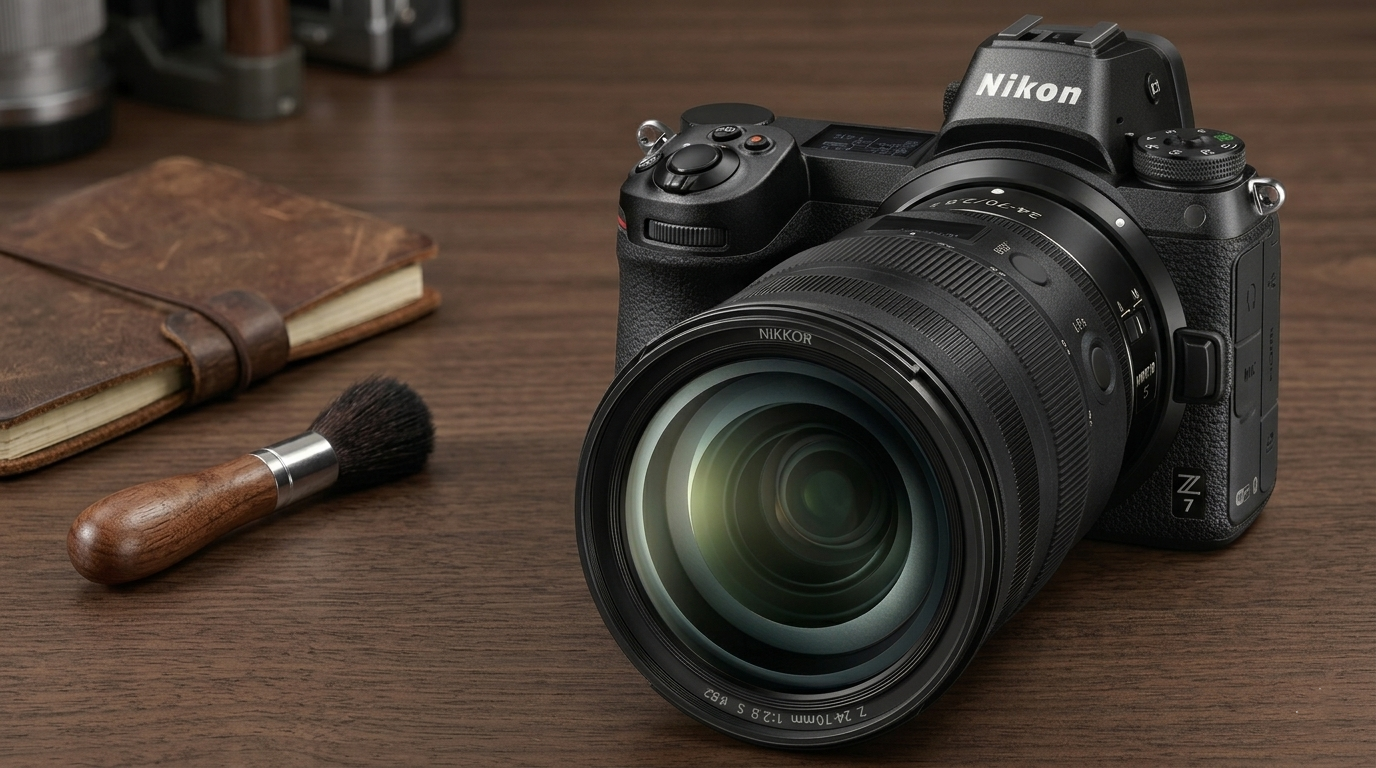
Quick Verdict: My Nikon Z 24-70mm f/2.8 S review, written after two years of sunrise shoots and alpine weather, lands on one finding: this is the sharpest corner-to-corner standard zoom Nikon has built. At 805g with an 82mm filter thread and full weather sealing, it held up through desert dust, Norwegian sea spray, and Swiss snow. Used copies at MPB run $949 to $1,399 in 2026, which puts it in reach of serious landscape shooters. The biggest trade-off is weight against the f/4 version, which saves 305 grams.
Last updated: April 2026 | 9 min read
In This Review
A Landscape Shooter’s Overview

This Nikon Z 24-70mm f/2.8 S review comes from a landscape photographer who paired the lens with a Nikon Z7 body before switching systems in 2020. For roughly two years, it sat on the front of my camera through sunrise shoots along fjords in Norway, midday desert runs in Southern California, and a long winter of high-altitude work in Switzerland. When I had room for a single lens, this is the one I reached for.
Nikon launched this flagship standard zoom for the Z mount in 2019 with a $2,299.95 price tag and expectations set by the older F-mount 24-70mm f/2.8E VR. However, the Z version surpasses its DSLR predecessor in almost every optical measurement while shedding 265 grams and nearly 28mm of length. For photographers debating a fast standard zoom, the f/2.8 aperture looks unnecessary at first glance, because most scenic work happens at f/8 to f/11. Notably, the optical design peaks at exactly those apertures, which makes the fast maximum aperture a bonus rather than the headline feature for Nikon Z 24-70 f/2.8 S landscape work.
As of April 2026, used copies at MPB sit between $949 and $1,399 depending on condition grade, compared to roughly $2,100 new. For a lens launched at $2,299.95, the used market offers a serious discount. Additionally, the biggest real-world cost is weight. At 805 grams and 126mm long with 82mm front filters, this is not a travel-light optic. Still, for a photographer who demands edge-to-edge sharpness, the weight earns its place in the bag.
Key Specs at a Glance
| Specification | Details |
|---|---|
| Mount | Nikon Z |
| Focal Length | 24-70mm |
| Maximum Aperture | f/2.8 (constant) |
| Weight | 805g (28.4 oz) |
| Length | 126mm (4.96 in) |
| Filter Thread | 82mm |
| Minimum Focus | 0.38m (1.25 ft) |
| Max Magnification | 0.22x at 70mm |
| Autofocus | Dual stepping motor (STM) |
| Stabilization | None (relies on IBIS) |
| Weather Sealing | Yes, with fluorine front coating |
| OLED Display | Yes (focal length, aperture, focus distance) |
| Launch Price (2019) | $2,299.95 |
| Used Price at MPB (2026) | $949 to $1,399 |
Featured on MPB
Find Used Nikon Z 24-70mm f/2.8 S Copies at MPB
Graded used copies from $949 with a six-month warranty and free trade-in on your old Nikon, Canon, or Sony gear.
Sharpness and Edge Performance

Sharpness is where this lens earns its reputation. At f/2.8 wide-open, the center rates as excellent across all focal lengths. Corners at 24mm hold up well for a fast zoom, while the 70mm end shows some softening at the edges before stopping down. Portrait work at close distances benefits from the wide-open center performance, with clean subject separation and strong micro-contrast.
For landscape shooters, however, the story begins at f/5.6. Edge-to-edge Nikon Z 24-70 f/2.8 S sharpness at f/5.6 reaches close to perfect with next-to-no visible vignetting or distortion. Stopped further to f/8 and f/11, performance is uniformly impressive across the entire zoom range. On my Nikon Z7’s 45.7-megapixel sensor, I consistently resolved fine detail in distant rock faces and tree bark across the frame, with no noticeable drop-off toward the corners. For comparison, the F-mount 24-70mm f/2.8E VR showed softer corners at equivalent apertures in my side-by-side tests from 2019.
The Nikon Z 24-70 f/2.8 S sharpness advantage holds up especially well at 35mm and 50mm, where many landscape compositions settle. At 70mm, midframe sharpness slightly outperforms dead-center in some tests, which rewards rule-of-thirds framing. Notably, diffraction begins to soften the image at f/16, though the drop is mild enough for focus-stacking workflows. For foreground-to-infinity scenes, f/8 to f/11 delivered the cleanest results, and the lens handled subject-backed detail at infinity without the smearing common to lesser zooms.
Build Quality and Weather Sealing
Build quality is where this lens feels like a tool built for working photographers. The barrel is a dense composite with metal accents, while the zoom and focus rings operate with calibrated resistance. Weather sealing is comprehensive, with gaskets at the control rings, buttons, focus mode switch, and mount. Additionally, a fluorine coating on the front element repels dust and water, which made cleaning sea spray off the glass during a Lofoten trip a straightforward task.
I shot this lens in snow at 9,000 feet in the Swiss Alps, in driving rain near Bergen, and in 110-degree desert heat east of the Salton Sea. Never once did moisture or dust work its way into the optical path. Because the Nikon Z 24-70 f/2.8 S weather sealed construction held up across every condition, I trusted it in shoots where backup gear was hours away. For anyone shooting coastal, desert, or alpine work, the Nikon Z 24-70 f/2.8 S weather sealed rating is a practical necessity, not a marketing bullet.
The original S version also includes an OLED info display on the barrel, a feature Nikon removed on the 2025 S II update. By pressing the DISP button, you cycle through focal length, aperture, and focus distance readouts. For hyperfocal work in low light, the focus distance readout is genuinely useful, because you read exact distance without pulling your eye from the viewfinder. Moreover, the control ring near the mount handles silent aperture adjustment or exposure compensation. Mounted on a Z7, the lens balances well on a tripod setup, though the 82mm front filter thread does add bulk to a step-up ring system if you run square filter holders.
Autofocus Behavior in the Field
Autofocus on the original Z 24-70mm f/2.8 S uses dual stepping motors (STM) moving two focus groups. In practice, focus acquisition happens in under a second from minimum focus to infinity, and the motor runs silently. When shooting landscapes, autofocus speed matters less than accuracy, and the lens consistently nailed critical focus on both distant subjects and foreground rocks when I used single-point AF.
For hybrid shooters who record video, focus breathing is well controlled on the original S, though the 2025 S II cuts breathing by more than half. Pulling focus during a sunset timelapse produced smooth, predictable transitions without the jarring field-of-view shift common to adapted DSLR zooms. Since the lens has no optical stabilization, handheld video relies on the body’s IBIS; paired with the Z7 or Z6 II, my shots held steady down to roughly 1/15 second handheld at 70mm.
One note for low-light landscape shooters: autofocus in near-dark conditions depends heavily on the camera body, though the lens itself never hunted excessively. For example, shooting the Milky Way on the Z7 required manual focus for critical accuracy, while autofocus acquired point sources accurately down to about minus-2 EV. Most dawn and dusk work, however, let me trust single-shot AF without issue.
Rendering, Flare, and Sun Stars
Rendering is the character half of any Nikon Z 24-70mm f/2.8 S review, and the lens handles bright light sources with confidence. Shooting directly into the sun during golden hour along the Amalfi Coast produced minimal veiling flare and almost no ghosting artifacts. The multi-element Nano Crystal and ARNEO coatings earn their keep here. For backlit subjects, contrast stays intact, and shadow detail recovers cleanly in post.
Sun stars at f/16 render with 18 points from the 9-bladed aperture, which gives a traditional, well-defined starburst effect. For landscape photographers who chase sunburst compositions through tree branches or between peaks, this is workable performance, though the star shape is less dramatic than some prime lenses deliver. Similarly, the bokeh at f/2.8 is smooth and free of distortion; backgrounds fall off pleasantly without harsh outlining on specular highlights.
Vignetting at f/2.8 is visible but corrects readily through the in-camera profile or Lightroom. By f/5.6, the corners brighten to match the center. Distortion is present, with barrel distortion at 24mm and mild pincushion at 70mm, though Nikon’s built-in correction profile handles both automatically in Raw files. For a landscape photographer who respects straight horizons, the corrected output is clean enough to skip manual adjustments in most cases.
Nikon Z 24-70mm f/2.8 S vs 24-120mm f/4 S
The most common question landscape shooters ask is whether the Nikon Z 24-70 vs 24-120 f/4 decision favors the faster lens or the longer reach. Both are S-line pro zooms; both offer excellent sharpness and weather sealing. However, they serve different shooters in meaningful ways.
The 24-120mm f/4 S trades a stop of aperture for an extra 50mm of reach, which matters for landscape compositions needing compression or detail shots of distant features. Moreover, it weighs 630 grams compared to the 805g f/2.8, saving 175 grams in the bag. For photographers who work exclusively at f/8 to f/11, the f/4 version delivers nearly equal landscape results at a lower price and with more framing flexibility. Used copies at MPB run roughly $700 to $950 in 2026.
However, the Nikon Z 24-70mm f/2.8 S wins on low-light flexibility, hybrid stills-and-video work, and build density. For event photographers, wedding shooters, or anyone who moves between landscape and portrait work, the f/2.8 aperture matters. Additionally, the OLED display and more robust construction reflect its flagship positioning. The Nikon Z 24-70 vs 24-120 f/4 debate ultimately comes down to use case: if your work lives at f/8 and needs 120mm, go with the f/4. For photographers who need f/2.8 or intend to shoot events and portraits alongside landscapes, the f/2.8 is the clear choice.
Pros and Cons
Pros
- Edge-to-edge sharpness at f/5.6 and beyond rivals prime lenses
- 805g weight is 265g lighter than the F-mount 24-70mm f/2.8E VR
- Full weather sealing with fluorine front coating survives desert dust and alpine snow
- Fast, silent dual STM autofocus acquires focus in under one second
- OLED info display shows focal length, aperture, and focus distance
- Used MPB pricing from $949 delivers a $1,100 discount versus new
- 0.32x magnification at 70mm enables close-up detail work
- Excellent flare resistance with Nano Crystal and ARNEO coatings
Cons
- 805g weight feels heavy on smaller bodies like the Z5
- No built-in optical stabilization, relying entirely on IBIS
- 82mm front filter thread requires large ND filters and adapters
- Sun stars at f/16 show 18 points but lack the drama of prime lenses
- 70mm reach feels short for distant landscape compression
- New retail price of $2,100 remains steep for hobbyists
Final Verdict

For landscape photographers working the Nikon Z system, my Nikon Z 24-70mm f/2.8 S review verdict is straightforward: this is the best Nikon Z lens landscape shooters have for one-zoom versatility. Its edge-to-edge performance at f/5.6 to f/11 earned a permanent slot in my bag during the Z7 years. Norwegian storms, Italian coastlines, and Southern California desert shoots all passed through this lens, and image quality never let me down.
The real trade-offs are weight and the absence of optical stabilization. At 805 grams, it adds perceptible load on a long hike, and shooters who prioritize travel weight should look at the Nikon Z 24-70mm f/4 S, which saves 305 grams. Additionally, landscape photographers who work exclusively at f/8 to f/11 and want more reach should consider the 24-120mm f/4 S because its extra 50mm of telephoto range adds compositional flexibility the f/2.8 option cannot match.
On value, the used market at MPB transforms this lens from a premium splurge into a workhorse investment. At $949 to $1,399 in 2026, used pricing brings it within reach of serious enthusiasts and working pros who would hesitate at $2,100 new. For any Nikon Z shooter building a long-term kit, a used copy through a graded marketplace delivers near-new optical performance at a discount.
My recommendation: if you shoot Nikon Z 24-70 f/2.8 S landscape scenes alongside portraits, events, or hybrid video, this is the best Nikon Z lens landscape photographers seeking versatility should buy. For pure landscape specialists on a tighter budget, the Z 24-120mm f/4 S remains a strong alternative worth comparing before committing.
Featured on MPB
Check Today’s Nikon Z 24-70mm f/2.8 S Stock at MPB
Live listings, condition grades, and free trade-in on your existing kit. Start saving versus new retail today.
Frequently Asked Questions
Is the Nikon Z 24-70mm f/2.8 S worth it for landscape photography?
Yes, for most Nikon Z landscape shooters, used pricing makes this lens a strong investment. Edge-to-edge sharpness from f/5.6 through f/11 rivals prime lenses. However, pure landscape specialists wanting more reach should also compare the 24-120mm f/4 S.
Is the Nikon Z 24-70 f/2.8 S weather sealed?
Yes, the lens is fully weather sealed against dust and moisture. Seals appear at the mount, rings, buttons, and switches. Additionally, a fluorine front coating repels water, simplifying field cleaning.
How heavy is the Nikon Z 24-70mm f/2.8 S?
It weighs 805 grams (28.4 ounces) and measures 126mm long. For comparison, the f/4 version weighs 500 grams. Moreover, it is 265 grams lighter than the older F-mount 24-70mm f/2.8E VR.
What filter size fits the Nikon Z 24-70mm f/2.8 S?
The front filter thread is 82mm. Plan for the larger diameter or step-up rings. Most pro-grade 82mm ND filters run $80 to $200.
Nikon Z 24-70 f/2.8 vs f/4: which is better for landscapes?
Shooting exclusively at f/8 to f/11 favors the f/4 version, which delivers similar sharpness at lower weight and cost. However, if you also shoot events, portraits, or video, the f/2.8 aperture adds low-light flexibility.

