


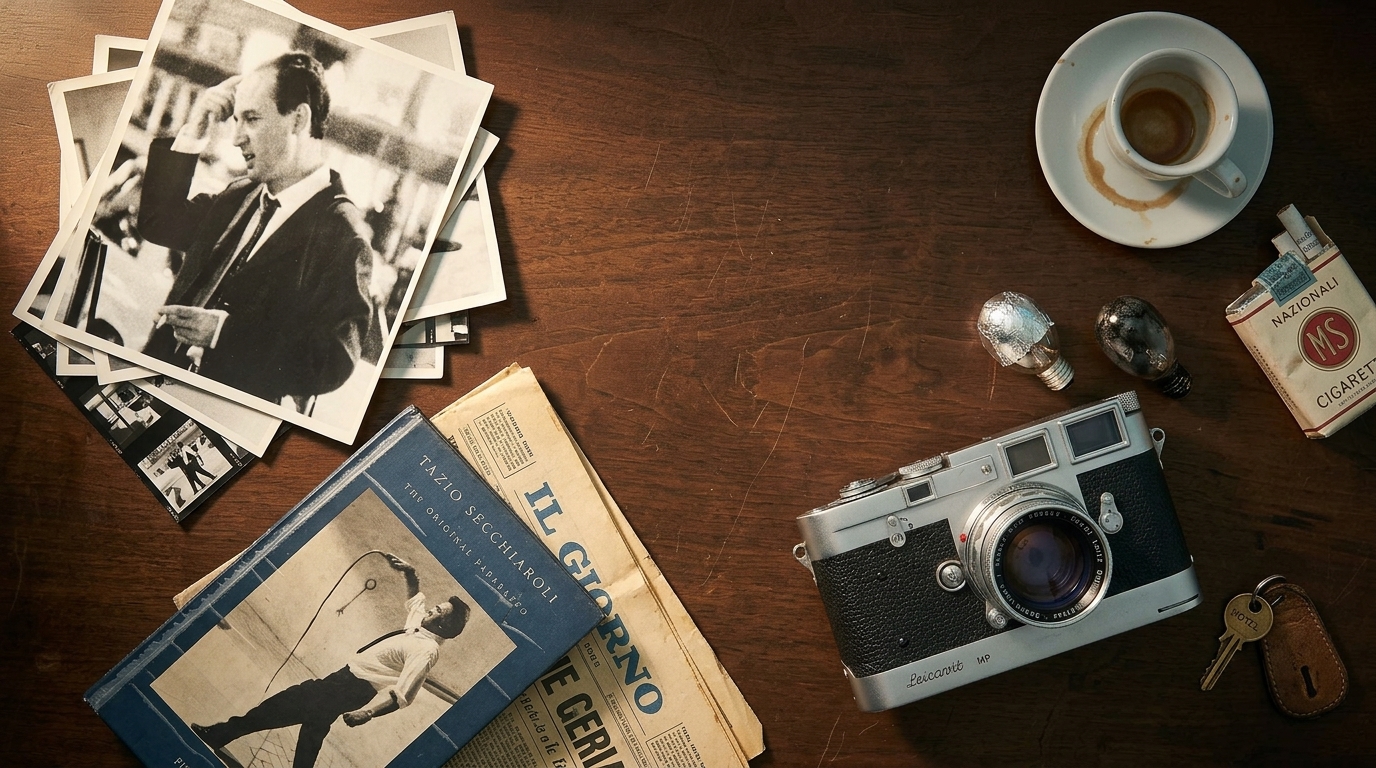
Quick Verdict: The Tazio Secchiaroli Leica MP No. 368 hits Leitz Photographica Auction No. 48 on June 13, 2026, with a starting price of €50,000 and an estimate of €100,000 to €120,000. The chrome rangefinder served the original Roman paparazzo on Via Veneto in 1958, capturing King Farouk, Aïché Nanà, and the celebrities Fellini would soon turn into “paparazzi.” Provenance is locked in by a signed dedication in Secchiaroli’s own book, which names the serial number. This is the working tool behind one of the most influential aesthetic shifts in postwar photography.
Last updated: May 2026 | 8 min read
In This Article
- Overview: The Camera Behind the Paparazzi Style
- Quick Facts
- What Makes the Tazio Secchiaroli Leica MP Specific
- Who Was Tazio Secchiaroli?
- The Assault Photographer
- Fellini, La Dolce Vita, and One Word the World Kept
- Why the Tazio Secchiaroli Leica MP Provenance Sells the Camera
- How to Bid
- Image Recommendations
- Final Thoughts
- Frequently Asked Questions
Overview: The Camera Behind the Paparazzi Style
The Tazio Secchiaroli Leica MP No. 368 worked Via Veneto in 1958. Specifically, Secchiaroli used the chrome rangefinder to photograph King Farouk, Aïché Nanà, and the celebrities Fellini would soon turn into “paparazzi.” On June 13, 2026, the camera hits the block at Leitz Photographica Auction in Wetzlar, Germany. Most collectors buy a camera for what it does. However, this one sells for what it captured.
I’ve been shooting professionally for over 20 years. Yet I have never owned a Leica. Still, I love a good story.
This one takes me back to my grandfather’s house in Hartford, New York. Specifically, he was an antique collector. As a kid I would walk into his place and find shelves of old cameras, brass shutter releases, leatherette cases, light meters with tarnished selenium cells. Then I would sit on the floor and pick them up one at a time. Each had a maker’s mark and, if you were lucky, an engraved name. Notably, each had been somewhere.
Secchiaroli’s MP No. 368 belongs to the same world, only with the receipts intact. Specifically, Tazio Secchiaroli used it on Via Veneto in 1958. First, he photographed King Farouk swinging at him in fury. Months later, he aimed it at Aïché Nanà during the Rugantino striptease. Then he carried it onto Federico Fellini and Sophia Loren film sets for years afterward. Notably, the book shipping with the camera names this exact serial number, written in Secchiaroli’s hand. As a result, there is no provenance question. The camera was his.
Quick Facts
| Detail | Value |
|---|---|
| Camera | Leica MP chrome, serial number MP-368 |
| Lens | Matching rigid Summicron 50mm f/2, serial 1468612 |
| Accessory | Leicavit MP rapid-advance base unit (around two frames per second) |
| Delivery date | January 16, 1958, per Leitz documentation |
| Original owner | Tazio Secchiaroli (1925–1998), one of Rome’s first paparazzi |
| Auction | Leitz Photographica Auction No. 48, Wetzlar, Germany |
| Date | June 13, 2026 (pre-bidding May 11–June 11, 2026) |
| Starting price | €50,000 |
| Estimate | €100,000–€120,000 |
| Lot number | A03001 |
| Condition | B+ |
| Provenance | Includes the book Tazio Secchiaroli: The Original Paparazzo with the photographer’s personal dedication naming serial number 368 |
What Makes the Tazio Secchiaroli Leica MP Specific
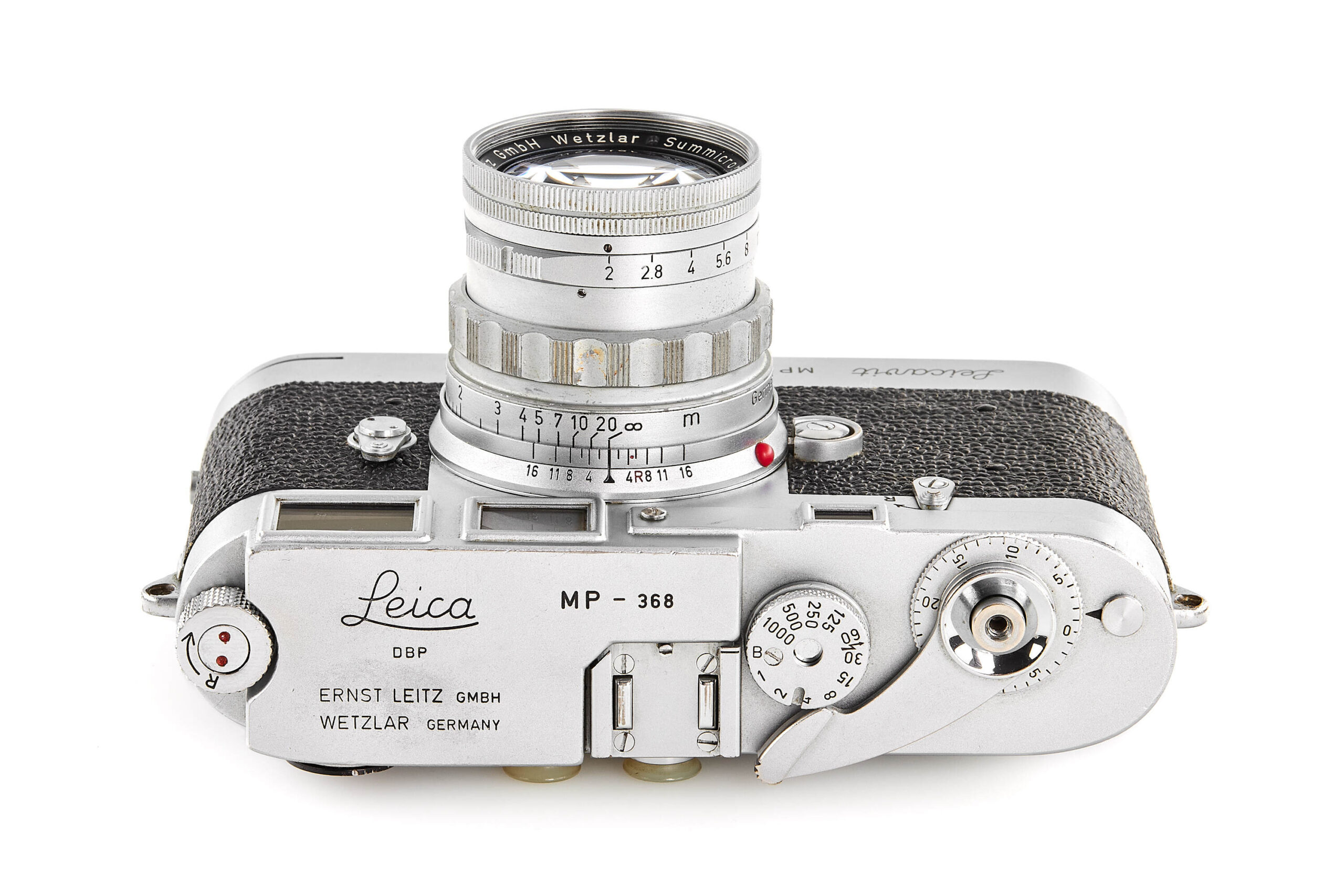
Notably, the original Leica MP barely existed as a product. In total, Leitz built roughly 449 cameras (around 311 chrome and 138 black bodies), almost all of them in 1956 and 1957. Specifically, Leitz documents this body, no. 368 in chrome, as delivered on January 16, 1958.
Initially, the MP was built as the press version of the Leica M3. Specifically, Leitz removed the self-timer, reinforced the top plate, and built the body to take the Leicavit MP, a trigger-style rapid-advance base. With the Leicavit installed, Secchiaroli pulled a lever to advance film and re-cock the shutter in one motion, firing roughly two frames per second. Fast, for a 1958 manual rangefinder. For example, on Via Veneto you had a half-second to catch a slap before the celebrity vanished into a Maserati. Two frames per second meant payday instead of an empty contact sheet.

Meanwhile, the lens is the matching rigid Summicron 50mm f/2, serial 1468612. Notably, Leitz grades the outfit at B+, with what they describe as “honest signs of professional use consistent with its historical role.” Translation: it has been used hard.
For context on how rare these original MPs are, our Top 10 Best Cameras of All Time covers the Leica M4, the descendant of the M3 and MP lineage. Likewise, our Best 35mm Film Cameras roundup places the broader Leica M-series alongside other pro film bodies a working photographer would still pick up today.

Who Was Tazio Secchiaroli?

Tazio Secchiaroli was born on November 26, 1925, in Centocelle, then a working-class town outside Rome. He started in photography after the Second World War, hauling a Rolleiflex around the Italian capital looking for paying news.
In 1955, he and his colleague Sergio Spinelli founded Roma Press Photo, a small agency built on a simple bet. At the time, most magazine pictures of Italian celebrities were studio portraits, polite and posed. However, Secchiaroli had a different idea. Specifically, he would put photographers on Vespas, point them at Via Veneto, and wait for the famous to misbehave.
It worked. Hard.
The Assault Photographer
Secchiaroli described his own technique as “assault photography.” (PetaPixel translates the same Italian phrase as “attack photography.” Both translations point to the same approach.) Either way, he would creep up on a celebrity, pop a flash bulb in their face, get the shocked reaction, and ride off before someone landed a punch.
Notably, two incidents from 1958 stand out.
In the summer of 1958, Secchiaroli photographed the deposed Egyptian King Farouk at a Café de Paris table on Via Veneto. Suddenly, Farouk lunged at him. Then, American actor Anthony Franciosa joined in. Subsequently, the Italian newspaper Il Giorno ran the story on its front page on August 19, 1958, under the headline “Photographer Attacked By Farouk and Franciosa.” As a result, Secchiaroli’s pictures sold across Europe. The headline made the photographer the story.
A few months later, on November 5, 1958, the Turkish dancer Aïché Nanà performed an impromptu striptease at a private party at the Trastevere restaurant Rugantino. Secchiaroli was there. His pictures of the Aïché Nanà striptease became the most widely circulated Roman scandal photographs of the decade. Soon after, Italian magistrates opened a public morality case. Eventually, the negatives became evidence in court.
How the Style Spread Through Rome
Art dealer James Hyman summed up the era in The Times of London in 2009: “Secchiaroli sparked the development of a whole new aesthetic in photography. There were whole gangs of them speeding around Rome chasing celebrities on their Vespas.”
Indeed, Secchiaroli’s MP No. 368 was the working tool through this period. Today, the wear on the chrome body is the documentation of those nights.
If you shoot in the same lineage, our piece on what makes a great street photo walks through the decisive-moment thinking Henri Cartier-Bresson popularized and the paparazzi adapted to chase celebrities. Similarly, 7 Techniques to Improve Your Street Photography covers the small-prime, fast-shutter discipline Secchiaroli practiced every night.
Fellini, La Dolce Vita, and One Word the World Kept
By 1958, Federico Fellini was watching Secchiaroli closely. Specifically, Fellini bought dinners for Secchiaroli and his crew, listened to the stories, and took notes. Eventually, he turned the whole scene into a movie.
In 1960, La Dolce Vita opened. In the film, Marcello Mastroianni played Marcello Rubini, a tabloid reporter chasing scandal across Rome. Meanwhile, Walter Santesso played his photographer sidekick: a buzzing, shameless, motorbike-mounted figure named Paparazzo.
The name stuck. By 1961, the Italian press was using “paparazzi” for any flash-bulb photographer chasing a celebrity. Subsequently, the word entered English the same decade. Fellini said in his autobiography the name came from an opera libretto and “sounded just right.” Meanwhile, other accounts trace it to George Gissing’s 1901 travel book By the Ionian Sea, in which a hotel owner named Coriolano Paparazzo appears.
Secchiaroli was the source. On screen, Paparazzo was the fictionalized version.
After La Dolce Vita, Secchiaroli pivoted off the streets. Subsequently, he worked closely with Sophia Loren as her personal photographer over many years and served as Fellini’s official set photographer through 8½ and other films. The MP No. 368 went with him to those sets. By the late 1960s, the camera had moved from “weapon” to “witness.”
Why the Tazio Secchiaroli Leica MP Provenance Sells the Camera

A regular 1958 Leica MP in B+ condition with a matching Summicron will sell at auction for roughly €15,000 to €25,000. By contrast, Leitz starts the bidding on the Tazio Secchiaroli Leica MP at €50,000 and estimates €100,000 to €120,000. Meanwhile, PetaPixel’s headline figure of $200,000 reflects a possible top end with buyer’s premium and currency conversion factored in.
The price difference is provenance.
Notably, the lot ships with Secchiaroli’s book Tazio Secchiaroli: The Original Paparazzo, published by Photology in Milan in 1996. Inside, the photographer’s own dedication identifies serial number 368 as his personal camera. In fact, direct, written, signed identification from the photographer himself is the gold standard for camera provenance. As a result, it eliminates the “probably his” question collectors fear.
For comparison, in November 2021 a 1957 Leica MP black paint sold at Leitz Photographica Auction for $1.34 million. Similarly, in November 2023, two Leica MP cameras once owned by actor Yul Brynner sold for over $3 million combined. Clearly, celebrity provenance moves a Leica MP from collector tool to historical artifact.
Secchiaroli’s case is different. He was not a celebrity. Instead, he was the photographer. Crucially, he invented the cultural moment the camera then documented. This mix of working-tool wear and cultural origin story is what the auction estimate is pricing.
How to Bid
Specifically, Leitz Photographica Auction No. 48 takes place on June 13, 2026, in Wetzlar, the German town where Ernst Leitz built the first commercial Leica in 1925. Meanwhile, pre-bidding for No. 368 runs from May 11, 2026, through June 11, 2026. The lot number is A03001 and the starting price is €50,000.
First, you will need to register an account on the Leitz Auction site and clear their bidder verification before placing a pre-bid. Notably, the lot is subject to VAT at the destination country rate within the EU.
Live Auction Lot
Tazio Secchiaroli’s Leica MP No. 368
Lot A03001 · Leitz Photographica Auction No. 48 · Wetzlar, June 13, 2026
Final Thoughts
I started this piece thinking about my grandfather’s shelves in Hartford. I’m ending it on a different note.
The Tazio Secchiaroli Leica MP No. 368 is the camera he used while inventing the paparazzi style. It is not a museum piece in the traditional sense. Instead, it was a working tool, used hard by a photographer who made roughly $50 a frame on a good night and risked his teeth on a bad one. Today, the serial number, the dedication in the book, the wear on the chrome body, all of it tracks back to Via Veneto in 1958.
With $200,000 in hand, the camera goes home with you. If not, here is the next best thing: the story of where this rangefinder went and what its viewfinder framed.
It is enough for me. My grandfather would have loved this one.
Frequently Asked Questions
When does the Tazio Secchiaroli Leica MP No. 368 go to auction?
Specifically, the lot goes live at Leitz Photographica Auction No. 48 on June 13, 2026, in Wetzlar, Germany. Meanwhile, pre-bidding runs from May 11, 2026, through June 11, 2026.
How much will the Tazio Secchiaroli Leica MP No. 368 sell for?
Leitz lists a starting price of €50,000 and an estimate of €100,000 to €120,000. Meanwhile, PetaPixel reports a possible top end of $200,000 with buyer’s premium and currency conversion factored in. By comparison, a regular 1958 Leica MP in similar condition sells for roughly €15,000 to €25,000, so the provenance markup is substantial.
What makes the Tazio Secchiaroli Leica MP unique?
Notably, the Tazio Secchiaroli Leica MP is documented as the photographer’s personal working camera through his most iconic 1958 paparazzi shoots, including the King Farouk attack and the Aïché Nanà striptease. Additionally, the auction lot ships with Secchiaroli’s book The Original Paparazzo, which contains a personal dedication naming serial number 368. In fact, direct, signed identification from the photographer himself is the gold standard for camera provenance.
Who was Tazio Secchiaroli?
Tazio Secchiaroli (1925–1998) was an Italian press photographer and one of the original Roman paparazzi. Specifically, he founded Roma Press Photo in 1955 with Sergio Spinelli and worked Via Veneto in Rome on a Vespa, photographing celebrities for tabloid magazines. Later, Federico Fellini based the character Paparazzo in La Dolce Vita on Secchiaroli’s work, and after 1960 Secchiaroli served as Sophia Loren’s personal photographer and Fellini’s official set photographer through 8½ and beyond.
Where does the word “paparazzi” come from?
Originally, the word entered popular usage from the 1960 Federico Fellini film La Dolce Vita, in which Walter Santesso played a photographer named Paparazzo. Specifically, Fellini said in his autobiography the name came from an opera libretto. Meanwhile, other accounts trace it to Coriolano Paparazzo, a hotel owner in George Gissing’s 1901 travel book By the Ionian Sea.
Sources: Leitz Photographica Auction (lot A03001), The Times of London, The Guardian, BBC News, Wikipedia (Tazio Secchiaroli), Cameraquest Leica MP serial-number records, Pacific Rim Camera production data, Photology Books archive, and Italy Segreta on the Fellini origin of the word “paparazzi.”

