


Quick Verdict: Why your photos look flat traces back to three fixable causes: harsh overhead light, composition with no foreground or layers, and an aperture wide enough to hold the entire frame in focus. Open up to f/2 or f/2.8, shoot during the first or last 90 minutes of daylight, and build depth through the viewfinder before you press the shutter. The fix is technique, not new gear.
Last updated: April 2026 | 9 min read
In This Guide
- Why Your Photos Look Flat: A Quick Overview
- Watch: Fix Flat Photos in Minutes
- What “Flat” Means in Photography
- The Three Reasons Why Your Photos Look Flat
- How to Fix Flat Photos Step by Step
- Quick Settings Guide to Add Depth Instantly
- Flat vs Dynamic: Real-World Examples
- Common Mistakes Behind Flat Photos
- Final Thoughts: It’s Not Your Camera
- Frequently Asked Questions
Why Your Photos Look Flat: A Quick Overview
Why your photos look flat is one of the most common questions beginner and intermediate photographers ask after they upgrade gear and the new camera fails to solve the problem. The frustration is familiar. You bought a quality body. Your lens cost a month of pay. Yet the images on the back of the screen still feel two-dimensional compared to what your eyes saw when you pressed the shutter.
Here is the encouraging part. Flat-looking photos almost always trace back to a small set of root causes, and none of them require new equipment. After running through Nikon D90, D700, D800, D850, Z7, Sony A7R, A7S, Panasonic GH5, and Canon R5, R6, R6 Mark II bodies over the past 15 years, I confirm the same lesson every cycle. The image quality lives in the choices you make before the shutter fires, not in the price tag of the kit.
This guide breaks the problem into three diagnosable causes, then walks through the exact technique fixes for each one. By the end, you will know how to spot a flat shot through the viewfinder, correct it on location, and lock in settings which build depth on every frame afterward.
Watch: Fix Flat Photos in Minutes
Before you read further, the video below covers the same fixes step by step. Watch it once, then come back and use the written guide as a checklist on your next shoot.
What “Flat” Means in Photography
In particular, a flat photo is one where the eye has no clear path through the frame. Specifically, four properties show up missing in flat images: tonal range, directional light, layered composition, and subject separation. When all four are weak, the image reads as a 2D wallpaper instead of a 3D scene. Your brain interprets a real environment using cues like cast shadows, relative size, atmospheric haze, and focus falloff. Strip those cues out and the photograph looks pasted flat.
Tonal range refers to the spread between the darkest and brightest values in the frame. A photograph from overcast midday often has only middle grays from edge to edge, which is why it feels washed out. Directional light, on the other hand, cuts shadows across textures and faces, building shape. Layered composition gives the eye foreground, midground, and background to travel through. Subject separation pulls the main element off the backdrop using focus, contrast, or distance.
After you name the four properties, every flat photo becomes diagnosable in seconds. If shadows are missing, the light is the issue. When the eye stops at the surface, composition is the issue. Whenever the subject blends into the backdrop, depth of field is the issue. Often a flat image suffers from two or three of these at once, which is why this guide treats them together.
The Three Reasons Why Your Photos Look Flat
1. You Are Shooting in Bad Light

Notably, light direction matters more than light quantity. Midday sun overhead gives you bright frames with almost no usable shadows, because the shadows fall straight down and disappear under the subject. Overcast skies act as a giant softbox covering 360 degrees, which sounds appealing but produces shapeless lighting on faces and textures. For most subjects, neither condition builds depth.
The fix lives in the timing and angle. Especially during the first 90 minutes after sunrise and the last 90 minutes before sunset, light pushes sideways across the scene. Side light cuts long shadows over textures, lifts highlights off skin, and gives every surface a sense of dimensional shape. Window light indoors does the same job. Position your subject at a 45 to 90 degree angle to the window and you instantly add the directional contrast a flat photo lacks.
2. Your Composition Has No Layers
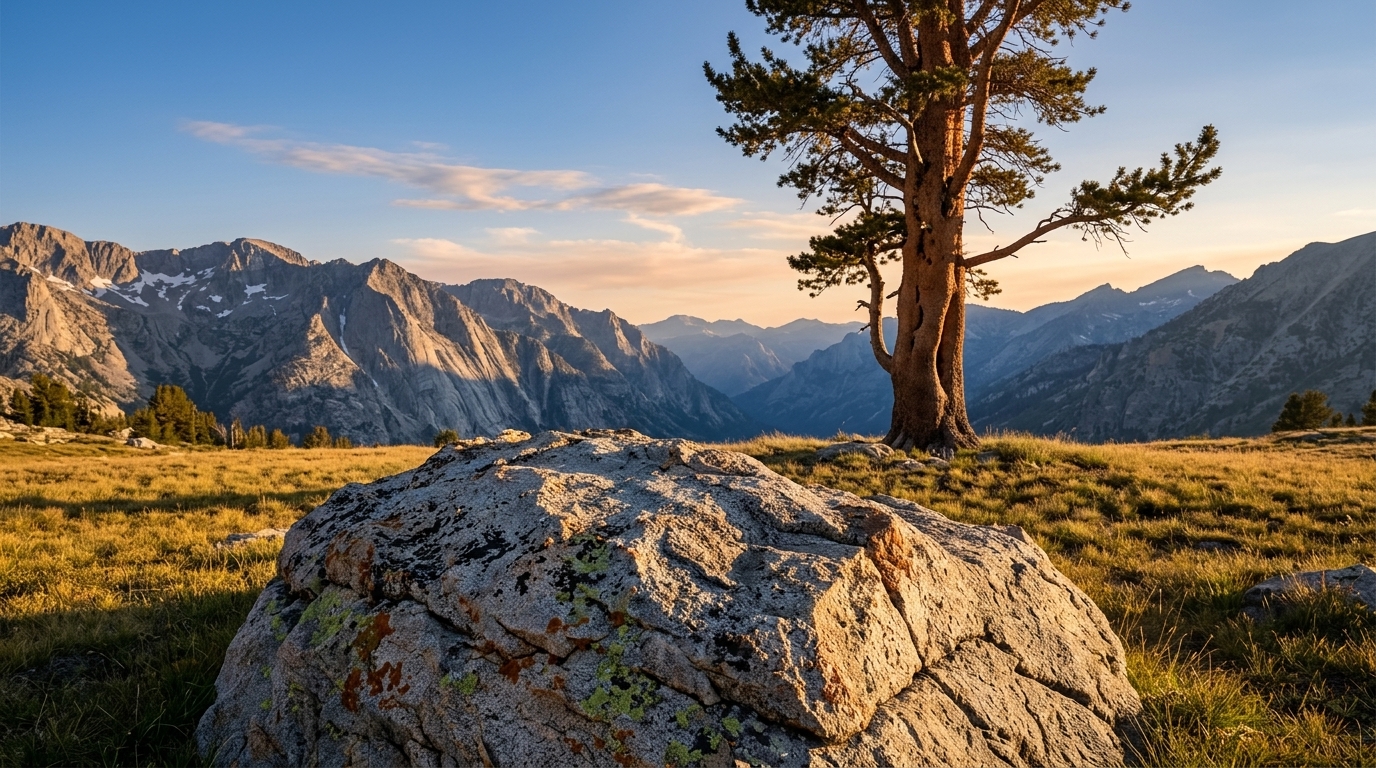
Flat compositions happen when everything sits on the same plane. A classic example is the beach scene with the horizon dead center, no rocks or driftwood in front, and no figure walking into the surf. The eye scans left to right, finds nothing to climb through, and moves on. Because foreground anchors are missing, the scene reads as a postcard rather than a place you stood inside.
Layered composition fixes this. Build the frame with three depth zones. Place a near object within a few feet of the lens, a midground subject 20 to 50 feet back, and a background element on the horizon. Leading lines, which include roads, fences, shorelines, and railings, work because they pull the viewer from foreground to background through the photo. The same principle applies to portraits, where shooting through a window frame, branches, or a doorway creates a near-zone the brain reads as depth.
3. Everything Is in Focus

In contrast, an aperture of f/8 to f/16 is the right call for landscape work, yet it kills subject separation in portraits, products, and close-up scenes. When the background is rendered as sharply as the subject, the eye cannot tell where to land. Subject separation comes from the difference in sharpness between subject and background, and the difference depends on a wider aperture and longer focal length.
For a tight head-and-shoulders portrait, f/1.8 to f/2.8 on a 50mm to 135mm lens is the proven combination. Why this range? Wider apertures let the depth of field collapse to inches at portrait distances, so the subject’s eyes stay tack sharp while everything behind dissolves into a soft wash of color. Longer focal lengths shrink the angle of view, which makes background detail appear larger and softer behind the subject. Push the subject another five to ten feet from the backdrop and the separation deepens further. This is why a sub-$240 nifty fifty often produces more depth than a $2,000 zoom set to f/8. The aperture, focal length, and subject-to-background distance work together to build the third dimension.
PhotographyTalk Pick on Amazon
Canon RF 50mm f/1.8 STM
Stop shooting portraits where the subject blends into the background. The f/1.8 aperture pulls subjects off the backdrop and fixes the single most common cause of flat-looking portraits.
How to Fix Flat Photos Step by Step
The full corrective workflow sits in three moves below. Each one targets a different cause from the section above. Run them in order on every shoot until the process becomes muscle memory.
Step 1: Use Better Light

Plan shoots around the sun position, not the calendar. Use a free app like PhotoPills or Sun Surveyor to find golden hour times for your location. For outdoor portraits, position the subject so the sun hits one side of the face and casts a soft shadow on the other. With landscapes, side-lit scenes show texture in rocks, grasses, and water which midday light flattens completely.
Indoors, kill the overhead lights and shoot by a window. North-facing windows give you the consistent soft light commercial photographers pay studio fees to replicate. South-facing windows produce stronger directional contrast, especially in winter. Move the subject closer to the window for harder shadows, farther away for softer falloff.
Step 2: Add Depth to Your Composition

Before you press the shutter, scan the frame for three depth zones. If the foreground is empty, take three steps forward and find a rock, a flower, a chair leg, or a leaf to anchor the bottom of the image. Specifically, including a foreground anchor within 4 to 6 feet of the lens transforms a flat scene into a three-dimensional one because the brain reads the size relationship between near and far objects as depth.
Change your angle on every shot. Instead of shooting from standing eye level, drop to one knee, climb a step, or move 90 degrees around the subject. New angles reveal new layers. Therefore, leading lines like roads, river bends, and rail lines become useful only after you find an angle where the line points toward the subject rather than past it.
Step 3: Control Depth of Field
Switch to aperture priority mode (Av or A on the dial) and dial the aperture to the widest setting your lens supports. For a kit zoom, the widest is often f/3.5 at the wide end and f/5.6 zoomed in. Consequently, a prime lens at f/1.8 or f/2 produces dramatically more separation than any kit zoom. Once you have the aperture set, let the camera handle shutter speed automatically.
Similarly, distance matters as much as aperture. Move your subject 10 to 20 feet away from the background for visibly softer backdrop blur. Then step back yourself and zoom in if the lens allows. Longer focal lengths compress the scene, making background elements look larger and softer behind the subject. This is why a 135mm lens at f/2.8 produces the classic creamy portrait look most beginners chase.
Quick Settings Guide to Add Depth Instantly
Use this table as a starting point on your next shoot. Adjust based on light and subject distance.
| Setting | Recommendation for Depth |
|---|---|
| Aperture (portraits) | f/1.8 to f/2.8 |
| Aperture (landscapes with foreground) | f/8 to f/11 |
| Focal length for compression | 85mm, 105mm, or 135mm |
| Subject-to-background distance | 10 feet minimum, 20+ ideal |
| ISO target | 100 to 800 for clean tonal contrast |
| Best light window | First 90 minutes after sunrise, last 90 before sunset |
| Foreground element distance | 4 to 6 feet from lens |
| Window light angle (indoors) | 45 to 90 degrees from subject |
However, treat these numbers as starting points. The light, subject, and scene drive every adjustment afterward. For a deeper look at aperture choice, our aperture explained guide covers the relationship between f-stop, depth of field, and exposure in more detail.
PhotographyTalk Pick on Amazon
Neewer 43″ 5-in-1 Reflector
Bounce sunlight back into shadows on portraits, soften harsh midday glare with the diffuser panel, or block backlight with the black side. One tool, five lighting fixes, under $30.
Flat vs Dynamic: Real-World Examples
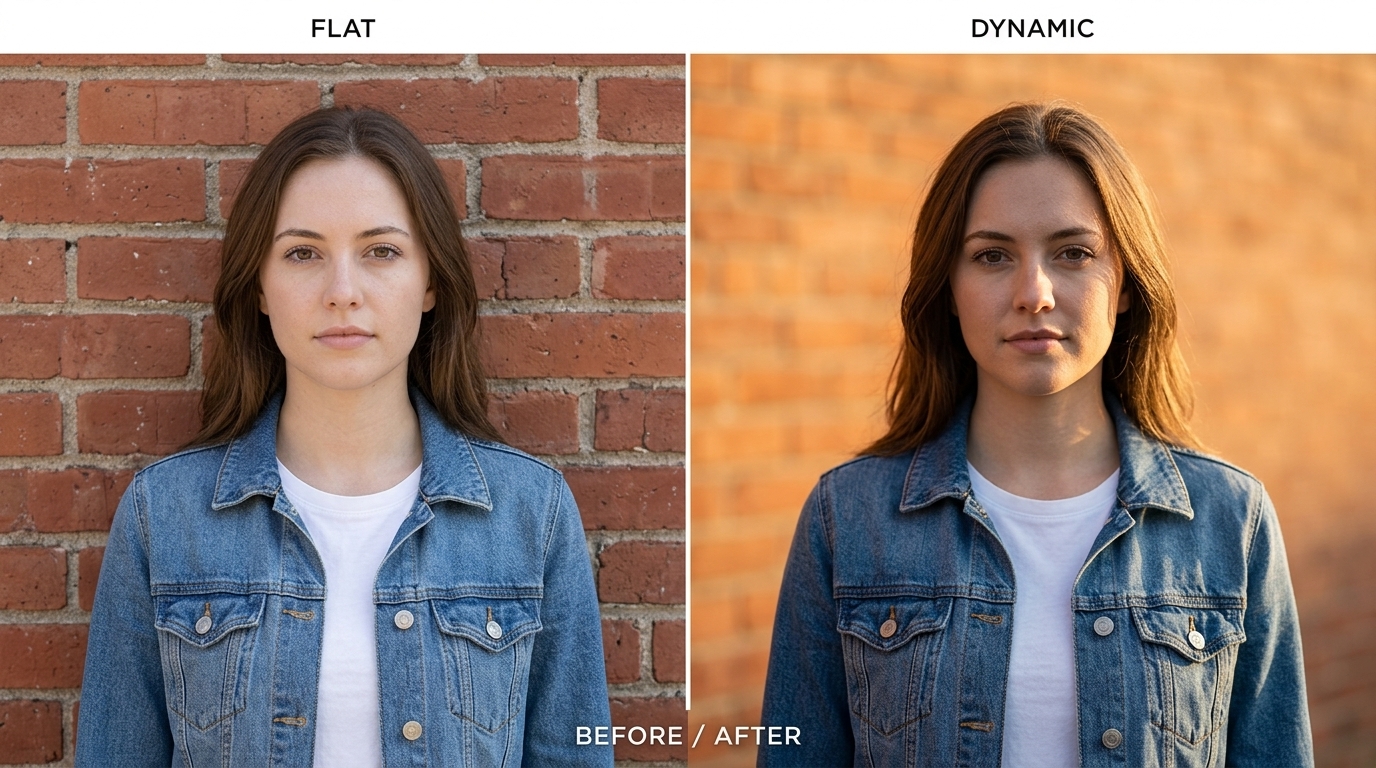
Picture a portrait shot at noon, subject standing six inches from a brick wall, lens set to f/8. The photograph reads flat because three failures stack up: overhead light flattens the face, the wall is too close to the subject, and the aperture holds the entire frame in focus. Move the subject 15 feet from the wall, return at 6:30 p.m. for golden hour side light, and reshoot at f/2 on an 85mm. The same person, the same wall, and the result feels three-dimensional. Brick blurs into warm color. Cheekbone shadow gives the subject’s face dimensional shape. Depth appears.
This same logic applies to landscapes. A horizon line dropped through the middle of the frame on a hazy overcast afternoon produces a flat image of a beautiful place. Wait two hours for low side light, walk 30 feet down the trail to find a foreground rock or wildflower patch, then drop the camera to knee height. The same vista now has a foreground anchor, midground form, and a sky with directional warmth. Three changes, no new gear, dramatically different result.
For instance, here is a real-world test: open any flat image you have shot in the last month. Identify which of the three causes apply. Reshoot the same scene with the corrections applied and compare the two side by side. Most photographers see the difference within two outings.
Common Mistakes Behind Flat Photos
Even after learning the three causes, four common mistakes keep producing flat results.
The first mistake is shooting only at midday because the work schedule allows it. Midday light flattens everything regardless of camera or lens. Either shift the schedule or accept the limitation and use a reflector and diffuser to control the harsh overhead light.
A second mistake is standing in one spot. Most beginner photographers walk to a scene, plant their feet, and shoot from eye level. Consequently, every photo carries the same compressed perspective. Move 20 feet in any direction, drop low, climb high, and the same scene reveals new depth options on every angle.
A third mistake is leaving the camera on default settings. Auto mode often selects f/5.6 to f/8 for safe sharpness, which is the wrong choice for portraits and intimate scenes. Switch to aperture priority and own the depth-of-field decision yourself.
A fourth mistake is ignoring the background. The eye reads a scene as flat when the background fights the subject for attention. Before pressing the shutter, scan the edges and far plane of the frame. Move two feet left or right to clean up a busy backdrop, or push the subject farther forward to throw it out of focus. Composition fixes happen before the shutter, not after.
Final Thoughts: It’s Not Your Camera
Why your photos look flat almost never traces back to the camera body or lens, even when the gear feels like the obvious culprit. Across every body I have shot, from a 12 megapixel Nikon D90 to a 45 megapixel Canon R5, the same scene shot with the same flat technique produces the same flat result. Conversely, the same scene shot with directional light, layered composition, and shallow depth of field produces depth on a $400 used body equally well as on a $4,000 flagship.
The encouraging part: the three causes covered in this guide are diagnosable in seconds and fixable on location. Walk into the next shoot with the depth-zone scan in your head, the aperture set to f/2 or f/2.8, and the schedule built around golden hour. Within two or three outings, the difference shows up across your whole portfolio.
Above all, practice with intent. Pick one of the three causes and shoot a project where you only fix the single variable across 100 frames. Then move to the next cause. After three projects, the diagnostic process becomes automatic, and flat photos stop appearing in your output. For more on building a strong foundation, our camera basics for beginners guide covers the exposure triangle and metering choices supporting every depth decision above.
Frequently Asked Questions
Why do my photos look dull even with a good camera?
The reason why your photos look flat with quality gear comes down to technique, not the body or lens. A high-end camera does not fix flat lighting, weak composition, or a closed aperture. Most photographers blame the equipment because the body is the visible variable, but the fix sits in the choices you make before pressing the shutter: time of day, angle, subject distance, and the f-stop you select.
Does editing fix flat photos?
Editing helps within limits. Boosting contrast, adjusting highlights and shadows, and adding clarity bring back tonal range a flat exposure has masked. However, no editing tool adds depth never captured in-camera. Subject separation, layered composition, and directional light have to exist in the frame first.
What aperture should I use to fix flat-looking portraits?
Set the aperture between f/1.8 and f/2.8 for tight portraits. Pair the wide aperture with a focal length between 50mm and 135mm and place the subject at least 10 feet from the background. The combination produces visible separation and the soft backdrop blur most beginners associate with professional results.
Why do my landscape photos look flat?
Landscape photos go flat for two main reasons. First, the light is overhead or overcast, which flattens texture across the scene. Second, the composition lacks a foreground anchor, so the eye has nothing to climb into the frame from. Shoot during the first or last 90 minutes of daylight, and add a foreground element within 6 feet of the lens.
Does a wider lens or longer lens add more depth?
Both add depth differently. Wide lenses (24mm to 35mm) build depth by exaggerating the distance between near and far objects when you place a strong foreground close to the lens. Longer lenses (85mm to 200mm) compress the scene and isolate subjects through shallow depth of field. Choose based on the depth effect you want.
Is a reflector worth it for outdoor portraits?
Yes. A 5-in-1 reflector solves the most common outdoor lighting problem in seconds. The white side bounces soft fill into shadow side of a face, the silver side adds punchy fill at golden hour, and the diffuser panel softens midday sun overhead. Under $30 of gear replaces hundreds of dollars of strobes for natural-light portrait work.

