


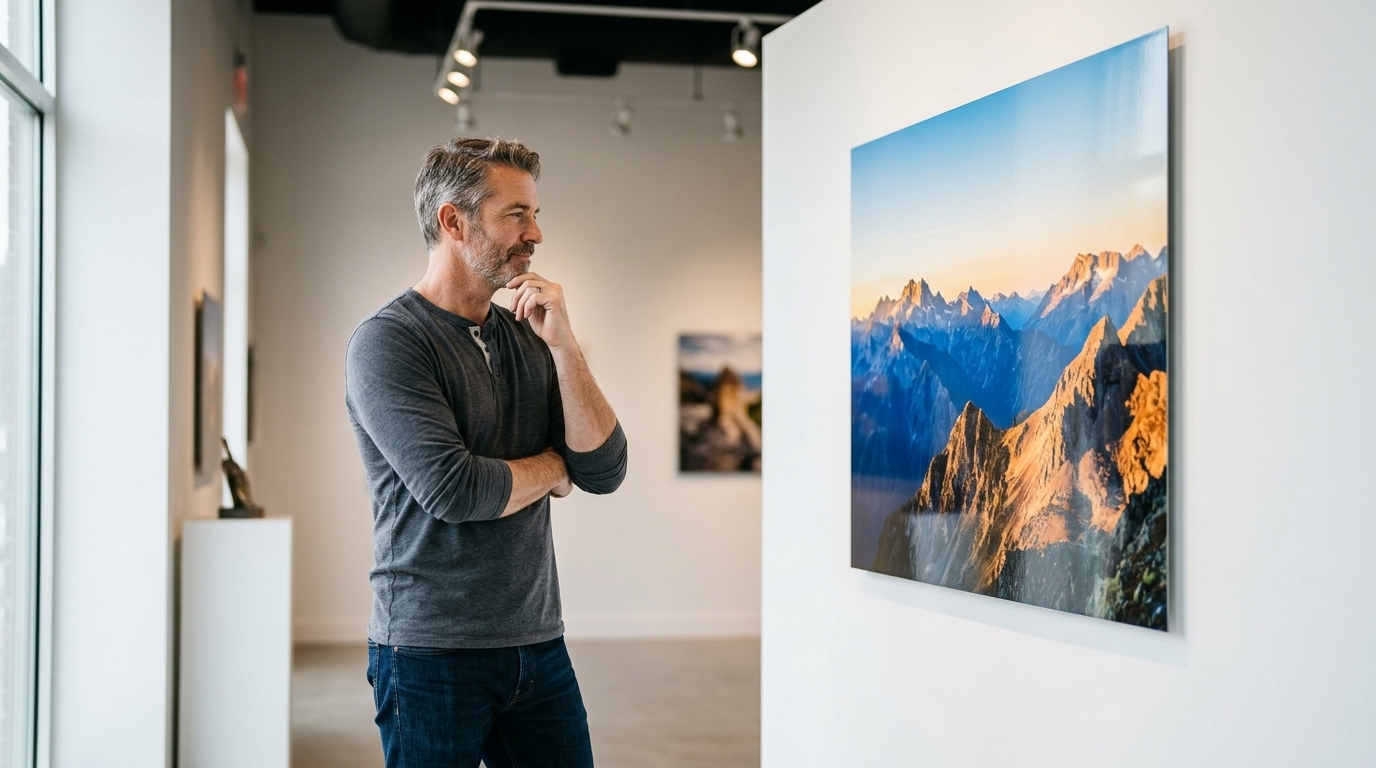
Quick Verdict: The biggest mistake most photographers make is never printing their work, or sending it to a budget lab and getting a flat, washed-out version of the file they spent hours editing. Metal photo prints fix both problems. With manufacturer-rated indoor lifespans of 100+ years, color saturation greater than silver-halide paper, and a frameless gallery look, they turn a digital file into a finished piece. Vivid Metal Prints, who pioneered dye-sublimation on aluminum in 2003, is my recommendation for photographers who want gallery-grade results.
Last updated: April 2026 | 9 min read
In This Article
- Why Most Photographers Skip the Most Important Step
- Print Mediums Compared at a Glance
- How Printing Forces You to Improve as a Photographer
- How Metal Photo Prints Are Made
- Why Metal Stands Out for Photography
- When Metal Photo Prints Are Worth It
- Metal vs Canvas vs Acrylic vs Paper
- Pros and Cons
- Final Verdict and Why I Recommend Vivid Metal Prints
- Frequently Asked Questions
Why Most Photographers Skip the Most Important Step
Think about how much time you put into a single image. You drove out before sunrise, waited for the light, fired hundreds of frames, and sat at your computer for two more hours nudging shadows and tuning color. Then you posted the file online and moved on. For most photographers, this is where the workflow ends, and it is also where the value of the work falls apart. The fix is simple: print your photography, and specifically, print on metal photo prints when the image deserves it.
Missed focus and blown highlights get blamed for ruined photos. However, the more frequent failure point is something quieter: the photo never lived anywhere outside a hard drive. Worse, when it did get printed, it went to a budget lab on cheap paper and came back looking nothing like the file on screen. At this point, the photo did not fail. The print failed it.
Photographers underestimate how much the medium matters. Photo prints on metal are one of the few options engineered specifically to hold the saturation, micro-contrast, and dynamic range a modern camera and modern editing workflow produce. Because the dyes are infused into a coated aluminum substrate instead of laid on top of paper fibers, the image keeps the punch you saw in Lightroom or Capture One. For serious work, this matters more than people realize.
This article walks through why printing belongs in your creative process, how the prints work, when they are the right call, and when a different medium might serve you better. By the end, you will know whether metal is the right move and where to order if it is.
Print Mediums Compared at a Glance

Before you commit to one medium, it helps to see how the common options stack up. The table below compares indoor archival lifespan, surface character, durability, and typical 16×20 retail price across the most popular formats for fine art and gallery photography.
| Medium | Indoor Lifespan | Color Saturation | Durability | Typical 16×20 Price |
|---|---|---|---|---|
| Metal prints (dye-sub aluminum) | 100+ years (Wilhelm extrapolation) | Highest of common print options | Water and scratch resistant | $110 to $200 |
| Acrylic face-mount | 75 to 100 years (paper-dependent) | High, deep blacks | Heavy, prone to scratches on face | $200 to $400 |
| Stretched canvas | 50 to 75 years | Softened by canvas weave | Susceptible to humidity | $60 to $120 |
| Glossy photo paper (framed) | 25 to 75 years (with UV glass) | High, but glass adds glare | Glass and frame protection | $80 to $250 |
| Matte fine art paper | 100+ years (rag paper) | Lower, painterly look | Sensitive to fingerprints | $50 to $180 |
Each medium has a clear use case. However, when the goal is maximum saturation, low maintenance, and a contemporary gallery presentation, dye-sublimation aluminum sits in a category of its own.
Recommended by PhotographyTalk
See What Your Photos Were Always Meant to Look Like
Vivid Metal Prints pioneered dye-sublimation on aluminum in 2003. Five finishes, made in the USA, and built to outlast the camera you shot the photo with.
How Printing Forces You to Improve as a Photographer
Printing is not the last step. It is part of the creative process, and skipping it removes one of the most useful feedback tools you have. When an image moves from a backlit screen to a physical surface, your relationship with it changes. Standing in front of a printed photograph forces you to scan it instead of scrolling past. Details you missed for weeks on a calibrated monitor suddenly stand out.
Subtle color shifts become obvious. A green which read clean on a properly calibrated monitor might still pull cyan in print, or a skin tone might lean too warm under gallery light. Sharpness, micro-contrast, and noise are also unforgiving on metal because the substrate has no fiber texture to hide softness. Screens forgive. Prints do not, and the discipline this enforces is exactly what improves your eye over time.
Photographers who print regularly tend to make better field decisions. Because they have learned what holds up at 24 inches wide and what falls apart, they shoot with intent. They expose carefully, focus more deliberately, and edit with restraint. For example, a landscape shooter who has printed at 30×40 will think twice before pushing clarity past +30, since they have seen the halos a wall-sized print exposes.
How Metal Photo Prints Are Made
The phrase “metal print” is slightly misleading. The image is not painted or laser-etched onto solid metal. Instead, the print is produced through dye sublimation, a process where solid dyes are converted directly into gas under high heat and pressure, then infused into a polymer coating bonded to an aluminum panel. The result locks the image inside the surface, not on top of it.
Aluminum photo prints are popular for a reason. The substrate is lightweight, dimensionally stable, and 100% recyclable. ChromaLuxe, the most widely used coated aluminum brand, has been independently tested by Wilhelm Imaging Research and rated for 65 years of permanence under controlled display conditions, with extrapolated indoor lifespans of 100+ years. Vivid Metal Prints uses its own proprietary dye-sublimation system on 94% recycled aluminum, with non-toxic water-based inks rather than solvent-heavy alternatives.
Because the dye is gaseous when it bonds, fine details transfer cleanly. Specifically, sharp edges, subtle gradients, and shadow detail come through without the dot-pattern artifacts you see in inkjet on paper at close viewing distance. This is one reason photo prints on metal have become a default for fine art landscape, architectural, and commercial portrait work.
Why Metal Stands Out for Photography
Several characteristics put metal in a different category than paper or canvas. Color saturation comes first. Wilhelm Imaging tested ChromaLuxe panels at three times the fade resistance of traditional silver-halide prints, which means the colors which land on day one stay close to those originals for decades. Reds stay red. Blues stay blue. Skin tones do not yellow.
Detail retention is the second factor. Because the substrate has no fiber, fine textures like feather barbs, water droplets, or weave patterns in fabric come through without softening. For photographers who shoot with high-resolution sensors like the Sony A7R V, Nikon Z8, or Fujifilm GFX 100 II, this matters. Resolving 60 to 100 megapixels of detail on a print only works if the medium handles it.
Durability rounds out the case. Metal prints resist moisture, fingerprints, and most surface scratches thanks to a hardened coating layer. Because you do not need glass, metal weighs less than a comparably sized framed piece, hangs more easily, and avoids the reflections gallery glass produces under spot lighting. The frameless float-mount presentation reads as modern and clean in almost any room.
When Metal Photo Prints Are Worth It
Metal is not the right answer for every image. However, certain photo styles benefit from it more than any other medium. Landscapes with high dynamic range and vivid color, especially golden-hour and blue-hour scenes, look exceptional on a glossy or semi-gloss metal finish. Underwater and macro work also benefit from the saturation boost, since metal preserves the wet, luminous quality of water and reflective subjects.
Portraits with strong contrast, modern architectural work, and product photography also pair well with metal. For example, a black-and-white street photograph with deep shadows holds its blacks better on a metal panel than on a matte paper print. Conversely, a soft, painterly portrait shot with a vintage lens often reads better on cotton rag paper, where the fiber texture supports the mood.
Large metal photo prints have one more advantage worth noting. Since aluminum is rigid and stable, it does not warp, ripple, or sag at sizes above 30 inches the way canvas or unmounted paper sometimes does. For wall art at 30×45, 40×60, or larger, metal stays flat and tight. If you are planning custom metal photo prints in non-standard panoramic or square sizes, most reputable labs accept custom dimension requests, and Vivid Metal Prints handles them through a direct upload process.
Metal vs Canvas vs Acrylic vs Paper
Photographers asking which medium to choose tend to weigh four real options. Here is how they break down in practice.
Canvas remains popular because it is affordable and gives photos a painterly feel. However, canvas weave softens fine detail, mutes saturation, and shows visible texture under raking light. For sports, automotive, or detail-heavy work, this is a real disadvantage. Photo prints on metal preserve sharpness and color in a way canvas simply cannot match.
Acrylic face-mount prints are the closest competitor to metal in terms of color and depth. Both produce a glossy, three-dimensional look. However, acrylic typically costs two to three times more, weighs significantly more (a 24×36 acrylic approaches 10 to 12 pounds depending on thickness), and is more prone to surface scratches. For most photographers, the best metal photo prints deliver 90% of the visual impact at a fraction of the cost and weight.
Framed paper prints behind glass are the traditional choice. They work, especially for matte fine-art presentations. However, glass adds reflections, weight, and shipping fragility. Framed presentations also pull attention toward the frame instead of the photograph. By contrast, a frameless metal print pulls the eye into the image itself.
Pros and Cons
Pros
- Manufacturer-rated indoor lifespan of 100+ years (Wilhelm extrapolated)
- Color saturation up to three times more fade-resistant than silver-halide paper
- Water-resistant surface, suitable for kitchens and humid spaces
- Scratch-resistant hard-coat finish
- Lightweight compared to acrylic or framed glass at the same size
- Frameless float-mount presentation has a contemporary gallery look
- Aluminum substrate is fully recyclable
- Holds detail from 60 to 100 megapixel files without softening
Cons
- Higher cost per square inch than canvas or budget paper labs
- Glossy finishes show reflections under direct spotlights
- Wrong fit for soft, painterly, or watercolor-style images
- Custom sizes have longer turnaround (5 to 7 business days at most labs)
- Outdoor display lifespan is limited to roughly 5 years for standard panels
- Once produced, the print is not editable if you ordered the wrong file
Final Verdict and Why I Recommend Vivid Metal Prints

If you have been treating prints as an afterthought, the fastest way to improve your photography is to reverse this habit. Print regularly, print at meaningful sizes, and pick a medium worthy of the file. For most photographers, the right medium is metal, and the best metal photo prints come from labs which specialize in the process.
Vivid Metal Prints sits at the top of my list. The company pioneered dye-sublimation on aluminum in 2003 and runs production from a single facility in Lexington, North Carolina. According to Vivid, they offer five finishes, multiple mounting options including curved panels, free metal proofs on prints over 20×20 inches, non-toxic water-based inks, and 94% recycled aluminum.
After six years of testing dozens of metal print labs and reviewing hundreds of finished pieces, I ordered two 16×24 landscapes from Vivid, one on White Base Satin and one on Semi Gloss. Both landed in the top tier of everything I have reviewed. The satin finish is photo-realistic, soft, and clean in a way no other lab has matched. Color accuracy held under close inspection, fine detail came through, and the packaging was as protective as the best in the category. My full breakdown lives in the Vivid Metal Prints satin print review. Short version: Vivid is my recommendation for serious print work.
Stop scrolling. Start printing.
Your Best Shot Belongs on a Wall, Not a Hard Drive
Order a sample kit, upload a file, or request a free proof on prints over 20×20 inches. Vivid Metal Prints handles photographers from first-print to gallery-grade.
Frequently Asked Questions
Are metal prints worth it for serious photographers?
Yes, especially for portfolio pieces, gallery work, and commercial sales. The prints hold color saturation, detail, and contrast better than canvas or budget paper. While the upfront cost is higher than a generic lab print, the indoor lifespan rating of 100+ years and the scratch and water resistance make the cost-per-year of display reasonable for archival images.
How do you print photos on metal?
Photo prints on metal are made through dye-sublimation. First, your image is printed onto a transfer paper using sublimation inks. Next, the transfer paper is pressed against a polymer-coated aluminum panel under high heat (typically around 400 degrees Fahrenheit) and pressure. The heat converts the dyes from solid to gas without passing through liquid, and the gas infuses into the coating, locking the image inside the surface.
What is the difference between metal prints and aluminum photo prints?
The terms are usually interchangeable. Most “metal” prints in the photography market are aluminum photo prints made through dye-sublimation on coated aluminum panels. Some labs use the term “metal” for marketing reasons even when the substrate is aluminum. True solid-metal printing (etched steel, for example) is rare and produced through different processes.
How long do metal prints last indoors?
Independent testing by Wilhelm Imaging Research has rated ChromaLuxe-grade dye-sublimation panels at 65 years of permanence under controlled display conditions, with extrapolated indoor lifespans of 100+ years away from direct sunlight. Outdoor lifespans are shorter, typically rated at five or more years for outdoor-grade panels.
Are custom metal photo prints available in non-standard sizes?
Yes. Most quality labs accept custom dimensions for panoramas, square formats, and oversized panels. Vivid Metal Prints handles custom orders through a direct file upload process and offers sizes from 4×6 up to 48×96, including curved panels, panoramic crops, and large-format multi-panel groupings. For wall installations, large metal photo prints up to 48×96 inches are available.
How do metal prints compare to canvas?
Metal prints preserve sharpness, color saturation, and fine detail far better than canvas. Canvas weave softens textures and mutes saturation, which works for painterly portraits and traditional landscape pieces. For modern, vivid, or detail-heavy photography, however, metal delivers a noticeably stronger result. Canvas is also less durable in humid environments because the cotton substrate absorbs moisture.

