


Inside the Sigma BF: How Sigma Carves a $1,999 Camera From a Single Aluminum Ingot
Quick Verdict: The Sigma BF takes seven hours of CNC machining to carve from a single aluminum ingot at Sigma’s only factory, in Aizu-Wakamatsu, Japan. Sigma produces only 200 to 400 of these bodies every month on a robot-linked line running around the clock. The result is the first true unibody full-frame mirrorless camera in production, priced at $1,999, and a winner of the 2025 Good Design Gold Award and 2026 Red Dot Best of the Best.
Last updated: Spring 2026 | 9 min read
In This Feature
- Sigma BF Overview: A Camera Built Against the Industry
- Key Specs at a Glance
- Why BF Means Beautiful Foolishness
- The Modern Camera Obscura Concept
- Inside Sigma’s Aizu Factory
- The Seven-Hour CNC Process
- Why the Unibody Makes Assembly Harder
- What the Sigma BF Has, and What It Removes
- The Awards Pile and What They Signal
- What Sigma Is Betting On
- Frequently Asked Questions
Sigma BF Overview: A Camera Built Against the Industry
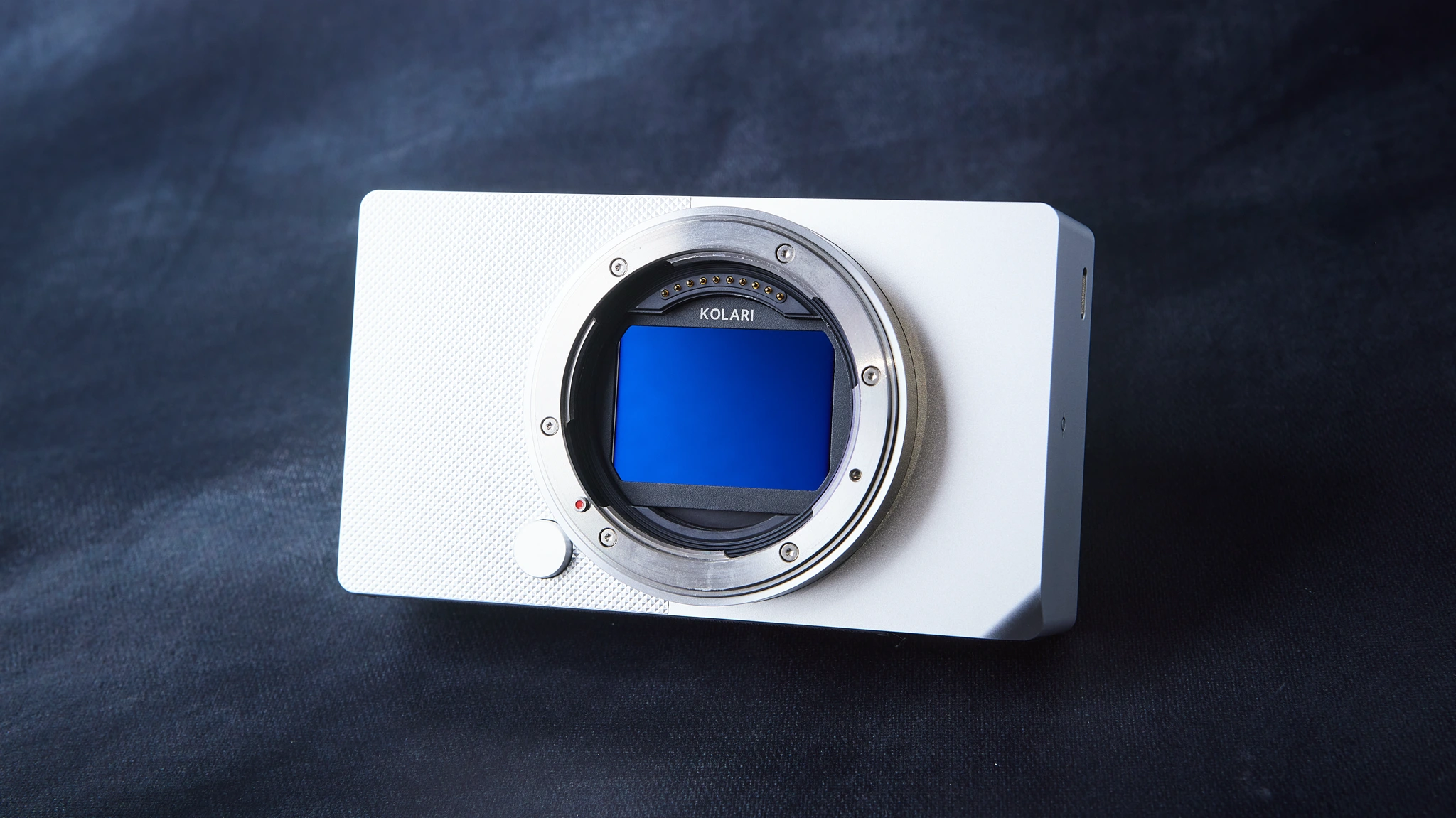
The Sigma BF is one of the strangest things happening in the camera industry right now. Most full-frame mirrorless bodies stamp together magnesium alloy shells, hide screws under leatherette, and ship in volumes hitting tens of thousands of units per quarter. However, the Sigma BF takes the opposite approach. Sigma carves each body from a single block of aluminum over seven hours of CNC machining at its only factory, in Aizu-Wakamatsu, Fukushima Prefecture.
In total, Sigma produces 200 to 400 of these cameras per month. For comparison, Canon ships hundreds of thousands of units every quarter. The launch price is $1,999. At 388 grams, the body sits lighter than many APS-C cameras.
This build process is impractical by every measure of modern manufacturing efficiency. Still, Sigma’s CEO, Kazuto Yamaki, built it anyway. He calls the camera “Beautiful Foolishness,” after a phrase from Okakura Kakuzo’s 1906 book on Japanese tea ceremony.
For photographers, the camera is a 24.6MP back-illuminated full-frame mirrorless with three buttons, one dial, no card slot, no mode dial, no mechanical shutter, no viewfinder, and a 230GB internal SSD. To the camera industry, however, the same product is an argument: an object photographers love for twenty years matters more than the spec sheet. After winning Japan’s 2025 Good Design Gold Award, the 2025 Minister of Economy Award, and the 2026 Red Dot Best of the Best, the industry is paying attention.
Here is how Sigma builds it.
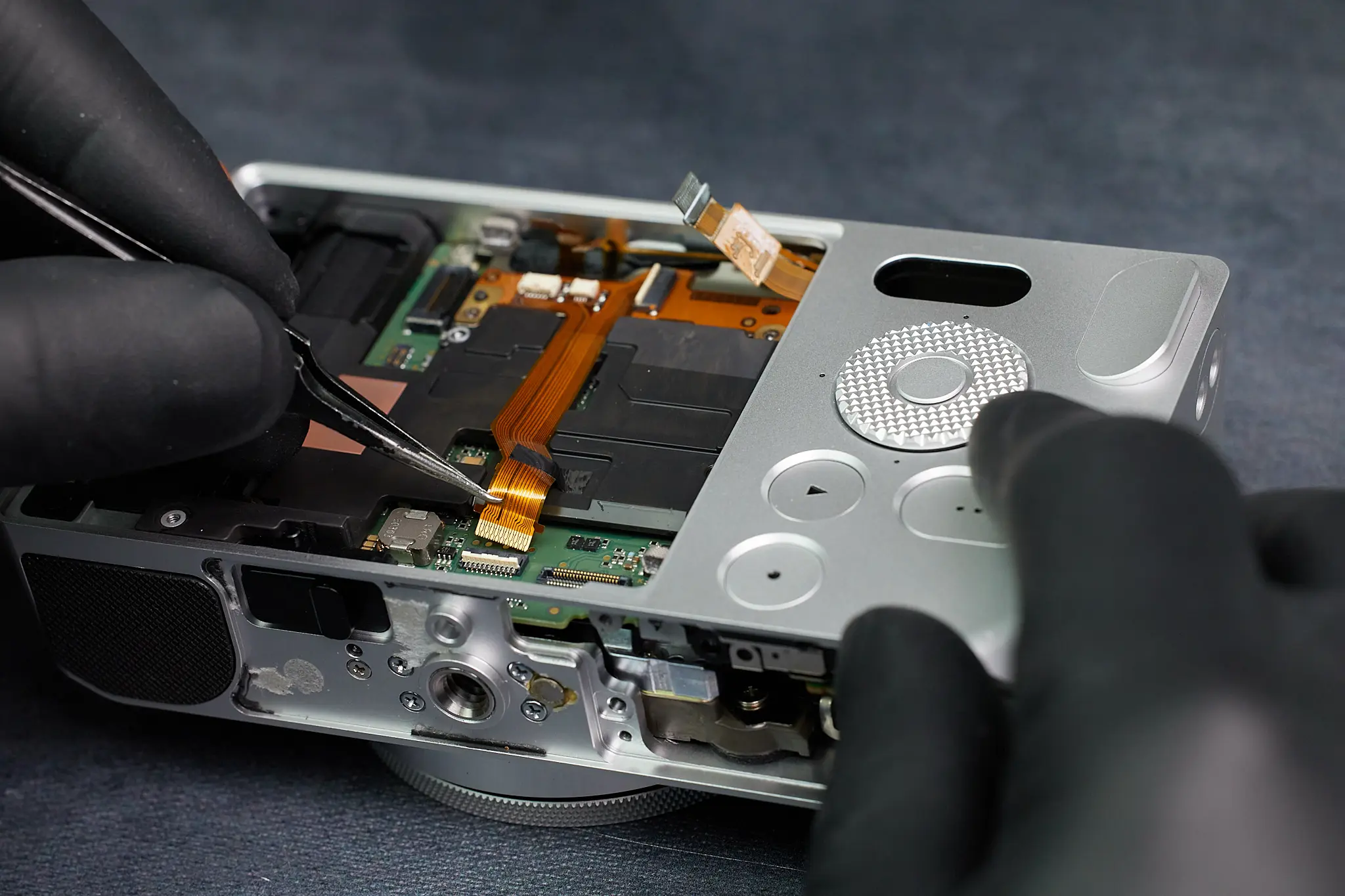
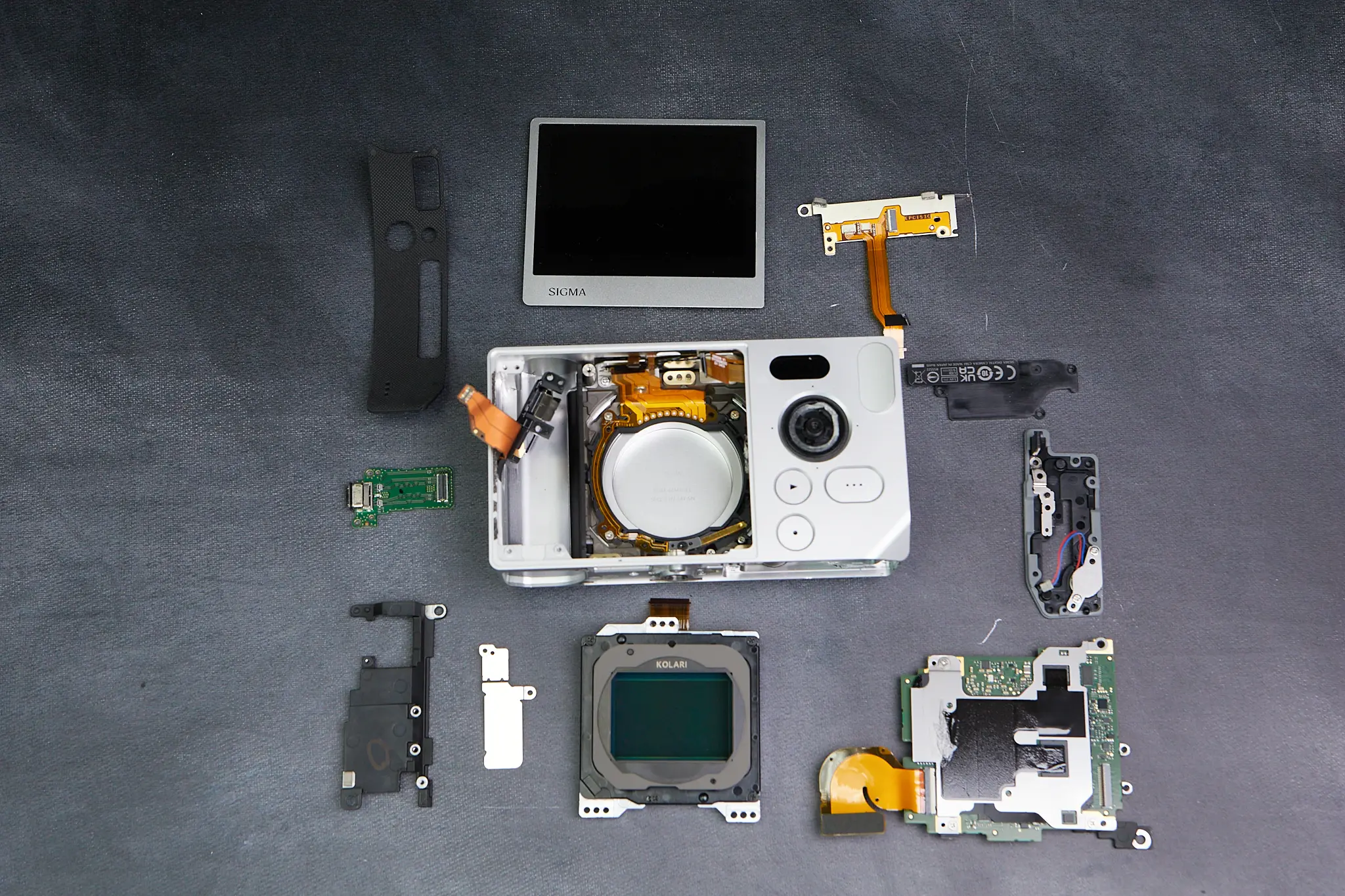
Much of what is visible inside the camera comes from a teardown by Kolari Vision. Notably, Kolari is known for its infrared conversions, optical filters, and deep work on experimental imaging workflows, so its teardown approaches the camera with a focus on optical performance and system design rather than pure hardware curiosity. Kolari also makes gear compatible with Sigma cameras, including a Magnetic Clip-in Filter system built for the BF, fp, and fp L.
Above, the full teardown and disassembly write-up from Kolari Vision reveals the tight internal architecture beneath the aluminum shell.
Key Specs at a Glance
| Specification | Details |
|---|---|
| Sensor | 35mm full-frame back-illuminated CMOS, 24.6MP effective |
| Body construction | Unibody machined from a single aluminum ingot |
| CNC machining time | 7 hours per body |
| Production rate | 200 to 400 bodies per month |
| Weight | 388g body only |
| Dimensions | 130.1 x 72.8 x 36.8 mm |
| Storage | 230GB internal SSD, no SD card slot |
| Video | 6K 30p, 4K 120p, L-Log |
| Controls | 3 buttons, 1 dial, shutter release, power; all with haptic feedback |
| Mount | L-Mount Alliance (Sigma, Leica, Panasonic) |
| Launch price | $1,999 USD, released April 2025 |
| Made in | Aizu-Wakamatsu, Fukushima Prefecture, Japan |
Why BF Means Beautiful Foolishness
The name traces back to two unrelated objects catching Kazuto Yamaki’s attention during the project. First was a perfume bottle. In 2022, Yamaki visited a Tokyo exhibition on Gabrielle Chanel. Specifically, the bottle for Chanel No. 5, designed in 1921, struck him as a piece of industrial design holding its beauty for over a century without modification.
Yamaki told Phototrend at CP+ 2025 the bottle felt magnificent, elegant, and timeless. He immediately wanted to build a camera as recognizable and as durable as the century-old design.
Second came a book. Okakura Kakuzo, a Japanese art historian, published “The Book of Tea” in English in 1906 to explain Japanese aesthetic philosophy to Western readers. One phrase in the book reads “the beautiful foolishness of things.” Yamaki had carried it with him for years.
Asked what BF stood for, Yamaki gave the literal answer first: Beautiful Foolishness. He then offered a second meaning. Manufacturing a camera body needing seven hours of machining from aluminum, he said, is itself a kind of beautiful foolishness. Therefore, the name carries a double, even triple, meaning.
Specifically, Yamaki described three layers in one word: a philosophical reference to the Okakura phrase, a description of how he wants buyers to live with the camera, and a self-aware nod to the impracticality of the build process. Sigma’s marketing has leaned into all three.
The Modern Camera Obscura Concept
While Yamaki was the producer and the philosophical voice behind the project, the industrial design came from Ichiro Iwasaki of IWASAKI DESIGN STUDIO in Tokyo. Sigma’s own UI team designed the interface. This credit appears in Sigma’s official 2025 Good Design Award submission and is missing from most English-language coverage.
Iwasaki and Sigma framed the entire project around one concept: “Modern Camera Obscura.” The reasoning, as Sigma submitted to the Japan Institute of Design Promotion, was a return to the original photographic device. A 17th-century camera obscura consisted of a lens and a dark box. Nothing more. The lens captured the image. Its box served only to release the shutter.
If photography were invented today, Sigma argues, with no historical baggage from film cameras, the result might look something like the Sigma BF. The lens stays at the core. Around it, the body becomes a refined enclosure, stripped of every element not strictly serving the lens.
This concept explains every visible decision on the camera. For example, the mode dial disappears because Sigma considers it a film-era artifact. Specifically, mode dials existed because film cameras locked ISO and color to the chosen film, leaving only shutter speed and aperture as in-body variables. In contrast, digital sensors carry no such constraint, so Sigma collapsed all four variables into equal status in the interface.
Similarly, the SD card slot disappears because internal storage is faster, more reliable, and harder to forget at home. Removing the mechanical shutter eliminates a wear point. Each absence is a deliberate choice, not a cost cut.
Inside Sigma’s Aizu Factory
Sigma builds the camera, and almost every other Sigma product, at a single facility in Aizu-Wakamatsu, Fukushima Prefecture. The factory sits about 300 km north of Tokyo, in a mountain region known for snow, hot springs, and sake. Notably, no other major camera manufacturer operates on a single-site model.
Numbers from the factory are unusual. Sigma employs roughly 1,850 people in Aizu. Together, they produce 75,000 lenses and 2,000 cameras per month across the entire Sigma product line. Glass grinding, plastic molding, paint application, anodizing, sensor mounting, screw manufacturing, mold machining, assembly, and final QC all happen under one roof.
Photographer Dustin Abbott toured the facility in early 2025 and described pristine, dust-controlled spaces where visitors wear shoe covers, lab coats, and branded caps before entering production floors. Each lens element gets inspected by hand. Engineers reject elements with surface imperfections. Robotic and human assembly run alongside each other in parallel.
According to interviews with Imaging Resource, Yamaki travels to Aizu roughly weekly from Sigma’s Tokyo headquarters to meet with manufacturing engineers. This proximity matters. When Yamaki pushed for the Sigma BF’s unibody construction, the factory floor was already familiar with the kind of custom tooling investment the project required. Consequently, Sigma’s vertical integration is what made the camera possible at all.
The Seven-Hour CNC Process
Each Sigma BF body begins as a solid block of aluminum. First, the block enters one CNC machining center. After completing roughly half the machining, a robot transfers it to a second CNC machining center, where the remaining cuts finish the body. In total, machining time per body reaches seven hours. The line operates 24 hours a day.
Initially, Yamaki heard from his engineers a unibody camera was impossible to produce. The machining time alone, they said, would kill production volumes. He pushed back. By connecting multiple CNC machining centers with a robot, Yamaki reasoned, Sigma would run the line continuously without paying operators to stand watch through the night.
The factory manager contacted a Japanese machining-center supplier, which customized its latest equipment and built a complete system for Sigma. Yamaki has not disclosed the supplier’s name or the alloy grade, though the investment, by his own admission, runs into the millions of dollars. No other camera manufacturer has built a comparable line.
Output sits at 200 to 400 finished bodies per month. Yamaki has said Sigma might add a second production line if demand sustains, though stockpiled machined bodies are already buffering early order volume. For now, the CNC line is the bottleneck on output.
Sigma’s Japan Good Design Award submission described the process plainly: a high-precision, high-rigidity body achieved by carefully shaving an aluminum ingot for seven hours. Notably, this single sentence captures what no other modern camera manufacturer is doing at this price point.
Why the Unibody Makes Assembly Harder
The most counterintuitive part of the Sigma BF story has nothing to do with CNC. It is what happens after. A typical mirrorless camera ships in two halves. Technicians drop the sensor, mainboard, screen, and battery housing into an open shell, then secure the second half on top. However, this design demands a different approach.
Because the body is a single sealed block of aluminum, internal components have to be threaded through a narrow opening before the back closes. Yamaki described this directly to Imaging Resource at CP+ 2025. Specifically, assembly work is more difficult and more time-consuming on the BF than on a conventional camera with an open body design.
This is the opposite of how automotive unibody construction works. When Tesla introduced its Gigapress to cast single-piece chassis sections, the goal was to eliminate hundreds of welded parts and cut assembly labor. For a camera, however, the single-piece body has the inverse effect. Internal parts now have to be installed through restricted access points.
Consequently, Sigma’s $1,999 price absorbs both extreme machining costs and elevated labor costs. Yamaki has been candid about this point. The camera is not a high-margin product. Instead, it is a statement of intent at a price calibrated to keep enthusiast photographers within reach.
What the Sigma BF Has, and What It Removes
The 24.6MP back-illuminated CMOS sensor sits at the heart of the camera. Sigma has not disclosed the sensor supplier, though industry consensus points to Sony. The sensor pairs with a hybrid autofocus system combining phase detection and contrast detection, with subject recognition for humans, dogs, and cats.
Internal 230GB SSD storage eliminates the SD card slot entirely. Capacity translates to roughly 14,000 JPEG files, 4,300 uncompressed RAW images, or 2.5 hours of video at the highest-quality setting. Offload speed runs at 10 Gbps over USB-C 3.2. For stills shooters, the storage volume comfortably covers most trips. Long-form video work, however, finds the limit faster.
Controls come down to three buttons, a single dial, the shutter release, and a power switch. Sigma claims the BF is the first mirrorless camera to incorporate haptic feedback into the dial, the Center button, the Option button, and the Playback button. Beyond reduced wear, Sigma’s reasoning is tactile precision without mechanical click points.
Notably absent: a viewfinder, a mechanical shutter, a mode dial, an SD card slot, an IBIS system, professional-grade weather sealing, and external strap lugs in the conventional sense. Sigma considered each removal deliberately. The 3.15-inch LCD handles framing work. A small secondary status display covers current settings, leaving the main screen clear of overlay clutter.
The Awards Pile and What They Signal
Industry recognition arrived faster than Sigma expected. In October 2025, the Sigma BF won Japan’s Good Design Gold Award, one of 19 Gold winners from the 1,200 designs entered the same year. It then received the Minister of Economy, Trade and Industry Award, which only three of those 19 Gold winners receive. In early 2026, the camera added the Red Dot Award: Best of the Best in Product Design, the top tier of one of Europe’s most-watched design competitions.
The Good Design jury comment is worth reading directly. They wrote the camera carries a freshness reminiscent of first encountering the iPod or iPhone, with a beauty arising from dedication to its single purpose. For a digital camera, this comparison is unusual praise.
Notably, this is the fourth consecutive Gold Award for a Sigma digital camera, following the fp, the sd Quattro series, and the dp Quattro series. Sigma’s design language, refined across more than a decade, is now drawing institutional recognition at a rate few competitors match.
What Sigma Is Betting On
The Sigma BF is a bet against the spec sheet. Sigma chose, deliberately, to build a camera measured in machining hours rather than burst frames per second. The cost of this choice shows up in production rate, in assembly difficulty, and in the absence of features photographers in adjacent segments would consider mandatory. However, the benefit shows up in the object itself.
For Yamaki, the underlying argument is about smartphone substitution. He has said in multiple interviews how camera enthusiasts still exist, still want better tools, and still respond to objects worth carrying every day. Specifically, the camera is built for this customer. Not the wedding shooter, not the wildlife photographer, and not the sports professional. Instead, the customer Sigma wants is the person who walks two hours through London or Tokyo and notices the light.
For the industry, the BF is a counter-example to the trend toward megapixel and burst-rate competition. Most camera makers are racing for stacked-sensor performance and AI subject detection. Sigma is making one case: at a certain point, what photographers want is a beautiful object worth loving for twenty years. The fourth consecutive Good Design Gold suggests the case has merit.
Whether the camera sells in volume matters less than what it represents. Sigma is a privately held company. Yamaki does not need to chase a market trend ending in six or twelve months. Instead, he has the freedom to manufacture a beautifully foolish camera and let the market sort itself out. So far, the market is sorting in his favor.
Frequently Asked Questions
How is the Sigma BF made?
Sigma machines each body from a single block of aluminum over seven hours of CNC milling at its Aizu factory in Fukushima Prefecture, Japan. Two robot-linked CNC centers run 24 hours a day, with each stage performing roughly half of the machining. The unibody shell then enters assembly, where internal components are threaded through a narrow opening before final quality control.
How long does it take Sigma to make one BF camera?
CNC machining alone takes seven hours per body. Assembly takes longer than on a conventional mirrorless, because the unibody shell offers only a narrow opening for installing the sensor, mainboard, screen, and internal SSD. Sigma has not published a total per-camera build time, though the bottleneck is the CNC line, which limits monthly output to 200 to 400 units.
What does BF stand for in Sigma BF?
BF stands for “Beautiful Foolishness.” Sigma CEO Kazuto Yamaki took the phrase from Okakura Kakuzo’s 1906 book “The Book of Tea,” which used “the beautiful foolishness of things” to describe Japanese aesthetic philosophy. Yamaki has also said the name describes the impractical decision to machine each body from one solid aluminum ingot.
Where is the Sigma BF manufactured?
The camera is built at Sigma’s only factory, located in Aizu-Wakamatsu, Fukushima Prefecture, about 300 km north of Tokyo. In total, the facility employs roughly 1,850 people and produces 75,000 lenses and 2,000 cameras per month across all Sigma products. Notably, no other major camera manufacturer uses a single-site production model.
How many Sigma BF cameras does Sigma produce per month?
Sigma produces 200 to 400 bodies per month. The limit is the CNC line. Yamaki has said Sigma might add a second production line if demand sustains, but the seven-hour machining time per body keeps total output far below conventional camera production volumes.
Why does Sigma machine the BF from a single block of aluminum?
The original design brief, from industrial designer Ichiro Iwasaki, asked for a seamless body with no visible screws or seams. Sigma’s engineers initially opposed the idea as impractical. Yamaki pushed forward by connecting two CNC machining centers with a robot, allowing the line to run unattended around the clock. The result is what Sigma calls the first true unibody in camera history.

