


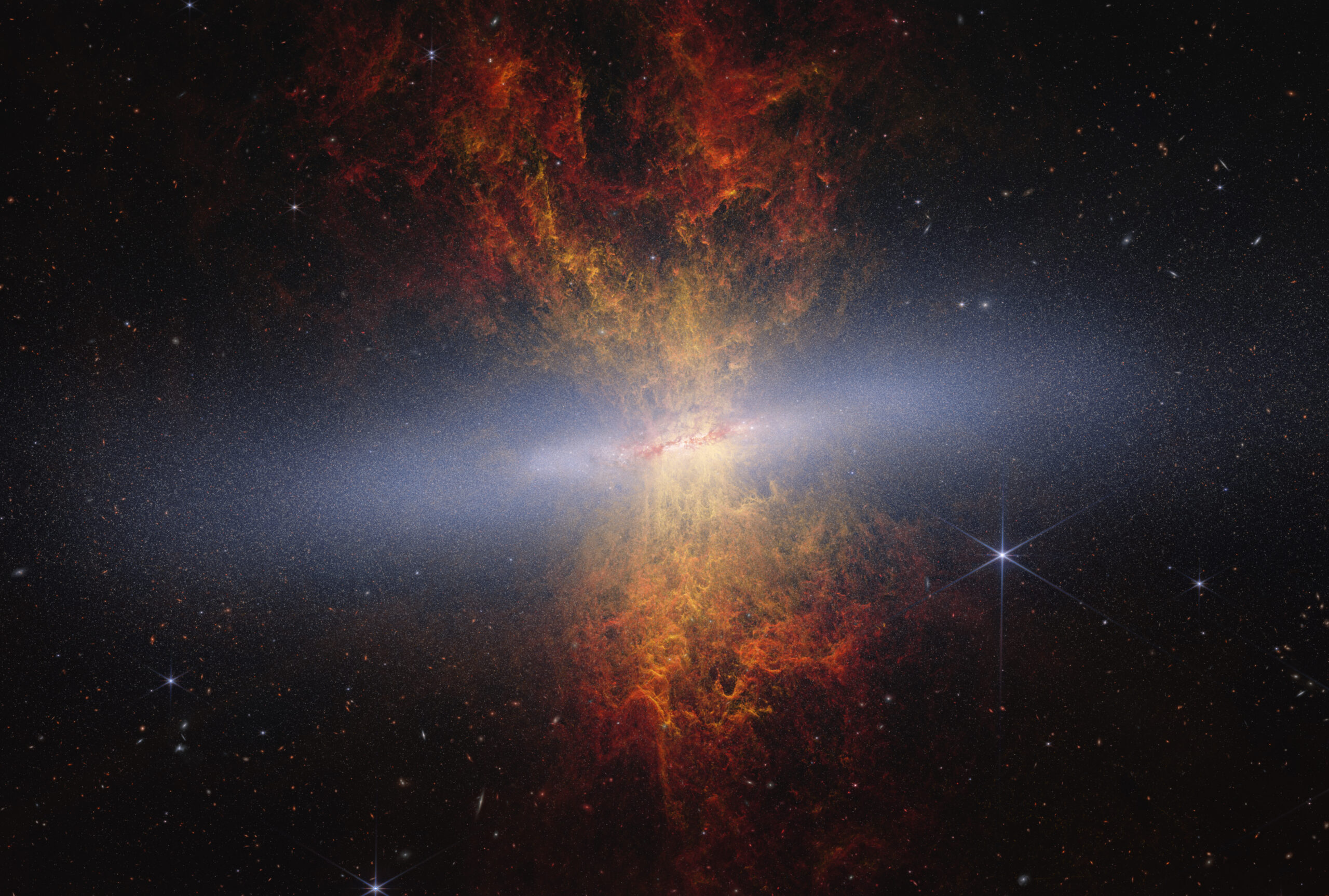
Quick Facts on the Cigar Galaxy:
- Galaxy: Cigar Galaxy (Messier 82, NGC 3034)
- Distance: 12 million light-years from Earth
- Constellation: Ursa Major
- Telescope: NASA’s James Webb Space Telescope (NIRCam)
- Observation time: 65 hours, nearly three days
- Image resolution: 223 megapixels
- Stars resolved: 16.5 million
- Apparent magnitude: 8.4, best viewed in April
7 min read
In This Article
Cigar Galaxy Overview: A New Record in Deep-Sky Detail
The Cigar Galaxy sits 12 million light-years from Earth, and it now anchors one of the most detailed deep-space portraits ever assembled. NASA’s James Webb Space Telescope spent 65 hours, nearly three days, observing this single target. The result is a 223-megapixel image holding 16.5 million individual stars, plus structural detail no telescope had resolved before.
Astronomers know this galaxy by several names. Charles Messier cataloged it as Messier 82, while modern catalogs list it as NGC 3034. Most stargazers, however, recognize the nickname earned by its long, slim, edge-on shape. Because it lies relatively close and burns so brightly, it ranks among the most studied galaxies in the northern sky.
The galaxy carries a long observational history. German astronomer Johann Elert Bode first spotted Messier 82 and its companion M81 in 1774. Charles Messier later added the pair to his famous catalog, which is how the M82 designation stuck. Since then, generations of telescopes have returned to it, each adding a new layer of detail.
For photographers, the appeal is immediate. You are looking at a working laboratory for star formation, captured in light your own camera cannot reach. Webb observes in near-infrared, so it pierces the dust lanes blocking visible-light instruments. As a result, the new view exposes millions of stars buried inside the galactic disk.
This release matters beyond its visual impact. Webb’s data gives researchers a detailed fossil record of how Messier 82 grew, stalled, and reshaped itself over hundreds of millions of years.
Key Facts at a Glance
| Detail | Value |
|---|---|
| Catalog names | Messier 82, NGC 3034, Cigar Galaxy |
| Distance | 12 million light-years |
| Constellation | Ursa Major |
| Galaxy type | Edge-on starburst galaxy |
| Instrument | Webb NIRCam (Near-Infrared Camera) |
| Stars resolved | 16.5 million |
| Star formation rate | About 10 times faster than the Milky Way |
| Apparent magnitude | 8.4, best viewed in April |
How Webb Resolved 16.5 Million Stars
First, a team of astronomers ran a deep imaging survey of Messier 82 using Webb’s NIRCam, the telescope’s Near-Infrared Camera. The observations totaled 65 hours. Because near-infrared light passes through gas and dust, Webb separated the galaxy into millions of pinpoints where earlier telescopes saw a smooth glow.
Near-infrared light matters here for a simple reason. Dust absorbs and scatters visible light, so optical telescopes see a dark, mottled lane across the galaxy’s middle. Infrared passes through most of the dust, however, so Webb reads the starlight behind it. As a result, the survey mapped stellar populations across the full disk rather than only the exposed edges.
The final mosaic spans 223 megapixels and contains 16.5 million stars. To grasp how dense the field is, consider the nearest star beyond our Sun. Proxima Centauri sits roughly 25 trillion miles away, and it is a single point. By contrast, Webb resolved 16.5 million such points inside one distant galaxy.
The survey also exposed the galaxy’s distended disk structure for the first time. Researchers had long suspected hidden detail inside the bright central plane, yet visible-light instruments failed to see through the dust. Webb’s resolution changed the picture entirely.
“The sheer number of stars … we were able to resolve with Webb is incredible,” said team member Benjamin Williams of the University of Washington. “It’s a whole different world from what we’ve been able to see with other telescopes. All of these stars collectively provide a detailed fossil record of the formation and evolution of M82.”
Hubble and Webb, Side by Side
Notably, the headline image is a composite. Webb supplies the near-infrared starlight, while the Hubble Space Telescope adds color information tied to specific wavelengths. In the blended frame, blue-white marks the 16.5 million stars, red-orange traces dust grains, and yellow shows ionized hydrogen gas streaming away from the core.

Color in these images is a translation, not a snapshot your eye would see. Astronomers map infrared and specific visible wavelengths to colors humans perceive, so blue marks resolved stars while red and orange track dust and gas. NASA also published a fade between the Hubble and Webb frames, which shows the dust dissolving as the view shifts into infrared. For photographers, it is a clear lesson in how filter choice and wavelength shape a final picture.
NASA also released a NIRCam-only version. Stripped of Hubble data, it loses some of the gas-and-dust color, yet it stays nearly as striking. In fact, the infrared-only frame shows the stars with equal clarity, because Webb sees through material hiding them from Hubble.
A direct comparison makes the difference obvious. Hubble captures the galaxy’s dramatic clouds of gas and dust in visible light. Webb, by contrast, pierces those clouds to reveal the stellar population underneath. Neither view is complete on its own, so the two missions work best together.
Kristen McQuinn of the Space Telescope Science Institute stressed the same point about teamwork between missions. Pulling Webb and Hubble data together, she noted, widens the range of questions researchers pose about a galaxy like this one.
Why the Cigar Galaxy Forms Stars So Fast
Messier 82 is a starburst galaxy, which means it builds new stars at an extreme pace. Specifically, its star formation runs about 10 times faster than the rate inside the Milky Way. This intensity is what makes the target so valuable to researchers.
Scientists believe a past galaxy merger triggered the surge. The gravitational disruption funneled gas toward the center, and the compressed gas ignited waves of new stars. However, this phase will not last. In astronomical terms the burst is brief, and models suggest the active period spans only a few hundred million years.
The rapid star birth also drives powerful outflows. Plumes of material push away from the galactic center, feeding the streams of ionized hydrogen visible in the Hubble data. Tracking those outflows helps astronomers understand how galaxies recycle and lose their raw material over time.
Messier 82 also drives one of the most studied galactic winds in the sky. Earlier observatories traced a vast outflow of hot gas streaming tens of thousands of light-years above and below the disk, powered by the same burst of young, massive stars. Webb and Hubble together now tie those plumes back to their source regions inside the galaxy. Consequently, researchers connect the cause, dense pockets of star birth, to the effect, gas escaping into intergalactic space.
“M82 is a mess, but it’s a beautiful mess,” said Adam Smercina, a NASA Hubble Fellow at the Space Telescope Science Institute. He described the galaxy as a rare local laboratory, one offering a simultaneous window onto many astrophysical questions unlike any other galaxy in the nearby universe.
How to Photograph M82 Yourself
You will never match Webb from your backyard, yet Messier 82 is one of the friendlier deep-sky galaxies for amateur gear. It shines at apparent magnitude 8.4, and it climbs high in the northern sky during spring. April evenings give the best window, when the galaxy rides near the bow of Ursa Major.
Begin by locating the pair it forms with neighboring galaxy M81, since both share the same low-power telescope field. Finding one leads straight to the other. A 6-inch or larger telescope reveals the elongated shape clearly, while smaller scopes still show the bright sliver under dark skies.
For imaging, the M82 galaxy rewards patience and good technique. Sharp focus is the foundation, so review how to capture sharp pinpoint stars before your session. Dark skies help even more, because the same night sky and light pollution problems frustrating astronomers also wash out faint galaxy detail.
If deep-sky targets are new to you, build your fundamentals first. Our full astrophotography guide walks through tracking mounts, exposure stacking, and processing, the same workflow you need to pull faint structure out of a galaxy like this one.
Gear-wise, a tracking mount does the heavy lifting. Without one, the sky’s motion smears stars during long exposures. Pair a sturdy star tracker with a 200mm or longer lens, or a small apochromatic refractor, then shoot many 30-to-90-second frames at a moderate ISO. Finally, stack the frames in free software such as DeepSkyStacker, since combining exposures cuts noise and pulls faint galaxy structure out of the background.
Frequently Asked Questions
Where is the Cigar Galaxy located?
The Cigar Galaxy lies 12 million light-years from Earth in the constellation Ursa Major. It sits close to the larger spiral galaxy M81, and the two share a low-power telescope field. Spring evenings, especially in April, offer the best viewing.
Why is Messier 82 called the Cigar Galaxy?
We see Messier 82 nearly edge-on, so its disk appears as a long, narrow sliver of light. Its slim profile resembles a cigar, which is how the nickname stuck. Catalogs still list the formal names Messier 82 and NGC 3034.
How many stars did the James Webb Space Telescope capture?
The James Webb Space Telescope resolved 16.5 million individual stars across the galactic disk. Webb’s near-infrared camera, NIRCam, collected the data over 65 hours. The final image spans 223 megapixels.
Is the Cigar Galaxy possible to photograph with a regular camera?
Yes, with the right setup. At magnitude 8.4 the M82 galaxy is within reach of a tracked DSLR or mirrorless camera paired with a telephoto lens or small telescope. Stack multiple long exposures under dark skies for the cleanest result. New shooters should start with our astrophotography tips for beginners.
What makes the Cigar Galaxy special to astronomers?
Messier 82 forms stars about 10 times faster than the Milky Way, likely because of a past galaxy merger. This intense, short-lived burst makes it a rare nearby laboratory for studying how galaxies build and lose material. Read NASA’s full release on the Webb survey of M82.

