


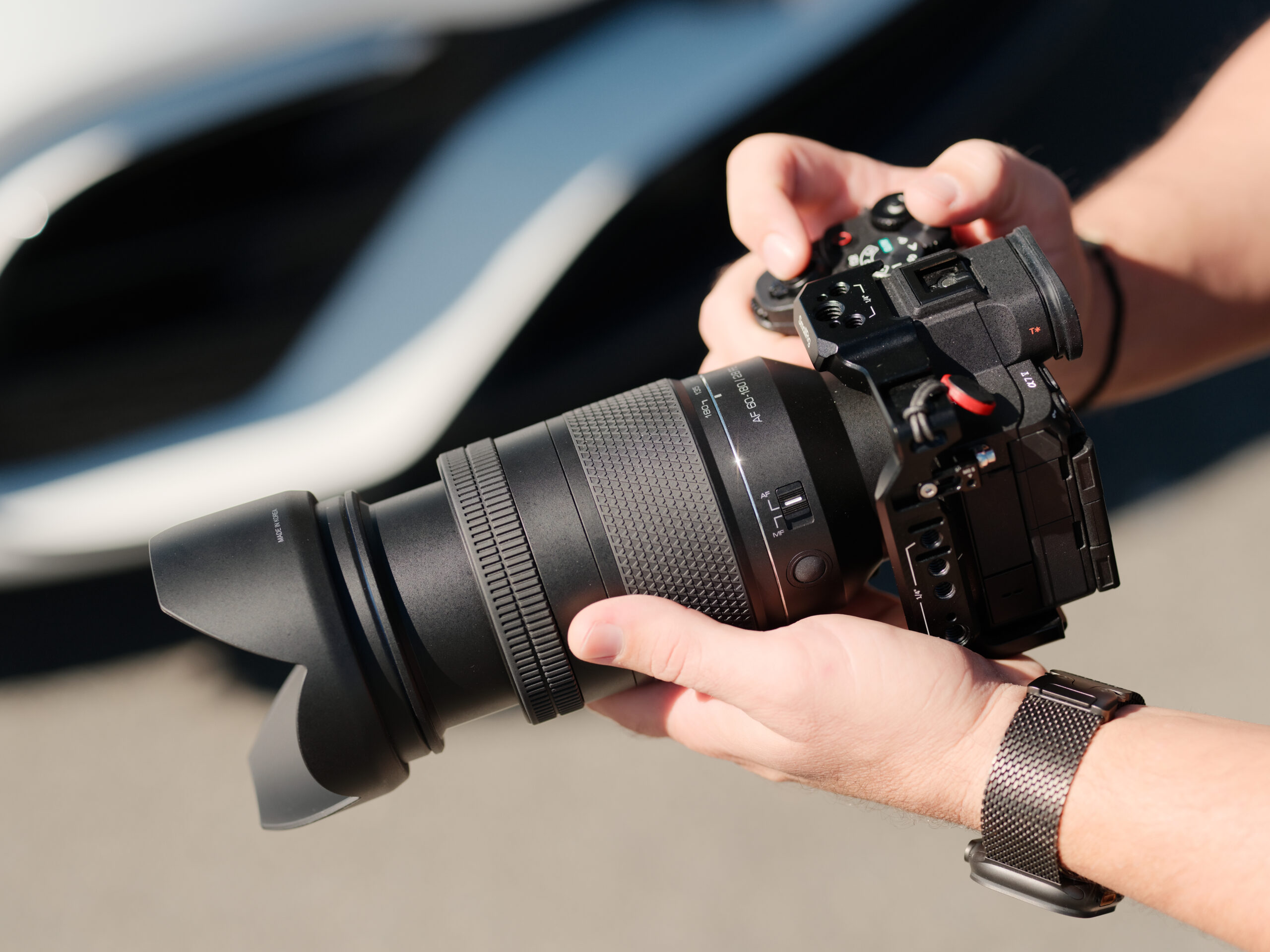
Quick Facts:
- Product: Schneider Kreuznach x LK Samyang AF 60-180mm f2.8 FE
- Mount: Sony E-mount, full-frame coverage
- Focal range: 60-180mm, constant f2.8
- APS-C field of view: 90-270mm equivalent
- Weight: 730g
- Filter thread: 77mm
- Stabilization: None, relies on in-body IS
- Weather sealing: Dust and splash resistant
- Price: 999 euros, around $1,099 in the US
- Best for: Sony shooters who want constant f2.8 reach at low weight
7 min read
In This Article
Samyang 60-180mm f2.8 Overview: Constant f2.8 Without the Bulk
The Samyang 60-180mm f2.8 brings constant-aperture telephoto reach to Sony E-mount at a weight few rivals match. At 730g, it undercuts Sony’s own 70-200mm f2.8 GM II by more than 300g, and it costs roughly a thousand dollars less. South Korean maker LK Samyang co-engineered the optics with German lens house Schneider Kreuznach. So the AF 60-180mm f2.8 FE pairs a premium pedigree with a mid-tier price of 999 euros, or about $1,099 in the US.
This is a full-frame Sony FE lens, so it covers the sensor on bodies like the a7 IV and the a1. Mount it on an APS-C body instead, and the crop turns the field of view into a 90-270mm equivalent. Because of this flexibility, one lens serves both formats. As a Sony E-mount telephoto, it adapts to your body rather than locking you to a single sensor size. For a refresher on how the two mounts differ, see our guide to Sony E and FE lenses.
The 730g figure also unlocks a new ultra-light system. Together with the AF 14-24mm f2.8 FE at 445g and the AF 24-60mm f2.8 FE at 494g, this zoom completes a 14-180mm f2.8 kit. Therefore, photographers who value a light bag now have a full constant-aperture range from one brand.
Pricing follows the budget-minded pattern Samyang built its name on. Moreover, the Schneider Kreuznach Samyang badge signals a focus on optical quality rather than corner-cutting. The lens launched on June 25, 2026, with sales rolling out across global markets through authorized retailers. Stock then reaches more regions in the weeks after launch. For shooters who want fast glass without GM-level outlay, the timing looks well judged.
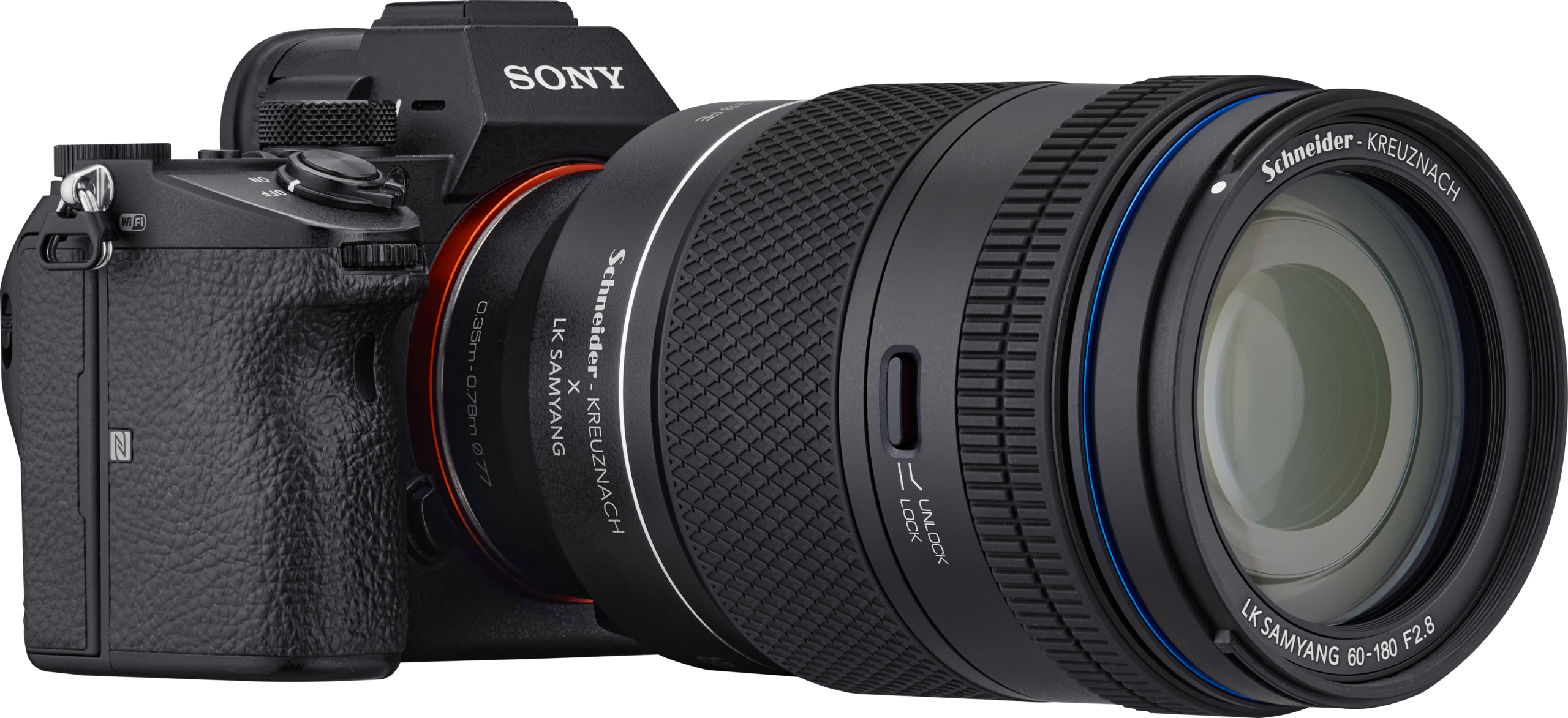
Key Specs at a Glance
The numbers below come from LK Samyang’s official product page. They paint a picture of a compact telephoto built for travel and long days in the field.
| Specification | Details |
|---|---|
| Mount | Sony E-mount, full-frame |
| Focal length | 60-180mm |
| Aperture | Constant f2.8, 9 blades |
| Optical design | 17 elements in 14 groups (1 HR, 7 ED, 2 aspherical) |
| Autofocus | Linear STM, AF/MF switch, custom button |
| Stabilization | None, relies on in-body IS |
| Minimum focus distance | 35cm at 60mm, 79cm at 180mm |
| Maximum magnification | 0.26x at 60mm, 0.21x at 180mm |
| Filter thread | 77mm |
| Dimensions | 86.7mm diameter, 149mm long (174.4mm at 180mm) |
| Weight | 730g |
| Weather sealing | Dust and splash resistant |
| Price | 999 euros, around $1,099 in the US |
Build, Autofocus, and Handling
The barrel extends as you zoom, reaching 174.4mm at the 180mm end from a 149mm resting length. Despite the moving design, the lens holds a slim 86.7mm diameter. Consequently, it balances well on compact Sony bodies rather than nosing toward the ground.
Autofocus runs on a Linear STM motor. According to LK Samyang, the system delivers fast, quiet focus for both stills and video. An AF/MF switch sits on the barrel for quick manual override. For video shooters, the quiet motor and the constant aperture both help during slow push-ins.
Weather sealing guards against dust and splashes, so light rain or trail dust should not stop a shoot. Similarly, the 77mm filter thread matches many pro zooms, which keeps your existing filters useful. One firmware detail stands out: a built-in USB port lets you update the lens directly. Because of this feature, the optics stay current as Sony bodies evolve.
Close focus reaches 35cm at the wide end, giving 0.26x magnification. While not a macro tool, the lens still handles tight detail shots and food or product frames. At 180mm, meanwhile, minimum focus stretches to 79cm, which suits headshots and candid portraits.
Image Quality and Optical Design
The optical formula uses 17 elements in 14 groups. Inside sit one HR element, seven ED elements, and two aspherical elements. Together, these glass types fight chromatic aberration and field curvature, two faults common in fast telephoto designs. In theory, the lens aims for sharp, clean frames across the zoom range.
Schneider Kreuznach’s involvement sets expectations here. The German maker built its reputation on optical coatings and precision design. On paper, the Schneider Kreuznach Samyang partnership aims for controlled flare and consistent contrast, though hands-on tests will tell the full story. For a constant aperture zoom, holding sharpness wide open is the harder task, so the dense element count makes sense.
The 9-blade diaphragm shapes the out-of-focus areas. Point lights should render as rounded highlights rather than hard polygons. At f2.8 and 180mm, background blur stays smooth, which portrait and event shooters value. Stopped down, the rounded blades also produce cleaner sunstars for landscape work.

Who the 60-180mm f2.8 Fits Best
Reach and speed define the appeal here. On a full-frame body, 60-180mm covers tight portraits through to distant action. Switch to APS-C, and the 90-270mm equivalent stretches into wildlife and field-sports territory. Because this is a lightweight telephoto lens, travel and street shooters also gain a fast reach option without a heavy bag. For shooters building a kit, our roundup of the best telephoto lenses for beginners offers helpful context on focal ranges.
Event and wedding photographers gain the most from the constant f2.8. A fixed aperture holds exposure steady as you zoom, so flash and manual settings stay predictable. Moreover, the bright aperture lifts shutter speed in dim receptions and indoor arenas. The 730g weight then keeps fatigue down across a long day.
Wildlife shooters get a lighter alternative to heavy super-telephotos, though 180mm sits short of extreme reach. Pair the lens with a high-resolution body, and cropping recovers some distance. For broader kit planning, see our wildlife photography gear list. Portrait photographers, meanwhile, gain creamy backgrounds from the f2.8 aperture and the 9-blade diaphragm.
Video creators round out the audience. Since the aperture holds steady through the zoom, exposure stays locked during a push-in. In addition, the quiet Linear STM motor avoids focus noise on built-in microphones. For run-and-gun work, a Sony E-mount telephoto at 730g eases gimbal balance and handheld stamina.
Samyang 60-180mm f2.8 vs. Sony’s Telephoto Zooms
Sony’s APS-C zooms tell the value story quickly. Both the 55-210mm f4.5-6.3 and the 70-350mm f4.5-6.3 G offer longer reach, yet both use variable apertures. Therefore, neither holds f2.8 as you zoom. By contrast, the Samyang trades some length for two extra stops of light and a steady exposure.
Sony’s nearest constant-aperture option costs far more. For example, the 70-200mm f2.8 GM II weighs roughly 1,045g and lists near $2,800. By comparison, this lightweight telephoto lens weighs 730g and sells for around $1,099. You lose 20mm at the long end and in-lens stabilization, yet you save weight and a large sum.
For long-range needs, Sony’s constant-aperture telephoto zoom in the 100-400mm class reaches much farther, albeit at a higher price and weight. Instead, the Samyang aims at a different buyer: someone who wants f2.8 speed, modest reach, and a light bag. As a result, the choice comes down to priorities rather than outright quality.
Final Verdict

The Samyang 60-180mm f2.8 answers a clear request from Sony shooters: constant f2.8 telephoto reach without GM weight or GM pricing. At 730g and 999 euros, it lands as one of the lighter fast telephotos for E-mount. Its biggest strength is the balance of speed, size, and cost in a single package.
Trade-offs do exist. The lens stops at 180mm, so sports and wildlife shooters who need extreme reach should look elsewhere. It also skips in-lens stabilization, which leans on your camera’s in-body system. A stabilized body like the Sony a6700 helps offset the missing optical IS, so owners of older bodies without strong IBIS should weigh this gap before buying.
On value, the math favors this lens for many buyers. Specifically, you gain two stops over Sony’s variable-aperture crop zooms and save well over a thousand dollars against the 70-200mm GM II. The Schneider Kreuznach optical input also raises expectations for rendering, pending hands-on reviews.
For event, portrait, and travel work on Sony, the AF 60-180mm f2.8 FE earns a serious look. However, those chasing distant wildlife or fast field sports should instead consider the 70-350mm f4.5-6.3 G for its longer reach. Match the lens to your subject, and the decision becomes simple.
Frequently Asked Questions
Is the Samyang 60-180mm f2.8 a full-frame lens?
Yes. The AF 60-180mm f2.8 FE covers full-frame Sony E-mount sensors. On an APS-C body, the crop gives a 90-270mm equivalent field of view, so the lens works across both formats.
Does the lens have image stabilization?
No. The Samyang 60-180mm f2.8 has no optical stabilization. It relies on your camera’s in-body image stabilization, so pairing it with a stabilized Sony body helps for handheld telephoto shots.
How much does the Samyang 60-180mm f2.8 cost?
The lens lists at 999 euros including VAT, with US pricing around $1,099. For a constant aperture zoom, the price sits well below Sony’s 70-200mm f2.8 GM II.
How does it compare to the Sony 70-200mm f2.8 GM II?
The Samyang weighs 730g against roughly 1,045g for the GM II, and it costs far less. You give up 20mm of reach and in-lens stabilization. For weight and budget, the Samyang wins; for reach and IS, the Sony leads.
What filter size does the lens use?
The lens uses a 77mm front filter thread. This size matches many professional zooms, so existing 77mm filters fit without an adapter.
When is the Samyang 60-180mm f2.8 available?
The lens launched on June 25, 2026, with sales rolling out across global markets through authorized retailers. Stock reaches more regions in the weeks after launch.
Specs sourced from LK Samyang’s official product page.

