


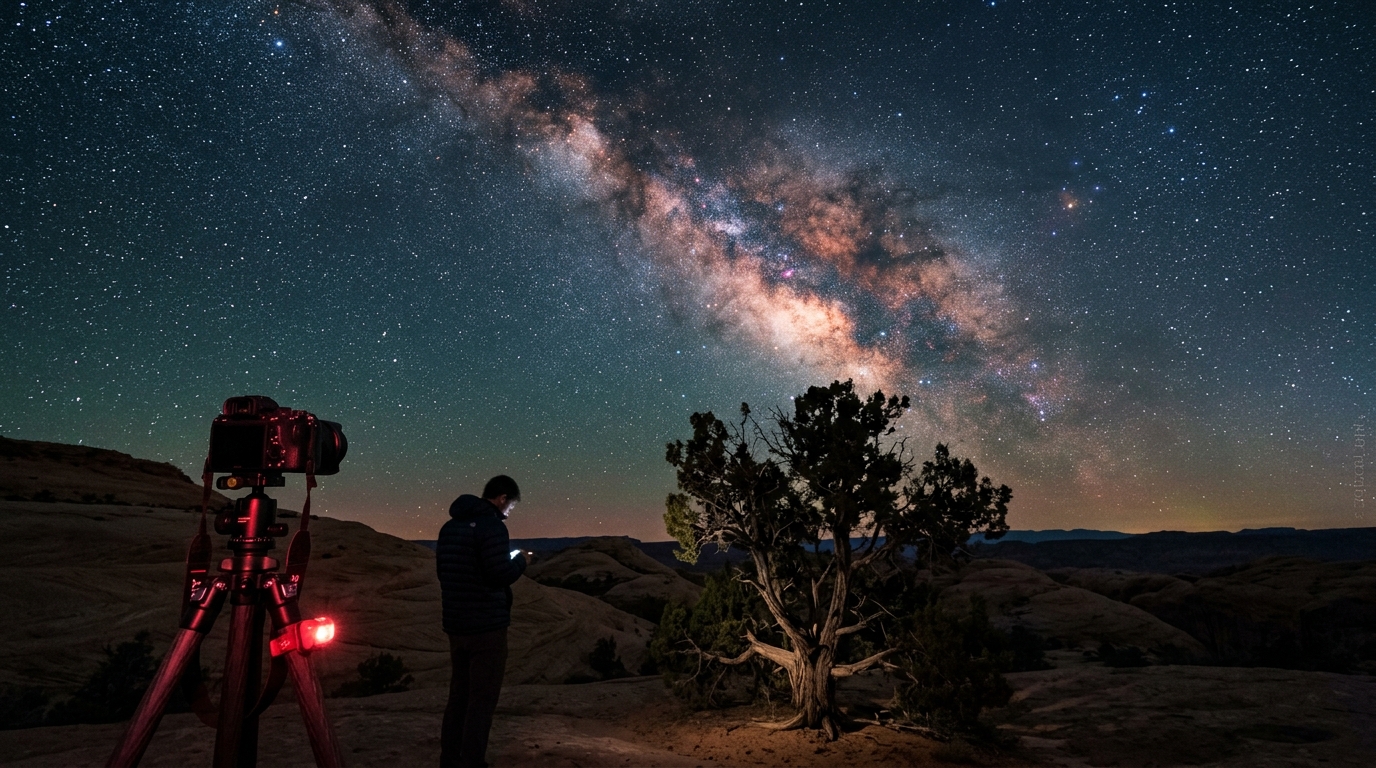
How to Photograph the Milky Way: A Beginner’s Guide Using Camera Gear You Already Own
Quick Verdict: Milky way photography works with a standard DSLR or mirrorless body, a lens at f/2.8 or wider, and a sturdy tripod. Plan around a new moon and a Bortle 1 to 3 dark-sky site, then shoot at ISO 3200 to 6400, 20 to 25 seconds, and your widest aperture. A 24mm full-frame setup runs about $1,200 used, and your first wall-worthy frame is usually one or two clear nights away. The biggest trade-off is travel time to dark skies, since most cities sit at Bortle 6 or worse and wash out the galactic core entirely.
Last updated: May 2026 | 12 min read
In This Guide
- Overview: Milky Way Photography for Beginners
- Milky Way Settings and Gear at a Glance
- Milky Way Camera Settings
- Planning Your Shoot: Dark Skies and Moon Phase
- Composition With Foreground Interest
- How to Focus on Stars at Night
- Star Trails: Avoid Them or Use Them on Purpose
- Why Astrophotography Hits Hardest on Metal
- Metal vs Canvas for Milky Way Prints
- Pros and Cons
- Final Verdict
- Frequently Asked Questions
Overview: Milky Way Photography for Beginners
After 20 years shooting landscapes, I picked up milky way photography as a winter side project on a Utah trip and was surprised at how little extra gear it took. Most readers arriving here own enough kit to capture a frame-worthy galactic core tonight, assuming the weather and moon cooperate. The common assumption is you need a tracker mount, a cooled astro camera, or a 50mm f/1.4 lens at minimum. Specifically, none of those tools are required for a single wide-field shot.
You need three things: a camera with manual mode and ISO 3200 or higher, a lens at 24mm or wider with f/2.8 or faster aperture, and a tripod. A Sony A7 III paired with a Tamron 17-28 f/2.8 covers the requirement at around $1,650 used. Likewise, a Canon R8 with a 16-35 f/4 also works, though f/4 forces you to ride higher ISO. Beginner astrophotography tips often push expensive specialty cameras, however a standard full-frame body handles single-shot wide-field work fine.
This guide walks through the four steps a first-night shooter needs: settings, planning, composition, and focus. Then it covers what to do with the file once you nail the shot. A great milky way photo is wasted as a JPEG buried on a hard drive. Printing the frame on metal is what turns a one-night effort into a piece of wall art you see every day. Anyone learning how to photograph the milky way for the first time also benefits from our guide on astrophotography on a budget.
Milky Way Settings and Gear at a Glance
The best lens for milky way photography sits at f/2.8 or wider in the 14mm to 24mm range. The numbers below are starting points for a full-frame body at 24mm under a Bortle 1 to 3 sky. Adjust ISO down by one stop if shooting under brighter conditions, or up by one stop for narrower apertures. Use these as a baseline, then tune for your specific lens and location.
| Parameter | Recommended Value |
|---|---|
| Aperture | f/2.8 (or widest available) |
| Shutter Speed | 20 to 25 seconds at 24mm |
| ISO | 3200 to 6400 |
| Focal Length | 14mm to 24mm wide |
| White Balance | 3800K to 4200K |
| File Format | RAW |
| Focus Mode | Manual, infinity |
| Tripod | Carbon fiber, hook-loaded |
| Bortle Class | 1 to 3 |
| Moon Phase | New moon, plus or minus 3 days |
Featured on Vivid Metal Prints
Hang Your Galactic Core in the Living Room
A clean milky way capture deserves more than a hard drive. Vivid renders deep blacks and pinpoint stars with dye-sublimation depth canvas physically fails to match.
Milky Way Camera Settings for Real Conditions
Three settings define every milky way photography frame: aperture, shutter, and ISO. First, open the aperture to its widest setting because the galactic core is dim and every fraction of a stop matters. Second, set the shutter long enough to gather light but short enough to keep stars as points instead of streaks. Third, lift the ISO until the histogram pushes about one third of the way from the left.
The maximum shutter you should use depends on your focal length. Most shooters follow the 500 rule, which divides 500 by your focal length to give the maximum exposure in seconds before stars trail. At 24mm full-frame, the math gives 20.8 seconds; pull back to 14mm and the limit stretches to 35 seconds. For crop sensors, multiply your focal length by the crop factor first, then divide.
ISO is where beginners hesitate. Modern full-frame bodies handle ISO 6400 with workable noise after a clean RAW conversion. Sony A7 IV, Canon R6 II, and Nikon Z6 II all clear noise at ISO 6400 well enough for prints up to 30 inches wide. Always shoot RAW so you preserve recovery range in post; for context on the format choice, see our breakdown of when to shoot in RAW. JPEG is too compressed for the heavy shadow lifting these scenes demand. Astrophotography for beginners almost always benefits from the extra latitude RAW preserves.
Planning Your Shoot: Dark Skies and Moon Phase

Settings alone do not produce a milky way shot. The session lives or dies on planning. Four inputs decide the outcome: season, moon phase, sky darkness, and weather. Get any one of them wrong and the night is wasted no matter how clean your camera settings are.
For Northern Hemisphere shooters, milky way core season runs from late February through October, with peak visibility from May through August. Specifically, the galactic core sits low on the southern horizon in spring, climbs higher through summer, and tilts back down in fall. Use PhotoPills or Stellarium to confirm rise and set times for your shoot date and location.
Moon phase trumps almost everything else. A full moon at 100 percent illumination obliterates the core even from a dark site. Aim for the three nights before or after a new moon, when moonlight sits below 25 percent. Then check the Bortle scale at lightpollutionmap.info for your shoot location. Bortle 1 to 3 reveals the full core structure with detail. Sites rated 4 or 5 still produce usable shots with longer exposures and careful processing. Anything 6 and above is wasted effort because city sky glow drowns out the galactic detail. For broader planning techniques, our piece on easy astrophotography tips for beginners covers the scouting process in depth.
Composition With Foreground Interest

A milky way photo with no foreground is a record of the sky. A milky way photo with a strong foreground is a piece of art. For instance, the difference is what makes a frame print-worthy versus throwaway. Strong foreground options include arches, lone trees, jagged peaks, abandoned cabins, and reflections in still water.
Compose the foreground first while there is still ambient light, then return after dark to shoot the sky. Use the rule of thirds to place the galactic core off-center, with foreground occupying the lower third and the sky filling the upper two thirds. Light-paint the foreground gently with a headlamp on its lowest setting for one to two seconds during the exposure. A standard headlamp at full power blows out the foreground and ruins the frame.
Sharpness across both foreground and stars is tricky because they sit at different focus distances. The fix is hyperfocal distance calculation, or focus stacking the foreground separately. At 24mm and f/2.8, the hyperfocal distance is roughly 22 feet. Set focus there and everything from 11 feet to infinity stays acceptably sharp, including the milky way core.
How to Focus on Stars at Night
Autofocus fails on stars because there is not enough contrast for the system to lock. Manual focus is required, and the workflow takes practice. Start by switching the lens to manual focus, then set focus to roughly the infinity mark. Most modern lenses focus past infinity, so the painted symbol is a starting point, not a final position.
Switch the camera to Live View and zoom in on the brightest star in the frame at 10x magnification. Slowly rotate the focus ring until the star is the smallest possible point. Take a test shot at ISO 6400 and 5 seconds, review the result at 100 percent, and confirm star edges look crisp. If they appear bloated or doughnut-shaped, refocus. Cold weather expands and contracts the lens, so re-check focus every 30 minutes during a long session.
Featured on Vivid Metal Prints
Some Frames Belong on a Wall, Not a Memory Card
Vivid offers clear satin aluminum panels engineered for the contrast astrophotography demands. Sizes from an 8×10 desk print up to a 40×60 statement wall.
Star Trails: Avoid Them or Use Them on Purpose
Star trails happen when the shutter stays open long enough for Earth’s rotation to drag stars across the sensor. Whether you treat trails as a flaw or a feature is a creative choice. For tight pinpoint stars in a single milky way frame, follow the 500 rule and stop the exposure before motion shows up. If you want trails as the subject, exposures are stacked over hours and the spinning effect becomes the entire point.
To avoid trails on a single-shot milky way frame, never exceed your 500-rule maximum at the chosen focal length. Conversely, embrace trails by shooting 30 to 60 minutes of consecutive 30-second exposures at f/4 and ISO 1600, then stacking them in StarStaX or Sequator. Both approaches require the same gear, although the intent and total exposure time change. A common mistake is shooting 40 second exposures at 24mm thinking they look sharp, then noticing motion blur on review at home. Always validate at 100 percent zoom in the field. Once you nail a sharp frame either way, the next decision shifts from capture to output, which is where print medium starts to matter.
Why Astrophotography Hits Hardest on Metal

Astrophotography lives or dies on contrast. A milky way frame is mostly black, punctuated by pinpoint highlights, with subtle gradients of nebulosity through the galactic core. Most print materials wash these details out. Canvas absorbs ink into a fabric weave, which softens the highlights and dulls the deep blacks until the image looks flat. Standard photo paper handles black better than canvas, however reflections and surface texture still mute the star points.
Metal prints solve the contrast problem through dye sublimation. Vivid Metal Prints applies a white base coating to the aluminum panel, then infuses the dyes directly into the coating using heat and pressure. Light hits the dye layer, then bounces off the white base, then exits through the surface. The result is a glow effect paper and canvas physically fail to reproduce. Stars look like actual points of light against velvet black, not gray dots on a near-black field.
For milky way prints specifically, ask Vivid for the clear satin finish. The satin surface controls glare in normal room lighting while preserving the depth needed for astro detail to render properly. A high-gloss panel reads better in controlled gallery light, although clear satin handles real living rooms and offices without forcing you to chase the perfect viewing angle. PhotographyTalk’s roundup of the best metal prints reviewed Vivid alongside four competitors and ranked the satin finish as the standout product for nuanced work.
Metal vs Canvas for Milky Way Prints: Which Should You Pick?
Canvas wears well for warm-toned portraits, paintings, and travel landscapes where soft gradients and earthy color dominate. Astrophotography is a different problem entirely. The fabric weave of canvas absorbs ink and scatters incoming light, which lifts the blacks and softens star points. A milky way print on canvas looks dim and grayish, not deep and crisp.
Metal prints handle the same image differently. The dye-sublimation process bonds pigment into a white-coated aluminum panel, and light interacts with the panel through reflection rather than absorption. Deep blacks stay black. Bright stars stay sharp. The galactic core gradients render with smooth tonal transitions, not stepped banding. Vivid Metal Prints’ clear satin panels deliver this contrast at $89 for an 11×14 and $189 for a 16×24, which sits in line with comparable industry pricing for premium dye-sub work.
For most beginners with one or two strong frames, the metal print is the better investment. A canvas of the same shot saves about $30, however the visual difference on the wall pays back the price gap immediately. Side by side, the metal panel reads brighter, deeper, and more dimensional. Reserve canvas for portraits and traditional landscape work where its texture is an asset.
Pros and Cons of Milky Way Photography for Beginners
Pros
- Existing camera kit handles single-shot milky way photography with no tracker required
- Free planning tools (PhotoPills, Stellarium, lightpollutionmap.info) replace expensive software
- Skills from landscape photography (composition, foreground, exposure) transfer directly
- Subject is free, reliable, and visible on most clear nights from May through August
- One $89 metal print pays back hundreds of dollars in gear because the result hangs on a wall
- Single 25-second exposure produces print-worthy frames at sizes up to 30 inches wide
- Phone apps replace handwritten star charts, weather notes, and dawn timing tables
Cons
- Most cities sit at Bortle 6 or worse, which forces 1 to 3 hours of driving to shoot
- Cold-weather sessions below freezing drain batteries to 30 percent in two hours
- Manual focus on stars takes 5 to 10 minutes of practice before the first usable frame
- Moon-phase windows narrow shoot dates to roughly 7 nights per month
- Post-processing (white balance, shadow recovery, noise reduction) has a 5 to 10 hour learning curve
- Cloud cover forecasts shift hourly, often cancelling planned trips with two hours notice
Final Verdict
Milky way photography is the most accessible specialty in the medium for landscape shooters. Every skill from your daytime work transfers, the gear requirement is low, and the subject is free. After 20 years of landscape work and a side path into astro, my main advice is to skip the gear obsession and book the trip to dark skies. A Bortle 2 sky with a Sony A7 III and Tamron 17-28 outperforms a $5,000 setup at Bortle 6 every time.
The honest trade-off is travel logistics. Dark skies sit a 1 to 3 hour drive away for most US shooters, and moon phase plus weather windows constrain shoot dates to about 30 useful nights per year. Anyone unwilling to chase weather forecasts at midnight might prefer our guide on photographing the northern lights instead, which involves a different commitment curve.
The value calculation favors anyone who already shoots landscapes. Your tripod, wide lens, and full-frame body cover 90 percent of the kit. Add a $30 intervalometer, a $40 red-light headlamp, and a $10.99 PhotoPills app purchase on iOS, and your total added cost stays under $90. Start with one location, one new moon weekend, and one frame as the goal. Print the best frame on metal once you nail it. The astrophotography for beginners learning curve flattens fast, and a single great shot on a Vivid Metal Prints clear satin panel justifies every cold night spent waiting for the core to rise.
Featured on Vivid Metal Prints
Your Milky Way Shot, Backlit on Aluminum
Stop scrolling past your best frame. Vivid produces gallery-grade aluminum panels in 5 to 7 business days, with the dye-sub white base coating no canvas print is built to match.
Frequently Asked Questions
What are the best milky way camera settings for beginners?
Set aperture to f/2.8, shutter to 20 to 25 seconds at 24mm focal length, and ISO to 3200 to 6400. Shoot in RAW with manual focus locked at infinity. Adjust ISO down a stop if shooting under brighter Bortle 4 conditions, or up a stop for narrower f/4 lenses.
What is the best lens for milky way photography on a budget?
The Tamron 17-28 f/2.8 for Sony E-mount runs about $550 used and covers nearly every milky way photography need. Canon RF shooters should consider the 16-35 f/4L at $700 used as a beginner option. Nikon Z shooters should look at the 14-30 f/4 S at $850 used.
Do I need a star tracker for milky way photography?
No, single-shot wide-field work produces print-worthy results without a tracker. A tracker becomes useful when shooting at focal lengths above 50mm or stacking exposures for deep-sky targets. At 14mm to 24mm, a sturdy tripod is sufficient.
How do I focus on stars at night?
Switch your lens to manual focus, set the camera to Live View at 10x magnification, and rotate the focus ring until the brightest star becomes the smallest possible point. Re-check focus every 30 minutes because cold weather shifts the focus position as the lens contracts.
Will milky way photography work from my backyard?
Only if your backyard sits at Bortle 4 or lower on lightpollutionmap.info. Most US backyards rate Bortle 6 to 9, where city sky glow eliminates the galactic core. Plan a drive to the nearest Bortle 1 to 3 site for the first shoot.
What is the best month for milky way photography in the US?
June and July offer the highest galactic core position for most US latitudes, while May and August work with the core sitting lower in the sky. February through April produces pre-dawn shots only, with the core rising around 3 AM.

