


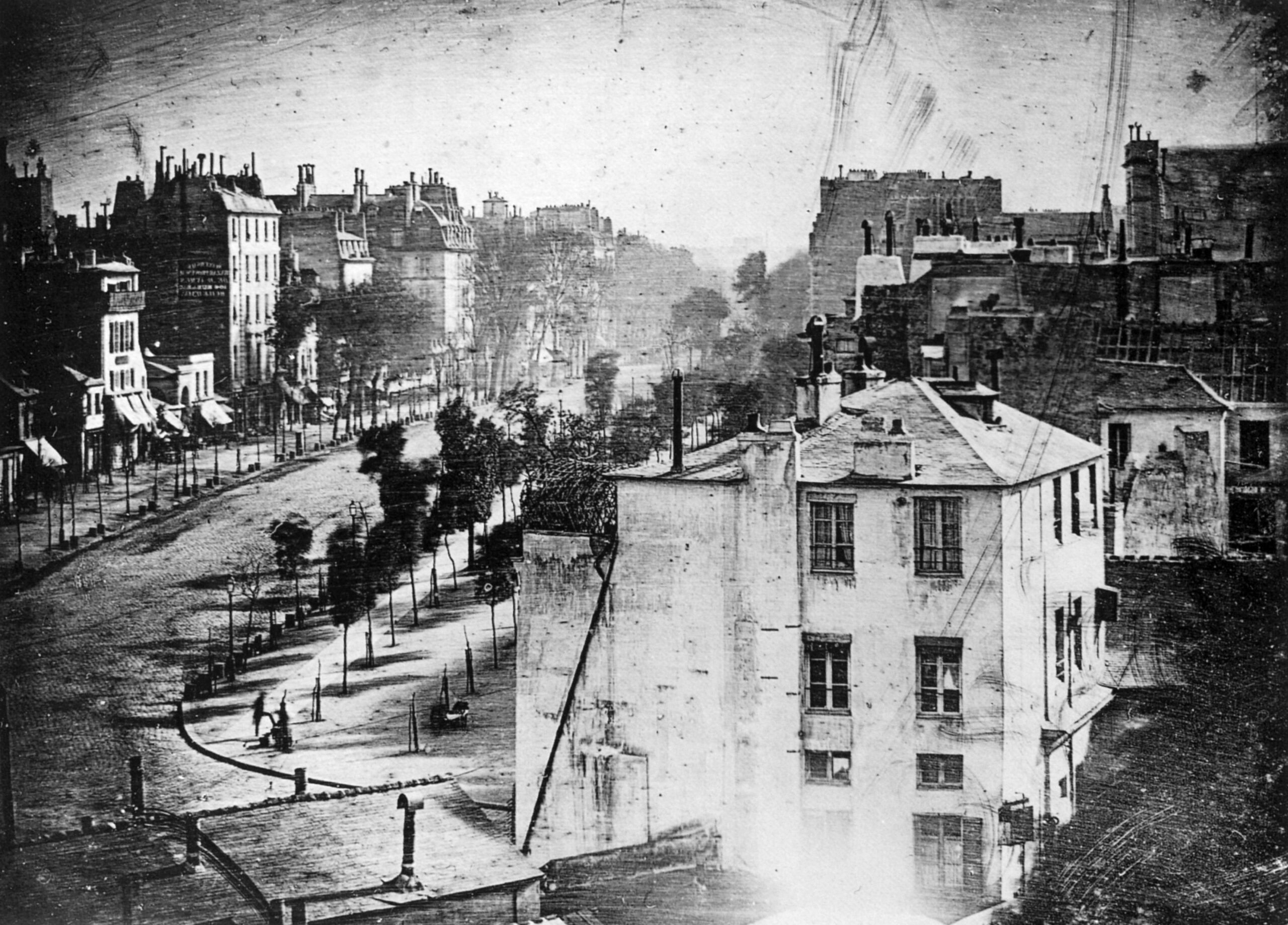
Quick Facts:
- Photograph: Boulevard du Temple, the morning plate
- Date taken: Spring 1838, in Paris
- Photographer: Louis Daguerre
- Location: A window above the Boulevard du Temple, Paris
- Process: Daguerreotype on a silver-coated copper plate
- Exposure: Several minutes, with sources citing a range of about four to fifteen
- First humans photographed: A bootblack and a customer in the lower-left corner
- Surviving plates: Two known views from the same window
- Holdings: Bayerisches Nationalmuseum, Munich
- Rights: Public domain by age
- Best for: Readers exploring the dawn of photography and early daguerreotypes
9 min read
In This Article
First Photograph of a Person Overview: Daguerre’s 1838 Boulevard du Temple
The first photograph of a person shows a Paris street under a bright spring sky, with two small human figures in the lower-left corner. Louis Daguerre exposed the silver-coated plate in 1838 from a window above the Boulevard du Temple. The exposure ran for several minutes. Everything moving across the street disappeared in the long wait, while a bootblack and his customer happened to stand still long enough to register.
This story runs from a French painter’s workshop to the first image of a human being ever recorded on a chemical plate. You will read who pressed the shutter, what the daguerreotype process required, why almost every passerby vanished from the frame, and how the surviving plate ended up in a Munich museum. The photograph belongs to a short list of frames on the history of photography timeline which anchor the medium’s earliest decade.
For a photography audience, the picture is more than a curiosity. It is a working lesson in what long exposure does to a scene, and a quiet reminder of how every photograph rests on choices a photographer has already made before the shutter opens.
At a Glance
Here are the core details of the photograph. The table below sets out the frame, the photographer, the process, and the holdings before the full story.
| Detail | Information |
|---|---|
| Title | Boulevard du Temple (the morning plate) |
| Date exposed | Spring 1838 |
| Photographer | Louis Daguerre |
| Location | A studio window above the Boulevard du Temple, Paris |
| Process | Daguerreotype on a silver-coated copper plate |
| Exposure time | About four to fifteen minutes (sources vary) |
| Plate dimensions | Roughly 13 by 16 centimeters |
| Surviving versions | Two known plates of the same view |
| Public announcement | January 7, 1839, at the French Academy of Sciences |
| Holdings | Bayerisches Nationalmuseum, Munich |
| Rights | Public domain by age |
How the First Photograph of a Person Was Made
In the spring of 1838, Louis Daguerre carried a freshly sensitized copper plate to a window in his Paris studio. The studio sat above the Boulevard du Temple, a busy theatre street lined with carriages, vendors, and pedestrians. He fixed his camera obscura on a tripod, framed the view down the boulevard, and opened the lens cap to begin the exposure.
Daguerre then waited. The chemistry on the plate needed several minutes of bright light to record an image. Estimates of the exposure run from about four minutes in the most generous accounts to roughly fifteen minutes in others. Either way, the wait was long enough to erase nearly every moving thing on the street.
Carriages rolled past. Pedestrians walked under his window. Vendors pushed their carts. None of them registered on the plate because none of them held still long enough for the light from their bodies to build up an image. Only the stationary parts of the scene survived in the silver: buildings, trees, paving stones, and the empty road.
In the lower-left corner of the frame, however, two figures stood still. A bootblack worked on the boots of a customer leaning against a building. The pair held position long enough for the chemistry to record them. After Daguerre developed the plate with mercury vapor, those two figures became the first known human beings preserved in any photograph.
Louis Daguerre: The Painter Who Built the Daguerreotype

Louis Daguerre was born in 1787 in Cormeilles-en-Parisis, France. He trained first as an architect, then turned to scene painting and the popular diorama theatre he co-built in Paris in 1822. The diorama drew large crowds with painted illusions and shifting light, and it gave Daguerre a working interest in how images and light behaved together.
In the late 1820s, he started a correspondence with Nicéphore Niépce, the French inventor who had already produced the first photograph ever taken, the 1826 or 1827 View from the Window at Le Gras. By 1829, the two men signed a formal partnership. Their goal was a faster, sharper photographic process than Niépce’s heliography.
Niépce died in 1833, before the partnership produced a workable result. Daguerre kept working alone. After several more years of trial and error, he settled on a sequence using iodine-sensitized silver plates and mercury-vapor development. By 1838, the process was ready for a serious test. The Boulevard du Temple plate was one of the first proofs the technique worked.
Daguerre lived another thirteen years after the process became public. He died in 1851. His name is now attached to the medium’s earliest practical technique, but he did not invent photography alone; he carried the work begun by Niépce across the finish line.
The Daguerreotype Process and the Long Exposure
The daguerreotype process was demanding. Each plate began as a sheet of copper coated with a thin layer of pure silver. The silver was buffed to a mirror finish, then exposed to iodine vapor inside a sealed box. The vapor reacted with the silver to form silver iodide, a light-sensitive compound.
Next, the sensitized plate went into a camera obscura, where the photographer aimed it at the scene and opened the lens. After several minutes of exposure, a faint latent image lay on the plate. Daguerre brought the plate over a heated dish of mercury, and the vapor reacted with the exposed areas to form a visible silver-mercury amalgam. Finally, a bath of salt or sodium thiosulfate fixed the image so it would not fade in daylight.
Why the Long Exposure Mattered
Early daguerreotype plates were slow. A single image required minutes of sunlight before any picture appeared. For a portrait sitter, this meant holding still under bright light for minutes at a stretch. For a city street, it meant erasing most of the people in the frame.
The long exposure is also a working tool for modern photographers. Long-exposure photography techniques still rely on the same physics. Anything moving during the open shutter becomes a streak or disappears, while anything fixed records cleanly. Daguerre saw the effect in 1838 by necessity. Photographers today use it by choice.
The Bootblack and the Customer
The figures in the lower-left corner are small. In a high-resolution scan, the customer stands with one foot raised on a shoeshine box, leaning into the wall behind him. The bootblack kneels at the customer’s feet, head tilted toward the work. The two men needed to hold their positions for several minutes for the chemistry to read them.
Their identities are unknown. Daguerre did not record their names, and no contemporary account places specific people in the frame. Both men were almost surely strangers to him, ordinary Parisians who happened to be working on a sidewalk under his window at the right moment.
Some scholars argue Daguerre arranged the scene, asking a shoeshiner and a customer to pose. Others read the image as accidental, the simple result of two stationary figures in a long exposure. The plate itself cannot answer the question, and no written evidence settles it. Either way, the bootblack and his customer became the first people ever recorded by photography.
Some scholars have proposed alternate readings of the lower-left scene. For example, a few argue the customer leans against a water pump rather than a shoeshine box. The bootblack reading remains the standard interpretation, and the lower-left corner is still the picture’s defining detail.
The Public Announcement of the Daguerreotype
The Boulevard du Temple plate was a proof of concept, not a public release. Daguerre kept the process to himself through most of 1838 and the early weeks of 1839 while he sought a French government partner.
On January 7, 1839, François Arago, a respected astronomer and member of the French Academy of Sciences, presented the daguerreotype to the Academy in Paris. He described the technique in broad terms without releasing the chemical recipe. The presentation set off intense public interest across Europe and North America.
Then, on August 19, 1839, the French government bought the rights from Daguerre and the heirs of Niépce in exchange for life pensions, and made the process freely available worldwide. Newspapers reported the gift as a present from France to the world. Within months, photographers across Europe and the United States were buying daguerreotype kits and producing their first plates.
1838 or 1839: The Dating Question
Reference sources sometimes date the Boulevard du Temple plate to 1838, sometimes to 1839. Both years appear in museum captions and history textbooks. The split is less a dispute and more a question of which event a writer is dating.
All evidence points to a 1838 exposure, during the spring or early summer. Daguerre needed the long, bright days of the warm months for the chemistry to work, and shadow analysis of the surviving plates points to the warm-weather window. The Boulevard du Temple plate was one of several test exposures he made during this period.
What happened in 1839 was the public announcement and the donation of the plate. In late 1839, Daguerre presented one of the surviving Boulevard du Temple plates to King Ludwig I of Bavaria. The plate eventually entered the Bayerisches Nationalmuseum in Munich, where it remains today. When a museum dates the plate to 1839, the curator is usually marking the donation, not the original exposure.
Why the First Photograph of a Person Still Matters
The Boulevard du Temple plate is small, faint, and partly damaged after nearly two centuries in storage. It is also one of the most consequential frames in the history of photography. Before this plate, the medium had captured rooftops, courtyards, and dishes of fruit. After it, the medium had a human face in the record.
For working photographers, the lesson is plain. Long exposure shapes what survives in a frame. Modern equivalents pull the same trick at different scales. The Pillars of Creation Hubble photograph required minutes of exposure across many sub-frames to record a star-forming region thousands of light-years away. Daguerre’s plate required minutes of exposure to record two men on a sidewalk a few meters from his lens. The physics is the same. Only the target has changed.
From a Sidewalk in Paris to the Modern Medium
The Boulevard du Temple plate also opened a door which has not closed since. Within a decade, daguerreotype portrait studios were operating in most large European and American cities. By the 1850s, war photographers were carrying plate cameras into the field. Apollo 8’s Earthrise photographed our home planet from lunar orbit in 1968. Each step grew from the chemistry Daguerre demonstrated on his Paris window in 1838.
The plate itself rests today at the Bayerisches Nationalmuseum in Munich. A 1970 cleaning attempt damaged the originals, so the museum now displays high-quality facsimiles in the historic framing while keeping the plates in protective storage. You will find the full curatorial record on its dedicated Wikipedia entry, which is the most thorough public reference. Like every public-domain image in this series, the plate is free for any reader to study, share, and reproduce.
Frequently Asked Questions
What Is the First Photograph of a Person?
The first photograph of a person is a daguerreotype plate made by Louis Daguerre in spring 1838, showing a view down the Boulevard du Temple in Paris. In the lower-left corner, a bootblack and his customer stood still long enough for the long exposure to register them. Everyone else on the busy street vanished from the frame.
Who Took the First Photograph of a Person?
Louis Daguerre, a French painter and the inventor of the daguerreotype, exposed the plate from a window above the Boulevard du Temple in Paris. He had spent nearly a decade refining the process, picking up where his former partner Nicéphore Niépce left off in 1833. The plate was one of his first successful test exposures.
When Was the First Photograph of a Person Taken?
The plate was exposed in the spring of 1838, in Paris. Sources sometimes give the date as 1839 because Daguerre announced his process publicly on January 7, 1839, and donated a Boulevard du Temple plate to King Ludwig I of Bavaria later the same year. The actual exposure, however, happened a year earlier.
Where Was the First Photograph of a Person Taken?
The view looks down the Boulevard du Temple, a busy theatre street in Paris. Daguerre exposed the plate from a window of his own apartment and studio, which sat above the boulevard. The exact building no longer survives in the same form, since the boulevard was reshaped under Baron Haussmann’s redesign of Paris in the 1860s.
Why Are Most People Missing From the Frame?
The daguerreotype required several minutes of exposure. Anything moving during the open shutter, including pedestrians, carriages, and vendors, did not stay in one spot long enough for the chemistry to record. Only stationary subjects, such as buildings, trees, and the bootblack pair, registered on the plate.
Where Is the Original Daguerreotype Today?
The most famous surviving Boulevard du Temple plate lives at the Bayerisches Nationalmuseum in Munich, Germany. Daguerre donated it to King Ludwig I of Bavaria in 1839, and it later entered the museum’s collection. After a 1970 restoration accident damaged the originals, the museum now shows high-quality facsimiles in the historic framing, with high-resolution digital scans available for public study.

