


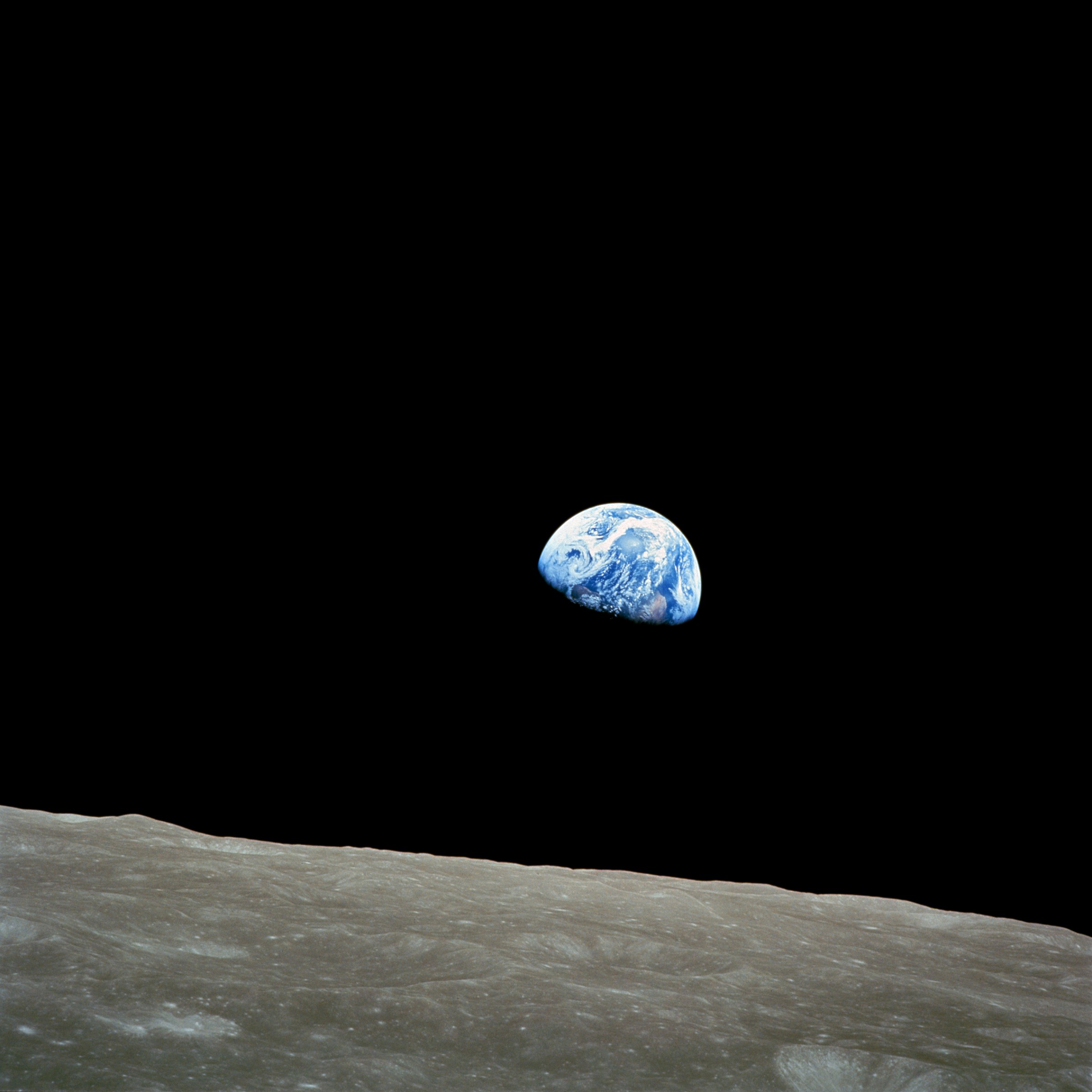
Quick Facts:
- Photograph: Earthrise (NASA frame AS8-14-2383)
- Date taken: December 24, 1968
- Photographer: William Anders, Apollo 8 astronaut
- Location: Lunar orbit, about 60 nautical miles above the Moon
- Camera: Modified Hasselblad 500 EL with a 250mm lens
- Film: 70mm Kodak Ektachrome color film
- Rights: Public domain, produced by NASA
- Best for: Readers exploring the history behind the Earthrise photo
10 min read
In This Article
- Earthrise Photo Overview
- Earthrise at a Glance
- The Moment Apollo 8 Saw Earth Rise
- Apollo 8: The Mission Behind the Picture
- William Anders: The Astronaut Who Pressed the Shutter
- The Camera and Film Used to Shoot the Earthrise Photo
- Who Took the Earthrise Photo?
- Which Way Is Up: The Orientation Debate
- Why the Earthrise Photo Still Matters
- Frequently Asked Questions
Earthrise Photo Overview: The Image of Earth From Another World
The Earthrise photo shows a blue-and-white Earth hanging in black space above a gray lunar horizon. William Anders took it on December 24, 1968, from the windows of Apollo 8. Until then, no human had photographed Earth from the Moon. Within months, the picture reshaped how people on the ground saw their own home.
The full story runs from a routine photo task to a picture studied around the world. You will learn who pressed the shutter, which spacecraft and camera made the frame possible, and why photographers still argue about it. Earthrise sits on the history of photography timeline as one of a few images people recognize on sight.
Apollo 8 carried three astronauts on the first crewed flight to orbit the Moon. The mission aimed to test the route toward a lunar landing. Instead, its most lasting result was a single color photograph of home. For a photography audience, the frame also raises practical questions, from the gear involved to the public-domain status of the file.
Earthrise at a Glance
Here are the core details of the photograph. The table below sets out the frame, the mission, and the gear before the full story.
| Detail | Information |
|---|---|
| Official NASA frame | AS8-14-2383 |
| Date and time | December 24, 1968, near 16:39 UTC |
| Mission | Apollo 8, fourth lunar orbit |
| Photographer | William Anders |
| Camera body | Modified Hasselblad 500 EL (electric drive) |
| Lens | 250mm telephoto |
| Film | 70mm Kodak Ektachrome, ASA 64 |
| Altitude | About 60 nautical miles above the Moon |
| Earlier frame | Black-and-white AS8-13-2329, shot about a minute before |
| Copyright status | Public domain, produced by NASA |
The Moment Apollo 8 Saw Earth Rise

The famous frame came as a surprise to everyone aboard. On December 24, 1968, Apollo 8 was circling the Moon for the fourth time. The crew then began a slow, planned roll of the spacecraft. Because the maneuver lined it up for a routine photo run, no one expected a view of home. About a minute into the roll, however, Earth slid into the frame of a side window.
During three orbits, the crew had studied a gray, cratered Moon. Its far side showed no color and no soft edges. Against the bleak ground, however, the blue and white of Earth looked almost shocking. The three men then reacted the way anyone would. As a result, they stopped the routine and stared.
Anders reacted first. He grabbed a camera already loaded with black-and-white film and then shot a frame, cataloged today as AS8-13-2329. Borman, half joking, said the picture was not on the flight plan. Still, Anders kept going. Within seconds, he wanted the blue of the planet on color film.
The Scramble for Color Film
Anders quickly asked Jim Lovell for a magazine of color film. Lovell found one and then passed it across the cramped cabin. After loading it, Anders aimed through a simple sighting ring and exposed the color frames. One frame, AS8-14-2383, finally became the image the world knows. The whole scramble took barely a minute.
No tripod helped here. Instead, Anders worked a 250mm telephoto lens by hand. He aimed on a moving spacecraft, against a target he had seconds to catch. A miss meant no second try. Like the first photo ever taken, the frame marks a threshold the medium crossed only once.
Apollo 8: The Mission Behind the Picture
Apollo 8 carried the first people ever to leave Earth’s orbit. The mission launched on December 21, 1968, on a Saturn V rocket. Three days afterward, the spacecraft reached the Moon. Because no crew had flown so far before, every hour drew a large television audience.
The decision to send Apollo 8 to the Moon came late and carried real risk. NASA changed the flight plan in 1968 because the lunar lander ran behind schedule. Engineers also watched Soviet plans for the Moon with concern. Therefore, the agency chose a bold step and sent a crew into lunar orbit before year’s end. Apollo 8 then brought home the first color view of Earth from the Moon.
Three astronauts flew the mission. Frank Borman commanded it. Jim Lovell served as command module pilot, while William Anders held the title of lunar module pilot. No lunar module flew on Apollo 8, so Anders instead took on much of the science and photography work.
The goal was reconnaissance, not a landing. First, NASA wanted to test the long route to the Moon. The crew also had to scout future landing sites. Because Anders carried a photo assignment for the lunar surface, a camera sat ready when Earth appeared. As a result, the photograph came from a mission built for a different purpose.
On Christmas Eve, meanwhile, the crew read from the Book of Genesis during a live broadcast. Millions of people watched and listened. Both the reading and the photograph came from the same few hours in lunar orbit. Finally, on December 27, 1968, Apollo 8 returned to Earth.
William Anders: The Astronaut Who Pressed the Shutter
William Anders worked as an engineer and a pilot, never as a photographer. Born in 1933, he grew up in a military family. After service in the U.S. Air Force, he earned a master’s degree in nuclear engineering. NASA then selected him as an astronaut in 1963.
Apollo 8 became his only spaceflight. During the mission, his duties also included photographing the Moon for landing studies. He handled the cameras more than anyone else aboard. Therefore, when Earth rose into view, the right crew member held the camera.
Anders trained hard for the camera work. Before launch, he practiced framing and exposure until the steps felt automatic. He also learned the film stock and the limits of each setting. Because of this preparation, he worked fast when Earth appeared. In a few seconds, he made choices most people would miss in a calm studio.
This pattern repeats across photo history. For example, a coastal lifesaver named John Daniels took the Wright brothers’ first flight photo, although he had never worked a camera. Landmark images often reach the hands of people doing another job. Similarly, Anders filled the role by assignment, not by training.
Anders later summed up the trip in a single thought. The crew flew all the way to the Moon, he said, yet the most important thing they found was their own planet. After NASA, he led the Nuclear Regulatory Commission and served as U.S. ambassador to Norway. He died on June 7, 2024, in a small-plane crash off the coast of Washington state, at age 90. The photograph he made in those few seconds outlived everything else on his record.
The Camera and Film Used to Shoot the Earthrise Photo

The famous frame came from a Hasselblad 500 EL, a Swedish medium-format camera. NASA chose Hasselblad bodies for their reliability and image quality. Before flight, engineers modified each one heavily. For instance, they swapped lubricants for the vacuum and fitted large controls for gloved hands.
During the Earthrise sequence, the body wore a 250mm telephoto lens. Earlier, Anders had used the same lens for close work on the lunar surface. A 70mm film magazine then held the film. Specifically, it carried Kodak Ektachrome, a color film rated at ASA 64.
Shooting Without a Viewfinder
NASA stripped the reflex viewfinder from the camera. In its place, engineers fitted a simple sighting ring on top of the body. Anders therefore aimed by lining up the ring, never by looking through the lens. As a result, the camera stayed lighter and simpler to work in bulky gloves.
Exposure came preset for a bright, sunlit subject. Sunlit Earth reads much like a clear day on the ground. So the crew used settings close to ordinary daylight, with a fast shutter and a mid-range aperture. Meanwhile, the black sky stayed empty, since the short exposure left faint stars unrecorded.
The film itself never developed in space. Each magazine traveled home sealed inside the spacecraft. After splashdown, NASA processed the rolls and copied the frames. Only then did the catalog number AS8-14-2383 attach to the picture. So the image the public saw had already passed through careful, ground-based handling.
For photographers, the gear story carries a plain point. The photograph did not need a rare or complex tool. Instead, it needed a reliable camera, a sharp lens, and a steady hand under pressure.
Who Took the Earthrise Photo?
NASA credits William Anders with the Earthrise photo. He shot the color frame AS8-14-2383 and the black-and-white frame a minute earlier. For decades, however, the credit stayed muddled.
Because Borman commanded the mission, some accounts named him as the photographer. National Geographic once printed his name beside the image. Meanwhile, Jim Lovell added to the confusion and claimed the shot as a joke. Three men in one small cabin left a tangled record.
The muddle made sense at the time. In a three-man cabin, for instance, cameras passed hand to hand within seconds. Meanwhile, no one logged each frame as it happened. Memory then filled the gaps, and three accounts slowly drifted apart. Therefore, only the tape and the film, read together, settled the order.
Anders stayed certain he took the frame. He then wrote to Richard Underwood, a NASA expert on astronaut photography. After reviewing the work, Underwood replied he believed Anders took it. Still, a firmer answer came later.
Later, a NASA analyst named Ernie Wright matched the onboard audio to the film and the spacecraft’s motion. The tapes show Anders spotting Earth, then asking Lovell for color film, and exposing the frames. Borman afterward accepted the finding. The record now points clearly to Anders.
Which Way Is Up: The Orientation Debate
Open a textbook to the Earthrise photo. In most printings, for instance, the Moon sits flat along the bottom. Above it, Earth hangs halfway risen. Yet the frame Anders exposed looked different.
Anders shot through a side window while the spacecraft rolled. In the original frame, therefore, the lunar horizon ran nearly vertical. The Moon sat to one side, and Earth rested beside it rather than above it. Afterward, NASA and publishers turned the image about 90 degrees.
The rotation broke no rules. In orbit, no fixed up or down exists. Therefore, editors picked the orientation a ground reader would grasp fastest. Even so, some prints still circulate turned the other way.
The point reaches past space history. Cropping and rotation still shape how any viewer reads a picture. Earthrise makes the case on the largest stage available.
Why the Earthrise Photo Still Matters

The photograph spread fast after Apollo 8 came home. In early 1969, newspapers ran it worldwide. Within weeks the image gave millions a clear view of one small, shared planet. Before then, no diagram or speech had carried the idea so well.
Honors followed quickly. First, in 1969, the U.S. Post Office placed a detail of the image on a stamp. The stamp carried the words “In the beginning God,” a nod to the crew’s Christmas Eve reading. Then, a year later, the picture became a symbol of the first Earth Day.
From the Photograph to a Global Movement
Earth Day arrived on April 22, 1970. About 20 million Americans took part in the first one. Meanwhile, the image became shorthand for the cause. Years afterward, wilderness photographer Galen Rowell called it “the most influential environmental photograph ever taken.”
Before long, the photo stood as a symbol of the modern environmental movement. The picture now sits beside other images of similar weight. For example, the study of how Muybridge froze a galloping horse proved what the eye misses on its own. Similarly, Dorothea Lange’s Migrant Mother put a human face on the Great Depression.
Earthrise also opened a short era of whole-Earth pictures. Four years afterward, the Apollo 17 crew shot the Blue Marble, the famous full-disk view of the planet. Yet Earthrise came first. Specifically, it gave the public an early, honest sense of Earth from the Moon, small and alone in the dark.
Modern missions also keep repeating the shot. In 2015, for instance, NASA’s Lunar Reconnaissance Orbiter built a sharp new Earthrise composite. Each later mission then adds its own version. For the full record, see NASA’s Apollo 8 Earthrise page.
Today, the photograph belongs to a small group of images people know on sight. It still appears in classrooms, on flags, and in climate reporting. Decades from now, the picture will still carry its plain message about home.
Frequently Asked Questions
What Is an Earthrise?
An earthrise is the sight of Earth climbing above the Moon’s horizon. The Moon keeps one face toward Earth, so from the surface our planet barely moves. From a spacecraft circling the Moon, however, Earth appears to rise and set. Apollo 8 saw the effect because it kept orbiting.
When Was the Earthrise Photo Taken?
Anders shot the Earthrise photo on December 24, 1968. Specifically, the time was near 16:39 UTC, during Apollo 8’s fourth orbit of the Moon. He exposed a black-and-white frame first, then the color frame about a minute later. Both frames came inside the same short window.
What Camera Was Used to Take the Earthrise Photo?
Anders used a modified Hasselblad 500 EL with a 250mm lens. First, NASA had stripped the reflex viewfinder and added a sighting ring. The body also held a 70mm magazine of Kodak Ektachrome color film. Because it stayed simple, the camera worked well in heavy gloves.
Is the Earthrise Photo Public Domain?
Yes. NASA produced the Earthrise photo as a U.S. government work, so it carries no copyright. You are free to reproduce it in books, prints, and online. Still, NASA asks you to avoid suggesting the agency endorses your work. Therefore, the file suits classrooms, articles, and personal projects.
Is the Earthrise Photo Real?
Yes. The image is an unstaged photograph from Apollo 8. The black sky holds no stars because the crew set the exposure for a bright, sunlit Earth. Similarly, daytime photos on the ground show an empty sky. The onboard audio and film record both back up the frame.
Has the Earthrise Photo Been Recreated?
Yes, many later missions have recreated the view. Later Apollo crews photographed Earth above the lunar horizon. In 2015, NASA’s Lunar Reconnaissance Orbiter produced a high-resolution Earthrise composite. Each new mission to the Moon then adds another version. Still, the 1968 frame holds its place as the first.
Heads up: a few links here are affiliate links. If you buy through one, PhotographyTalk earns a small commission, no extra charge to you. Enough for a cup of coffee, and we appreciate it.

