


Quick Facts:
- Project: The North American Indian
- Years: 1907 to 1930 (project), 1895 to 1930 (full Native American work)
- Photographer: Edward Sheriff Curtis (1868 to 1952)
- Primary funder: J. Pierpont Morgan and the Morgan family
- Output: 20 volumes, 2,228 photogravures, 1,500 textual pages
- Tribes documented: More than 80 across North America
- Camera: 6.5×8.5 and 11×14 field cameras, with a 14×17 view camera for studio work
- Process: Glass plate negatives, photogravure prints, platinum prints
- Holdings: Library of Congress, Smithsonian, Morgan Library, Seattle Art Museum
- Rights: Public domain (Curtis died 1952; PD by age in the US since 2023)
- Best for: Readers interested in documentary photography history and Native American studies
10 min read
In This Article
- Overview
- At a Glance
- How Curtis Made the Project
- Edward Curtis: From Seattle Studio to J.P. Morgan
- The North American Indian Project
- The Iconic Images: Geronimo, Chief Joseph, The Vanishing Race
- Cameras, Process, and the Staging Debate
- Legacy and Critical Reappraisal
- Why Edward Curtis Photography Still Matters
- Frequently Asked Questions
Edward Curtis Photography Overview: The North American Indian Project
Edward Curtis photography centers on a single twenty-three-year documentary project: The North American Indian. From 1907 to 1930, Edward Sheriff Curtis and a small field team traveled across the United States and Canada to document more than eighty Native American tribes. The work appeared in twenty leather-bound volumes containing 2,228 photogravures and roughly 1,500 pages of text. Today it remains one of the most ambitious documentary projects in the history of photography.
The project ran on private funding. J. Pierpont Morgan agreed to underwrite the work in 1906 with an initial commitment of $75,000, and the Morgan family continued funding through the 1920s after his death. President Theodore Roosevelt wrote the foreword. The first volume appeared in 1907; the twentieth and final volume reached subscribers in 1930. Curtis photographs belong on the photography history timeline as the high-water mark of the Pictorialist documentary impulse in early twentieth-century American photography.
The full story runs from Curtis’s chance encounter with the Piegan Blackfoot in Montana around 1900 to the bankruptcy auction of his glass plates in 1935. For a photography audience, the project is more than a Native American studies subject. It is a case study in scope, staging, patronage, and the gap between documentary intent and documentary practice.
At a Glance
Here are the core details. The table below sets out the project, the photographer, the dates, and the scholarly footprint before the full story.
| Detail | Information |
|---|---|
| Project | The North American Indian |
| Years | 1907 to 1930 |
| Photographer | Edward Sheriff Curtis (1868 to 1952) |
| Primary funder | J. Pierpont Morgan and the Morgan family |
| Total output | 20 volumes, 2,228 photogravures, ~1,500 pages text |
| Tribes documented | More than 80 across North America |
| Subscription edition | 500 sets planned, ~272 sets sold |
| Original price | $3,000 per set (about $90,000 today) |
| Camera | 6.5×8.5 and 11×14 field cameras, 14×17 for studio |
| Foreword | President Theodore Roosevelt, 1907 |
| Holdings | Library of Congress, Smithsonian, Morgan Library, Seattle Art Museum |
| Rights | Public domain (PD by age in the US since 2023) |
How Curtis Made Edward Curtis Photography of The North American Indian
Curtis worked in long field seasons, typically four to six months at a stretch, with short returns to Seattle for editing and gallery sales. Also, he traveled by horse, wagon, river boat, and railroad. His field team included translators, ethnographers, sound recordists, and assistants who carried plates and chemicals. The team also captured wax cylinder recordings of language and song supplementing the photographs in the published volumes.
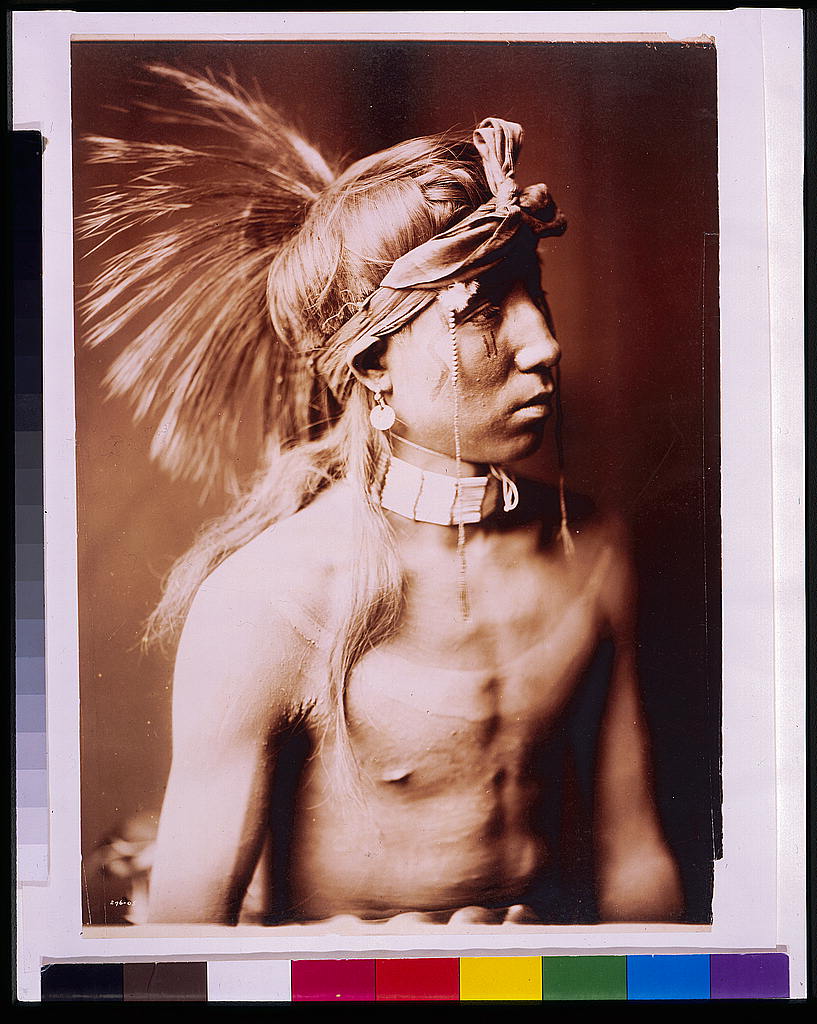
Notably, each field stop began with introductions through a local contact, often a trader or a previous tribal contact. Curtis paid his subjects, sometimes in cash and sometimes in goods. He typically asked subjects to wear traditional dress and to remove or hide modern items. Curtis photographs frequently show subjects against neutral backgrounds, posed with the photographer’s careful eye on lighting and composition.
The field work moved slowly. A single portrait session sometimes ran an entire day, with Curtis adjusting reflectors, repositioning the subject, and exposing multiple plates. Then the team would pack, move to the next site, and start again. Over two decades, this pattern produced the negatives filling twenty volumes.
Translators, Ethnographers, and Field Process
The team carried wax cylinder recorders alongside the cameras. Anthropologists working with Curtis, especially William E. Myers, transcribed languages, songs, and oral traditions. Myers stayed with the project from 1906 until 1926, contributing roughly two-thirds of the text in the published volumes. After Myers left, Curtis struggled to maintain the editorial standard, and the late volumes are widely seen as thinner in scholarly substance.
Curtis often hired older tribal members specifically because younger generations had moved away from the dress and customs the project sought to document. This selection bias would later become central to scholarly critique. The published photographs over-represent older subjects in traditional dress and under-represent the contemporary reality of reservations in 1910 or 1920.
Edward Curtis: From Seattle Studio to J.P. Morgan
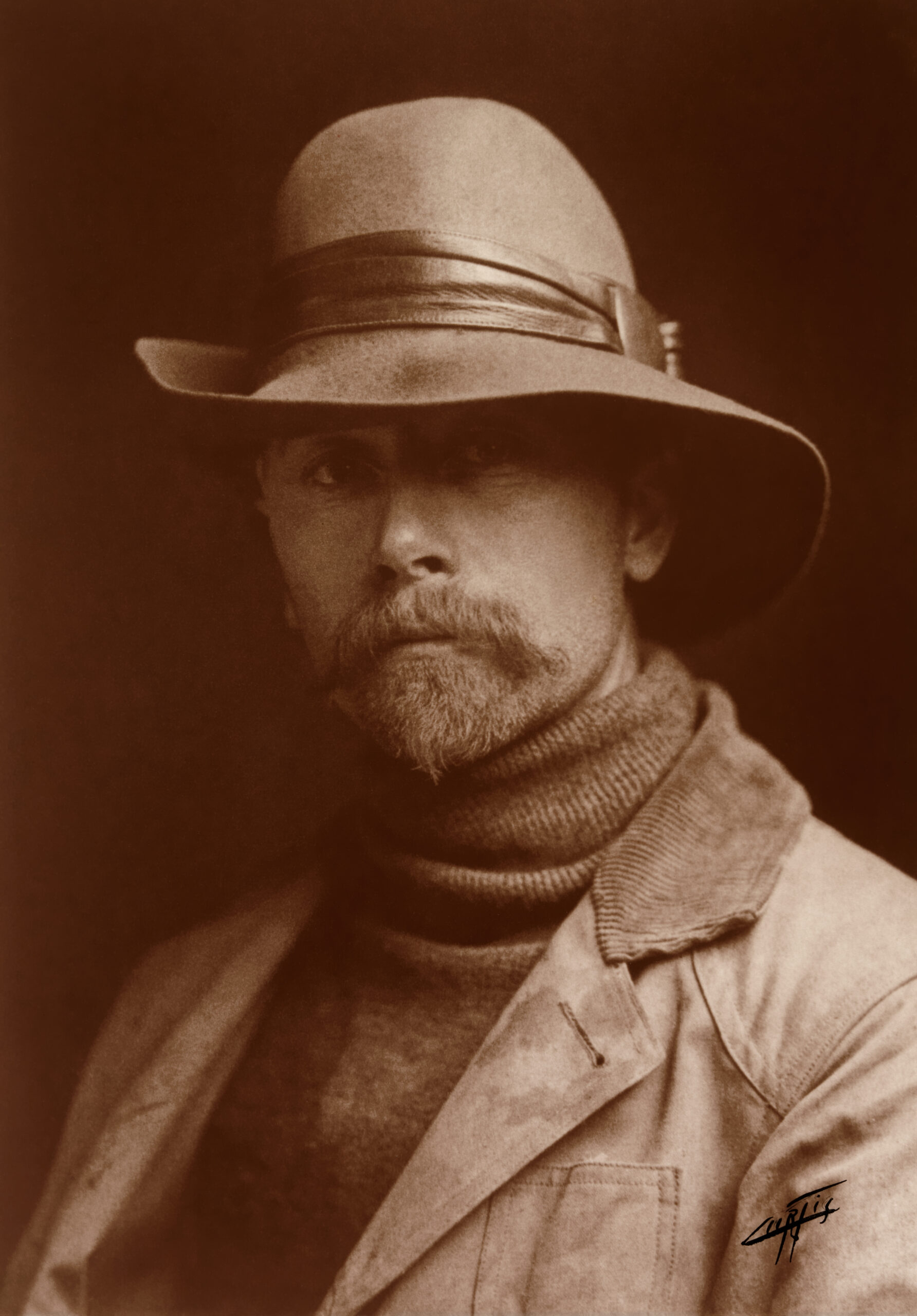
Edward Sheriff Curtis was born in Whitewater, Wisconsin, on February 16, 1868. His father was a Civil War veteran and itinerant minister, and the family moved often. Curtis built his first camera as a teenager from instructions in a photography manual. After his father’s death in 1887, the family moved to the Puget Sound area of Washington Territory.
By 1895, Curtis had bought a half-interest in a Seattle portrait studio, which he soon owned outright. The studio thrived. Notably, his 1895 portrait of Princess Angeline, daughter of Chief Seattle, helped establish his reputation; in 1898 his print Homeward won a gold medal at the National Photographic Society exhibition. In 1898 on Mount Rainier, Curtis encountered a party of scientists led by George Bird Grinnell. He helped guide them down the mountain. Grinnell would later introduce Curtis to the Piegan Blackfoot of Montana. Soon afterward, Curtis’s commercial portrait career turned toward Native American documentary.
From 1900 forward, Curtis spent every summer in the field. In 1906, an introduction to J. Pierpont Morgan produced the funding for the full North American Indian project. Morgan died in 1913, but his family and the Morgan Library continued the funding through the 1920s. Curtis finished the twentieth volume in 1930. He died in Los Angeles on October 19, 1952, age 84, largely forgotten by the photography world he had once shaped.
The North American Indian Project
The full title was The North American Indian. Its subtitle described the scope across the United States, Canada, and Alaska. The original prospectus promised twenty large-format volumes plus twenty portfolios of separate plates. Each volume covered specific tribes or culture groups. Volume one began with the Apache, Jicarillas, and Navajo. Later volumes covered the Salishan tribes, the Sioux, the Plains tribes, the Northwest Coast peoples, the Eskimo, and others.
Subscribers paid $3,000 per set, equivalent to roughly $90,000 today. Curtis originally projected 500 sets. Actual sales reached fewer than 300 sets, most often cited as about 272, partly because the price was prohibitive and partly because the Great Depression interrupted the late years of subscription. The 1935 sale of the publication rights to the Morgan estate priced the remaining material at $1,000, and the original glass plates were sold separately for scrap value.
The book’s structure paired text on the left page and photogravure on the right. Maps, vocabularies, ceremonial descriptions, and ethnographic essays filled the text pages. Photogravures occupied most of the picture pages. The portfolios held the largest and most ambitious frames, including the iconic Vanishing Race plate and many of the chief and warrior portraits defining the project.
The Iconic Images: Geronimo, Chief Joseph, The Vanishing Race
Today a handful of frames have entered the canon of American photography. The 1905 portrait of Geronimo, made when the Apache leader was about seventy-six years old, is one of the most reproduced single images of any Native American leader. Curtis photographed Geronimo at the Carlisle Indian Industrial School in Pennsylvania the day before Theodore Roosevelt’s second inauguration. The image is a close head-and-shoulders portrait against a dark backdrop, the eyes cast slightly downward.
The 1903 Chief Joseph portrait carries similar weight. Curtis made the photograph at a hotel in Seattle in November 1903, about ten months before Joseph’s death. It is widely regarded as the last formal portrait of the Nez Perce leader. The two prints, taken minutes apart, show Joseph in traditional dress against a neutral backdrop, his expression composed and weary.
The Vanishing Race, made in 1904, is the most-quoted single Edward Curtis photograph and the conceptual emblem of the project. Riders move into shadow, their backs to the camera. Curtis published the plate as the opening photogravure of volume one, and the title set the framing the project would carry through every subsequent volume. Notably, the phrase “vanishing race” became the most contested element of the entire body of work in later scholarship.
Cameras, Process, and the Staging Debate
Curtis worked primarily with 6.5×8.5 and 11×14 field cameras, with the larger 14×17 view camera reserved for studio and exhibition work. The large plates produced contact prints of exceptional detail. From these negatives the team produced platinum prints for collectors and photogravures for the published volumes. Photogravure was the print process of choice: a copper-plate intaglio method yielding warm-toned, archival prints with continuous tonal range.
The staging question runs through every honest treatment of the work. Specifically, Curtis paid subjects to wear regalia they no longer wore daily. Also, he retouched negatives to remove suspenders, pocket watches, and umbrellas. In one well-documented case from the volume on the Piegan, he scraped a small alarm clock out of an interior scene before the plate went to photogravure. Likewise, Gardner’s staged Civil War photograph raised similar questions about documentary authenticity a half century earlier, and the Curtis case extends the same problem into ethnographic work.
Still, Curtis defended the practice as the only way to record what was disappearing from daily life. Critics, especially from the 1980s onward, have read the staging as evidence the project tells the story Curtis wanted to tell rather than the story his subjects were living. Both readings continue to circulate, and serious treatment of the work has to hold them together rather than choose between them.
Legacy and Critical Reappraisal
The project was nearly forgotten by mid-century. Curtis died in 1952 in modest circumstances, and his negatives sat in storage until the 1970s. His daughter Florence Curtis Graybill helped lead the revival. The Pierpont Morgan Library, the Smithsonian, and the Library of Congress all hold complete or near-complete sets. The Seattle Art Museum owns a significant Curtis archive built from his original Seattle studio holdings.
Scholarly reappraisal began in the 1970s and accelerated in the 1980s and 1990s. T.C. McLuhan’s 1974 independent film The Shadow Catcher helped launch the public revival. Books by Christopher Cardozo, scholarship from Mick Gidley, and Native American voices like Vine Deloria Jr. then reset the terms of how the project is read. Today most serious treatments hold both the achievement and the staging in view at once.
Compared to Dorothea Lange’s Migrant Mother and the FSA work a generation later, the Curtis project sits at the older boundary of documentary practice. Curtis used the camera as a salvage tool. Lange used the camera as a policy lever. Likewise, Ansel Adams’s American West for the Mural Project drew on a similar federal documentary impulse but with sharply different aesthetic and political ends.
Why Edward Curtis Photography Still Matters
Edward Curtis photography sits at the center of every modern conversation about documentary intent and ethnographic photography. The 20-volume archive holds genuinely irreplaceable information: language recordings, ceremonial documentation, and portraits of people whose grandchildren and great-grandchildren still use the prints as family records. Many tribal members and tribal historians value the work as a record despite, or because of, the staging debate.
For working photographers, the project is a study in scope and patronage. Curtis spent twenty-three years and roughly $1.5 million in early twentieth-century dollars on a single body of work, sustained by one wealthy family. Similarly, Stieglitz’s 1907 Pictorialist photography shaped the visual language Curtis worked in. The same warm tones, soft focus, and aestheticized framing followed the photogravure medium’s strengths.
For full curatorial detail, including a searchable index of every photogravure, see the Northwestern University Library’s Edward S. Curtis’s The North American Indian digital edition. The Library of Congress also offers high-resolution scans of the complete LoC Curtis holdings. Like every public-domain image in this series, the photographs are free for any reader to study, share, and reproduce.
Frequently Asked Questions
Who Was Edward Curtis?
Edward Sheriff Curtis was an American documentary photographer who lived from 1868 to 1952. After building a successful Seattle portrait studio in the 1890s, he turned to Native American documentary work around 1900. From 1907 to 1930, with funding from J. Pierpont Morgan, he produced the twenty-volume work The North American Indian.
What Cameras Did Edward Curtis Use?
Curtis worked primarily with 6.5×8.5 and 11×14 field cameras, with the larger 14×17 view camera reserved for studio and exhibition portraits. Reflex cameras handled faster field work. The large plates produced contact prints of exceptional detail, and the team produced platinum prints for collectors and photogravures for the published volumes.
Are Edward Curtis Photographs Public Domain?
Yes. Edward Curtis photographs entered the public domain in the United States in 2023, seventy years after his October 19, 1952 death. Most of the published photogravures were also public domain before then because they were published without renewed copyright notice. High-resolution scans are freely available from the Library of Congress and the Northwestern University Library digital edition.
How Many Photographs Did Edward Curtis Take?
The 20 published volumes of The North American Indian contain 2,228 photogravures. Curtis’s total negative archive ran to roughly 40,000 to 50,000 glass plates over the course of the project, though many were destroyed in the 1935 bankruptcy sale and subsequent storage losses. The Library of Congress, the Pierpont Morgan Library, and the Seattle Art Museum hold most of the surviving negatives and prints.
What Is The Vanishing Race?
The Vanishing Race is the most-quoted single Edward Curtis photograph, made in 1904. Riders move away from the camera into shadow. Curtis published it as the opening image of volume one of The North American Indian. The title became the conceptual frame of the entire project, and it also became the most contested element of the work in later scholarship.
Where Do I Find Original Prints?
Original Curtis photogravures and platinum prints live in the Library of Congress, the Pierpont Morgan Library, the Smithsonian National Museum of the American Indian, the Seattle Art Museum, the Beinecke Library at Yale, and major museum collections worldwide. The Northwestern University Library hosts the most complete free online edition of the photogravures. Selected vintage prints continue to appear at auction, with strong portrait plates selling in the low-to-mid five figures.

