


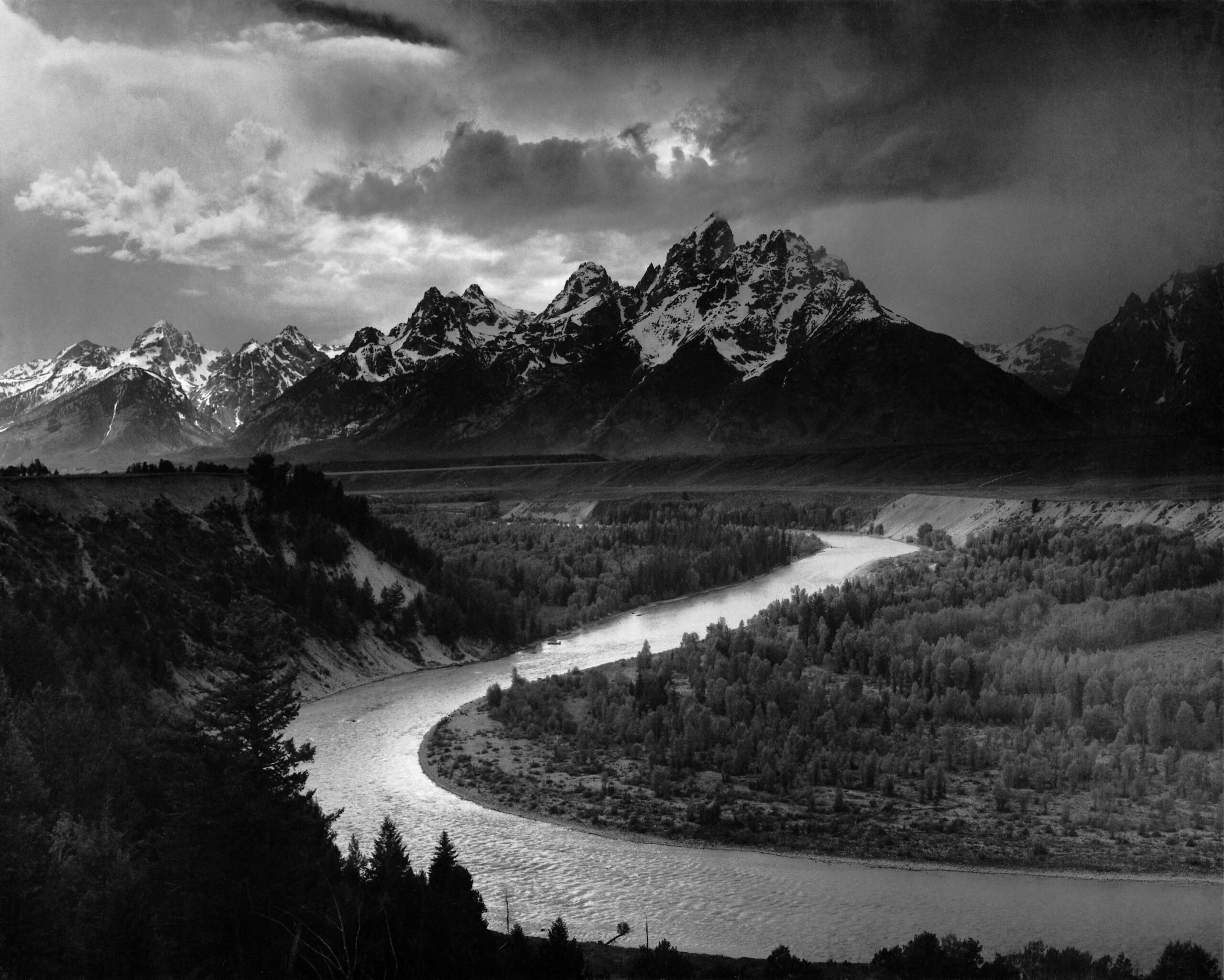
Quick Facts:
- Photograph: The Tetons and the Snake River
- Date taken: Summer 1942
- Photographer: Ansel Adams
- Location: Snake River Overlook, Grand Teton National Park, Wyoming
- Camera: 8 by 10 inch view camera on a wooden tripod
- Commission: U.S. Department of the Interior Mural Project
- Voyager Golden Record: One of 115 photographs sent on the 1977 NASA mission
- Public domain: The Mural Project version held by the National Archives
- Holdings: National Archives, National Gallery of Art, Philadelphia Museum of Art, J. Paul Getty Museum, University of Michigan Museum of Art
- Rights: Public domain as a U.S. federal government work
- Best for: Readers exploring American landscape photography and the Mural Project
8 min read
In This Article
The Tetons and the Snake River Overview: Ansel Adams’s 1942 Mural Project Photograph
The Tetons and the Snake River shows a dramatic view from a turnout in Grand Teton National Park on a July afternoon in 1942. Specifically, Ansel Adams made the photograph for a federal government commission, the Department of the Interior Mural Project. Notably, the image carries clouds, mountains, river, and forest in sharp focus across an 8 by 10 inch negative. Then, thirty-five years after Adams pressed the shutter, NASA included the picture on the Voyager Golden Record and sent it into interstellar space.
First, this article runs from a contract with the Department of the Interior to a photograph orbiting the Sun on a gold record. You will read who made the picture, what camera and process produced it, how Adams’s Zone System shaped the tonal range, and why the Mural Project negatives stayed in the National Archives instead of on a Washington wall. Above all, the photograph anchors a clear stop on the history of photography timeline as the moment American landscape photography became national property.
For a photography audience, the picture sits at the heart of mid-twentieth-century American landscape work. For instance, Adams shot it on the same scale he used for his commercial gallery work, with a contact print from an 8 by 10 inch negative as the original output. The result reads as cleanly today as it did in 1942.
At a Glance
Here are the core details. The table below sets out the frame, the photographer, the commission, and the gear before the full story.
| Detail | Information |
|---|---|
| Title | The Tetons and the Snake River |
| Date taken | Summer 1942 |
| Photographer | Ansel Adams |
| Location | Snake River Overlook, Grand Teton National Park, Wyoming |
| Camera | 8 by 10 inch view camera |
| Process | Black and white silver gelatin contact print |
| Commission | U.S. Department of the Interior Mural Project |
| Voyager Golden Record | One of 115 photographs sent on Voyager 1 and 2 in 1977 |
| Holdings | National Archives, National Gallery of Art, Philadelphia Museum of Art, J. Paul Getty Museum, University of Michigan Museum of Art |
| Rights | Public domain (Mural Project version, U.S. federal government work) |
How Adams Made The Tetons and the Snake River
In July 1942, Ansel Adams arrived at Grand Teton National Park as part of his federal commission. First, he drove to a turnout on the highway, now known as the Snake River Overlook. Then he set up his 8 by 10 inch view camera on a tripod. Below the overlook, the Snake River wound through a forested valley. Above the valley, the Teton Range cut a jagged line across the sky.
Adams waited for the light. Specifically, he photographed in black and white, so he watched for cloud shadows and the play of sunlight across the snow on the peaks. After a stretch of waiting, the clouds opened in the right places. He exposed a single sheet of 8 by 10 film through the lens shutter.
The negative came back to Adams’s home darkroom, where he developed and printed it later in the year. Notably, he pre-visualized the final image before the exposure happened, a method later called the Zone System. The final print carried a wide tonal range, from the bright snow on the peaks to the dark of the evergreens, with rich middle tones in the river and the cottonwoods along its banks.
Ansel Adams: Photographer of the American Wilderness
Ansel Adams was born in 1902 in San Francisco. First, he took up photography on a family trip to Yosemite in 1916, where his father gave him a Kodak Brownie. He spent decades returning to the Yosemite Valley to photograph it. Within two decades, he was one of the country’s leading landscape photographers.
In 1932, Adams co-founded Group f/64 with Edward Weston, Imogen Cunningham, and others. Notably, the group rejected the soft-focus pictorialism of the previous era. Instead, they favored sharp focus, deep depth of field, and full tonal range. Their approach became known as straight photography, a foundation for most modern American landscape and documentary work.
Adams also taught. Specifically, he helped found the photography department at the California School of Fine Arts in 1946 and ran workshops at Yosemite for decades. Several thousand photographers trained under him or with his published methods. He died in 1984 in Carmel, California, at the age of 82.
The Mural Project and the Department of the Interior
The Mural Project was a federal initiative within the U.S. Department of the Interior. Specifically, Secretary Harold L. Ickes wanted large photographic murals for the walls of the new Department of the Interior headquarters in Washington, D.C. In 1941, he hired Adams as a consultant to travel to national parks and shoot the necessary photographs.
Adams accepted the contract and spent 1941 and 1942 traveling. For example, he photographed Grand Canyon, Yellowstone, Carlsbad Caverns, Sequoia, Kings Canyon, Saguaro, Glacier, Mesa Verde, and Grand Teton, among others. The Department paid him a per diem rate plus expenses for the work.
Then the United States entered World War II. Specifically, by 1942, federal budgets shifted hard to the war effort. Therefore the Mural Project was suspended. As a result, the murals planned for the Department of the Interior walls were never installed. Adams’s photographs went into the National Archives, where they have stayed ever since.
The Camera and the Zone System
Adams worked with an 8 by 10 inch view camera mounted on a heavy wooden tripod. Specifically, the view camera used a large ground glass at the back for composing. The photographer focused under a dark cloth, slid in a film holder, and exposed a single sheet of black-and-white film for each image. There was no second take.
For landscape work, the 8 by 10 was a slow tool. Each exposure took several minutes of setup. For instance, the camera had to be leveled, the front and rear standards adjusted for depth of field and perspective, and the shutter timed by hand.
The Zone System
Adams and Fred Archer developed the Zone System at the Art Center School in Los Angeles in 1939 and 1940. In particular, the method divides the tonal range of a scene into eleven zones, from pure black to pure white. The photographer chooses an exposure and development plan placing the highlights and shadows where the print needs them.
For The Tetons and the Snake River, the Zone System mattered. Notably, the scene held bright snow, deep evergreens, and the silver of the river. Without careful zone placement, the print would have lost either the highlights on the peaks or the shadows in the trees. Adams pre-visualized the print before exposure, exposed for the shadows, and developed for the highlights. As a result, the final print carries detail across the full range. For a modern introduction to the method, see mastering Zone System exposure, which walks through the technique in plain language.
From the Mural Project to the Voyager Golden Record
In 1977, NASA launched the two Voyager spacecraft on a tour of the outer planets. Specifically, each spacecraft carried a Golden Record, a gold-plated copper disc with sounds, music, greetings, and 115 photographs. The record was a message to any intelligent life finding the spacecraft in interstellar space.
Carl Sagan led the team selecting the photographs. They picked images of Earth, of human bodies, of art, and of cities. Notably, they also picked landscapes. Adams’s photograph was one of the landscape pictures included. Similarly, Apollo 8’s Earthrise was another.
The Voyager spacecraft are still traveling. Today, both have crossed the heliopause into interstellar space, carrying the photograph with them. In a real sense, an Ansel Adams print now travels through interstellar space at the edge of human reach.
Why It Still Matters
The Tetons and the Snake River has held a place in American culture for more than eighty years. The image appears in textbooks, on calendars, on the walls of museums, and in conservation campaigns. It also belongs to a small set of photographs shaping what most readers picture when they hear the words American West.
The picture also serves as evidence for Adams’s environmentalism. Notably, he served on the Sierra Club board for decades. The frame’s clean, unpeopled landscape became a touchstone for conservation arguments well past Adams’s lifetime.
From a National Park to the Stars
From the Snake River Overlook to the Voyager Golden Record, the photograph has carried a quiet argument. The American landscape is worth photographing, worth seeing, and worth keeping. Adams himself shot it for a federal mural project. Then NASA carried it into interstellar space. Today, the lineage covers more than eighty years.
The image also belongs alongside other photographs the public knows by sight. For instance, Apollo 8’s Earthrise showed Earth from the Moon. Similarly, Adams’s frame showed the Snake River cutting through one of the country’s grandest mountain ranges. Curious readers will find more in the famous nature photographers roundup, which covers the broader history of the tradition. For a working photographer’s take on composition, the article on foreground interest in landscape composition uses this exact photograph as a case study.
For full curatorial detail, see the photograph’s catalog entry inside the National Archives Ansel Adams collection. Notably, the Mural Project version is in the public domain and free for any reader to study, share, and reproduce.
Frequently Asked Questions
What Is The Tetons and the Snake River?
The Tetons and the Snake River is a 1942 black-and-white photograph by Ansel Adams of the Snake River and the Teton Range in Wyoming. Adams made the image for the U.S. Department of the Interior Mural Project. It was later carried on the Voyager Golden Record in 1977, with the Voyager 1 and Voyager 2 spacecraft.
Who Took the Photograph?
Ansel Adams took the photograph in the summer of 1942. He worked from a turnout in Grand Teton National Park called the Snake River Overlook, with a heavy 8 by 10 inch view camera on a wooden tripod. The image was part of his federal commission for the Department of the Interior.
Where Was the Photograph Taken?
The photograph was taken from the Snake River Overlook, a turnout along U.S. Highway 26/89/191 in Grand Teton National Park, Wyoming. The same view is still accessible today, though trees have grown over the original line of sight. Modern visitors often note the change in the foreground.
Is the Photograph in the Public Domain?
Yes, the Mural Project version of the photograph is in the public domain. Adams made the image as a Department of the Interior contractor in 1942, and the negative is held by the National Archives. Later commercial prints made by Adams himself for the art market are under separate copyright.
How Did the Photograph Reach the Voyager Golden Record?
NASA included the photograph as one of 115 images on the Voyager Golden Record, a gold-plated disc sent to interstellar space with the Voyager 1 and Voyager 2 spacecraft in 1977. Carl Sagan led the team selecting the photographs. Adams’s landscape represented Earth’s natural scenery on the record.
Why Is the Image Famous?
The image is famous for several reasons. It is one of Ansel Adams’s most reproduced photographs. It represents the country’s grandest landscape for a generation of viewers. And it carries on the Voyager Golden Record as a representative of Earth’s natural scenery.

