


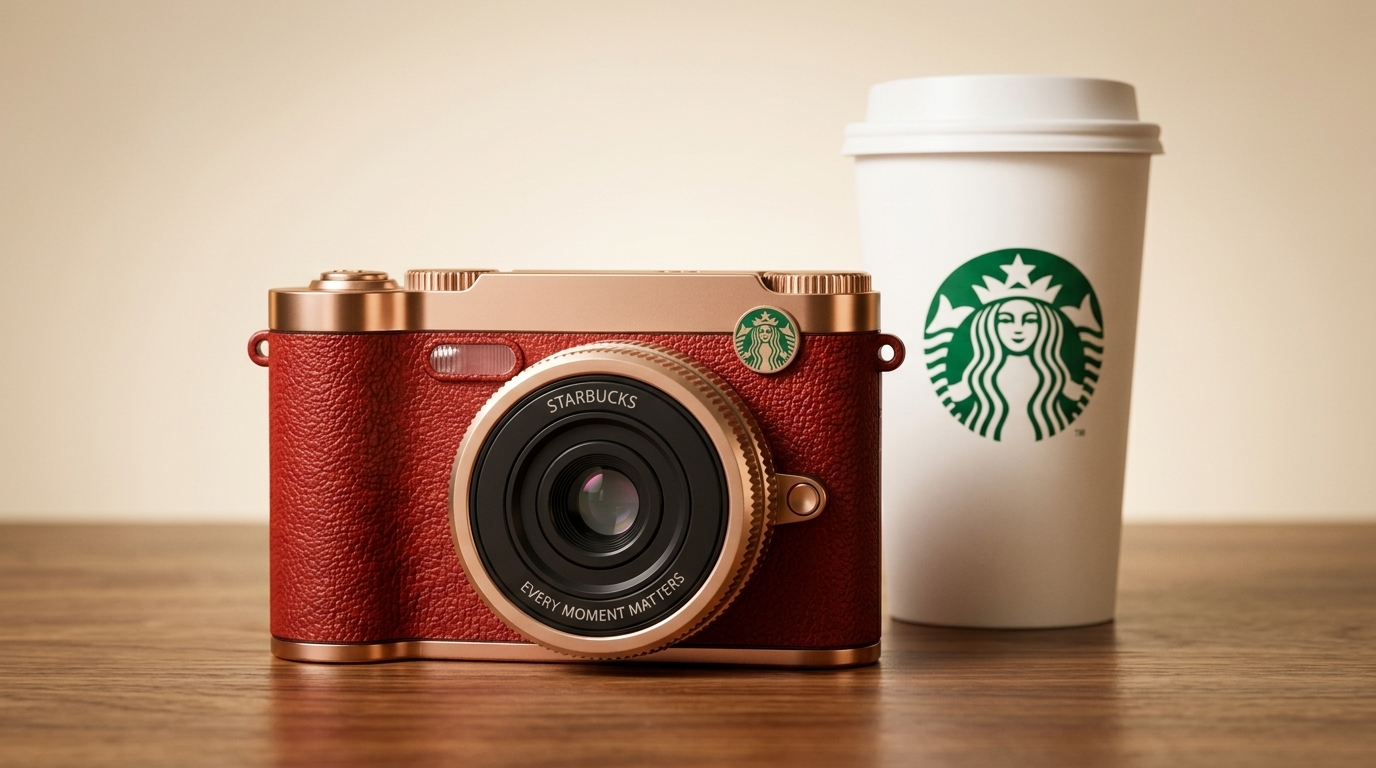
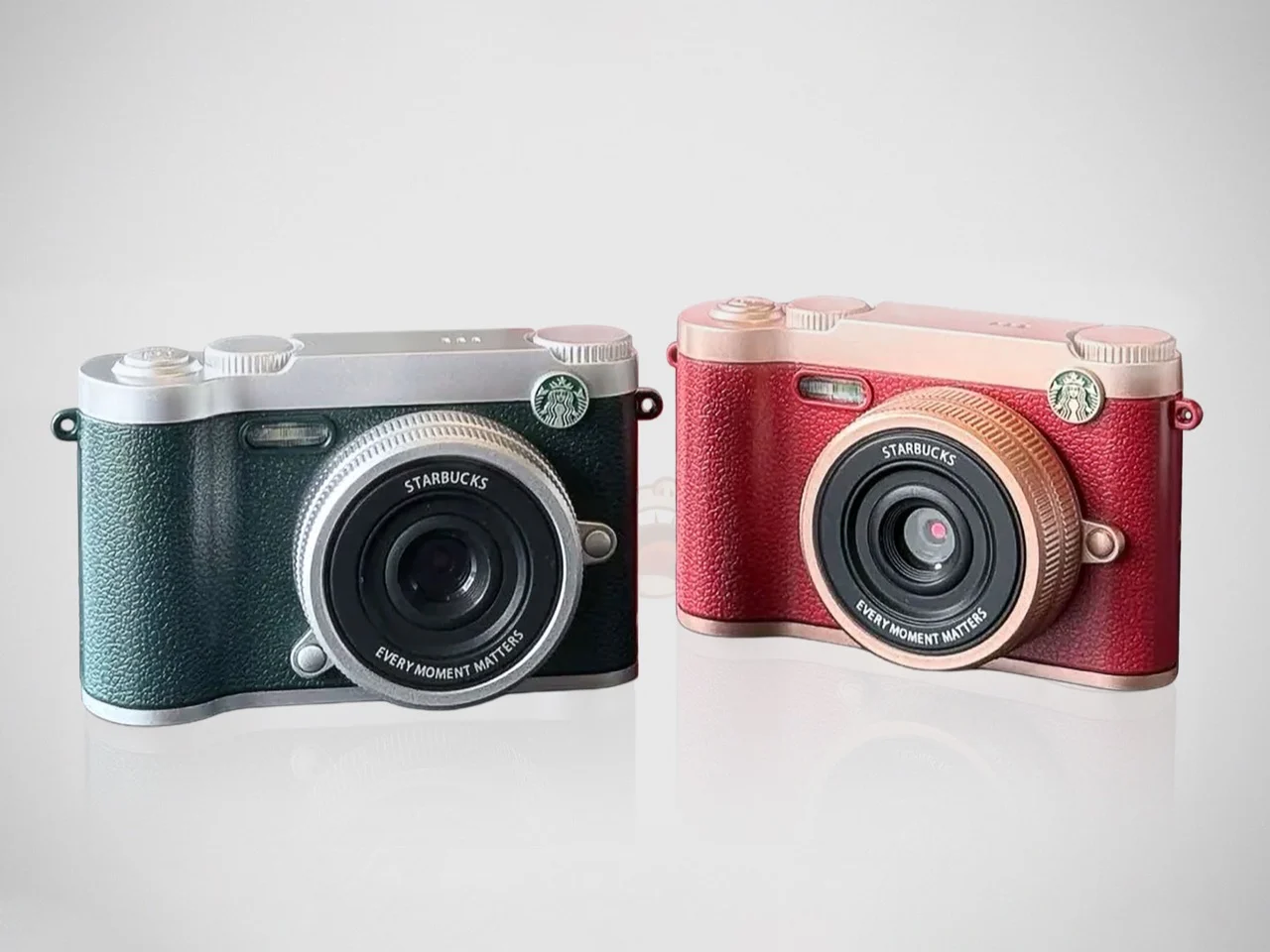
Quick Verdict: The Starbucks Retro Digital Camera quietly launched in China in November 2025 as part of the chain’s holiday Rewards Kit, priced at 198 yuan (about $28 USD). It comes in two colorways, a green and silver version and a red with rose gold variant, both wearing a Leica-style rangefinder shell with a “siren” badge and the phrase “EVERY MOMENT MATTERS” engraved around the lens. Dual sensors, nine Y2K photo frames, and resale prices reportedly tripling to roughly $72 tell you everything about why this little novelty has become one of the strangest camera stories of the year.
Last updated: May 2026 | 9 min read
In This Article
When the Starbucks Retro Digital Camera Launched
You have been asking about this camera, so we decided to dig in. It is not breaking news, but the story keeps surfacing in our inbox, in comment threads, and across photography forums. Months after the quiet launch, readers still want to know what it is, where it came from, and whether it is worth caring about. Here is what we found.
Starbucks is known for coffee, seasonal drinks, branded mugs, tumblers, and the occasional collectible drop. Ironic, because I am writing this from inside a Starbucks with a flat white at my elbow. Cameras, however, were not on anyone’s bingo card. The Starbucks Retro Digital Camera quietly arrived in China in November 2025, slipped into the chain’s holiday Rewards Kit and limited-edition merchandise lineup ahead of the gift-giving season. The launch has picked up only a small amount of US coverage so far, mostly through niche photography and design blogs, and remains largely unknown to mainstream American audiences.
Although the launch was geographically narrow, the buzz spread fast. Resale listings appeared within days of the in-store debut, with secondary-market prices reportedly hitting around $72 USD, roughly triple the original 198 yuan ticket. For a coffee company branding a budget-tier compact, demand of this kind is the real story.
The product is positioned as a collectible gift item, not a serious imaging tool. Both colorways lean hard into the early-2000s “CCD camera” look popular on social platforms, especially among younger creators chasing the softer, slightly imperfect digital aesthetic of the era.
Quick Facts at a Glance
| Detail | Specification |
|---|---|
| Product Name | Starbucks Retro Digital Camera |
| Release Date | November 2025 (part of Starbucks China Rewards Kit) |
| Region | China only |
| Price | 198 yuan (about $28 USD) |
| Reported Resale Price | Around $72 USD |
| Colorways | Green and silver, red with rose gold (also called “molten gold”) |
| Sensors | Dual (front-facing and rear-facing) |
| Filters and Frames | Nine Y2K-style photo frames plus built-in retro filters |
| Body Construction | Metal-look frame with leatherette wrap |
| Engraving | “EVERY MOMENT MATTERS” around the front lens |
| Likely Manufacturer | Chinese OEM camera supplier (white-label, not Starbucks-engineered) |
Two Cameras, Same Concept
Both versions of the Starbucks Retro Digital Camera share the same internals. The only meaningful difference is color treatment. One model uses Starbucks’ signature green paired with silver accents, while the other leans festive with a red body and rose gold trim. Chinese retail descriptions and photographs from Starbucks promotional channels show a metal-look chassis wrapped in a leather-textured material. At this price point, however, you should expect budget construction rather than premium camera-grade materials.
The green and silver version reads as the brand-identity model. It pulls directly from the company’s core color palette: deep green, silver trim, white Starbucks logos, and a matching strap and packaging in some promotional shots. By contrast, the red and rose gold model leans into holiday energy. It photographs well next to red Starbucks cups, ornaments, pine branches, and gift-box props, which is almost surely the marketing point.
Visual appeal is doing the work here. These cameras are not chasing the Sony RX100, Ricoh GR III, or Fujifilm X100VI shopper. They aim at customers who want something cute, giftable, social-media-friendly, and collectible.
What the Camera Does
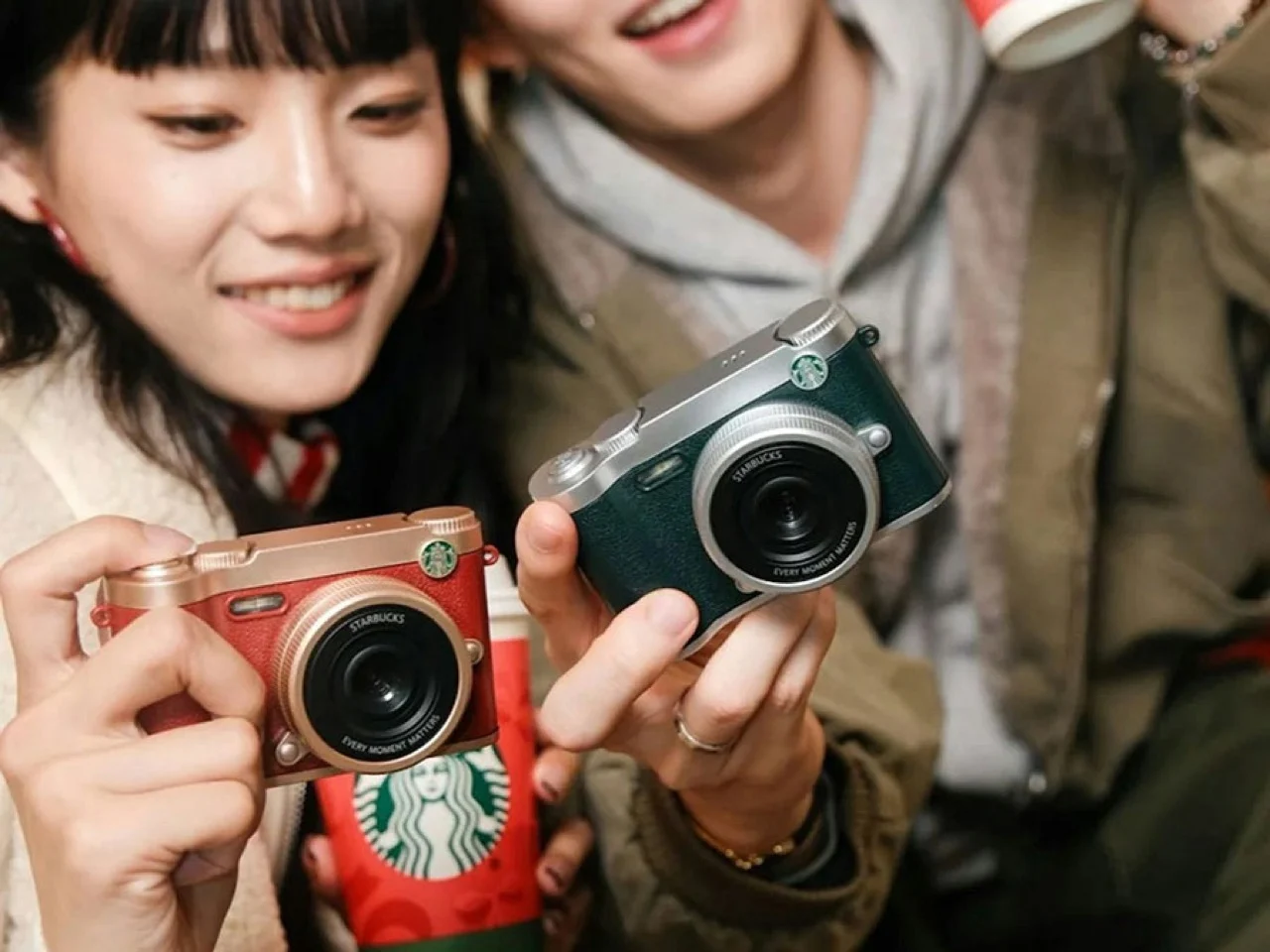
The headline feature is the dual-camera design. The body holds one sensor on the front, set inside the large vintage-style “lens” ring, and a second sensor on the back where a viewfinder would normally sit. Users switch between sensors through the menu on the small rear LCD, which is also how all framing is handled.
For the intended audience, this is a smart trick. Traditional point-and-shoot cameras are fun, but selfies become awkward without a flip screen or front-facing display. Instead of solving the problem with a hinged LCD, Starbucks added a rear-facing sensor positioned right above the screen. You frame yourself the same way you would on a smartphone, which removes most of the guesswork.
Beyond the dual-sensor layout, the camera includes built-in retro filters and nine Y2K-style photo frames, both of which line up with the current popularity of CCD-style compacts. Several outlets also mention video recording support, although Starbucks has not published detailed official spec sheets the way a dedicated camera maker would.
Some reseller listings claim a 2.4-inch screen, 1080p or 720p video capture, and a 600mAh lithium battery. Treat those numbers as secondary-market claims rather than confirmed manufacturer specs, because Starbucks has not publicly verified them.
Why China Got This First
Starbucks chose China deliberately. Four factors line up neatly behind the decision.
First, Starbucks China runs an aggressive localized merchandise calendar. The market consistently sees limited-edition collectibles, seasonal gift sets, mobile-first retail experiences, and social-sharing-friendly drops. China is also one of the company’s most important markets, second only to the United States in store count, with Starbucks operating roughly 8,000 locations and recently moving its China business into a joint venture with Boyu Capital aimed at long-term expansion.
Second, the Chinese consumer market responds strongly to lifestyle-driven, limited-edition product drops. A Starbucks-branded camera might feel random in the U.S., but in China, branded collectibles, trendy gadgets, and social-media-ready merchandise move quickly when they hit the right cultural moment.
Third, the Y2K and CCD camera trend has been especially strong across Asia, particularly with younger consumers on platforms like Xiaohongshu and Douyin. Compact digital cameras from the 2000s have become fashionable again because they produce images feeling less clinical than modern smartphone shots. Starbucks tapped into the nostalgia directly with the filters, frames, and a chassis designed to look more analog and more expensive than the price tag suggests.
Fourth, Starbucks is under serious competitive pressure in China. Domestic chains such as Luckin Coffee and Cotti have pushed pricing and convenience hard, forcing Starbucks to think more locally and creatively. Industry reporting shows the company’s China market share fell from 34 percent in 2019 to 14 percent in 2024, with rivals offering lower-priced drinks and rapidly expanding store networks. A novelty camera will not reverse the trend on its own. However, it does fit a broader strategy of staying culturally relevant, generating buzz, and giving customers reasons to engage with the brand beyond the cup.
Is Starbucks a Camera Maker Now?
Not in any meaningful sense.
The likely scenario is straightforward. Starbucks China commissioned an existing Chinese camera OEM to produce a branded novelty unit. The limited photography press coverage has framed it the same way, noting the design appears to be a rebranded white-label product rather than a ground-up Starbucks imaging system. Similar dual-sensor compacts already exist on AliExpress under different brand names, which lines up with the OEM theory.
This matters because expectations should stay realistic. At roughly $28, the Starbucks Retro Digital Camera will not feature premium glass, a large sensor, fast autofocus, strong low-light performance, or pro-grade controls. The decorative top dials reportedly do not function at all, serving as styling elements rather than working controls.
None of which is the point. The point is the experience. You pull it out at a coffee shop, take a few casual snapshots, run a retro filter, post the result, and enjoy the quirky collectible value of owning a Starbucks-branded camera.
Worth noting, this is also not the company’s first camera collaboration. In 2024, Starbucks partnered with Lomography on a co-branded Lomo’Instant Automat carrying the Starbucks logo and packaging. The 2025 retro digital camera, however, marks the first time Starbucks has shipped a digital camera under its own merchandising program rather than co-branding through a heritage maker.
Why Photographers Should Pay Attention

For serious photographers, this camera is easy to dismiss on technical grounds, and they would be right. It is not a meaningful imaging tool, and it is not trying to be.
From a photography culture standpoint, however, the release is interesting.
The Starbucks Retro Digital Camera is another signal showing cameras are becoming fashion objects again. For roughly a decade, smartphones swallowed the compact camera market. Most casual users stopped carrying separate cameras because the phone was easier, better, and always in the pocket.
Now small dedicated cameras are clawing their way back, not because cheap compacts outperform phones, but because they feel different. They create a separate shooting experience. They have buttons. They have quirks. They produce imperfect images. They are fun to hold.
This is why old Canon PowerShots, Nikon Coolpix models, Sony Cybershots, and early-2000s compacts have found new life on TikTok, Instagram, and Xiaohongshu. Starbucks did not invent the trend. It simply packaged the trend in a way matching its own brand.
For working photographers, the trend is worth tracking because it influences what casual customers expect from a camera in 2026. Tactility, character, and shareable visual style now compete with raw image quality as buying drivers, especially for sub-$500 compacts.
Image Recommendations
Because the camera is a Chinese retail exclusive, official product imagery is limited and licensing varies. The safest path for this story is generic stock photography paired with original lifestyle shots if you have access to a unit. Try the following Shutterstock searches:
- Retro compact camera for the hero image
- Coffee and camera lifestyle for an in-use shot
- Vintage camera lens ring close-up for a detail shot
- Starbucks coffee for brand context (use editorial-licensed images only)
- Y2K digital camera for trend context
Confirm licensing for any image showing branded Starbucks merchandise before publication.
Final Thoughts
The Starbucks Retro Digital Camera is not a camera release in the traditional photography sense. It is not here to challenge Canon, Nikon, Sony, Fujifilm, Ricoh, or Leica. It is a novelty product, a collectible, and a piece of lifestyle marketing wrapped in a nostalgic camera shell.
However, the novelty status does not make it uninteresting.
The reason this small $28 camera is getting attention worldwide is because it sits at the intersection of three powerful trends: coffee culture, retro tech, and social-media-driven photography. It is affordable, visually charming, easy to understand, and strange enough to make people talk about it.
Honestly, the marketing instinct behind it is the smartest part of the whole release.
Starbucks did not need to build a great camera. It only needed to build a camera people wanted to photograph, talk about, and share. On that front, the Starbucks Retro Digital Camera appears to have done exactly what it was designed to do.
Frequently Asked Questions
When was the Starbucks Retro Digital Camera released?
The camera launched in China in November 2025 as part of Starbucks China’s holiday Rewards Kit and seasonal merchandise drop. US coverage has been light, picking up only in scattered photography and design publications during December 2025.
How much does the Starbucks Retro Digital Camera cost?
The official retail price is 198 yuan, roughly $28 USD at current exchange rates. However, early demand pushed secondary-market and resale listings to around $72 USD shortly after launch.
Is the Starbucks Retro Digital Camera available outside China?
Officially, no. The camera is sold through Starbucks China’s retail and rewards channels only. Some units have surfaced on resale platforms and grey-market sites internationally, but Starbucks has not announced plans for a U.S. or global release.
Did Starbucks design this camera?
Almost surely not. The available reporting points to a Chinese OEM camera manufacturer producing a Starbucks-branded version of an existing dual-sensor compact design. Similar units exist on AliExpress under other brand names. Starbucks handled branding, color, packaging, and the engraved phrase “EVERY MOMENT MATTERS” around the lens.
What is the dual sensor used for?
One sensor sits on the front of the body inside the large decorative lens, while a second sensor sits on the back near the LCD where a viewfinder would normally appear. You switch between them through the menu, which makes selfies easier because you frame yourself directly on the rear screen instead of guessing at arm’s length.
Is this a serious camera for photographers?
No. The Starbucks Retro Digital Camera is a budget novelty product aimed at casual users, collectors, and lifestyle shoppers. Its image quality, sensor size, and feature set are far below dedicated compacts like the Ricoh GR III or Fujifilm X100VI. However, it is fun, affordable, and well-suited to the retro Y2K trend driving compact camera nostalgia on social media.

 with dual sensors and Y2K filters. Here is the full story.)