


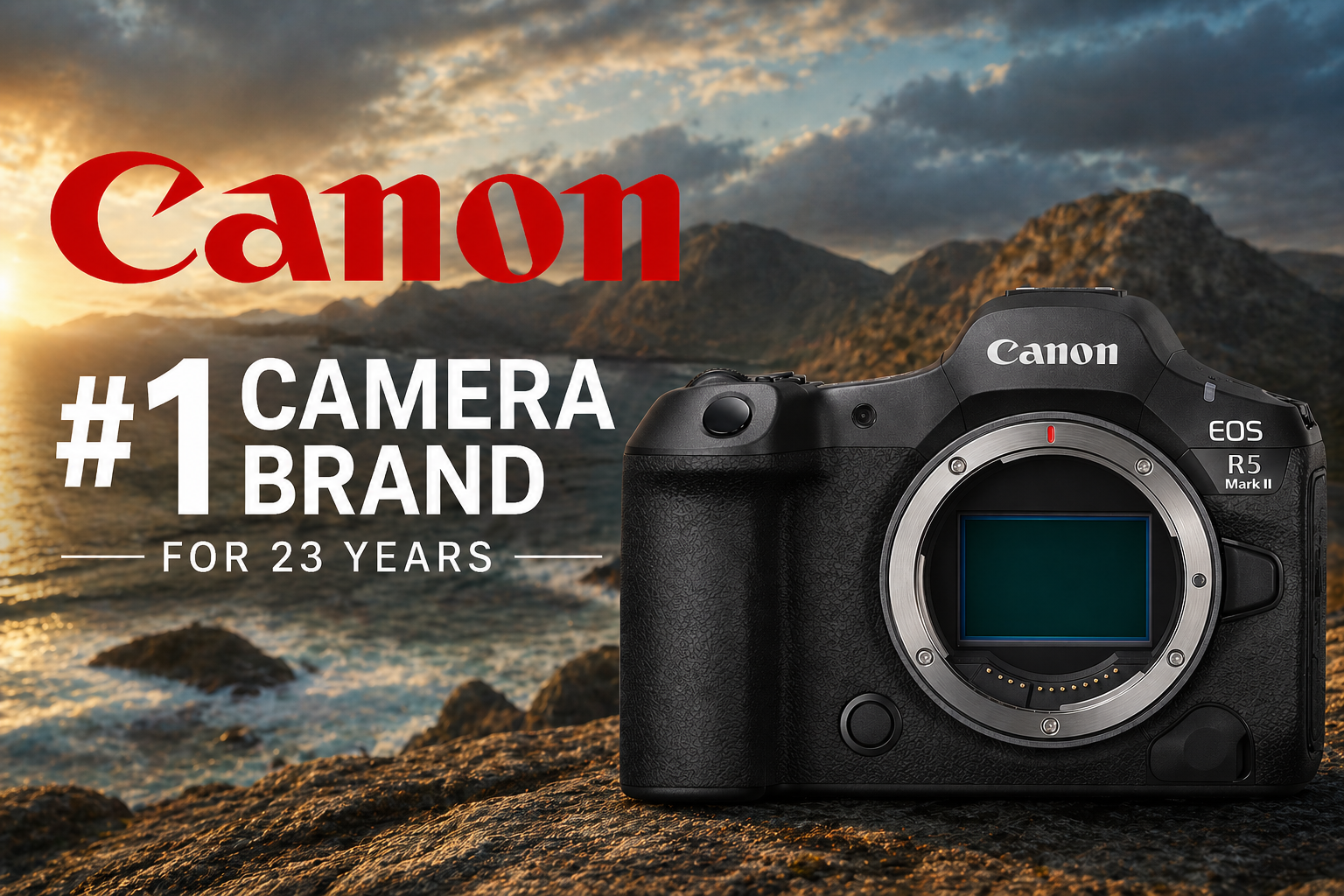
Quick Verdict: Canon market share leads the global interchangeable-lens camera market for 23 straight years, holding the #1 position from 2003 through 2025. Roughly 90% of Canon’s interchangeable-lens unit sales now come from mirrorless bodies, and the RF lens lineup keeps expanding. For buyers, the streak signals a stable platform with the broadest lens catalog of any maker, anchored by flagships like the EOS R5 Mark II.
Last updated: April 2026 | 9 min read
In This Review
- Canon’s 23-Year Run by the Numbers
- Key Facts at a Glance
- How Canon Held the Lead Through the Mirrorless Shift
- Canon vs Sony: Where Each Brand Wins
- Why the RF and EF Lens Ecosystem Matters
- What the Streak Means for You as a Buyer
- An Editor’s Take After Six Years on Canon
- Pros and Cons of Buying into Canon Right Now
- Final Verdict
- Frequently Asked Questions
Canon’s 23-Year Run by the Numbers
Canon market share holds the global top spot in interchangeable-lens cameras for 23 consecutive years, and the company first announced the latest streak in February 2026, then reaffirmed it at a Middle East press event on April 28, 2026. The announcement covers calendar year 2025 and counts both DSLR and mirrorless bodies, the combined category the industry calls ILCs. Canon first claimed the #1 position in 2003, then defended it through every major shift since: the rise of full-frame, the smartphone disruption, and most recently the move to mirrorless.
For context, the broader camera market shipped roughly 7 million interchangeable-lens cameras in 2025 according to CIPA data, and Canon accounts for close to half of those units. While Sony has closed the gap inside the mirrorless-only segment, the combined ILC category still puts Canon ahead by a clear margin. The camera market share by brand picture stays remarkably stable year over year, and twenty-three years of leadership reflects something deeper than marketing momentum, because lens ecosystems, dealer relationships, and pro-level service networks compound over time.
For shoppers comparing systems, the durability of the Canon market share lead matters because Canon interchangeable lens cameras tie directly to lens availability, third-party accessory support, and resale value. A used Canon R5 retains stronger pricing on the secondary market than most rivals, and rental houses stock RF glass deeper than any other mirrorless mount. Specifically, those advantages compound for working photographers who depend on borrowed gear during travel shoots.
The streak also speaks to Canon’s willingness to cannibalize itself. While the company built its DSLR empire on the EF mount, it pivoted aggressively to RF starting in 2018, and today nearly 90% of Canon’s interchangeable-lens sales come from mirrorless bodies. Few companies dominate one technology era and then survive the transition to the next.
Key Facts at a Glance
| Metric | Detail |
|---|---|
| Years at #1 in ILCs | 23 consecutive (2003 to 2025) |
| Announcement dates | February 24, 2026 (global) and April 28, 2026 (Middle East) |
| Reporting period | Calendar year 2025 |
| Estimated global ILC share | Approximately 48% of units |
| Mirrorless share of Canon ILC sales | Around 90% |
| Lens lineup (RF plus EF) | More than 1,100 native and legacy options |
| Top mirrorless rival | Sony (mirrorless-only segment) |
| Source data | Canon Global press release, BCN, CIPA |
Featured Body
Canon EOS R5 Mark II
The 45MP stacked-sensor flagship driving Canon’s mirrorless leadership. 8K RAW video, in-body stabilization, and Eye Control AF in a 670g body.
How Canon Held the Lead Through the Mirrorless Shift
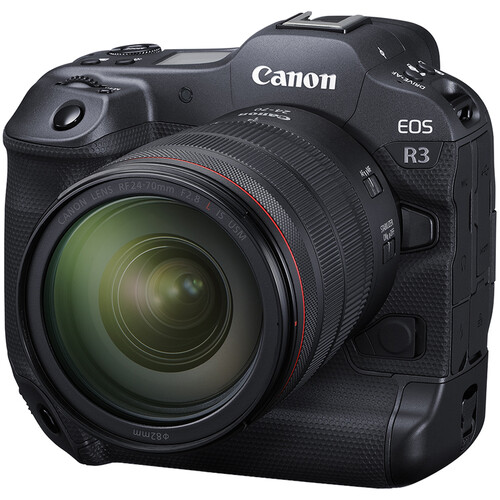
The Canon market share streak survived the most disruptive shift in modern camera history. In 2018, when Canon launched the EOS R, Sony had already released four generations of full-frame mirrorless bodies, and many analysts predicted a leadership change within three years. Instead, Canon used its dealer network, pro-services infrastructure, and existing EF customer base to ramp RF adoption faster than rivals were ready to react.
By 2022, Canon had shipped its first stacked-sensor body in the EOS R3, a key milestone in the broader story of canon mirrorless camera leadership, then followed with the R5 Mark II and R1 in 2024. As a result, Canon’s mirrorless lineup now spans entry-level (R10, R50, R100), mid-tier (R8, R6 Mark II, R7), and flagship (R5 Mark II, R1). Few rivals offer such breadth at every price point, and the lineup depth keeps Canon competitive in markets where buyers trade up over time.
Notably, Canon also kept its DSLR business alive longer than competitors. The 5D Mark IV remained in production through 2025, and Canon shipped more new DSLRs in 2024 than Fujifilm shipped of all camera types combined. While DSLRs are declining as a category, the residual demand from documentary shooters and emerging-market institutions keeps the line viable. Consequently, Canon collects revenue from both technology generations while rivals depend on mirrorless alone.
Canon vs Sony: Where Each Brand Wins
Looking at canon vs sony market share inside the mirrorless-only segment, the picture tightens considerably. Sony shipped roughly 29.9% of mirrorless units in 2025 versus Canon’s 27.4%, with Nikon, Fujifilm, and Panasonic splitting the rest. However, when DSLR sales fold back in, Canon pulls clearly ahead, because the company still ships hundreds of thousands of EF-mount bodies each year.
Sony wins on certain technical metrics. The A1 II reads sensor data faster than the R5 Mark II in burst-heavy sports work, and Sony’s third-party lens ecosystem is broader because the E-mount has been open longer. Yet Canon counters on color science (skin tones especially), Eye Control AF, and weather sealing on bodies like the R5 Mark II. For wedding and portrait shooters, those Canon strengths translate to real workflow gains.
The camera market share by brand picture also shifts by region. Canon dominates Asia, Latin America, and the Middle East, partly because of long-running dealer relationships and government procurement contracts. Sony performs strongest in North America and Western Europe among hybrid creators who shoot heavy video. As a result, the right pick depends on where you live, what you shoot, and which lenses already sit in your kit bag.
Featured Lens
Canon RF 24-70mm f/2.8L IS USM Z
The workhorse zoom anchoring most Canon kits. Constant f/2.8 aperture, 5.5-stop image stabilization, and the second-generation Z-series optical update for hybrid shooters.
Why the RF and EF Lens Ecosystem Matters
Canon interchangeable lens cameras enjoy access to roughly 1,100 native and legacy options across the RF and EF mounts, the broadest selection in the segment. The EF-to-RF adapter retains autofocus and image stabilization on every modern body, which protects the long-term value of older glass. For photographers building a kit, the practical effect is simple: you walk into a rental house in any major city and find the glass you need.
RF-mount native options now cover the full range from the RF 5.2mm f/2.8L Dual Fisheye for VR capture to the RF 1200mm f/8L IS USM for wildlife. Notably, third-party support has improved substantially since Canon opened the mount to Sigma and Tamron in 2024. Sigma offers four RF-native APS-C primes (16mm, 23mm, 30mm, and 56mm F1.4 DC DN Contemporary), and additional third-party releases continue to roll out across both APS-C and full-frame mounts.
For buyers comparing systems on lens lineup alone, the math favors Canon. Sony E-mount remains broader on third-party options because of its earlier opening, but Canon RF closes the gap each quarter. Meanwhile, EF lenses bought between 2010 and 2020 still mount cleanly through the adapter, which protects the investment of long-time shooters who switched from DSLR to mirrorless inside the family.
What the Streak Means for You as a Buyer
Twenty-three years on top translates to four practical buyer benefits, and the cumulative Canon market share advantage shows up in everything from store shelves to insurance availability. The canon number one camera reputation shapes everyday buyer experience well beyond the spec sheet. First, lens availability stays deep across price tiers, so a beginner finds an affordable 50mm f/1.8 and a pro finds a 400mm f/2.8 inside the same mount family. Second, training resources, YouTube tutorials, and forum knowledge skew Canon-heavy, especially for newer shooters who lean on community help.
Third, resale value holds. A two-year-old Canon R6 Mark II loses less of its launch MSRP than competing bodies in the same segment, partly because demand stays steady on the used market. Fourth, pro-services coverage matters when gear breaks during a paying shoot. Canon Professional Services maintains repair depots across multiple countries worldwide, with loaner equipment options available for CPS Platinum members.
Still, leadership comes with trade-offs. Canon prices premium bodies and L-series lenses at the top of the market, and the company has historically been slower to roll out experimental features (like global shutter) than Sony or Nikon. For shooters chasing the latest sensor technology on a tight budget, a competitor sometimes makes more sense in any given quarter.
An Editor’s Take After Six Years on Canon
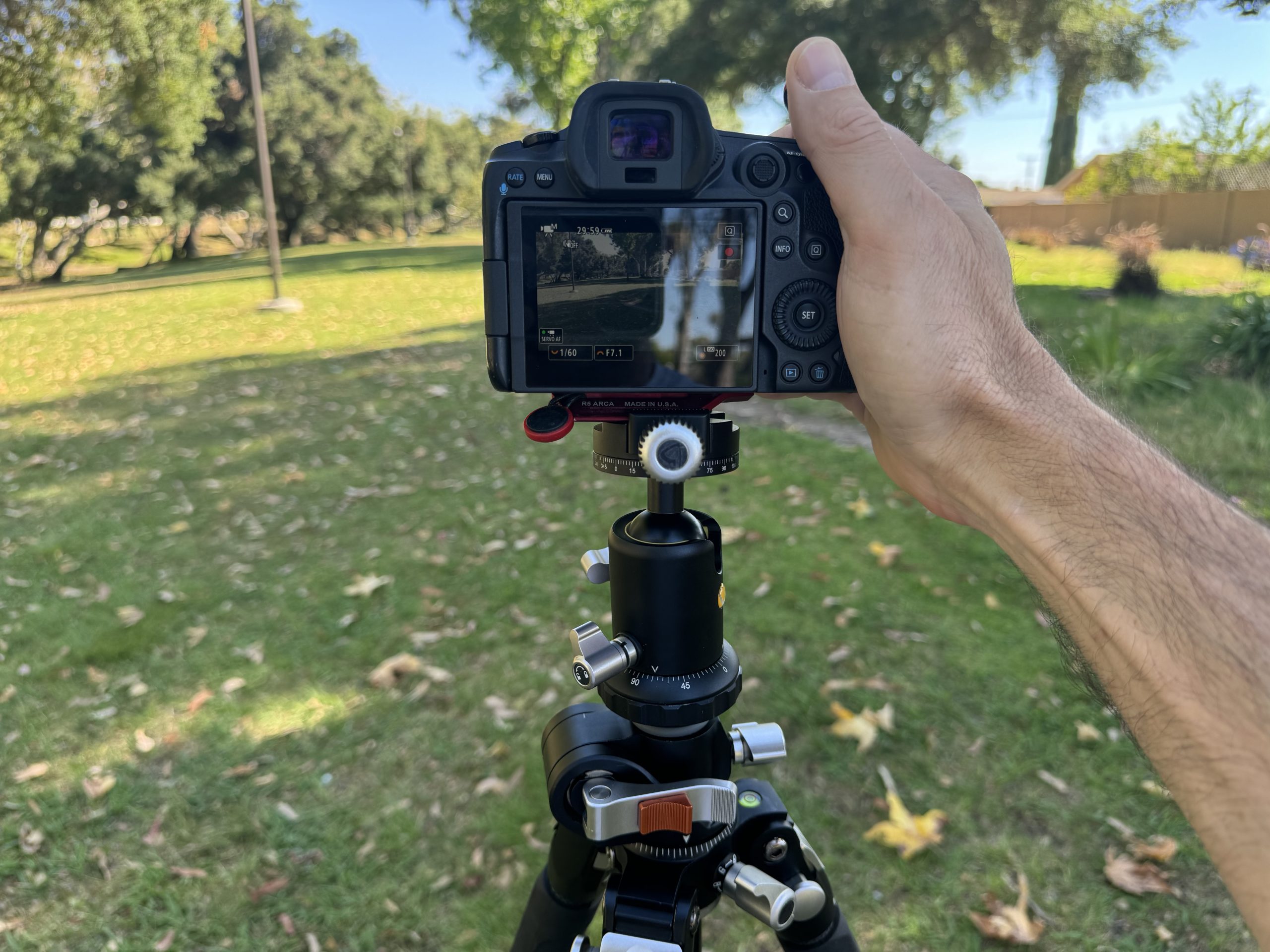
Six years ago I moved my kit from Nikon and Sony bodies over to Canon, and I have not looked back. The cameras and lenses have been a blast to use day in and day out, especially the R5 paired with the original RF 24-70mm f/2.8 zoom. Color out of the box matches what my eye expects, and the Eye Control AF on newer bodies removed a friction point I lived with for years on competing systems.
What stands out about this 23-year streak is what it tells me about where Canon is heading. The company protected its DSLR base while building a mirrorless lineup good enough to win mirrorless-only shootouts in some categories. Looking ahead at what Canon has on the horizon, I expect the next R5 generation, deeper third-party RF support, and continued expansion into hybrid video. From where I sit, the Canon market share streak feels less like a finish line and more like a midpoint.
Pros and Cons of Buying into Canon Right Now
Pros
- Largest combined lens lineup of any mount with 1,100+ RF and EF options
- Strongest resale values across mirrorless and DSLR segments
- Deepest rental inventory in major cities for travel and event shoots
- Canon Professional Services repair coverage across multiple countries with loaner options for Platinum members
- Industry-leading skin tone color science out of camera
- Eye Control AF on the R3, R5 Mark II, and R1 reduces focus selection time
- EF lenses adapt cleanly to RF bodies with no autofocus or stabilization loss
Cons
- Premium pricing on L-series glass runs 10 to 20% above rivals
- Slower to release experimental features like global shutter sensors
- Third-party RF lens support trails Sony E-mount in total options
- Some legacy EF lenses show their age on 45MP+ sensors
- Mirrorless-only buyers might find better single-body specs from Sony
Final Verdict
For most buyers shopping interchangeable-lens systems in 2026, Canon market share leadership earns the benefit of the doubt. Twenty-three years at #1 reflects a depth of lens options, dealer support, and color science few rivals match, and the company has proven willing to cannibalize its own DSLR business to defend the lead. If you value workflow stability and ecosystem breadth above absolute spec-sheet wins, Canon belongs at the top of your shortlist.
The trade-offs are real. Premium L-series pricing eats budget, and a mirrorless-only buyer chasing the fastest sensor readout sometimes finds a stronger answer at Sony or Nikon. Specifically, sports specialists who need 30 frames per second with zero rolling shutter should price out the Sony A1 II before committing. For wedding, portrait, travel, and hybrid creators, however, the Canon platform answers more questions than it raises, and the canon number one camera reputation reduces friction at every stage from purchase to resale.
Value-wise, the EOS R5 Mark II at its current $4,299 launch price slots between the Sony A1 II ($6,499) and the Nikon Z8 ($3,999), and the body delivers 8K RAW, IBIS, and the deepest lens support in the segment. Pair it with the RF 24-70mm f/2.8L IS USM Z and you own a kit handling 80% of professional work without a lens swap.
The recommendation: shoppers replacing aging full-frame bodies in 2026 should price out the EOS R5 Mark II as their default option, then test the Sony A1 II side by side only if they shoot heavy sports or wildlife. For canon mirrorless camera leadership to extend into a 24th year, bodies like the R5 Mark II and lenses like the RF 24-70mm f/2.8 will do most of the work. Going forward, expect Canon market share to stay durable as long as RF lens releases keep the mount fresh.
Frequently Asked Questions
How long has Canon been the #1 camera brand?
Canon has held the #1 global market share in interchangeable-lens digital cameras for 23 consecutive years, from 2003 through 2025. The streak covers both DSLR and mirrorless bodies combined, the segment the industry calls ILCs. Canon Global confirmed the latest year of leadership in late February 2026, with regional announcements following through April 2026.
What is Canon’s global market share in cameras?
Canon market share sits at roughly 48% of global interchangeable-lens camera unit sales, based on triangulated data from Canon, BCN, and CIPA. The figure covers both DSLRs and mirrorless models combined, and Canon leads every other manufacturer by a clear margin in the combined category.
Is Canon still #1 in mirrorless cameras?
Inside the mirrorless-only segment, Sony narrowly leads on units shipped, with roughly 29.9% share versus Canon at 27.4% in 2025. However, when DSLR sales fold into the broader interchangeable-lens category, Canon returns to the top spot. The full ILC count gives Canon the overall #1 position.
How does Canon compare to Sony in market share?
Canon vs sony market share comes down to whether you measure mirrorless alone or all interchangeable-lens cameras. Sony leads mirrorless-only by a few percentage points, while Canon leads the full interchangeable-lens category by a significant margin because of residual DSLR demand and broader entry-level mirrorless reach.
Why does Canon dominate the camera market?
Canon’s lead rests on four pillars: the broadest lens lineup across RF and EF mounts, the deepest pro-services network, strong color science, and aggressive pricing at entry-level tiers. Additionally, Canon protected its DSLR base while transitioning to mirrorless, which gave the company two revenue streams during the shift.
Does Canon sell more cameras than Nikon?
Canon outsells Nikon by a wide margin across both DSLR and mirrorless categories. In 2025, Canon held roughly 48% of interchangeable-lens unit sales versus Nikon’s estimated 12 to 14%. The gap has widened since 2020 because Canon’s mirrorless lineup spans more price tiers than Nikon’s Z series.
Which Canon cameras have the best market share?
Among 2025 sellers, the EOS R6 Mark II, EOS R10, and EOS R8 lead Canon’s mirrorless unit sales by volume. The EOS R5 Mark II carries flagship attention and rental-market dominance, though its higher price keeps unit numbers below the mid-tier bodies. Together, these models drive the bulk of Canon’s recent share gains.

