


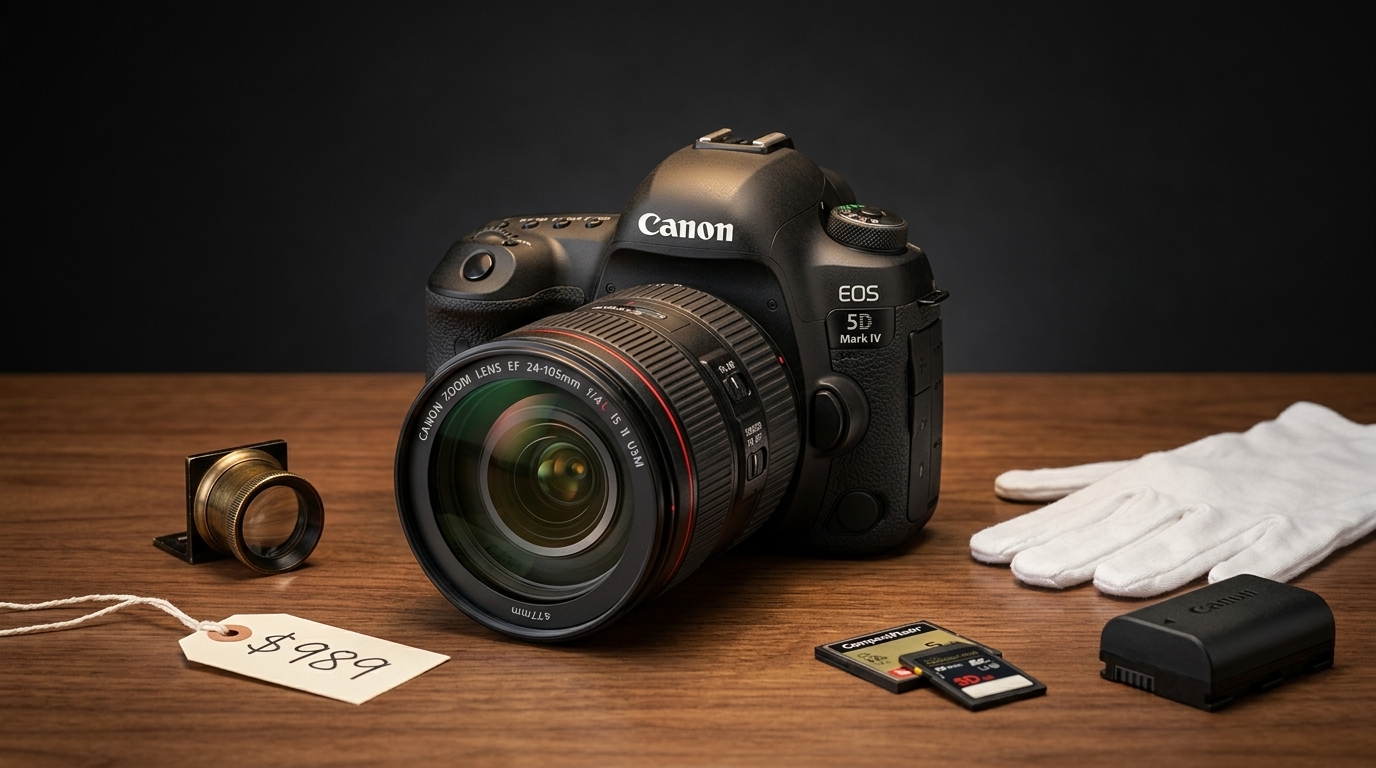
QUICK VERDICT
The used Canon 5D Mark IV is the strongest sub-$1,000 full-frame buy of 2026. Excellent-condition bodies sell for $900 to $1,070 on the major used marketplaces, backed by healthy shutter counts and Canon’s full EF lens catalog. Stay under 100,000 actuations and run the 17-point inspection below. You will be buying a working professional DSLR for roughly a quarter of its 2016 launch price.
Last Updated: May 12, 2026 | 9 min read | By Alex Schult, PhotographyTalk Founder
Table of Contents
- Why a Used Canon 5D Mark IV Is Still Worth It in 2026
- Canon 5D Mark IV Used Pricing in 2026
- Shutter Count: What the Number Tells You
- How to Check Shutter Count on a 5D Mark IV
- 17-Point Inspection Checklist
- Common Issues to Watch For
- Where to Buy a Used Canon 5D Mark IV
- Final Thoughts
- FAQ
Quick Facts
| Spec | Detail |
|---|---|
| Sensor | 30.4MP full-frame CMOS |
| ISO Range | 100-32,000 native, 50-102,400 expanded |
| Autofocus | 61 points, 41 cross-type, EV -3 sensitivity |
| Burst Speed | 7 fps with full AF/AE tracking |
| Video | DCI 4K up to 30p (Motion JPEG, internal only), Full HD 60p |
| Weight | 890 g with battery and card |
| Storage | Dual slot: 1x CompactFlash (UDMA 7), 1x SD UHS-I |
| Battery | LP-E6N, ~900 shots per CIPA |
| Wireless | Built-in Wi-Fi, NFC, GPS (no Bluetooth) |
| Original MSRP (2016) | $3,499 body only |
| Used Range (2026) | $634 to $1,069 across condition tiers |
I switched to Canon full-time in 2020 after a long stretch with the Nikon D850, and the 5D Mark IV was the body I reviewed and tested side-by-side before making the jump. Six years later, the 5D Mark IV remains a workhorse Canon released in 2016 and a body I would hand to a paid second shooter today. Considering a Canon 5D Mark IV used purchase in 2026? Your money goes further than ever. With mirrorless dominating new releases, the rules for buying a used DSLR have shifted. Read the numbers, then the listings, then the body itself before you spend a dollar.
Why a Used Canon 5D Mark IV Is Still Worth It in 2026

First, Canon launched the 5D Mark IV in September 2016 at $3,499 body only. Today, however, the same body trades hands at one quarter of the original sticker price. As a result, the value math is straightforward. For example, you get a 30.4MP full-frame sensor, a magnesium-alloy weather-sealed body, dual card slots, and Canon’s deep EF lens catalog. Above all, this comes at a price point where APS-C mirrorless used to live.
Image quality also still produces client-ready files in 2026. In fact, Canon skin tones, color science, and dynamic range hold up against most current mid-range mirrorless bodies. While the 61-point autofocus system is older, it locks reliably for portraits, weddings, events, and most landscape work. Similarly, at 7 fps with full AF/AE tracking, burst speed handles anything short of pro sports.
In addition, the 5D Mark IV gives you something new mirrorless bodies often do not. Specifically, a real optical viewfinder, a familiar two-dial control layout, and battery life north of 900 shots per charge. For wedding shooters swapping bodies between ceremony and reception, these add up fast.
Finally, if you already own EF lenses, the upgrade path from a Rebel, an 80D, or a 6D Mark II to a used 5D Mark IV is the cheapest full-frame jump on the market right now.
Canon 5D Mark IV Used Pricing in 2026
First, here is the live used inventory as of May 2026, pulled from MPB today.
MPB (US warehouse): 55 bodies in stock, priced from $634 to $1,069. For example, Excellent runs $919 to $1,069 depending on shutter count, while Good covers $874 to $909, and Well Used and Heavily Used drop to $634 to $794. As a standout listing on the day of writing: an Excellent-condition body with only 5,579 actuations at $919.
Across condition tiers, MPB’s grading is conservative. Specifically, an MPB “Excellent” body typically shows minimal cosmetic wear, comes with a six-month warranty, and ships with the actual unit photographed in the listing.
Overall, prices have stabilized over the last 12 months. In particular, the big drop happened between 2022 and 2024 because the R5 Mark II and R6 Mark II pulled professionals to mirrorless. If you are waiting for prices to fall further, the data does not support it. As a result, the still-viable working life left in each body now anchors used 5D Mark IV pricing.
| Condition Tier | MPB Price Range | Typical Shutter Count |
|---|---|---|
| Like New | $1,000 to $1,070 | Under 10,000 |
| Excellent | $919 to $1,069 | 5,000 to 90,000 |
| Good | $874 to $909 | 30,000 to 180,000 |
| Well Used | $634 to $794 | 100,000 to 250,000+ |
Shutter Count: What the Number Tells You
First, shutter count is the first number I look at on any used DSLR listing. Specifically, it tells you how many times the mechanical shutter has fired across the camera’s life. However, think of it as a wear proxy, not a hard ceiling.
Although Canon does not publish an official rated cycle count for the 5D Mark IV in its US spec sheet, most buyers inherit the 5D Mark III’s published 150,000-cycle rating and apply the same number to the IV. For example, plenty of 5D Mark IV bodies cross 300,000 actuations without a shutter swap. Conversely, plenty also fail earlier. As a result, treat 150,000 as the planning figure, not a guarantee.
Here is how professional buyers usually read the shutter count tiers:
| Actuation Range | What It Means |
|---|---|
| Under 50,000 | Low risk. Body has plenty of life left for both pro and enthusiast use. |
| 50,000 to 100,000 | Mid-life. Negotiate price down if seller is asking Like New money. |
| 100,000 to 150,000 | Approaching the 5D Mark III rated life. Factor a possible $400 shutter replacement into your offer. |
| 150,000 and above | Past the planning figure. Only worth it at deep discount or as a backup body. |
How to Check Shutter Count on a 5D Mark IV
Unfortunately, Canon does not show shutter count in any menu on the 5D Mark IV. In addition, EOS Utility will not tell you either. As a result, to pull the number you need a third-party tool or a reputable seller who lists the count up front.
Below are the two reliable options for buyers and sellers in 2026:
- Tornado Shutter Counter (Windows, free). Most-recommended free tool across photography forums. Some antivirus tools flag the installer; the file is safe but check forum guidance before installing.
- ShutterCount (macOS and iOS, paid). A few dollars on the App Store, runs over USB or Wi-Fi.
For verified counts, MPB also lists shutter count on every body they sell. In addition, private sellers should be willing to provide a screenshot. If a Craigslist or eBay seller refuses to run a shutter count check before you pay, then walk away.
One caveat. For instance, a 5D Mark IV with 80,000 wedding actuations from a careful pro is often a better buy than a 30,000-count body from a casual user who never cleaned the sensor. In short, shutter count is one signal among many, not the whole story.
17-Point Inspection Checklist
First, run this checklist whether the body is shipping from MPB or sitting on a stranger’s coffee table. Although some items apply only to in-person inspections, for online buys you should request photos or video covering the rest.
Body, controls, and optics (items 1-9)
- Verify shutter count against the listed condition tier.
- Inspect the sensor at f/16 to f/22 against a white wall or sky. Look for dust, oil spots, and scratches.
- Check the rubber grips on the front, back, and side. Lifting rubber is a common wear point and usually signals heavy use.
- Test every button and dial. The mode dial, top LCD button cluster, joystick, and rear control wheel should all respond crisply.
- Inspect the lens mount for brassing, deep scratches, or play when a lens is attached.
- Look through the viewfinder for fungus, hair, or debris.
- Test both card slots. Bring a known-good CF and SD card and shoot to each.
- Inspect the top LCD for cracks or dead segments.
- Inspect the rear LCD for cracks, scratches, and dead pixels by displaying a solid color image.
Connectivity, accessories, and final verification (items 10-17)
- Confirm AF accuracy. Mount a fast prime at f/2.8 and shoot a static target. Afterward, repeat with all 61 AF points if time allows.
- Test Wi-Fi pairing with the Canon Camera Connect app.
- Confirm GPS by stepping outside and waiting for a fix. Because GPS battery drain is real, also verify the camera turns it off when powered down.
- Check the battery door for a clean latch and intact gasket.
- Inspect the strap lugs for excessive wear.
- Verify the serial number matches any documentation, and check Canon’s stolen-camera registry if available.
- Ask for the original box, charger, and battery. An OEM Canon LP-E6N adds resale value and rules out a worn third-party cell.
- Confirm the latest firmware is installed (version 1.4.0, released May 2023).
For online purchases through MPB, the dealer’s own inspection process covers items 1, 2, 7, 9, and 17. As a result, most buyers pay a small premium over private sale because of the grading.
Common Issues to Watch For
Generally, nine years in the field surfaces patterns. In particular, four show up often enough to mention.
GPS battery drain. First, the most consistent complaint. If GPS is set to Mode 1 instead of Mode 2, then built-in GPS will drain the LP-E6N even when the camera is off. As a fix, set GPS to Mode 2 (auto-off with camera) or disable it when not needed. In short, this is a setting fix, not a hardware defect.
Sensor dust. Second, universal to any DSLR with frequent lens swaps. Although the 5D Mark IV’s self-cleaning system handles light dust, it does not replace a periodic wet clean. Therefore, always inspect the sensor on a used body.
Memory card door wear. Third, the plastic door hinge softens with heavy use. During inspection, open and close it three or four times and listen for any cracking sound.
Worn shutter button feel. Finally, a shutter button with a mushy half-press signals heavy use beyond the listed actuation count alone.
In short, none of these kill a buy. Instead, all of them give you negotiating room.
Where to Buy a Used Canon 5D Mark IV

In total, three places to buy in 2026, ranked by how much risk you are taking on.
Graded marketplace (MPB). First, this offers the best balance of price, inspection rigor, and warranty. In addition, MPB offers a six-month warranty on used gear, photographs the actual unit you receive, and grades conservatively. As a result, pricing is typically $50 to $150 above private-sale floor, and worth it for the peace of mind.
Manufacturer-refurbished (Canon Refurbished, when in stock). Second, Canon’s refurbished program occasionally lists 5D Mark IV bodies with a one-year warranty. However, stock is intermittent in 2026 because Canon discontinued the body in Japan in March 2026 and US new-stock supply is winding down. Still, worth a monthly check on Canon’s outlet page.
Private sale (eBay, Facebook Marketplace, Craigslist). Finally, lowest prices, highest risk. Only buy from a seller willing to provide shutter count, a run-through video, and original purchase paperwork. In addition, use payment methods with buyer protection.
Overall, MPB is where I send friends asking for a 5D Mark IV recommendation. Specifically, selection rotates fast, every listing shows shutter count up front, and pricing is fair.
Final Thoughts
Overall, the 5D Mark IV is one of those rare used DSLRs where price, build, and image quality still line up on the open market. For example, at under $1,000 for an Excellent-tier body, you are buying a working professional camera. In addition, you get the largest first-party EF lens catalog of any system, a familiar two-dial control layout, and the kind of battery life mirrorless owners envy.
First, stick to bodies under 100,000 actuations and run the 17-point inspection. Next, buy from a graded marketplace or a transparent private seller. Afterward, skip any listing where the seller will not share a shutter count. Finally, set GPS to Mode 2 the moment the camera arrives.
When I moved off the Nikon D850 in 2020 and went all-in on Canon, the 5D Mark IV was the body I leaned on while learning the system. Six years later, it still earns a place in working pros’ bags as a reliable second body or as a cost-effective primary for portrait, wedding, and event work. In short, the used market in 2026 is the best entry point this camera has ever had.
FAQ
Is the Canon 5D Mark IV still worth buying in 2026?
Yes, on the used market. A 30.4MP full-frame sensor, weather-sealed magnesium body, and the entire EF lens catalog at under $1,000 is a strong value. Buy mirrorless instead if you need eye-detect autofocus or in-body stabilization.
What is the shutter life of a Canon 5D Mark IV?
Canon does not publish an official figure for the IV. The accepted planning number, inherited from the 5D Mark III’s official rating, is 150,000 actuations. Many bodies exceed 200,000 with no shutter issues; some fail earlier.
How do I check shutter count on a Canon 5D Mark IV?
The 5D Mark IV does not display shutter count in its menu. Use Tornado Shutter Counter on Windows or ShutterCount on macOS and iOS. MPB lists the count on every body they sell.
How much does a used Canon 5D Mark IV cost in 2026?
Live pricing on MPB ranges from $634 in Well Used to $1,069 in Excellent. Prices have stabilized; do not wait for a major drop.
Should I buy a 5D Mark IV or switch to mirrorless?
If you already own EF lenses and value optical viewfinders and battery life, the 5D Mark IV is the cheaper, faster path to full-frame. If you need eye-detect AF, IBIS, or 4K without a crop, save up for the R6 Mark II or a used R5.
What is the most common problem with the Canon 5D Mark IV?
GPS battery drain. The fix is setting GPS to Mode 2 or disabling it when not needed. It is a setting issue, not a hardware defect.

