


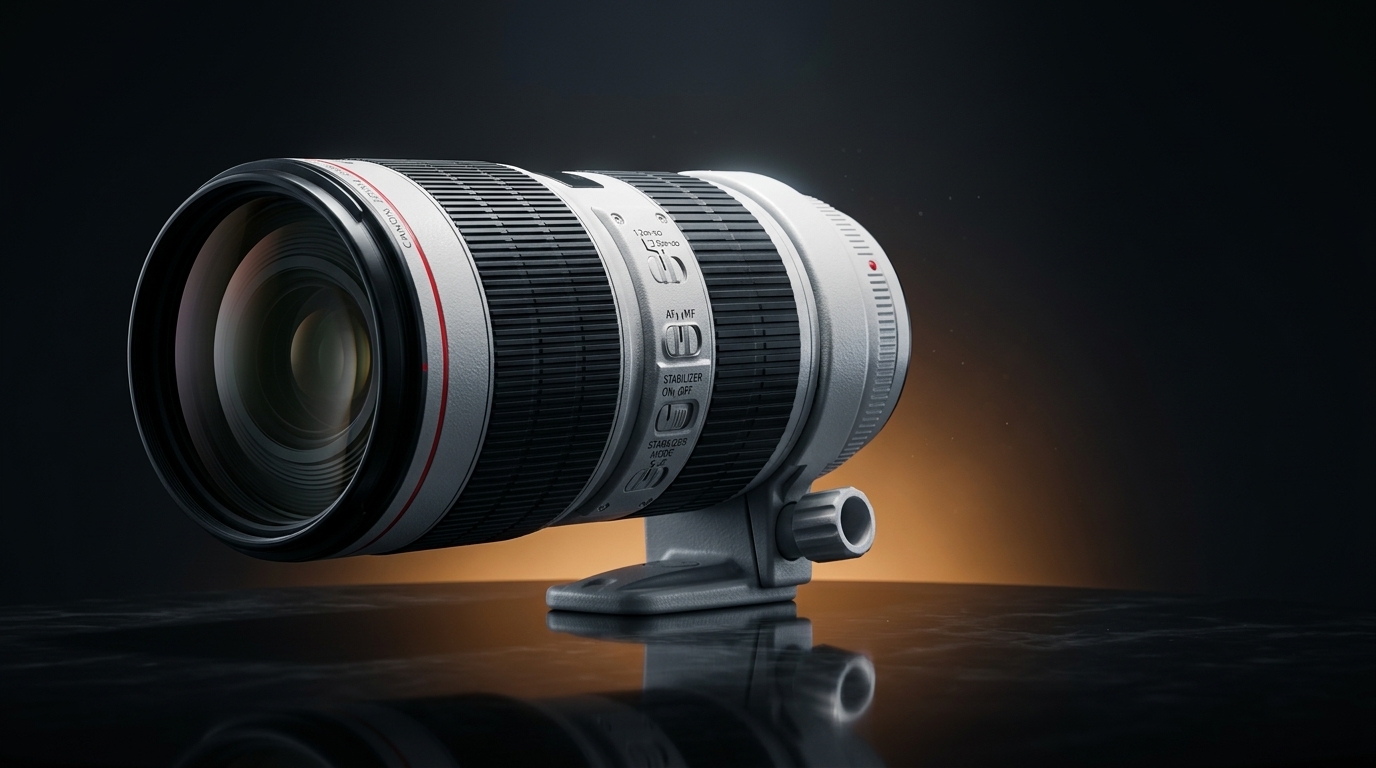
Quick Facts:
- Product: Canon EF 70-200mm f/2.8L IS III USM
- Lens type: Full-frame EF-mount telephoto zoom
- Optical formula: 23 elements in 19 groups, one fluorite plus five UD elements
- Image stabilization: Optical IS, carried over from the IS II
- Weight: 1,480 g (3.26 lb)
- Filter size: 77mm
- Status: Discontinued by Canon in 2026
- Used price: About $1,500 to $1,950 at MPB
- Best for: Sports, wedding, portrait, and event photographers on Canon DSLRs
9 min read
In This Article
- Canon Discontinues the EF 70-200mm f/2.8L IS III
- Canon EF 70-200mm f/2.8L IS III: Key Specs
- A Walk Down Memory Lane: 30 Years of the Canon 70-200mm f/2.8
- Why Canon Discontinued the EF 70-200mm f/2.8L IS III
- EF 70-200mm f/2.8L IS III vs. the RF 70-200mm f/2.8
- Buying the Canon EF 70-200mm f/2.8L IS III Used
- What the Discontinuation Means for Canon Shooters
- Frequently Asked Questions
Canon Discontinues the EF 70-200mm f/2.8L IS III
Original introduction video From Canon, released seven years ago
The Canon EF 70-200mm f/2.8L IS III has reached the end of its production run. Canon has discontinued the lens, and with it goes the last new f/2.8 telephoto zoom the company built for the EF mount. Production has stopped. Whatever stock sits in Canon warehouses and on dealer shelves is now the final supply. The lens no longer appears on Canon USA’s online store.
Canon Rumors broke the news, citing the Japanese site Asobinet along with several retailers marking the lens as out of production. Its report also walked through the full 30-year history of Canon’s 70-200mm f/2.8 telephoto zoom, and this article adds a look back of its own. You will find the original Canon Rumors story and visual history here.
For photographers shooting Canon DSLRs, the discontinuation carries weight. The III earned a loyal following among sports, wedding, and event shooters across its production life. Once dealer stock runs dry, the used market becomes the only route to a new-condition copy. Sites such as MPB already list plenty of used examples, so the lens is far from gone.
Still, the move surprises almost no one. Canon has steadily wound down its EF lineup since 2020 while shifting research and factory capacity to the RF mount and mirrorless bodies. The III simply outlasted most of its EF siblings before its turn finally came.
Canon EF 70-200mm f/2.8L IS III: Key Specs
Canon kept the optical core of the IS II for the III and refined the coatings. Below is a snapshot of the specifications photographers care about most when they shop for one used.
| Specification | Details |
|---|---|
| Lens name | EF 70-200mm f/2.8L IS III USM |
| Mount | Canon EF, full-frame |
| Focal length | 70-200mm |
| Maximum aperture | f/2.8, constant across the zoom range |
| Optical design | 23 elements in 19 groups |
| Special elements | One fluorite element, five UD elements |
| Coating | Air Sphere Coating (ASC) |
| Aperture blades | 8, circular |
| Minimum focus distance | 1.2 m (3.9 ft) |
| Maximum magnification | 0.21x at 200mm |
| Filter size | 77mm |
| Weight | 1,480 g (3.26 lb) |
| Dimensions | 88.8 x 199 mm |
| Announced | 2018 |
| Launch price | $2,099 USD |
| Status | Discontinued, 2026 |
Shop the Used Market
Find the EF 70-200mm f/2.8L IS III at MPB
Production has ended, so the used market is where this lens lives now. MPB grades every copy, includes a six-month warranty, and lists used prices from about $1,500.
A Walk Down Memory Lane: 30 Years of the Canon 70-200mm f/2.8
Canon Rumors framed the discontinuation as the end of an era, and the framing fits. To understand why this lens matters, it helps to see where it came from. The Canon telephoto zoom story stretches back more than three decades, and it explains why the 70-200mm is so versatile for working photographers today. Here is how the line evolved.
1989: The EF 80-200mm f/2.8L and the “Magic Drainpipe”
The story starts before the 70-200 name existed. In 1989, Canon released the EF 80-200mm f/2.8L, a professional telephoto zoom for the sports and news photographers of the day. Shooters nicknamed it the “Magic Drainpipe” for its smooth black barrel. It used Canon’s Arc-Form Drive motor, the first autofocus motor Canon built for the EF mount. Autofocus was slow and loud by modern standards. Even so, the constant f/2.8 aperture and the heavy, all-metal build set the template for everything after it.
1995: The First EF 70-200mm f/2.8L USM
Canon replaced the 80-200 in 1995 with the EF 70-200mm f/2.8L USM. The goal was direct: build a telephoto zoom sharp enough to rival prime lenses. A ring-type ultrasonic motor brought fast, quiet autofocus with full-time manual override. Four UD elements held chromatic aberration in check. The lens also paired with Canon’s 1.4x and 2x extenders, stretching its reach to 280mm or 400mm when a shooter needed it. For 1995, this was about as good as a zoom got.
2001: Image Stabilization Joins the Line
The EF 70-200mm f/2.8L IS USM arrived in 2001 and added the feature photographers wanted most: optical image stabilization. A wedding shooter gained the freedom to hold 200mm at a slow shutter speed in a dim church and still walk away with a sharp frame. Its first-generation IS system delivered roughly three stops of correction, paired with a refreshed optical formula built around the new stabilizer unit. For this reason, stabilization quickly became worth every extra dollar pros spent.
2010: The IS II Becomes the Benchmark
Many photographers still call the EF 70-200mm f/2.8L IS II the best of the bunch. Released in 2010, it added a fluorite element and a fifth UD element, which sharpened contrast across the zoom range. Image stabilization climbed to four stops. Minimum focus distance dropped to 1.2 m, and Canon reinforced the weather sealing for working pros. For a full decade, the EF 70-200mm f/2.8L IS II was the standard every rival measured against.
2018: The EF 70-200mm f/2.8L IS III USM
After eight years, Canon refreshed the line with the EF 70-200mm f/2.8L IS III USM. Optically, little changed. The III kept the 23-element design, the fluorite element, and the five UD elements from the IS II. What Canon added was Air Sphere Coating, a layer engineered to fight flare and ghosting when light strikes the front element head-on. The result was cleaner backlit images. It launched in 2018 at $2,099.
2019 and 2024: The RF Mount Takes Over
Canon’s mirrorless pivot reshaped the 70-200 idea. The RF 70-200mm f/2.8L IS USM of 2019 was the shortest and lightest 70-200mm f/2.8 ever made for a full-frame camera, though it traded extender support to achieve its compact size. In 2024, the RF 70-200mm f/2.8L IS USM Z went further with an internal zoom design, an 11-blade aperture, 5.5 stops of stabilization, and extender compatibility. With two strong RF options on shelves, the EF III had served its purpose.
Why Canon Discontinued the EF 70-200mm f/2.8L IS III
The discontinuation is part of a long, deliberate exit. Canon stopped developing new EF lenses years ago and now channels its research into RF optics for EOS R mirrorless bodies. Every fresh f/2.8 telephoto since 2019 has worn the RF mount. The EF III was a holdover, kept in production while demand from DSLR shooters held up.
Demand finally thinned. New DSLR sales have fallen sharply across the industry, and Canon has not released a new EF-mount camera body since 2020. Meanwhile, the used DSLR market is thriving, which gives EF shooters a healthy supply of bodies and lenses without new production. Canon, like Nikon, has moved its factory capacity toward mirrorless.
The III also outlived its purpose inside Canon’s own catalog. Two RF 70-200mm f/2.8 lenses now cover the focal range with newer coatings, lighter builds, and stronger stabilization. Because of this overlap, keeping an aging EF design on the production line no longer made financial sense.
EF 70-200mm f/2.8L IS III vs. the RF 70-200mm f/2.8
The choice comes down to your camera body. If you shoot a Canon DSLR such as the 5D Mark IV or the 1D X Mark III, the EF III is the direct fit, and a used copy costs far less than any RF lens. Photographers who have moved to an EOS R body find the RF 70-200mm f/2.8 lenses mount natively and skip the adapter entirely.
An EF lens still works on RF bodies through Canon’s EF-EOS R adapter, with no loss of image quality or autofocus speed. Many photographers run exactly this setup to save money. The RF 70-200mm f/2.8, by contrast, is lighter and newer, and it sits within Canon’s wider RF lens lineup. Even so, it costs roughly twice what a used EF III does.
For a shooter on a budget, the math favors the EF III. A photographer building a long-term RF kit, by contrast, finds the RF lens earns its premium. Neither choice is wrong, since every 70-200mm f/2.8 Canon has made still performs well in the field. Newer shooters weighing the focal range should also review our picks for the best telephoto lenses for beginners.
Buy It Used
Used EF 70-200mm f/2.8L IS III Copies, Inspected and Warrantied
A used copy now costs roughly half the price of a new RF 70-200mm f/2.8. Every MPB lens is graded for condition and shipped free.
Buying the Canon EF 70-200mm f/2.8L IS III Used
With production over, the used lens market is where this lens lives now. MPB lists used copies of the EF 70-200mm f/2.8L IS III from about $1,500 to $1,950, depending on cosmetic condition. This price undercuts the $2,099 launch figure and runs roughly half the cost of a new RF 70-200mm f/2.8.
Check a few things before you buy. First, inspect the front and rear elements for fungus, haze, or scratches. Next, confirm the image stabilizer engages cleanly and stays quiet. Then test autofocus at both 70mm and 200mm. Finally, look at the tripod collar and zoom ring for any play or grit. A reputable dealer inspects and grades every lens, which removes most of the guesswork.
MPB grades each lens, includes a six-month warranty, and ships free, so a used purchase carries less risk than a private sale. For anyone worried about scams or hidden faults, the warranty is worth the small premium over a marketplace listing. Our guide to buying used camera gear safely covers the rest of the checklist.
What the Discontinuation Means for Canon Shooters
The end of the EF 70-200mm f/2.8L IS III is a milestone more than a crisis. Owners of the lens lose nothing the day production stops. EF glass keeps working on EF bodies and on every EOS R camera through the adapter. Existing copies will shoot for many years.
For buyers, the discontinuation strengthens the value case across the used lens market. Used prices tend to soften once a lens leaves production and supply settles. Because of this, a photographer who wants pro-grade f/2.8 reach on a Canon DSLR has rarely had a better entry point than right now.
The 70-200mm f/2.8 itself is not retiring. Canon sells two RF versions, and the focal range remains a staple in sports, wedding, and portrait bags. What ends here is the EF chapter, a 30-year run of telephoto zooms central to professional photography. Canon Rumors marked the moment well, and the lens earns the send-off.
Ready to Buy?
Check Today’s Price on the EF 70-200mm f/2.8L IS III
MPB carries graded used copies with a six-month warranty and free shipping. Prices start near $1,500 while supply lasts.
Frequently Asked Questions
Is the Canon EF 70-200mm f/2.8L IS III discontinued?
Yes. Canon ended production of the lens in 2026. The lens no longer appears on Canon USA’s online store, though some retailers still sell remaining new stock. Canon Rumors reported the discontinuation after Asobinet and several dealers flagged the lens as out of production.
How much does a used Canon EF 70-200mm f/2.8L IS III cost?
Used copies run from about $1,500 to $1,950 at MPB, depending on cosmetic condition. This range sits below the lens’s $2,099 launch price and well under a new RF 70-200mm f/2.8. Prices often soften further as more copies enter the used lens market.
What changed between the EF 70-200mm f/2.8L IS II and III?
Almost nothing optically. The III kept the 23-element design of the EF 70-200mm f/2.8L IS II and added Air Sphere Coating to reduce flare and ghosting in backlit scenes. Autofocus, image stabilization, and weight stayed close to identical between the two models.
Does the EF 70-200mm f/2.8L IS III work on Canon mirrorless cameras?
Yes. The lens mounts on any EOS R camera through the Canon EF-EOS R adapter, with full autofocus and image quality. Many photographers pair this EF telephoto zoom with a mirrorless body to save money over the RF 70-200mm f/2.8.
Should I buy the EF 70-200mm f/2.8L IS III or the RF version?
DSLR shooters and budget-focused buyers should pick the EF III, since a used copy costs far less. Photographers committed to the RF system gain a lighter, newer lens with the RF 70-200mm f/2.8, although it costs roughly twice what a used EF copy does.
Why did Canon discontinue the EF 70-200mm f/2.8L IS III?
Canon has shifted lens development to the RF mount and mirrorless cameras. DSLR sales have fallen, and two RF 70-200mm f/2.8 lenses now cover the same focal range. As a result, keeping an aging EF design in production no longer made sense for Canon.
Heads up: a few links here are affiliate links. If you buy through one, PhotographyTalk earns a small commission, no extra charge to you. Enough for a cup of coffee, and we appreciate it.

